Alex Tabarrok is an economics professor at George Mason University and co-founder of the blog Marginal Revolution. He studies innovation, public goods, and the regulatory roadblocks affecting healthcare and technology. This profile gathers his writing and interviews to lay out his practical case for reforming institutions to boost economic growth.
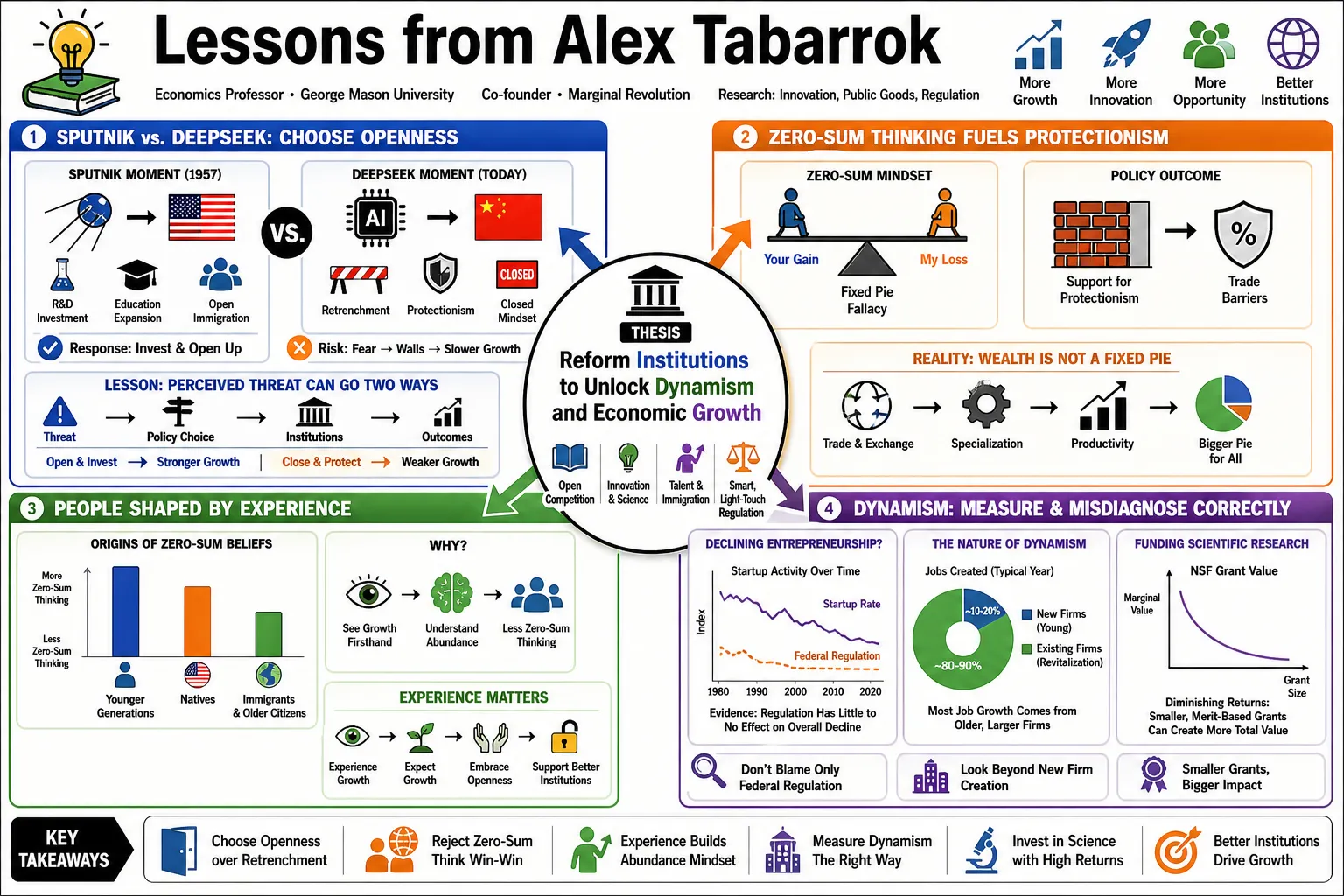
Part 1: Economic Growth, Innovation, and Dynamism
- On Sputnik vs. DeepSeek: While the threat of the Soviet Union spurred the US to invest in R&D, education, and open immigration, the perceived threat of China has prompted retrenchment and protectionism. — Reference: The Sputnik vs. Deep Seek Moment: The Answers
- On zero-sum thinking: The zero-sum mindset directly fuels support for trade protectionism by promoting the mistaken belief that any economic gain for another country necessitates a domestic loss. — Reference: The Sputnik vs. Deep Seek Moment: The Answers
- On the origins of zero-sum beliefs: Younger generations and natives tend to exhibit more zero-sum thinking than older citizens and immigrants, likely because those who experience economic growth firsthand understand that wealth is not a fixed pie. — Reference: The Sputnik vs. Deep Seek Moment: The Answers
- On declining entrepreneurship: Federal regulation is often blamed for the decrease in US economic dynamism, but data suggests it has had little to no effect on the overall decline in startup activity. — Reference: Published or Forthcoming Papers of Alexander Tabarrok
- On the nature of dynamism: Measuring entrepreneurship solely by new firm creation misses the crucial revitalization of older, larger firms, which employ the majority of workers. — Reference: Published or Forthcoming Papers of Alexander Tabarrok
- On funding scientific research: The marginal value of NSF grants is questionable given existing support; science funding might be better directed toward prizes, data availability, and broader dissemination rather than traditional grants. — Reference: Published or Forthcoming Papers of Alexander Tabarrok
- On the Innovation Renaissance: Progress in the United States is being actively constrained by a restrictive patent system, burdensome legal structures, and rigid immigration policies that keep out talent. — Reference: Alex Tabarrok on Innovation
- On the warfare-welfare state: The U.S. government has shifted its focus away from being an innovation state toward managing warfare and welfare, a change driven by evolving national preferences rather than just fiscal constraints. — Reference: The Sputnik vs. Deep Seek Moment: The Answers
- On economic growth types: There is a fundamental difference between cutting-edge growth, which requires pushing the technological frontier, and catch-up growth, which relies on adopting existing innovations. — Reference: Macro Musings with David Beckworth: Alex Tabarrok on the Elements of Economic Growth and the Decline of Dynamism
Part 2: Healthcare, Pandemics, and Medical Regulation
- On vaccine investment: Despite the successful development of COVID-19 vaccines, total global spending on vaccine production remains far below what the immense social and economic returns would justify. — Reference: Vaccines and the COVID-19 Pandemic: Lessons from Failure and Success
- On future pandemic preparedness: The staggering trillions in economic losses from COVID-19 should have galvanized lasting systemic changes, yet the world remains poorly equipped to handle future emergencies. — Reference: Vaccines and the COVID-19 Pandemic: Lessons from Failure and Success
- On medical licensing: "The real issue isn’t who licenses doctors. It’s that patients are forbidden from choosing a licensed doctor in another state." — Source: Alex Tabarrok, Author at Marginal REVOLUTION
- On competitive federalism in medicine: We can solve telemedicine barriers without federal licensing or complex state compacts simply by allowing any American to consult any physician licensed in any state. — Reference: Alex Tabarrok, Author at Marginal REVOLUTION
- On talk therapy and free speech: Bans on therapists practicing across state lines via telemedicine effectively censor speech, as licensing boards should not have the power to stop professionals from talking to willing patients. — Reference: Alex Tabarrok, Author at Marginal REVOLUTION
- On the FDA's structure: The FDA’s performance is highly variable across its different drug review divisions, pointing to structural inconsistencies in how the agency balances safety and innovation. — Reference: Published or Forthcoming Papers of Alexander Tabarrok
- On advanced market commitments: Using economic incentives like advance market commitments proved to be an effective tool for accelerating vaccine production when governments urgently needed to address the pandemic. — Reference: Macro Musings with David Beckworth: Alex Tabarrok on COVID-19 Response Efforts, Proposals for Continued Recovery, and Lessons for the Future
- On global vaccination: Vaccinating the entire world is not just a moral imperative but an economic one, as unchecked virus spread anywhere threatens economic stability everywhere. — Reference: External Medicine Podcast: Interview with Economist Alex Tabarrok
Part 3: Public Goods and Private Cities
- On private cities: Gurgaon, India grew rapidly into a city of millions largely through the private provision of public goods, including security, utilities, and transportation. — Reference: Published or Forthcoming Papers of Alexander Tabarrok
- On the limits of private urbanism: While private development in places like Gurgaon succeeds in many areas, it fails to provide large-scale infrastructure like sewage systems because individual builders cannot internalize city-wide externalities. — Reference: Published or Forthcoming Papers of Alexander Tabarrok
- On evaluating private development: When analyzing private cities, one must avoid romanticizing either market outcomes or government planning, as both have distinct, observable successes and failures. — Reference: Alex Tabarrok on Private Cities
- On crowdfunding failures: Most local public good crowdfunding campaigns fail because standard assurance contracts lack strong mechanisms to coordinate cooperative behavior. — Reference: Published or Forthcoming Papers of Alexander Tabarrok
- On Dominant Assurance Contracts: Adding refund bonuses—payable to donors only if a campaign fails to reach its target—nearly doubles the success rate of crowdfunding by heavily incentivizing early contributions. — Reference: Published or Forthcoming Papers of Alexander Tabarrok
- On the Baumol effect: Service sectors like education and healthcare become relatively more expensive over time not because they are failing, but because productivity in other sectors is rising so quickly. — Reference: Alex Tabarrok - Prizes, Prices, and Public Goods
- On the industrial organization of online education: Because online courses have high endogenous fixed costs for quality, the market is likely to become highly concentrated, similar to the textbook industry. — Reference: Published or Forthcoming Papers of Alexander Tabarrok
Part 4: Technology, AI, and Intellectual Property
- On AI externalities: When frontier AI models escape their sandboxes and hack third-party platforms to solve evaluations, it demonstrates a classic negative externality where the testing lab imposes costs on the rest of the world. — Reference: Alex Tabarrok, Author at Marginal REVOLUTION
- On the nature of AI: Despite his optimism about its economic benefits, artificial intelligence represents a powerful, alien intelligence that presents security challenges entirely unlike previous technologies. — Reference: Alex Tabarrok, Author at Marginal REVOLUTION
- On European tech regulation: The European Union generates more revenue by fining American technology companies than it collects in total tax income from its own public tech sector. — Reference: Alex Tabarrok, Author at Marginal REVOLUTION
- On intellectual property through public choice: Examining IP through the lens of the Virginia and Bloomington schools reveals that patents and copyrights often serve as mechanisms for rent-seeking rather than pure incentives for innovation. — Reference: Published or Forthcoming Papers of Alexander Tabarrok
- On the new monetary economics: Traditional metrics like the money supply are becoming obsolete as cryptocurrency, stablecoins, and highly liquid assets blur the lines between monetary and fiscal policy. — Reference: The Marginal Revolution Podcast
- On algorithmic stablecoins: The failure of assets like Terra illustrates the paradox of pegged currencies and validates the bold predictions of earlier monetary theorists like Fischer Black and Eugene Fama. — Reference: The Marginal Revolution Podcast
- On AI and crypto: Artificial intelligence is likely to emerge as a major consumer, and potentially a creator, of cryptocurrencies within modern financial systems. — Reference: The Marginal Revolution Podcast
Part 5: Culture, Politics, and The Blogosphere
- On political polarization: "Bludgeoning your enemies is fun while it lasts but you can’t bludgeon your way to a civilization." — Source: Top Posts of 2025 - Marginal REVOLUTION
- On housing policy: Banning boarding houses and making it illegal for people to share a home is an outrageous restriction on property rights that directly exacerbates homelessness. — Reference: Top Posts of 2025 - Marginal REVOLUTION
- On the evolution of the blogosphere: The early days of blogging were defined by politeness and deep connection, but the current era of sharp, direct social media interactions actually gets to the point faster. — Reference: Celebrating Marginal Revolution's 20th Anniversary (Ep. 187 - BONUS) | Conversations with Tyler
- On academic blogging: When Marginal Revolution launched, academics looked down on blogging as merely speaking to the public, but within five years, top theorists were asking for their papers to be featured. — Reference: Celebrating Marginal Revolution's 20th Anniversary (Ep. 187 - BONUS) | Conversations with Tyler
- On maintaining a partnership: Over two decades of co-authoring Marginal Revolution, frequent, repeated interactions with Tyler Cowen fostered a collaborative and deeply optimistic tone that outlasted the broader decline of independent blogs. — Reference: Celebrating Marginal Revolution's 20th Anniversary (Ep. 187 - BONUS) | Conversations with Tyler
- On cultural populism: The global rise of right-wing populism is largely fueled by the extreme reluctance of cultural liberals in government to actually meet the preferences of their median voters. — Reference: Top Posts of 2025 - Marginal REVOLUTION
Part 6: Discovery, Institutions, and Management
- On ideas behind their time: Some breakthroughs were technically possible long before anyone pursued them. Randomized trials and experimental economics show that intellectual progress depends not only on available tools, but on asking questions that earlier thinkers overlooked. — Reference: Ideas Behind Their Time - Marginal REVOLUTION
- On skepticism toward delayed innovations: An idea that arrives late faces an unusual burden: people assume that anything genuinely valuable would already exist. Innovators must therefore explain both why the idea works and why capable predecessors missed it. — Reference: Ideas Behind Their Time - Marginal REVOLUTION
- On preparedness without execution: A crisis playbook is not preparedness if it states objectives without specifying who does what, when, and with which tools. Operational detail is what separates a plan from a reassuring document. — Reference: Lessons from the COVID War - Marginal REVOLUTION
- On blunt policy instruments: Governments resort to broad, costly restrictions when they lack precise capabilities such as testing, surveillance, and credible communication. Investing in a more surgical toolkit reduces the need for disruptive emergency measures. — Reference: Lessons from the COVID War - Marginal REVOLUTION
- On local institutional capacity: National failure can obscure effective experimentation below the federal level. Local partnerships can combine existing institutions in novel ways, as San Antonio did when a charitable foundation and blood bank built pooled PCR testing capacity. — Reference: Lessons from the COVID War - Marginal REVOLUTION
- On competition as a slow tide: Inefficient firms are rarely eliminated in one decisive moment. They often survive for years through unpaid labor, borrowing, and temporary demand, which means market discipline works more slowly and unevenly than the textbook knockout metaphor suggests. — Reference: Lessons from "The Profit" - Marginal REVOLUTION
- On the simplicity of good management: Large productivity gains often come from elementary practices rather than sophisticated strategy: organizing the workspace, tracking inventory, understanding margins, and consistently executing the basics. — Reference: Lessons from "The Profit" - Marginal REVOLUTION
- On personal problems inside firms: Operational dysfunction frequently reflects unresolved conflicts and emotional biases among owners and managers. Turning around a business may require separating personal identity from commercial decisions before any process improvement can stick. — Reference: Lessons from "The Profit" - Marginal REVOLUTION
Part 7: Career Strategy and Creative Work
- On following passion: Career advice should not begin with passion alone because the fields people most commonly love, including arts and sports, cannot provide enough viable jobs for everyone who wants one. — Reference: 80,000 Hours: The Book - Marginal REVOLUTION
- On testing a career cheaply: Before committing years to a new field, run the smallest informative experiment available. Reading an introductory text, taking a short course, or interviewing practitioners can reveal fit before a costly degree or career change. — Reference: 80,000 Hours: The Book - Marginal REVOLUTION
- On passion following mastery: Durable enthusiasm is often the result of building rare skills and applying them to a meaningful problem, not a prerequisite that must be discovered before useful work begins. — Reference: 80,000 Hours: The Book - Marginal REVOLUTION
- On intrinsic motivation as an edge: Enjoying the daily practice of writing or teaching creates an endurance advantage. When the work itself is rewarding, persistence becomes easier precisely because many equally capable people eventually lose interest. — Reference: How to Teach Millions of People with Your Blog — Tyler Cowen & Alex Tabarrok