Philip Trammell is an economist at Stanford University and Epoch AI, focusing on the intersection of economic growth theory, artificial intelligence, and global prioritization. Known for his work on "patient philanthropy" and the economic implications of transformative AI, he models how vast improvements in technology could alter wages, labor dynamics, and long-term human flourishing. The following lessons capture his core insights on how to rigorously weigh our present choices against their impact on the distant future.
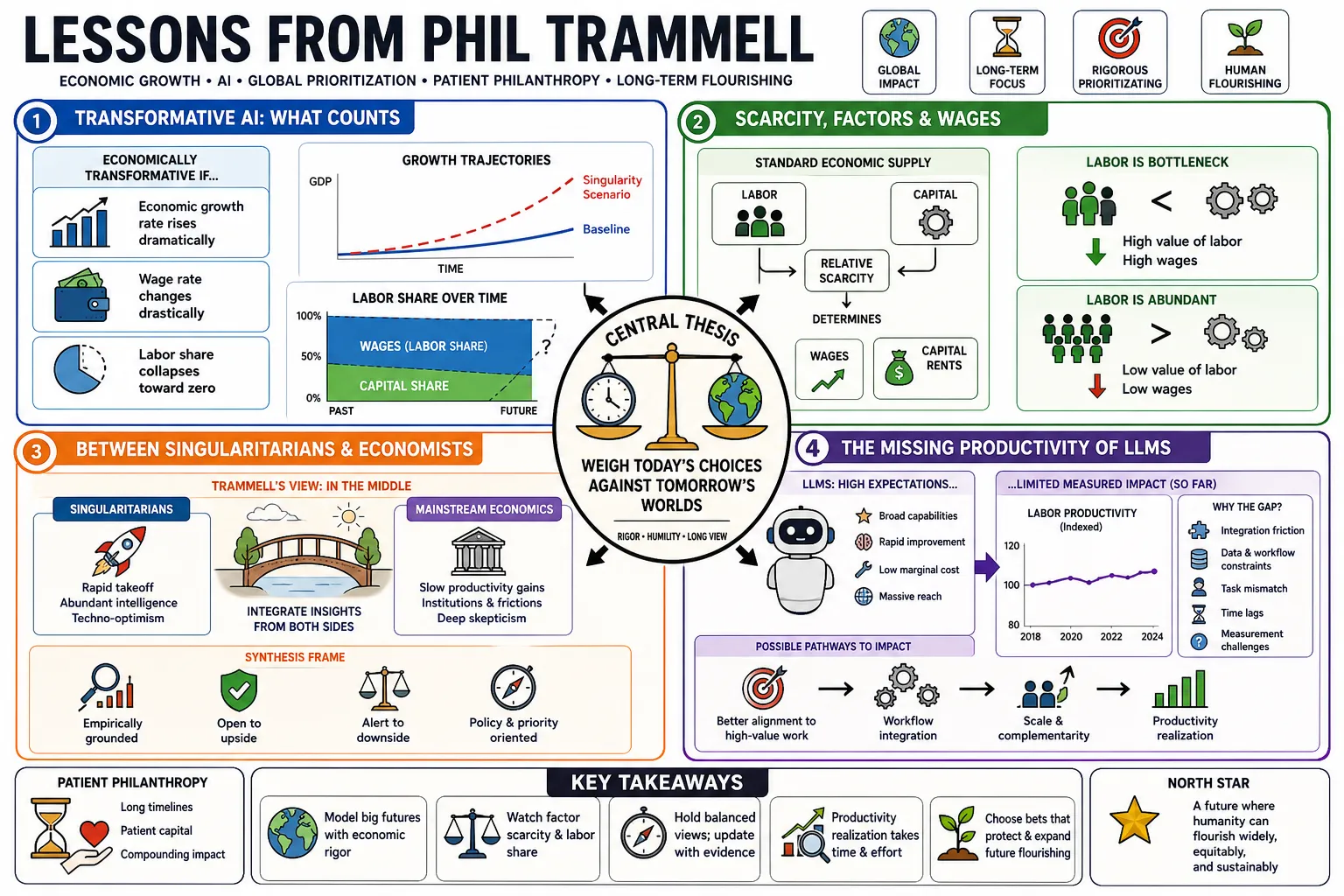
Part 1: The Economics of Transformative AI
- On Transformative AI Definitions: AI can be considered economically transformative if it drastically alters the economic growth rate, the wage rate, or the labor share. This could look like growth rates rising toward a singularity, or the labor share collapsing to zero. — Reference: alignmentforum.org
- On the Historical Labor Share: Despite massive technological shifts over the long run of history, roughly two-thirds of total economic output has consistently been paid out as wages for human labor, with the remaining third going to capital investments. — Reference: alignmentforum.org
- On Factor Scarcity and Wages: In standard economic supply equations, wages and capital rents are determined by relative scarcity. If labor is the production bottleneck, it becomes highly valuable; if there is abundant labor relative to capital, wages fall. — Reference: hearthisidea.com
- On Modulating the Singularitarian and Economist Views: Trammell finds that his perspectives on the economics of AI often sit squarely between the technological optimism of the singularitarian community and the skepticism of the mainstream economics community. — Reference: x.com
- On the Missing Productivity of LLMs: Despite the ability of large language models to automate a vast array of small cognitive tasks, aggregate productivity gains have yet to manifest. This is likely because human labor is typically bundled into multi-task roles, making piecemeal automation less immediately impactful. — Reference: x.com
Part 2: Explosive Growth and its Bottlenecks
- On the Limitations of the Jones Growth Model: The semi-endogenous Jones model posits that economic growth is constrained primarily by a lack of research inputs. If this were completely accurate, automating R&D would instantly yield explosive growth, but reality likely involves other bottlenecks. — Reference: Epoch AI
- On Alternative Growth Constraints: A Schumpeterian model of economic growth suggests that the pace of innovation is bottlenecked by the need for temporary monopolies. New innovations must emerge sparsely enough for patents and trade secrets to actually justify the initial R&D costs. — Reference: Epoch AI
- On Parallelizing Research: While scaling up the number of researchers can speed up technological progress, the returns to parallelization eventually hit a ceiling. Adding an infinite number of engineers to a project does not yield infinite progress in a short timeframe. — Reference: Epoch AI
- On LLMs and Autonomous Research: Large language models cannot independently conduct AI research on their own. Algorithmic progress still strictly requires human researchers in the loop, acting as a hard complement to the AI systems. — Reference: Epoch AI
- On the Latency Bottleneck: A fundamental reason why simply adding more minds to a project yields diminishing returns is the high communication latency between different human brains. Coordinating complex projects among many individuals is inherently difficult. — Reference: Epoch AI
- On the Potential for Unprecedented Progress: If artificial neural networks grow larger and more internally integrated, they might bypass the inter-brain communication latency that slows human collaboration, potentially removing a historic bottleneck to economic growth faster than traditional models predict. — Reference: Epoch AI
Part 3: Patient Philanthropy and the Hinge of History
- On the Value of Patience in Philanthropy: Just as a random passerby is rarely the optimal recipient for charitable funds, the present moment is statistically unlikely to be the time when those funds can achieve their greatest possible impact. — Reference: 80000hours.org
- On the Power of Compound Interest: Over the last century, the U.S. stock market has averaged a return of roughly 7% per year. Because this money doubles every decade, a philanthropic endowment can multiply its giving power exponentially by waiting. — Reference: effectivealtruism.org
- On Defining Philanthropic Investments: True investments involve spending money now to structurally generate more resources for moral goals later, such as fundraising or movement building. While building a school increases future earnings, it is an immediate expenditure that removes capital from a charity's control. — Reference: effectivealtruism.org
- On the Discount Rate for Altruists: While individuals rationally discount future welfare to account for their own mortality risk, patient philanthropists should not hold a pure time preference. They should value helping a descendant a century from now equally to helping someone today. — Reference: effectivealtruism.org
- On Future Epistemic Advantages: Donors operating 200 years ago could not have funded highly effective modern interventions like anti-malarial bed nets because the germ theory of disease was unknown. By waiting, patient funds can rely on the vastly expanded knowledge base of future generations. — Reference: 80000hours.org
- On Buying the Future at a Discount: The mechanics of investment mean that purchasing land and selling a 100-year lease allows a buyer to control the asset in the distant future for a fraction of its current price. This dynamic allows patient actors to effectively purchase long-term influence from impatient present owners. — Reference: effectivealtruism.org
- On the Odds of the Present Moment: Given that the future of humanity might be incredibly long, there is a high probability that some era in the future will be far more pivotal and morally malleable than our current moment, making it mathematically rational to save philanthropic resources. — Reference: 80000hours.org
- On Practical Commitment to Giving: Trammell personally committed to capping his own consumption at $30,000 per year (adjusted for inflation) and donating all remaining resources. — Reference: philiptrammell.com
Part 4: The Surviving and Flourishing (SF) Model
- On Expected Value: The expected value of our choices can be cleanly split into two parts: near-term impacts and the vastly larger future component. For those seeking to do the most good, maximizing the future component is paramount. — Reference: forethought.org
- On the SF Model: The expected value of the long-term future can be evaluated as a product of two variables: Surviving (the probability of avoiding an existential catastrophe this century) and Flourishing (the expected value of the future conditional on our survival). — Reference: forethought.org
- On the Balance Between Survival and Flourishing: Because maximizing a product of two variables requires attention to both, attempting to solely maximize the probability of near-term survival is very unlikely to be the optimal strategy for improving the future. — Reference: forethought.org
- On Defining Value: In the context of analyzing the long-term future, value can be strictly defined as the net difference that Earth-originating intelligent life makes to the overall value of the universe. — Reference: forethought.org
- On Precisifying Survival: True "survival" in a longtermist context doesn't just mean avoiding literal extinction; it means avoiding any event that locks humanity into a near-zero value trajectory, preserving the potential for a flourishing future. — Reference: forethought.org
- On Prioritizing Flourishing: Under the standard "scale, neglectedness, tractability" framework used in effective altruism, efforts focused on ensuring the long-term flourishing of life should be treated as a comparable priority to efforts focused on sheer survival. — Reference: forethought.org
Part 5: Economic Theory and Evaluating the Future
- On the Nature of Economic Theory: The discipline of economic theory can sometimes be viewed as an inherently destructive project that reveals pessimistic realities rather than optimistic guarantees. — Reference: Epoch AI
- On the Nuances of GDP: Real GDP functions less like a fixed physical quantity and more as a dynamic metric; the introduction of new goods can fundamentally alter how wealth relates to a society's willingness to sacrifice consumption for safety. — Reference: Epoch AI
- On the Complexity of Measuring Output: Tracking real GDP requires holding prices fixed from a specific year to account for inflation. This methodology works for stable goods like haircuts, but it struggles to consistently measure output over long time horizons where entirely new products are introduced. — Reference: alignmentforum.org
- On Economic Extremes: The most extreme economic transformation caused by AI would be a singularity event, where the data traces a path that appears to approach infinite economic output in a finite amount of time, even if it eventually flattens out. — Reference: alignmentforum.org
Part 6: Production Automation, Growth, and Distribution
- On Production Automation as the First Break: Fully automating production would let machines reproduce the capital needed to make more machines. That alone could sharply accelerate growth, even before research itself is automated. — Reference: Economic Growth under Transformative AI
- On R&D Automation Not Being Sufficient by Itself: Automating research can accelerate technological progress, but it does not guarantee explosive growth if research remains difficult to parallelize or if production still depends on scarce human inputs. — Reference: Economic Growth under Transformative AI
- On Breaking the Kaldor Facts: A world in which capital can substitute broadly for labor would break two long-standing patterns at once: relatively stable growth rates and a relatively stable labor share of income. — Reference: Economic Growth under Transformative AI
- On Why the Labor Share Can Collapse: When machines can perform nearly all production tasks and can be reproduced at scale, human labor is no longer the binding input. Its share of total output can then fall toward zero even as total output explodes. — Reference: Economic Growth under Transformative AI
- On Why Wages Remain Ambiguous: A collapsing labor share does not mechanically imply falling wages. Whether wages rise or fall depends on returns to scale, the importance of fixed natural resources, and whether technical change favors or displaces the remaining human contribution. — Reference: Economic Growth under Transformative AI
Part 7: Workflows and the Uneven Arrival of Automation
- On Jobs as Bundles of Tasks: Most labor is bought as a job rather than task by task because performing one task often makes a worker more effective at related tasks. Automation forecasts miss something important when they treat each task as independent. — Reference: Workflows and Automation
- On Learning Spillovers: Workers retain apparently automatable tasks when doing them provides context, judgment, or knowledge that improves their performance on the tasks machines still cannot handle. — Reference: Workflows and Automation
- On Why Early Automation Can Look Disappointing: Automating the first few tasks in a tightly connected workflow may produce little measured output because workers still need to perform parts of those tasks to stay effective at the rest of the job. — Reference: Workflows and Automation
- On the Workflow Completion Threshold: Productivity can jump discontinuously when automation covers the remaining tasks in a workflow. At that point, organizations can finally adopt the technology fully instead of keeping humans inside a partially automated process. — Reference: Workflows and Automation
- On Automation Beyond Human Specialization: The largest gains arrive when machines can learn by doing and cover a wider task range than any one person. Automation then removes both the task bottleneck and the limits imposed by human specialization. — Reference: Workflows and Automation
Part 8: Growth and Existential Risk
- On Why Stagnation Is Not Automatically Safe: Once dangerous technologies already exist, freezing technological progress does not reduce existential risk to zero. Nuclear, biological, and environmental hazards can remain active even without further growth. — Reference: Existential Risk and Growth
- On the Safety-Technology Channel: Faster development can lower cumulative risk when it brings forward technologies that prevent, detect, or mitigate catastrophe. Slower growth can also mean waiting longer for those protections. — Reference: Existential Risk and Growth
- On the Wealth-and-Safety Channel: As societies become wealthier, they may be willing to sacrifice more consumption for protection. Growth can therefore move society along a safety Kuznets curve in which demand for risk reduction rises with income. — Reference: Existential Risk and Growth
- On a Positive Risk-Minimizing Growth Rate: When existing hazards, future safety technologies, and rising willingness to pay for protection are modeled together, the growth rate that minimizes cumulative existential risk is usually positive and may be high. — Reference: Existential Risk and Growth
- On Speed Versus Direction: Slowing all technological development is different from redirecting it. The stronger policy may be to delay dangerous capabilities while accelerating vaccines, monitoring, resilience, and other safety-enhancing technologies. — Reference: Existential Risk and Growth
Part 9: What Remains Scarce After Automation
- On Human-Intrinsic Goods: Some goods remain valuable partly because a human provides them. Performances, relationships, and other human-intrinsic experiences can preserve demand for labor even after machines become technically capable of doing the same tasks. — Reference: Is labor a luxury in the long run?
- On Labor Share Versus Absolute Wages: Humans can retain a comparative advantage and earn higher absolute wages even while labor receives a shrinking fraction of a vastly larger economy. Distributional analysis must keep those two measures separate. — Reference: Is labor a luxury in the long run?
- On Why a Positive Labor Share Can Still Be Unequal: Labor's share could stabilize above zero because a small number of elite performers command enormous value. That outcome would preserve a headline labor share without preserving broad-based labor income. — Reference: Is labor a luxury in the long run?
- On Why Human Labor May Still Become Economically Small: Human-intrinsic goods can slow the decline of labor's share, but they may not stop it. Other scarce goods, changing consumption opportunities, and the rising opportunity cost of human-provided services can still push typical labor income toward a small share of output. — Reference: Is labor a luxury in the long run?
Part 10: New Products and Long-Term Welfare
- On Growth as More Than More of the Same: Long-run growth does not merely give people larger quantities of existing goods. It creates foods, medicines, electronics, and experiences that earlier generations could not buy at any price. — Reference: New Products and Long-term Welfare
- On Why Standard Models Understate Welfare Gains: Models that treat new products as equivalent to consuming more old products can arbitrarily understate how much better future lives become through innovation. New categories of goods can raise the ceiling on attainable welfare. — Reference: New Products and Long-term Welfare
- On Why Future Demand May Not Saturate: If innovation keeps introducing valuable new goods, the marginal value of consumption need not fall as quickly as standard models assume. Future societies may remain willing to save and invest rather than shifting nearly all resources toward leisure or safety. — Reference: New Products and Long-term Welfare