Reiner Pope is the co-founder and CEO of MatX and a former architect on Google's TPU team. He designs custom silicon to make large language models more efficient by working directly with physical hardware constraints. These lessons cover his views on chip physics, the memory wall, and the economics of scaling data centers.
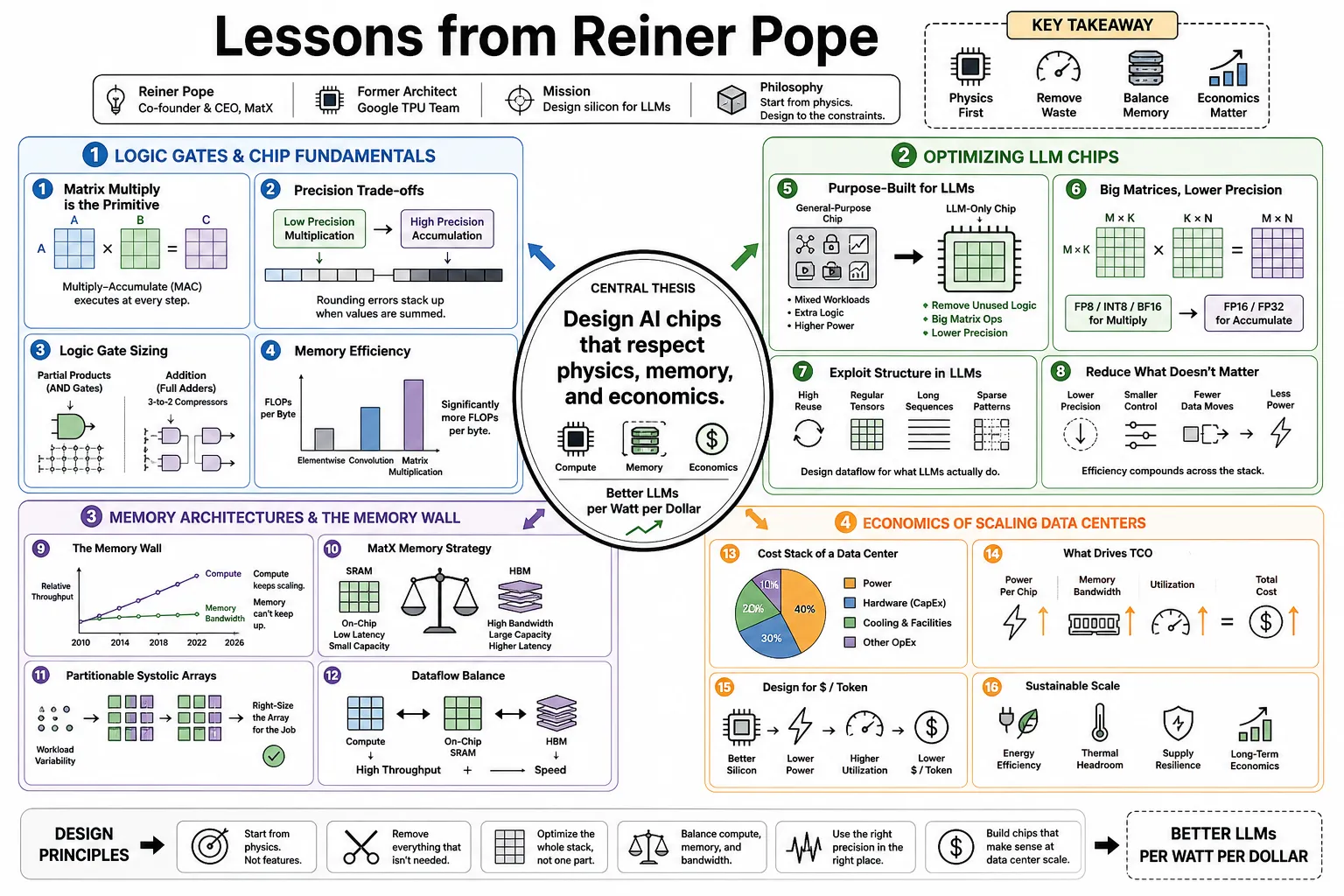
Part 1: Logic Gates and Chip Fundamentals
- On matrix multiplication: The multiply-accumulate operation is the most natural primitive for AI chips because it executes at every single step of a matrix multiply loop. — Reference: Reiner Pope – Chip design from the bottom up
- On precision trade-offs: Low-precision numbers are sufficient for multiplication, but accumulation requires higher precision because rounding errors stack up rapidly when summing multiple values. — Reference: Reiner Pope – Chip design from the bottom up
- On logic gate sizing: Generating partial products for a multiplication step requires consuming simple AND gates, while adding bits together requires large full adders acting as 3-to-2 compressors. — Reference: Reiner Pope – Chip design from the bottom up
- On memory efficiency: Matrix multiplication stands out from other algorithms because it requires significantly more floating-point operations per byte of memory. — Reference: How To Scale Your Model
- On optimizing LLM chips: Hardware designed exclusively for language models should remove logic meant for other workloads, support large matrix operations, and run at lower precisions. — Reference: An Interview with MatX CEO Reiner Pope About LLM Chips
- On memory architectures: MatX attempts to balance high throughput and speed by combining partitionable systolic arrays with a hybrid of SRAM and HBM storage. — Reference: MatX Secures $500M Series B to Accelerate AI Chip Development Against Nvidia | MLQ News
Part 2: The Memory Wall and Inference Trade-offs
- On the baseline inference latency: The absolute lower bound for generating a token is determined by the time required to fetch the model weights from High Bandwidth Memory, which takes about 15 to 20 milliseconds on modern hardware. — Reference: Reiner Pope: The Physics And Economics Of AI Architecture
- On computing boundaries: Speculative decoding performs more operations than autoregressive decoding, meaning it only provides a speedup when generation is severely bottlenecked by memory access rather than compute. — Reference: SPIRe: Boosting LLM Inference Throughput with Speculative Decoding
- On low-latency drafting: When targeting low latency, fetching model weights is the primary bottleneck, so smaller draft models are more effective. — Reference: SPIRe: Boosting LLM Inference Throughput with Speculative Decoding
- On high-throughput drafting: When generating at high throughput with large batches, the KV cache becomes the limiting factor, making it possible to employ larger draft models without a performance penalty. — Reference: SPIRe: Boosting LLM Inference Throughput with Speculative Decoding
- On pipeline parallelism: Splitting a model across multiple racks allows weights to be distributed, but it requires maintaining more sequences in flight, meaning the KV cache memory burden per GPU remains constant. — Reference: Reiner Pope: The Physics And Economics Of AI Architecture
Part 3: Physical Constraints of Data Center Scaling
- On strong scaling: The goal of model scaling is to add more chips to a cluster and achieve a strictly proportional, linear increase in throughput, which is often limited by chip-to-chip communication overhead. — Reference: How To Scale Your Model
- On interconnect protocols: High-speed NVLink networks work best for short-distance scale-up inside a single enclosure, while InfiniBand is used to scale out across a data center at the cost of higher protocol overhead. — Reference: Reiner Pope: The Physics And Economics Of AI Architecture
- On architectural constraints: The size of a model is indirectly shaped by its interconnect domain; if routing between expert networks relies on slow scale-out cables, researchers will avoid highly sparse architectures. — Reference: Reiner Pope: The Physics And Economics Of AI Architecture
- On rack size limitations: Vertical scaling in data centers is constrained by the bend radius of copper cables, the weight of the metal preventing rack sag, and the massive power draw of clustered GPUs. — Reference: Reiner Pope: The Physics And Economics Of AI Architecture
Part 4: LLM Architecture and Batching Economics
- On batch sizes: Processing one user at a time forces the system to pay the full memory fetch cost for a single output; batching thousands of users amortizes this cost and improves economics by a factor of up to a thousand. — Reference: How GPT, Claude, and Gemini are actually trained and served – Reiner Pope
- On optimizing batch size: The ideal batch size is a product of the model's sparsity and the ratio of the hardware's compute throughput to its memory bandwidth, which currently translates to roughly 2,000 to 3,000 tokens. — Reference: Reiner Pope: The Physics And Economics Of AI Architecture
- On long context lengths: The KV cache expands with every token a model remembers, acting as a variable cost that makes long-context sessions extremely expensive to run purely in High Bandwidth Memory. — Reference: Reiner Pope: The Physics And Economics Of AI Architecture
- On multiquery attention: Configuring models so that multiple query heads share a single key and value head reduces memory requirements enough to support context lengths up to 32 times larger. — Reference: Efficiently Scaling Transformer Inference
- On memory tiering: API providers manage the cost of long sessions by moving idle tokens to slower storage like DDR or Flash, keeping only the active tokens in expensive HBM. — Reference: Reiner Pope: The Physics And Economics Of AI Architecture
- On cost allocation: The most efficient models balance the compute budgets across pre-training, reinforcement learning, and inference, aiming for a roughly equal three-way split. — Reference: Reiner Pope: The Physics And Economics Of AI Architecture
Part 5: The Business of AI Hardware
- On software lock-in: The historical moat provided by software ecosystems like CUDA is weakening because frontier labs are highly motivated to use multi-platform environments to secure negotiating power and lower their hardware costs. — Reference: An Interview with MatX CEO Reiner Pope About LLM Chips
- On engineering costs: Frontier labs spend tens of billions of dollars on compute, making it economically rational to hire specialized software engineers to write custom kernels for alternative silicon to save money. — Reference: An Interview with MatX CEO Reiner Pope About LLM Chips
- On deducing architectures: You can infer the underlying structures and training strategies of frontier labs simply by examining their public API pricing and applying basic scaling equations. — Reference: Reiner Pope – The math behind …–Dwarkesh Podcast – Apple Podcasts
- On design philosophy: The fastest and most effective iteration loops in chip and software design happen mentally before a single line of code is written. — Reference: Reiner Pope of MatX on acceler… – Cheeky Pint – Apple Podcasts
Part 6: Additional lessons on Additional lessons on Logic Gates and Chip Fundamentals
- On hardware parallelism: A modern chip is inherently parallel; because it takes hundreds of clock cycles for a signal to cross the die, transistors on opposite sides cannot efficiently execute sequential tasks. — Reference: Reiner Pope of MatX on accelerating AI with transformer-optimized chips
Part 7: Additional lessons on Additional lessons on The Memory Wall and Inference Trade-offs
- On roofline modeling: Evaluating the execution time of a transformer model involves building a simple mental model comparing the time needed to compute matrix multiplies against the time required to fetch weights and KV cache. — Reference: How GPT, Claude, and Gemini are actually trained and served – Reiner Pope
Part 8: Additional lessons on Additional lessons on Physical Constraints of Data Center Scaling
- On physical trace routing: Logic primitives on a chip must be physically connected by metal traces, which introduces spatial constraints when laying out the design. — Reference: Reiner Pope – Chip design from the bottom up
Part 9: Additional lessons on Additional lessons on LLM Architecture and Batching Economics
- On batch timing: Inference requests are typically structured into a train that departs at a fixed interval of roughly 20 milliseconds, which explains the latency floors users observe regardless of how full the batch is. — Reference: The Most Useful Two Hours in AI This Year | by ADITHYA GIRIDHARAN | Medium
Part 10: Additional lessons on Additional lessons on The Business of AI Hardware
- On hardware business models: Unlike frontier AI labs that must build a model before identifying its product fit, chip companies offer a straightforward business plan because they manufacture a physical product with clear margins. — Reference: An Interview with MatX CEO Reiner Pope About LLM Chips
- On early-stage investing: Seed investments in deep tech are predominantly bets on the founders' backgrounds and operational history rather than the unproven technology itself. — Reference: An Interview with MatX CEO Reiner Pope About LLM Chips
- On ambitious performance targets: MatX is engineering its specialized processors with the specific goal of achieving a tenfold improvement in language model training speed over current Nvidia GPU architectures. — Reference: MatX Secures $500M Series B to Accelerate AI Chip Development Against Nvidia | MLQ News
- On versatile chip design: While heavily optimized for inference operations, emerging specialized hardware must still handle full pre-training and reinforcement learning workloads to win over datacenter buyers. — Reference: MatX Secures $500M Series B to Accelerate AI Chip Development Against Nvidia | MLQ News
Part 11: Additional lessons on Additional lessons on Speculative Decoding and Inference Optimizations
- On advanced draft models: Employing a draft model with static sparse attention, pruned initialization, and feedback memory can double the modeled throughput of speculative decoding compared to using a basic, smaller draft model. — Reference: SPIRe: Boosting LLM Inference Throughput with Speculative Decoding
- On weight quantization: Applying integer-8 weight quantization alongside other low-level memory optimizations makes it possible to generate text rapidly while keeping the hardware's compute utilization high. — Reference: Efficiently Scaling Transformer Inference
Part 12: Additional lessons on Additional lessons on Hardware History and TPU Evolution
- On early AI chips: The original TPU v1 was developed in barely over a year by a small team because it was a remarkably simple product—essentially a single massive systolic array paired with local memory. — Reference: Reiner Pope of MatX on accelerating AI with transformer-optimized chips
- On shifting table stakes: Today's semiconductor startups cannot match the rapid development timeline of early TPUs because the market’s baseline requirements for AI hardware have grown exponentially more complex. — Reference: Reiner Pope of MatX on accelerating AI with transformer-optimized chips
- On co-design stress: Hardware engineers face the daunting task of predicting the trajectory of algorithms two to three years in advance so the physical chips provide exactly enough compute and memory bandwidth upon release. — Reference: How To Scale Your Model
- On instruction sets: A CPU resembles a motorcycle steering through a complex obstacle course of fine-grained instructions, while a GPU acts like a truck driving straight ahead with a massive payload of wide vector mathematics. — Reference: Reiner Pope of MatX on accelerating AI with transformer-optimized chips
Part 13: Additional lessons on Additional lessons on Training vs. Inference Cost Balance
- On the equalization principle: When optimizing the overall economics of a model's lifecycle, the minimum expense is mathematically achieved when the volume of tokens for pre-training, RL, and lifetime inference are essentially identical. — Reference: The Most Useful Two Hours in AI This Year | by ADITHYA GIRIDHARAN | Medium
- On over-training models: By analyzing inference token volumes and model replacement cycles, one can deduce that frontier language models are trained on nearly a hundred times more tokens than what the original Chinchilla scaling laws prescribed. — Reference: The Most Useful Two Hours in AI This Year | by ADITHYA GIRIDHARAN | Medium
- On the irrelevance of parameter counts: When summing the combined costs of pre-training, RL, and deployment across a model's entire lifespan, the active parameter count effectively cancels out of the optimization equations. — Reference: The Most Useful Two Hours in AI This Year | by ADITHYA GIRIDHARAN | Medium
Part 14: Additional lessons on Additional lessons on Decoding Industry Secrets
- On unintentional information leaks: Because API providers must price their services close to hardware cost to stay competitive, their public pricing tiers inherently encode their closely guarded hardware deployment decisions. — Reference: The Most Useful Two Hours in AI This Year | by ADITHYA GIRIDHARAN | Medium
- On decoding bottlenecks: The stark difference in pricing between input and output tokens indicates that generating new text is severely memory-bandwidth bound, while processing the initial prompt is compute-bound. — Reference: The Most Useful Two Hours in AI This Year | by ADITHYA GIRIDHARAN | Medium
- On inferring cache sizes: A sudden API price hike for processing contexts beyond a certain threshold allows an observer to accurately calculate a model's exact KV cache size per token. — Reference: The Most Useful Two Hours in AI This Year | by ADITHYA GIRIDHARAN | Medium
- On storage technologies: Pricing variations between short-term and long-term context storage reveal that labs are aggressively moving state data off expensive HBM onto cheaper flash memory or even spinning disk drives. — Reference: The Most Useful Two Hours in AI This Year | by ADITHYA GIRIDHARAN | Medium