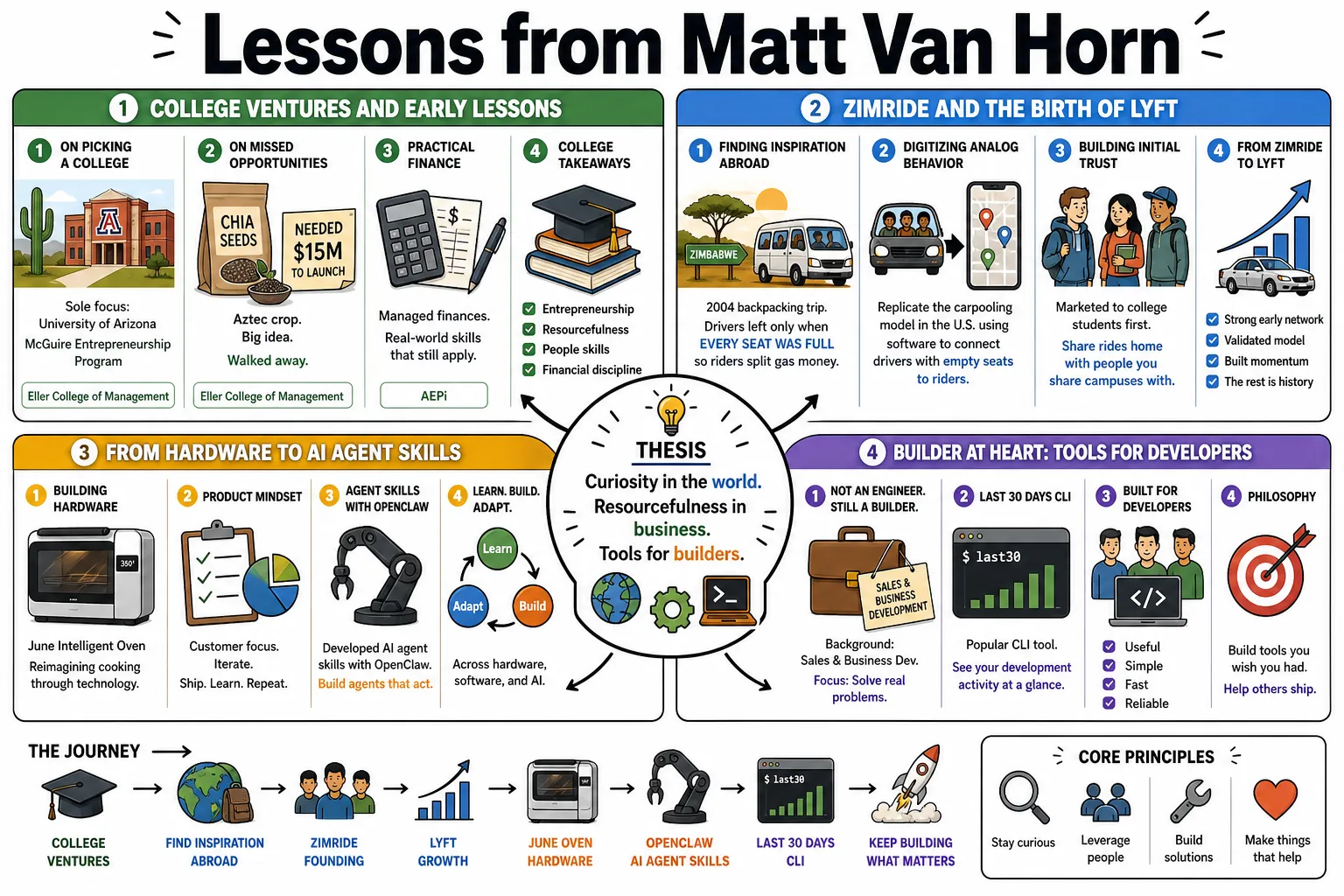
Matt Van Horn's career spans several distinct eras in tech, from co-founding the ride-sharing service that became Lyft to building the June Intelligent Oven and developing OpenClaw AI agent skills. This profile traces his progression from college business projects to launching hardware and eventually creating popular developer tools like the "Last 30 Days" CLI, despite his background in sales and business development rather than engineering.
Part 1: College Ventures and Early Lessons
- On picking a college: "[I] don’t think I visited one other school" because he was solely focused on attending the University of Arizona for its McGuire Entrepreneurship Program. — Reference: Eller College of Management
- On missed opportunities: In college, his team drafted a business plan to commercialize an ancient Aztec crop known as chia seeds, but abandoned the project because they estimated they needed $15 million to launch. — Reference: Eller College of Management
- On practical finance: Managing finances and working closely with people in his college fraternity gave him real-world experience that he still uses in his daily business operations. — Reference: AEPi
Part 2: Zimride and the Birth of Lyft
- On finding inspiration abroad: A 2004 backpacking trip to Zimbabwe showed him a transportation culture where drivers only left when every seat was full so passengers could split gas money. — Reference: 10 Questions With Matt Van Horn
- On digitizing analog behavior: He and his co-founders sought to replicate the Zimbabwean carpooling model in the United States by using software to connect drivers with empty seats to riders. — Reference: Eller College of Management
- On building initial trust: Zimride initially marketed specifically to college students, offering a way to share rides home with people they could vet using Facebook profiles. — Reference: 10 Questions With Matt Van Horn
- On knowing when to step back: Recognizing he lacked the deep passion for mass transit that his co-founders possessed, he transitioned into an advisory role to pursue further education under experienced entrepreneurs. — Reference: 10 Questions With Matt Van Horn
Part 3: Climbing the Silicon Valley Ladder
- On apprenticing under founders: Before starting a massive hardware company, he spent six years purposely working at Digg and Path to learn directly from founders like Kevin Rose, Dave Morin, and Shawn Fanning. — Reference: 10 Questions With Matt Van Horn
- On forcing your way in: When Digg was only hiring engineers, he persistently petitioned the company until they created a marketing assistant position for him. — Reference: Eller College of Management
- On outworking peers: At Digg, he arrived first in the morning, left last at night, and spent his after-hours working on partnerships with the head of business development. — Reference: Eller College of Management
- On sharing milestones: He is comfortable bringing the public into his personal life, famously live-streaming his marriage proposal to his wife Lauren in 2010. — Reference: Matt Van Horn - Wikipedia
Part 4: The June Oven Concept
- On immediate monetization: When brainstorming start-up ideas with co-founder Nikhil Bhogal, a primary requirement was that the product generate revenue on the first day it hit the market. — Reference: 10 Questions With Matt Van Horn
- On questioning legacy design: "Why is everything in your kitchen so dumb?" — Source: June Oven Wants to Fulfill Your ‘Back to the Future 2’ Dreams – GeekDad
- On the advantage of inexperience: Having no background in the appliance industry allowed him and Bhogal to approach the kitchen space with an entirely fresh perspective. — Reference: 10 Questions With Matt Van Horn
- On recognizing difficulty: "[H]ardware is so hard" — Source: McGuire Program Grad Matt Van Horn Cooks Up Great Business Ideas | Eller College of Management
Part 5: Hardware and User Experience
- On product priorities: "[U]ser experience is everything in consumer products." — Source: 10 Questions With Matt Van Horn (S1, Ep8) | by Ken Yeung | Corner of Wherever | Medium
- On defining smart hardware: Adding a Wi-Fi chip and a remote access feature to an existing appliance does not make it a true smart product. — Reference: 10 Questions With Matt Van Horn
- On packaging complex technology: The goal of the June Oven was to take advanced internal systems and deliver them to users in a simple, intuitive exterior. — Reference: June Oven Wants to Fulfill Your ‘Back to the Future 2’ Dreams
- On solving personal pain points: He used the oven's remote app and camera to monitor temperature-sensitive meals while soothing his crying daughter in another room. — Reference: June Oven Wants to Fulfill Your ‘Back to the Future 2’ Dreams
- On automation logic: The oven utilizes cameras to identify food types, suggest past preferences, and predict exact finish times based on dynamic heat data. — Reference: 10 Questions With Matt Van Horn
Part 6: Talent and Recruiting
- On initial hiring: "Make engineers and designers your co-founders or the first hires for your company" — Source: McGuire Program Grad Matt Van Horn Cooks Up Great Business Ideas | Eller College of Management
- On time allocation: He spends roughly half of his time actively recruiting for his companies. — Reference: Eller College of Management
- On applying college skills: He credits the time he spent doing fraternity rush as teaching him the exact skills he relies on to recruit talented candidates today. — Reference: AEPi
- On leadership duties: "The most important thing I can be doing is getting very talented people in the door working on hard challenges." — Source: McGuire Program Grad Matt Van Horn Cooks Up Great Business Ideas | Eller College of Management
Part 7: Building AI Agent Tools
- On bridging walled gardens: He built the "Last 30 Days" agent skill to solve the problem of LLMs lacking relationships with all major data platforms, allowing users to supply multiple keys to search X and Reddit simultaneously. — Reference: How a "Non‑Technical” Founder Built World‑Class Agent Tools
- On shipping fast: He coded the first version of the "Last 30 Days" tool from a ski lodge in one day after finding the slopes closed due to poor snow conditions. — Reference: How a "Non‑Technical” Founder Built World‑Class Agent Tools
- On coding without an engineering background: The rise of AI tooling has allowed him to build and ship viable software products despite spending his previous career strictly in business and sales roles. — Reference: How a "Non‑Technical” Founder Built World‑Class Agent Tools
- On open-source learning curves: After putting his code online, he had to quickly learn how to handle pull requests and issue queues when the community began submitting updates. — Reference: How a "Non‑Technical” Founder Built World‑Class Agent Tools
- On automating daily tasks: He developed a specific OpenClaw skill to have his AI order him a sushi lunch while keeping the cost under $20. — Reference: This Week in Startups | E2247
Part 8: CLI Development and Token Efficiency
- On purpose-built agent tools: He argues that standard APIs and official CLIs waste too many agent tokens, making purpose-built tools necessary to keep agent loops tight and cheap. — Reference: Context Window — W19 2026
- On scaling operations: He launched "Printing Press," a factory capable of spinning up dozens of agent-native CLIs for services like Linear and ESPN. — Reference: Context Window — W19 2026
- On architectural decisions: He designs his agent tools to be local and SQLite-backed to increase speed and decrease token burning compared to heavy MCP server stacks. — Reference: Context Window — W19 2026
- On connecting business systems: His tools aim to bypass the limitations of vendor-provided connectors, which often read-only or artificially limit data retrieval for AI agents. — Reference: How a "Non‑Technical” Founder Built World‑Class Agent Tools
Part 9: Acquisition and Strategic Scale
- On proving a partnership before a deal: June and Weber collaborated on Weber Connect before Weber acquired the company, giving both sides a working relationship and a concrete product to evaluate. — Reference: Weber Acquires June
- On designing for a larger platform: Weber acquired not only the June Oven line but also JuneOS, its software, technology, and intellectual property, showing that the operating system behind a product can become as strategic as the product itself. — Reference: Weber Acquires June
- On using an acquirer for distribution: Van Horn saw Weber's global footprint, infrastructure, and resources as a way to broaden the reach of June's technology rather than merely as an exit. — Reference: Weber Acquires June
- On carrying the team into the next chapter: He emphasized that joining Weber would create new challenges for June's team while continuing the mission of bringing intelligent cooking to more households. — Reference: Weber Acquires June
Part 10: Designing Agent-Native Tools
- On starting with curiosity: Last 30 Days began as an attempt to make something useful for himself, not as a search for a market or a business model. — Reference: How a "Non‑Technical” Founder Built World‑Class Agent Tools
- On learning from the community first: Printing Press searches existing open-source projects before generating a CLI so it can reuse proven methods instead of reinventing them. — Reference: How a "Non‑Technical” Founder Built World‑Class Agent Tools
- On treating popularity as evidence: It evaluates community projects using signals such as star count, age, and continued functionality to distinguish durable techniques from abandoned experiments. — Reference: How a "Non‑Technical” Founder Built World‑Class Agent Tools
- On designing beyond API wrappers: He argues that most official CLIs and MCP servers merely expose an API, while a genuinely agent-native tool should be built around what an aggressive power user needs to accomplish. — Reference: How a "Non‑Technical” Founder Built World‑Class Agent Tools
- On combining multiple discovery lanes: Printing Press studies community projects and official interfaces, inspects hidden web endpoints when necessary, and then designs around user personas rather than trusting any single source of truth. — Reference: How a "Non‑Technical” Founder Built World‑Class Agent Tools
- On building for more than one user type: Its persona step asks what power users, analytical users, back-office users, and other distinct operators would expect, reducing the chance that a tool reflects only its creator's workflow. — Reference: How a "Non‑Technical” Founder Built World‑Class Agent Tools
- On making authenticated tools portable: Agent Cookie was designed to securely replicate a user's logged-in browser state to a remote Mac through Tailscale so an agent can use authenticated services without repeated manual logins. — Reference: How a "Non‑Technical” Founder Built World‑Class Agent Tools
Part 11: An Agentic Working Style
- On planning for the agent: He has the agent write a detailed plan file before substantial work, using specificity and ordered instructions to counter the tendency of language models to do the minimum. — Reference: How a "Non‑Technical” Founder Built World‑Class Agent Tools
- On reading the summary, not the plan: Once the prompt is strong, he often asks for a short summary of the plan and starts execution rather than spending his time reviewing every line of the planning document. — Reference: How a "Non‑Technical” Founder Built World‑Class Agent Tools
- On parallelizing attention: After launching one agent task, he moves immediately to another tab and begins planning a different project, accepting that a later correction is often cheaper than perfecting every plan in advance. — Reference: How a "Non‑Technical” Founder Built World‑Class Agent Tools
- On judging outputs instead of internals: He reviews whether the prototype, CLI, or application does what he wanted rather than treating code inspection as the primary quality check. — Reference: How a "Non‑Technical” Founder Built World‑Class Agent Tools
- On adversarial security prompting: Before releasing Agent Cookie, he told the agent to assume a security expert considered the project dangerous, using the challenge to surface and harden weaknesses even without a specific reported flaw. — Reference: How a "Non‑Technical” Founder Built World‑Class Agent Tools
- On letting experiments kill themselves: When an agent-built database benchmarked poorly against SQLite, he abandoned the one-day project instead of defending it, treating rapid falsification as one of AI-assisted building's main advantages. — Reference: How a "Non‑Technical” Founder Built World‑Class Agent Tools
Part 12: Building an Agentic Operating System
- On using plans as durable checkpoints: A plan file lets him restart in a fresh session after context becomes overloaded and continue from the same structured execution state. — Reference: Every Agentic Engineering Hack I Know
- On planning the plan: For strategy, competitive analysis, board updates, and other non-engineering work, he first asks the agent to design how it will combine the available evidence before asking it to produce the deliverable. — Reference: Every Agentic Engineering Hack I Know
- On giving agents raw context: He prefers feeding a complete meeting transcript into the agent rather than summarizing it first, allowing the model to extract relevant details against the codebase and prior plans. — Reference: Every Agentic Engineering Hack I Know
- On treating capture as an interface: Product ideas, GitHub issues, terminal screenshots, design mockups, and Slack discussions can all become direct inputs to the same planning workflow. — Reference: Every Agentic Engineering Hack I Know
- On using voice for high-bandwidth direction: Voice transcription does not need to be perfect when the receiving model can infer context, so he uses speech to express ideas faster than he could type them. — Reference: Every Agentic Engineering Hack I Know
- On specializing models by role: He commonly keeps Claude focused on planning and judgment while routing major parallel builds to Codex, treating the two systems as complementary engines. — Reference: Every Agentic Engineering Hack I Know
- On making personal knowledge compound: He points agents at prior plans, notes, meetings, ideas, and decisions so each new session can build on his own accumulated context instead of starting from generic knowledge. — Reference: Every Agentic Engineering Hack I Know
- On preserving human review: He moves plan files into a document-style review surface where colleagues can comment inline, then feeds those comments back into the agent loop. — Reference: Every Agentic Engineering Hack I Know
- On productizing repetition: Anything he performs more than twice becomes a reusable skill, making the agent permanently better at that workflow and reducing the cost of every later session. — Reference: Every Agentic Engineering Hack I Know
Part 13: Open Source as a Career and Recruiting Engine
- On open source becoming infrastructure: Companies have adopted Printing Press output as their official CLI and skill rather than building an integration from scratch, showing how a personal tool can become part of another company's product surface. — Reference: Agentic Engineering, Clearly Explained in 50 Minutes
- On earning automation gradually: His open-source contribution system now runs much of its work while he sleeps, but it began with manually identifying one problem or missing feature at a time. — Reference: Agentic Engineering, Clearly Explained in 50 Minutes
- On respecting community limits: Being banned from the Rust project after an early burst of AI-assisted contributions taught him that contribution velocity matters less than proving that the work adds value on the maintainers' terms. — Reference: Agentic Engineering, Clearly Explained in 50 Minutes
- On proposing before implementing: Before building a substantial Python feature, he discussed the idea with core developers, incorporated their feedback, and secured conceptual support before submitting code. — Reference: Agentic Engineering, Clearly Explained in 50 Minutes
- On disclosing AI assistance: He is explicit with maintainers that he uses AI rather than presenting agent-produced contributions as conventionally hand-written work. — Reference: Agentic Engineering, Clearly Explained in 50 Minutes
- On keeping a human at the social boundary: When a maintainer inserted an unrelated request into a GitHub discussion to test whether his agent would blindly obey, Van Horn recognized the trap and stopped the drafted response before it was posted. — Reference: Agentic Engineering, Clearly Explained in 50 Minutes
- On recruiting through contribution: The greatest return from open source has been access to fast-moving builders and maintainers, creating relationships and a recruiting network for his next company rather than merely accumulating GitHub credit. — Reference: Agentic Engineering, Clearly Explained in 50 Minutes
- On retaining launch fear: Even after million-view releases, he still hesitates to ship finished projects that may not find an audience, so he values tools that solve his own problem even if no one else adopts them. — Reference: Agentic Engineering, Clearly Explained in 50 Minutes