Sriram Krishnan helped build consumer products at Microsoft, Facebook, Snap, and Twitter before leaving Andreessen Horowitz to serve as the Senior White House Policy Advisor for AI. He now advocates for American leadership in the global tech race. This profile covers his views on consumer product craft, founders and careers, online networks, open-source software, geopolitical competition, and the infrastructure needed to power the next era of computing.
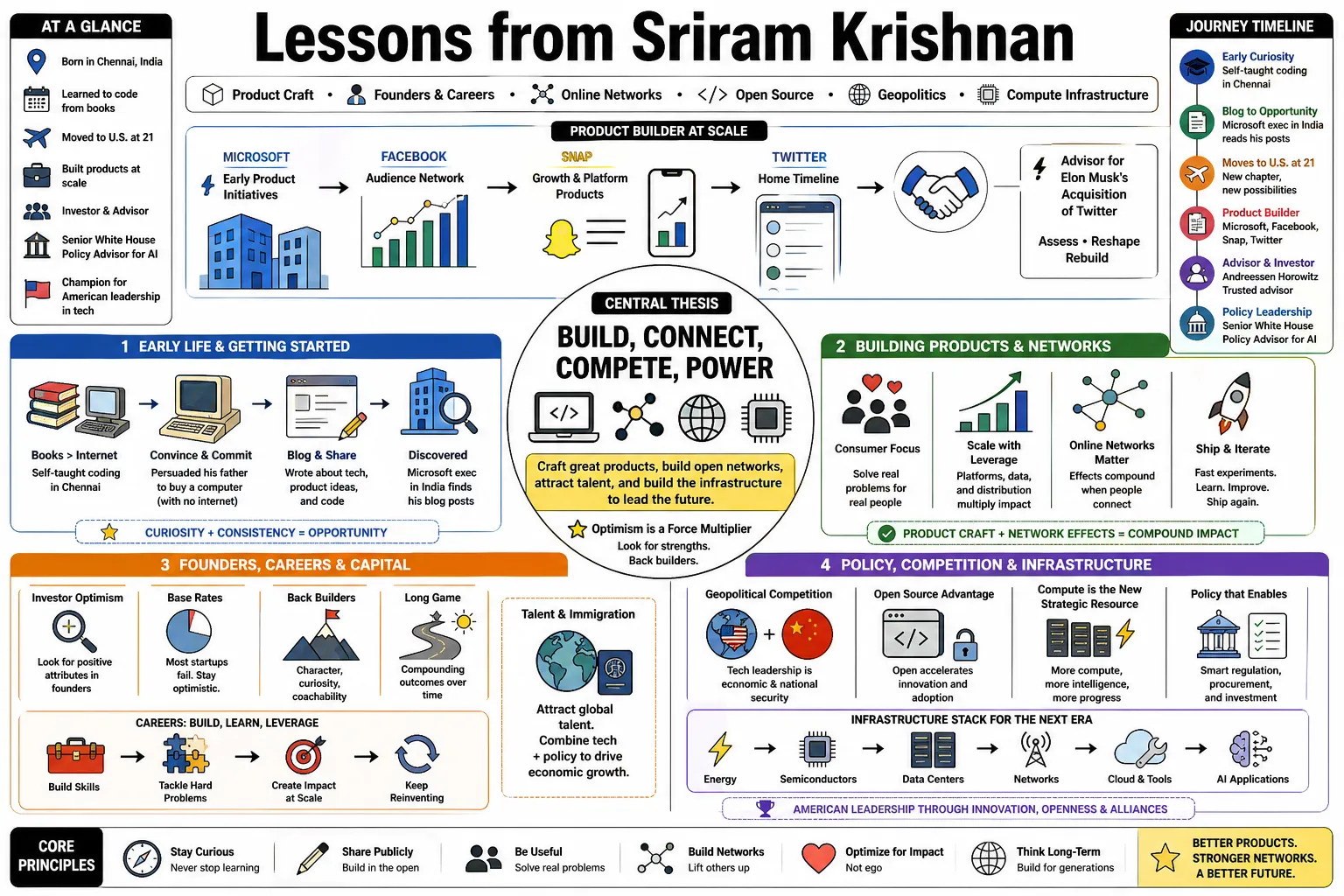
Part 1: Early Life and Career Building
- On early coding: He taught himself to program from books in Chennai, India, after convincing his father to purchase a computer that lacked internet access. — Reference: Shawn Ryan Show Transcript
- On getting a foot in the door: A Microsoft executive operating in India discovered his online blog posts, leading to an interview and ultimately his move to the United States at age 21. — Reference: Business Chief UK & Europe
- On building at scale: His product career involved leading major initiatives at several consumer technology companies, including the Facebook Audience Network and Twitter's home timeline. — Reference: Andreessen Horowitz
- On immigration and talent: He supports immigration reform as a necessary mechanism to attract top global talent and combine technology with policy to drive economic growth. — Reference: The Shawn Ryan Show on Spotify
- On investor optimism: He approaches venture capital by actively looking for positive attributes in founders, noting that it is difficult to focus on success when the default outcome for most startups is failure. — Reference: Andreessen Horowitz
- On advising acquisitions: When Elon Musk purchased Twitter, Krishnan was brought in as a trusted advisor to help assess and reshape the platform due to his previous experience as a product leader there. — Reference: Business Chief UK & Europe
Part 2: Open Source and Market Dynamics
- On market demand: "If you're providing a product of value, capitalism will find a way to make the supply chain work for you." — Source: The a16z Show
- On pricing pressure: The proliferation of highly capable open-weight models forces frontier AI labs to reconsider their token pricing, which will likely erode their gross margins over time. — Reference: MTS Podcast
- On security through transparency: Adhering to Linus's Law, he believes open-weight models are fundamentally secure because they allow the entire world to inspect, dismantle, and patch vulnerabilities. — Reference: The a16z Show
- On model distillation: The practice of newer models learning from older ones is a natural continuation of how early AI bootstrapped itself by absorbing existing human knowledge from the internet. — Reference: The a16z Show
- On unintended consequences of safeguards: Overly strict refusals on American frontier models can drive security professionals to use foreign alternatives for their cybersecurity work to avoid constant roadblocks. — Reference: MTS Podcast
- On defending infrastructure: Ensuring Western developers have access to the most capable AI tools is a requirement to defend against malicious, automated AI agents attempting to breach software systems. — Reference: The a16z Show
Part 3: AI Policy and Public Perception
- On regulatory agencies: He strongly opposes the creation of a centralized, FDA-style licensing agency for software developers, arguing it would stall technological progress. — Reference: The Times of India
- On public backlash: He blames the leaders of top AI labs for fueling public distrust by excessively promoting dystopian scenarios and job-loss fears instead of highlighting benefits like medical advancements. — Reference: The Times of India
- On wealth concentration: The resistance to AI from average citizens stems from a feeling of exclusion while a small number of companies accumulate massive wealth and power. — Reference: The Times of India
- On public stakes in AI: He supports policies that would require top AI firms to donate equity stakes to the American public, ensuring citizens directly benefit from the models they use daily. — Reference: The Times of India
- On state-level regulation: Before and during his government tenure, he worked to block local and state-level tech regulations that he believed would complicate AI development. — Reference: The Times of India
- On domestic innovation: A core pillar of his policy agenda is removing red tape to unleash the capabilities of both established tech giants and future startups without the constraints of international safety summits. — Reference: India Today Global
Part 4: Geopolitics and the American AI Stack
- On the AI race: He views the competition with China over artificial intelligence as a critical conflict where losing would bring catastrophic consequences. — Reference: Shawn Ryan Show
- On foreign models: He expressed discomfort with moments when the highest-performing open-source models were Chinese, strongly preferring that American models remain at the absolute frontier. — Reference: The a16z Show
- On hardware dominance: He advocates for global adoption of the "American AI stack," starting at the foundational level with semiconductors and advanced chips designed by US companies. — Reference: India Today Global
- On software exports: Beyond hardware, the US strategy involves ensuring that international partners utilize American-made AI models and build their local applications on top of them. — Reference: India Today Global
- On sovereign AI: He believes allied nations can maintain their strategic autonomy while still taking advantage of the massive, multi-billion-dollar infrastructure investments made by US hyperscalers. — Reference: India Today Global
- On physical infrastructure: The success of AI depends entirely on unlocking domestic physical infrastructure, including electrical grids, gas turbines, and nuclear power, to feed data centers. — Reference: India Today Global
- On platform shifts: He categorizes AI as the next definitive technological era, following the microprocessor in the 1970s, the internet in the 1990s, and the mobile phone in the late 2000s. — Reference: Shawn Ryan Show Transcript
Part 5: Media, Writing, and Content Creation
- On human expression: He was inspired by late peers like Om Malik to return to online writing, viewing the act of sharing one's passions publicly as a gift reminiscent of early blogging. — Reference: Sriram Krishnan Blog
- On digital authenticity: He values having a personal corner of the internet where text is typed by hand, finding it a comforting contrast to a web increasingly filled with AI-generated tokens. — Reference: Sriram Krishnan Blog
- On AI assistance: Despite prizing manual writing, he uses AI coding tools to reduce the friction of setting up the technical scaffolding for his website. — Reference: Sriram Krishnan Blog
- On AI text detectors: He has grown so cautious about sounding artificial that he runs his own entirely human-written text through AI detectors to ensure it won't be falsely flagged. — Reference: The a16z Show
- On community building: He and his wife launched a talk show to host organic, long-form discussions on technology, interviewing everyone from startup founders to cultural icons like AR Rahman. — Reference: Business Today
- On AI in the arts: When discussing music production, he noted that while AI is highly effective at sorting samples and identifying frequencies, creating cohesive, finalized art still requires human direction. — Reference: Business Today
- On speech constraints: He noted that leaving government service allowed him to speak freely and opine online again, escaping a default posture of public silence. — Reference: Sriram Krishnan Blog
Part 6: Consumer Product Craft
- On the opening experience: A product's first moments should reveal what kind of experience it offers, just as a film's opening scene establishes what the audience is about to watch. — Reference: a16z Consumer Products 101
- On frictionless onboarding: Signup should avoid questions that make a new user pause and deliberate; every extra decision creates an opportunity to abandon the product before seeing its value. — Reference: a16z Consumer Products 101
- On finding the magic moment: Consumer teams need to identify the specific behavior that separates retained users from those who leave, then organize the early product journey around reaching that threshold quickly. — Reference: a16z Consumer Products 101
- On activation trade-offs: Helping a newcomer reach a product's magic moment can justify temporarily favoring that user over someone who is already retained, because network products must balance several participants at once. — Reference: a16z Consumer Products 101
- On metrics and emotion: A company should know whether a product decision belongs to the measurable world of experiments and dashboards or the slower world of trust, perception, and feeling; confusing the two produces blind spots. — Reference: a16z Consumer Products 101
- On useful difficulty: Making every interaction effortless is not always the goal; carefully placed difficulty can create mastery, identity, and a more satisfying payoff. — Reference: a16z Consumer Products 101
- On proportional friction: Product friction can communicate the weight of an action, so lightweight choices should feel easy while consequential permissions or transactions should require greater deliberation. — Reference: a16z Consumer Products 101
- On stable scarcity: Scarcity gives status and recognition meaning, but changing an established scarce signal into something abundant can alienate the people who built identity around it. — Reference: a16z Consumer Products 101
- On systems thinking: He prefers mapping every participant, incentive, constraint, and trade-off in a product system over reducing the design to a single user's job to be done. — Reference: Lenny's Podcast with Aarthi and Sriram
Part 7: Founders, Careers, and Communities
- On founder detail: Great founders stay close enough to the product, code, recruiting, sales, and operations to recognize how small problems connect to the larger system. — Reference: Sifted interview with Sriram Krishnan
- On urgency: Strong founders compress the interval between discussion and action, preferring the next-day follow-up to a meeting scheduled weeks away. — Reference: Sifted interview with Sriram Krishnan
- On founder conviction: Exceptional company builders combine an unyielding picture of the world they want to create with enough belief to keep pursuing it when the idea still appears irrational to others. — Reference: Sifted interview with Sriram Krishnan
- On attention and brand: Media, social posts, fundraising, and even time on a factory floor should be judged by whether they serve the company's cause, not by blanket rules about what a founder should avoid. — Reference: Sifted interview with Sriram Krishnan
- On informed micromanagement: What looks like micromanagement can be a CEO maintaining enough contact with the details to see cross-functional problems that isolated teams miss. — Reference: Sifted interview with Sriram Krishnan
- On authentic networking: A durable network begins with genuine curiosity about people and a willingness to help without treating every relationship as a future transaction. — Reference: Lenny's Podcast with Aarthi and Sriram
- On compounding relationships: Two thoughtful conversations a week, followed by periodic check-ins, can compound over years into a broad network without requiring performative networking events. — Reference: Lenny's Podcast with Aarthi and Sriram
- On public bodies of work: Publishing useful work creates a visible signal of what you care about and gives unexpected collaborators a reason to find you. — Reference: Lenny's Podcast with Aarthi and Sriram
- On hosting communities: A community works more like a hosted gathering than an abstract platform: the host needs to set the tone, choose an initial mix of people, and actively protect the environment. — Reference: Lenny's Podcast with Aarthi and Sriram
- On storytelling: His enthusiasm for professional wrestling taught him to study audience connection, narrative buildup, and how a compelling story can make people care about an event or idea. — Reference: Shawn Ryan Show
Part 8: Open Networks and Web3
- On shared platform economics: Web3 social networks can let the creators who generate a platform's value participate directly in its economic upside rather than receiving reach alone. — Reference: TechCrunch interview on crypto social networking
- On user governance: Giving stakeholders a voice in how a platform develops changes the power relationship between creators and the companies that host their work. — Reference: TechCrunch interview on crypto social networking
- On the right of exit: Open protocols make platforms more accountable when users can take their assets and content elsewhere or choose an alternate client without abandoning the underlying network. — Reference: TechCrunch interview on crypto social networking
- On permissionless building: His attraction to decentralization comes from the early internet's promise that anyone could build on shared infrastructure without first obtaining an API key from a dominant company. — Reference: Sifted interview with Sriram Krishnan
- On Web3 onboarding: Economic incentives and open architecture do not compensate for a difficult first-run experience; wallets, tokens, and unfamiliar mechanics still have to become simple enough for mainstream users. — Reference: TechCrunch interview on crypto social networking