DJ Patil co-coined the term “data scientist” and later served as the first U.S. Chief Data Scientist. His work spans data products, organizational practice, public policy, healthcare, and data ethics. These lessons focus on his recurring themes: making difficult problems tractable, building data-capable teams, and keeping people and consequences at the center of technical work. [source]
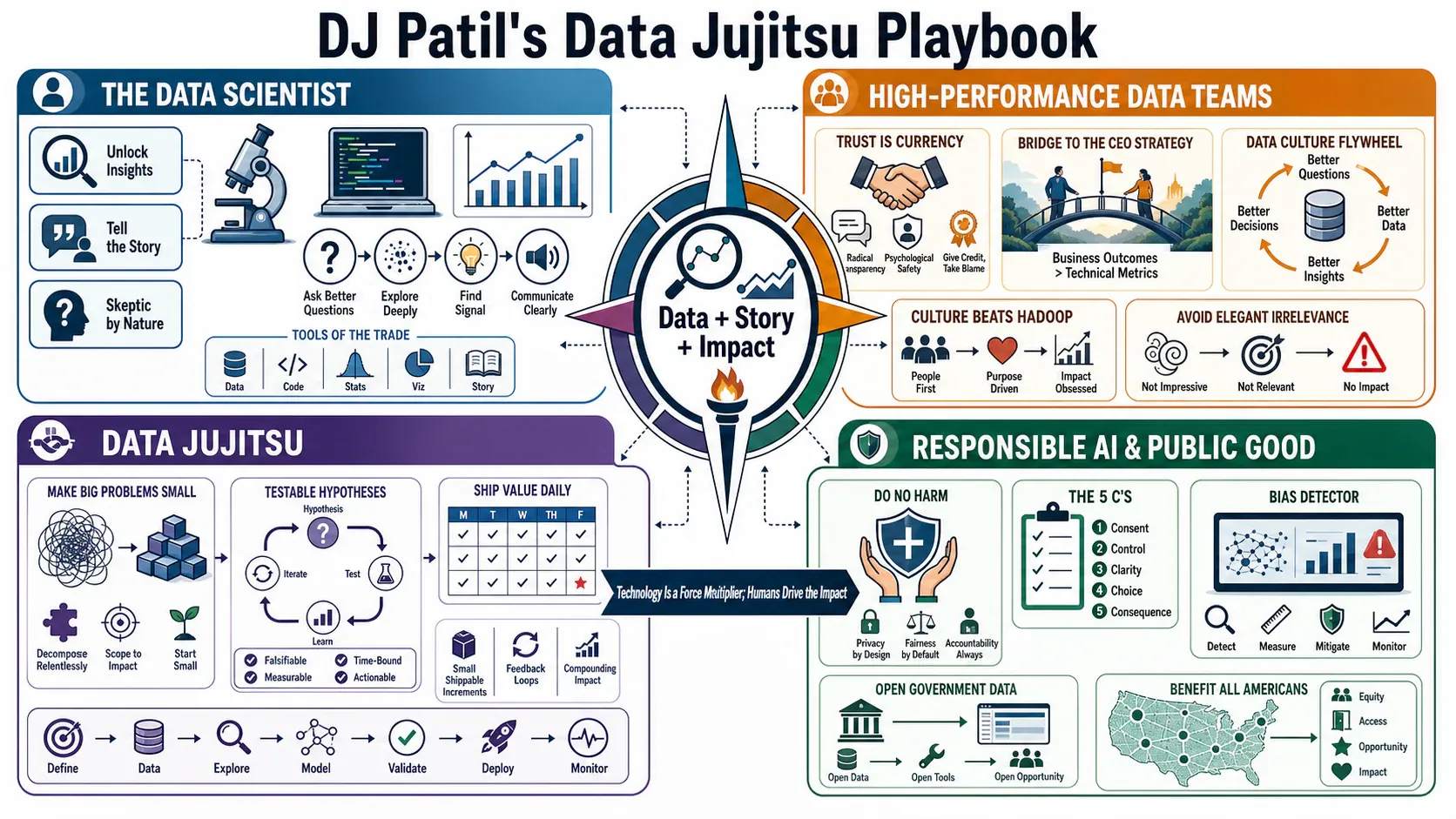
Part 1: Defining the Data Scientist & The Field
- On the Definition of a Data Scientist: Davenport and Patil describe a data scientist as a rare hybrid of data hacker, analyst, communicator, and trusted adviser. [source]
- On the “Data Scientist” Title: Patil and Jeff Hammerbacher rejected titles that were too narrow or too detached from product work. “Data scientist” fit people who use data and science to create something new. Source: [source]
- On Essential Qualities: The best data scientists combine depth in a scientific discipline with curiosity—the drive to get beneath a problem and reduce it to testable hypotheses. [source]
- On Communication: Patil treats storytelling as a core data-science skill: practitioners must use data to tell a story and communicate it effectively. Source: [source]
- On Data as a Team Sport: Patil built LinkedIn’s data group as an integrated product team spanning design, engineering, web development, product marketing, and operations. [source]
- On Missing Data: Missing instrumentation can determine whether a team can understand an attack or product problem; Patil describes the inevitable “if only” moment when needed data was never collected. Source: [source]
- On Training: Every technology team should ask two hard questions: How could this go wrong, and what are the consequences? [source]
- On Cleverness: Cleverness is the ability to look at a problem in different, creative ways. [source]
Part 2: Building High-Performance Data Teams
- On the "Small Room" Test: When evaluating a candidate, Patil’s team asked whether they would willingly build a startup together and spend long periods in the same room. Trust, communication, and enjoyment of one another’s company mattered. [source]
- On Data Culture: Succeeding with data is not a matter of installing Hadoop or hiring a few specialists. It requires cultural change and broad access to data across the organization. Source: [source]
- On Organizational Placement: At LinkedIn, Patil placed the data team in Product so it could drive change, own outcomes, and work in close alignment with Engineering. Source: [source]
- On Cultural vs. Technical Problems: Data challenges are often culture problems more than deployment or process problems; the organization has to learn how to think together about data. [source]
- On Measurement: Strong data-driven organizations live by the motto “if you can’t measure it, you can’t fix it”—a principle Patil credits to an operations leader he worked with. [source]
- On "Boring" Problems: AI can create value not only on the thorniest business problems but also on the “stupid, boring problems” in back-office work. [source]
- On Avoiding Irrelevance: Patil and Mason warn against spending scarce data-science effort on elegant solutions to irrelevant problems. Source: [source]
- On Hiring for Curiosity: Patil looks for broad, persistent curiosity alongside technical depth: the impulse to keep asking what else the data might reveal. [source]
- On Representation: Patil argues that people who will be affected by a technology should be represented at the table while it is being built; otherwise, real people are reduced to abstract “edge cases.” Source: [source]
Part 3: Data Jujitsu & Product Strategy
- On Data Jujitsu: Data jujitsu uses multiple data elements in clever, iterative ways so their combined effect can solve a problem that otherwise looks intractable. [source]
- On Problem Sizing: Smart data scientists do not only solve big, hard problems; they have an instinct for making big problems small. [source]
- On Iterative Design: "Ideas for data products tend to start simple and become complex; if they start complex, they become impossible." [source]
- On Testing Hypotheses: Use data to develop intuition, formulate a question, and iterate until the hypothesis is testable. Source: [source]
- On Expectation Management: Carefully setting users’ expectations gives a data product a better chance of succeeding. [source]
- On Data Product Teams: Patil organized LinkedIn’s data group as a product team responsible for designing, implementing, and maintaining products so its work could create direct value. Source: [source]
Part 4: Ethics, Privacy, and Responsible AI
- The Primary Rule: Responsible data work starts with a limit: just because we can do something with data does not mean we should. Source: [source]
- On Professional Ethics: Patil supports a professional ethics code that gives people working on technology standing to say when something is not right. Source: [source]
- On Ethics as Core Curriculum: Ethics and security must be part of the core curriculum wherever people learn to build with data and technology—not electives. [source]
- On Consent (The 5 C's): Consent begins with agreement about what data is collected and how it will be used; without that agreement, trust cannot be established. [source]
- On Clarity (The 5 C's): People need clarity about what data they provide, what will be done with it, and the downstream consequences of its use. [source]
- On Consistency (The 5 C's): Trust requires consistency over time; even good intentions do not make unpredictable behavior trustworthy. [source]
- On Control (The 5 C's): People should have meaningful control over their data, including the ability to obtain it and ask for its removal. [source]
- On Consequences (The 5 C's): As data products become more sophisticated and consequential, teams must ask whether the data or its use could harm an individual or group. [source]
- On Algorithmic Bias: Models can cause public harm when their training data fails to represent the people they encounter; calling the problem “bad training data” is not an acceptable excuse. Source: [source]
- On Universal Benefit: Technology is neither radical nor revolutionary unless it benefits every single person. [source]
Part 5: Public Service & Policy
- On the White House Mission: The mission Patil developed with President Obama was to responsibly unleash the power of data to benefit all Americans. [source]
- On the Police Data Initiative: The Police Data Initiative asked departments to open data for transparency and let communities use it to understand problems faster. [source]
- On Criminal Justice Reform: The Data-Driven Justice initiative used linked criminal-justice and health data to identify people cycling through local systems, connect them with care, and reduce detention caused by inability to afford bond. Source: [source]
- On Open Data: Federal data produced under the administration’s open-data policy was meant to be open and machine-readable by default. [source]
- On Data as a First Responder: After helping with the national COVID response, Patil began to think of data scientists as a new kind of first responder. Source: [source]
- On Force Multipliers: Data is a force multiplier, but it belongs inside a broader principle: people matter more than data, and the time to engage is now. [source]
- On People First: No matter how much technology and data we use, the work is about people first. [source]
Part 6: Leadership, Culture, and the Exponential Mindset
- On the Execution Framework: Dream in years, plan in months, evaluate in weeks, but always ship daily. [source]
- On the Exponential Mindset: Because people struggle to reason about exponential change, leaders need an exponential mindset as AI capabilities compound. [source]
- On Silicon Valley Mantras: Instead of “move fast and break things,” Patil advocates a more accountable operating principle: move fast and fix things. [source]
- On Operating Through Crisis: During California’s COVID response, useful progress came from combining policymakers, domain experts, data scientists, and technologists around a concrete operating problem—not from waiting for a perfect system. Source: [source]
- On Data-Informed vs. Data-Driven: Data should inform how we think about the world, but it should not define how we think about the world. Source: [source]
Part 7: Healthcare & Precision Medicine
- On the Cancer Moonshot: For the Cancer Moonshot, Patil focused on enabling new datasets that let researchers ask better questions while keeping patients and participants central. Source: [source]
- On Precision Medicine: Precision-medicine data programs should keep patient participants at the table when deciding consent, access, and use—not treat an advocacy group as a substitute for the people affected. Source: [source]
- On Data Silos in Health: Patil warns that data abuse can include locking up medical data that families facing rare or terminal disease may want shared in pursuit of a cure. Source: [source]
- On Patient Access: When a hospital database contains a person’s record, Patil argues that the person should be able to access it and correct errors. Source: [source]
- On Health-Record Infrastructure: Digitizing health records created major benefits, but much of the infrastructure was built on old billing systems and still leaves clinicians typing instead of talking with patients. Source: [source]
- On Pandemic Modeling: In California’s COVID response, scaling an epidemiological model made it possible to run hundreds of scenarios; the resulting curves helped leaders judge hospital-capacity risk and act. Source: [source]
- On Public-Health Early Warning: Patil’s COVID work focused on improving models and developing early-warning signals for outbreaks. Source: [source]
Part 8: Personal Growth & The Future of Technology
- On Career Roots: Patil’s path into data-intensive work began with weather forecasting: understanding complex systems required far more data than conventional methods could handle. [source]
- On AI and Boring Work: Patil highlights a practical use for AI: tackling the “stupid, boring problems” in back-office work. Source: [source]
- On Agentic AI: As AI systems begin to take actions, data platforms need stronger context, guardrails, and management layers—not observability alone. Source: [source]
- On Data Engineers: The growth of data science has made data engineering a key role because usable data still depends on cleaning, preparation, and reliable infrastructure. Source: [source]
Learn more:
- Data Scientist: The Sexiest Job of the 21st Century
- Building Data Science Teams
- Data Driven: Creating a Data Culture
- Data Jujitsu: The Art of Turning Data into Product
- The Five Cs
- The Evolution of Data Science with DJ Patil
- Full transcript: DJ Patil on Recode Decode
- What Makes a Radical and Revolutionary Technology?
- On Data Ethics: An Interview with DJ Patil
- DJ Patil on Using AI to Move Fast and Fix Things
- An Exit Interview With U.S. Chief Data Scientist DJ Patil
- A Conversation with the Chief Data Scientist of the United States
- Launching the Data-Driven Justice Initiative
- DJ Patil on the Importance of Interpreting Data
- The Rise of Big Data and California’s COVID-19 Response
- How Agentic AI Breaks Data Platforms