Eugene Wei is one of the most insightful thinkers in tech, media, and product strategy. His blog, Remains of the Day, is a goldmine of frameworks that have become standard vocabulary in Silicon Valley.
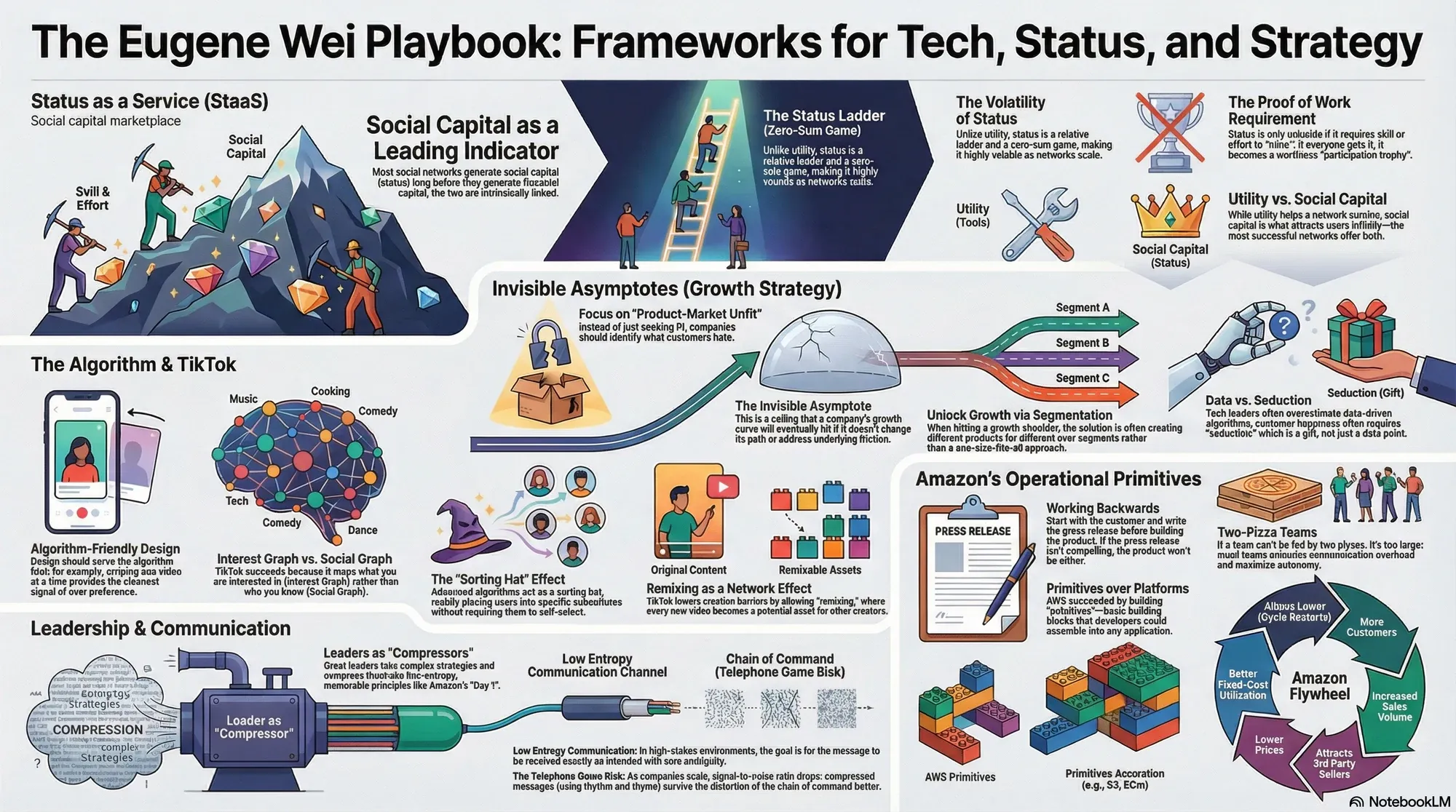
I. Status as a Service (StaaS)
Source: Status as a Service
1. The Two Core Principles of Human Nature
"Let’s begin with two principles:People are status-seeking monkeys.People seek out the most efficient path to maximizing social capital."
2. Social Capital as a Leading Indicator
"Social capital is a leading indicator of financial capital, and most social media networks generate much more social capital than actual financial capital."
3. The Definition of a Successful Social Network
"Social networks are marketplaces for social capital...[1] To succeed, they must offer their own unique form of status token, earned through some distinctive proof of work."[2]
4. Proof of Work is Essential
"Status isn't worth much if there's no skill and effort required to mine it. If everyone can achieve a certain type of status, it's no status at all, it's a participation trophy."
5. Utility vs. Social Capital
"Come for the fame, stay for the tool? No. Come for the tool, stay for the network? That is the classic definition of a network effect... But the most successful networks often offer both utility and social capital."
6. The Volatility of Status
"Status is a relative ladder. It is a zero-sum game in a way that utility is not."
7. Why Copying Features Often Fails
"If you can't change the proof of work competition as a challenger, copy and throttle is an effective strategy for the incumbent.[1] The reason that matching the basic proof of work hurdle of an incumbent fails is that it generally duplicates the status game that already exists."[1]
8. The "Cool" Factor
"Young people tend to be the tip of the spear when it comes to catapulting new Status as a Service businesses... because they are generally social capital poor."
9. Evaporative Cooling
"As a network grows, the quality of the content and the signal-to-noise ratio tends to drop... This is often referred to as 'context collapse'."
10. Context Collapse
"When you speak to a massive audience, you inevitably have to water down your message to avoid offending anyone. This is the 'lowest common denominator' effect of large social graphs."
11. Algorithm as Market Maker
"The algorithm acts as a rapid, efficient market maker, connecting videos with the audiences they're destined to delight. The algorithm allows this to happen without an explicit follower graph."
12. Scarcity is Value
"Value is tied to scarcity, and scarcity on social networks derives from proof of work."
II. Invisible Asymptotes (Growth Strategy)
Source: Invisible Asymptotes
13. Defining the Invisible Asymptote
"An invisible asymptote is a ceiling that a company's growth curve will eventually bump up against if it continues down its current path."
14. Product Market Unfit
"We focus so much on product-market fit, but once companies have achieved some semblance of it, most should spend much more time on the problem of product-market unfit."
15. Ask Customers What They Hate
"Customers are often bad at articulating what they want (the faster horse problem), but they are very good at pinpointing what they don't like."
(Learning: Amazon discovered Prime not by asking what people wanted, but by realizing people hated paying for shipping.)
16. The Shoulder of the S-Curve
"Every successful business experiences an S-curve... few think about the shoulder that comes soon after; the point when, inevitably, a company's growth flattens."
17. Segmentation is the Key
"When you hit an asymptote, the key to unlocking growth is usually customer segmentation—creating different products for different users."
18. Seduction vs. Data
"Seduction is a gift, and most people in technology vastly overestimate how much of customer happiness is solvable by data-driven algorithms."
19. Personal Asymptotes
"Successful people are often much more conscious of their own personal asymptotes at a much earlier age than others."
III. TikTok & Seeing Like an Algorithm
Sources: TikTok and the Sorting Hat, Seeing Like an Algorithm
20. Algorithm-Friendly Design
"To serve your users best, first serve the algorithm. TikTok is an exemplar of 'algorithm-friendly design'—design that helps the algorithm 'see' user preference."
21. The Interest Graph vs. The Social Graph
"TikTok is not a social network; it is an interest network. It builds a graph of your interests, not your friends."
22. Friction Can Be Good
"The goal of any design is not to minimize friction, it's to help the user achieve some end. Sometimes, friction (like swiping one video at a time) provides the cleanest signal to the algorithm."
23. Cultural Determinism and Tech
"I used to think cultural barriers prevented Chinese apps from succeeding in the West. TikTok proved that a sufficiently advanced algorithm can abstract away cultural differences."
24. Remixing as a Network Effect
"TikTok lowers the barrier to creation by providing tools that allow for 'remixing'. This creates a 'content network effect' where every new video is a potential asset for other creators to use."
25. The Sorting Hat
"The For You Page is a Sorting Hat. It sorts users into subcultures rapidly and efficiently without them having to self-select."
26. Signal Clarity
"By relying on a long scrolling feed... apps like Instagram made a tradeoff in favor of lower friction scanning at the expense of a more accurate read on negative signal.[1] You can't see what a user ignores in a fast scroll."
27. The Feedback Loop
"The magic of TikTok is the tight feedback loop between creation, consumption, and the algorithm. The user trains the algorithm, and the algorithm trains the user on what to create."
IV. Compress to Impress (Communication & Leadership)
Source: Compress to Impress[3]
28. Compression is Power
"Great leaders are often great compressors.[4] They can take complex strategies and compress them into memorable slogans or principles (e.g., 'Day 1')."
29. The Telephone Game (Chinese Whispers)
"As companies scale, the signal-to-noise ratio drops. Messages get distorted as they pass down the chain of command.[5] A compressed message survives this distortion better."
30. Verse and Rhyme
"Rhythm and rhyme allow humans to compress and recall a message with greater accuracy than prose."[3]
31. Defining the Enemy
"Jeff Bezos articulated 'Customer Obsession' to give the company a level of oppositional definition.[5] You can be competitor-focused, product-focused, or technology-focused; choosing one defines you by what you are not."
32. Low Entropy Communication
"In high-stakes environments, you want low entropy communication. You want the message to be received exactly as intended, with zero ambiguity."
V. Amazon & Product Management
Sources: Various essays including The Amazon Tax
33. Process as Proxy
"Good process serves you so you can serve customers.[5] But if you’re not watchful, the process becomes the thing.[5] This is the death knell of a company."
34. Working Backwards
"Start with the customer and work backwards. Write the press release before you build the product. If you can't write a compelling press release, you don't have a compelling product."
35. Two-Pizza Teams
"If a team can't be fed by two pizzas, it's too large. Small teams minimize communication overhead and maximize autonomy."
36. The Institutional "No"
"In large organizations, 'no' is the easiest answer. It requires the least amount of work. Innovators have to fight against the institutional inertia of 'no'."
37. Distribution is King
"Distribution is king, even when, or especially when, it allocates social capital."[1]
38. The Amazon Flywheel
"Lower prices lead to more customers. More customers increase the volume of sales. More volume attracts more third-party sellers. This allows for better fixed-cost utilization, which allows for lower prices."
39. Your Margin is My Opportunity
"Amazon's strategy was often described by Bezos as 'Your margin is my opportunity.' They were willing to operate at zero or negative margins to gain market share."
40. Primitives vs. Platforms
"Amazon (AWS) succeeded by building 'primitives'—basic building blocks that developers could assemble into anything. They didn't try to guess the final application; they just provided the Lego blocks."
VI. General Strategy & Tech Wisdom
41. Copy and Throttle
"When an incumbent sees a threat, they can copy the feature and use their superior distribution to 'throttle' the competitor's growth (e.g., Instagram Stories vs. Snapchat)."
42. The "User" is a Myth
"There is no such thing as 'the user'. There are only segments of users with different needs, behaviors, and motivations."
43. Network Effects are Not Forever
"Network effects can be negative.[6] As a network scales, it can become less useful (spam, noise, context collapse) if not managed correctly."[1]
44. Look at the Outliers
"In data analysis, the averages often hide the truth. Look at the outliers—the power users or the churned users—to find the invisible asymptotes."
45. Narrative vs. Slides
"Amazon banned PowerPoint because slides allow for lazy thinking. Writing a 6-page narrative memo forces you to clarify your thoughts and connect your arguments."
46. The ROI of Status
"Users constantly calculate the ROI of their posts. If I post this, how many likes will I get? If the ROI drops too low, I stop posting."
47. Participation Trophies Kill Networks
"If everyone gets a trophy, the trophy has no value. A social network must maintain a hierarchy of status to remain engaging."
48. Cultural dysmorphia
"Tech companies often suffer from cultural dysmorphia—they build products for people like themselves (wealthy, coastal, tech-savvy) and fail to understand the rest of the world."
49. Single-Player Mode
"To bootstrap a network, you often need a 'single-player mode'—a tool that is useful even if no one else is on the network (e.g., Instagram's filters)."
50. Strategy is Path Dependent
"You cannot simply copy a competitor's strategy because their strategy is a result of their specific history, culture, and assets. Context matters."
Sources