Lessons from Kevin Kwok, drawn from his essays on kwokchain.com and his work with Reforge. They are grouped by recurring themes, including: Growth Loops, Marketplaces, Collaboration & Productivity, and Strategy. Reference: Kevin Kwok: Kwokchain Archive Reference: Reforge: Growth Loops are the New Funnels
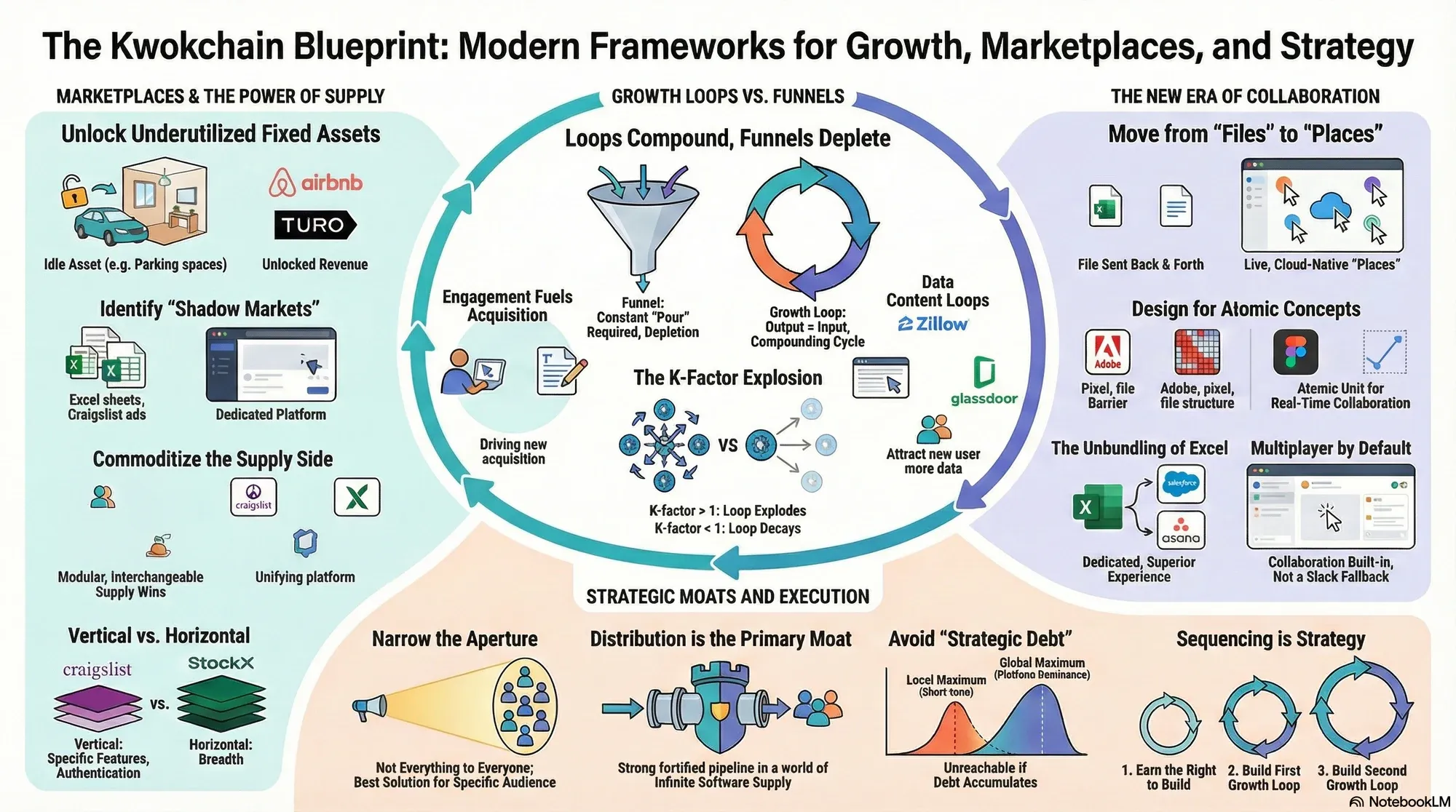
On Growth Loops vs. Funnels
- The Shift to Loops: The essay opens with almost exactly this claim: funnels were a good starting point but do not accurately represent how the fastest growing products grow, and it is time to move past the funnel framework and focus on growth loops. [5]
- Compounding vs. Linear: The essay makes the same point more precisely: funnels operate in one direction, put more in at the top, get more out at the bottom, with no concept of how to reinvest what comes out at the bottom to get more at the top -- in other words, no compounding effect. [3]
- The Problem with Funnels: The essay's real framing is Funnels Create Strategic Silos: product strategy, acquisition strategy, and monetization get treated as separate silos, when product, channels, and monetization actually need to be thought about together because they are interlinked. [4]
- Reinvestment: Growth loops compound when the output of one cohort is reinvested to produce the next cohort. Reference: Reforge: Growth Loops are the New Funnels
- Acquisition Loops: "There are four primary acquisition loops: Viral, Content, Paid, and Sales.[1] The best companies usually dominate one or two rather than trying to be average at all of them." (Source: Reforge)
- Engagement Loops: "Acquisition loops get users to the product; engagement loops keep them in the product. The output of an engagement loop (e.g., creating a document) should fuel an acquisition loop (e.g., sharing that document)."[1] (Source: Reforge)
- The K-Factor: The cohort K-factor measures how many additional users each new signup produces through a viral loop. Reference: Reforge: Map Your Acquisition Loops
- Data Content Loops: The essay names this the Rich Barton Playbook: build Data Content Loops to disintermediate incumbents and dominate search, then use that traction to own demand -- in order to grow demand high enough to become a beneficial flywheel, Barton's companies used a Data Content Loop to bootstrap demand and create unique content indexing an industry online, homes for Zillow, hotels and flights for Expedia, companies for Glassdoor. [9]
- Good Friction: His real framing is: good friction looks like it hurts its step of the loop, but it net improves the entire loop, pre-filtering for customers who are more committed rather than low-intent users who will just churn. [6]
On Marketplaces & Supply
- Underutilized Fixed Assets: The essay makes this its opening claim: historically it's very hard to find a successful marketplace that wasn't built on an underutilized fixed asset, and Airbnb's guest bedroom is the canonical example -- always there, a fixed asset, but unused and generating no money until the marketplace unlocks it. [7]
- The "Free" Supply: The essay's real framing is about being already paid off: fixed assets can be viewed as assets that are already paid off, so any incremental uses of them are functionally free, unlike variable assets where incremental usage always still carries a cost. [8]
- Finite Supply Creates an Asymptote: Underutilized assets help marketplaces bootstrap supply cheaply, but that pool is finite; continued growth eventually depends on professional suppliers bringing new capacity online. Reference: Kevin Kwok: Underutilized Fixed Assets
- TAM Expansion Is Segment-Specific: Market expansion often comes from serving customer segments whose needs the incumbent system could not satisfy, as ride-hailing did in New York’s outer boroughs. Reference: Kevin Kwok: Quantifying TAM Expansion—Uber and Lyft in NYC
- Expansion and Cannibalization Can Coexist: A new service can enlarge a market while also replacing part of the incumbent volume; Uber and Lyft did both in New York. Reference: Kevin Kwok: Quantifying TAM Expansion—Uber and Lyft in NYC
- Efficiency Alone May Shrink a Marketplace: Improving market efficiency can reduce the size of the original market unless the product also unlocks new customers, use cases, service levels, or price points. Reference: Kevin Kwok: Quantifying TAM Expansion—Uber and Lyft in NYC
- Better Service Can Unlock Latent Demand: Mobile dispatch and mapping let ride-hailing improve availability, reliability, and coverage enough to serve demand that traditional taxis left unmet. Reference: Kevin Kwok: Quantifying TAM Expansion—Uber and Lyft in NYC
- Fragmented Supply Is a Software Opportunity: The operational complexity of bringing fragmented supply online can favor software marketplaces, because software can make that supply legible and manageable. Reference: Kevin Kwok: Underutilized Fixed Assets
On Collaboration & Productivity
- The Arc of Collaboration: In cloud software, collaboration moves out of exchanged documents and into the functional workflows where the work actually happens. Reference: Kevin Kwok: The Arc of Collaboration
- Slack as a Fallback: Slack functions as an exception handler for work that a specialized application cannot coordinate natively. Reference: Kevin Kwok: The Arc of Collaboration
- Contextual Communication: Figma keeps feedback in context by letting collaborators comment directly in the design file instead of moving discussion to email. Reference: Kevin Kwok: Why Figma Wins
- Atomic Concepts: Sketch established vectors and projects as atomic concepts for digital-product design; Figma extended that foundation by making collaboration part of the product’s core model. Reference: Kevin Kwok: Atomic Concepts
- Disciplines Improve by Commoditizing Their Own Work: Engineering advances by turning yesterday’s specialized work into shared tools, abstractions, and practices; other disciplines can compound progress the same way. Reference: Kevin Kwok: Why Figma Wins
- Platforms Can Advance an Entire Discipline: Figma’s larger opportunity is to become a platform whose plugins and community improve how design work is created, shared, and extended across companies. Reference: Kevin Kwok: Why Figma Wins
- Meta-Layers: Discord operates as both a messaging product and a meta-layer that persists across individual games. Reference: Kevin Kwok: The Arc of Collaboration
- Discord's Secret: Discord provides persistent social presence even when its users are not actively playing a game. Reference: Kevin Kwok: The Arc of Collaboration
- Multiplayer by Default: Figma’s browser-native architecture lets multiple people work on the same design without file syncing or version conflicts. Reference: Kevin Kwok: Why Figma Wins
- Files are Archaic: In a cloud-native workflow, documents and files become constraints inherited from pre-cloud software rather than the natural unit of collaboration. Reference: Kevin Kwok: The Arc of Collaboration
On Strategy & Business Models
- Narrative as Strategy: Founders must distill a company’s narrative for customers, investors, and employees, because each audience needs a coherent account of the company’s progress and ambition. Reference: Kevin Kwok: Narrative Distillation
- Business Models Follow Market Structure: Business models should align a market’s needs with the cost and human capital required to serve them; when either side changes, the viable model changes too. Reference: Kevin Kwok: Aligning Business Models to Markets
- Outliers Move Industries Off Local Maxima: Industries converge on structures that are known to work; experiments that perturb the equilibrium can reveal better models and create learning for everyone. Reference: Kevin Kwok: The Mike Speiser Incubation Playbook
- Judge Investors by Value Added Above Replacement: Fund returns do not show whether an investor changed a company’s trajectory; founders should also ask what would have happened with a different firm. Reference: Kevin Kwok: The Mike Speiser Incubation Playbook
- Specialization Compounds a Playbook: By focusing exclusively on incubation, an investor can repeatedly refine the same company-formation, customer-development, fundraising, and leadership-transition processes. Reference: Kevin Kwok: The Mike Speiser Incubation Playbook
- Platforms Extend Products Through Ecosystems: Products such as Figma and Canva become more extensible when plugins, communities, and marketplaces let outside participants add capabilities. Reference: Kevin Kwok: Atomic Concepts
- A Complete AI Loop Joins Product and Model: In coding agents, product usage generates the work and feedback needed to train better models, while better models improve the product that generates the next round of learning. Reference: Kevin Kwok: Cursor and SpaceX—In Search of a Complete Loop
- In Fast AI Markets, Teams Can Outlast Products: When products become obsolete quickly, the durable acquisition value may sit in the founders and team that know how to build at the frontier. Reference: Kevin Kwok: The HALO Effect
- Distribution as a Moat: Figma’s growth compounds because its product and distribution loop are aligned: collaboration draws more participants into the product. Reference: Kevin Kwok: Why Figma Wins
- A CEO Handoff Can Signal Success: In a deliberate incubation model, replacing an interim CEO after the product begins working can be the planned next stage rather than a rescue. Reference: Kevin Kwok: The Mike Speiser Incubation Playbook
On Crypto & Web3
- Forks Lower the Cost of Challenging an Ecosystem: Unlike a competitor starting from scratch, a fork can create a credible alternative while preserving enough of the ecosystem to make exit and competition feasible. Reference: Kevin Kwok: The Future Is Forked
- Illegibility Breeds Centralization: When crypto systems are too difficult for users to evaluate directly, people rely on exchanges, experts, defaults, and brands, concentrating influence around those intermediaries. Reference: Kevin Kwok: The Future Is Forked
- Forking as Voice: A protocol fork combines exit with voice, lowering the cost of challenging an incumbent ecosystem and providing an internal check on governance. Reference: Kevin Kwok: The Future Is Forked
- Governance Should Preserve Adaptability: The goal of protocol governance is not decentralization for its own sake, but a legible and accountable system that can adapt as circumstances change. Reference: Kevin Kwok: The Future Is Forked
On Focus & Execution
- Quantify Selection Effects Before Trusting Intuition: Observed outcomes come from a filtered population; measuring the filter is necessary before generalizing from the winners that remain visible. Reference: Kevin Kwok: Selection Bias in Poker
- Familiarity With Uncertainty Is Learned Through Repetition: Judgment in company formation develops by repeatedly experiencing the full founding journey, including its earliest and most ambiguous stages. Reference: Kevin Kwok: Joining Sutter Hill Ventures
- Prescriptive Onboarding Can Strengthen Retention: Superhuman’s high-touch onboarding teaches a specific workflow, accelerates setup, tightens feedback, and can improve retention and referrals among high-intent users. Reference: Kevin Kwok: Notes on Superhuman’s Acquisition Loops
- Sequencing: Durable companies repeatedly find and build the next loop instead of relying indefinitely on the loop that produced their initial success. Reference: Kevin Kwok: Why Figma Wins
- The Product is the Loop: For Figma, the core product experience is also the core distribution loop: people join because collaborators share work with them. Reference: Kevin Kwok: Why Figma Wins
- Feedback Loops Compound a Company: A company improves by shortening the loops through which it observes customers, tests changes, and incorporates feedback into the product. Reference: Kevin Kwok: Notes on Superhuman’s Acquisition Loops
- Conviction Can Precede Founder Identity: Strong technical builders may have firm views about what should exist even when they do not identify as founders or want the CEO role. Reference: Kevin Kwok: The Mike Speiser Incubation Playbook
- Atomic Concepts Clarify What to Build: Clear atomic concepts give customers and employees a shared vocabulary for the workflows a product should support and the compounds it should build next. Reference: Kevin Kwok: Atomic Concepts
Primary Sources:
- Blog: Kwokchain.com
- Essays: The Arc of Collaboration, Growth Loops are the New Funnels (Reforge), Notes on Superhuman’s Acquisition Loops, Underutilized Fixed Assets.
Sources