Jaya Gupta is a Partner at Foundation Capital focusing on early-stage enterprise software and AI/ML picks and shovels, leveraging a strong background that includes Georgia Tech, CardioBuddy, and rich startup operating experience. She identifies transformative enterprise AI infrastructure and backs visionary technical founders who are reshaping how businesses operate. The following lessons encapsulate her investment philosophy and strategic insights into the evolving landscape of artificial intelligence.
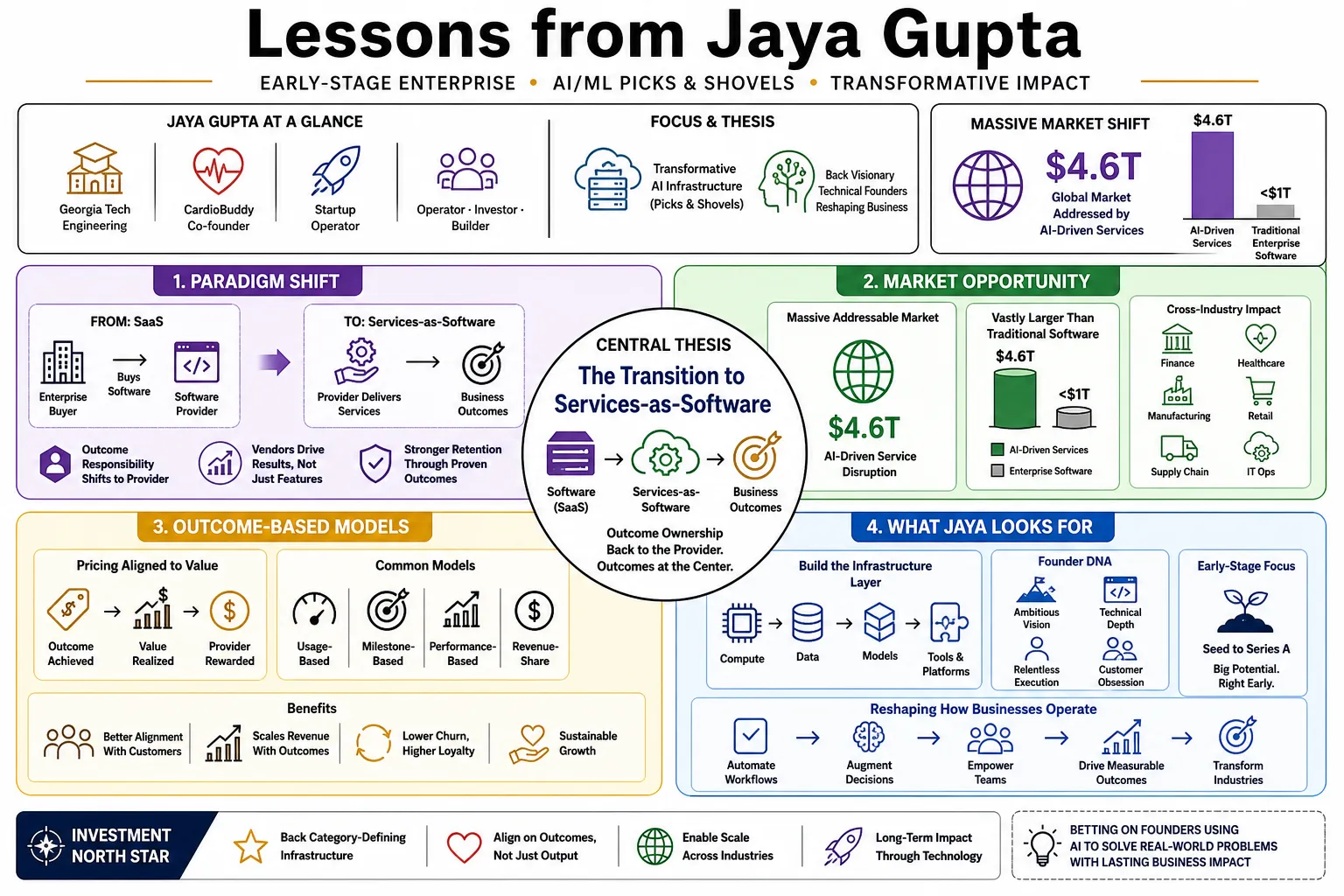
Part 1: The Transition to Services-as-Software
- The transition from software-as-a-service to service-as-software fundamentally flips the responsibility for business outcomes from the enterprise buyer back to the software provider. Reference: AI leads a service as software paradigm shift
- AI-driven service disruption addresses a $4.6 trillion global market that vastly eclipses traditional enterprise software spending. Reference: AI leads a service as software paradigm shift
- Outcome-based pricing models perfectly align software costs with actual business value, allowing vendors to scale revenue alongside their customers. Reference: AI leads a service as software paradigm shift
- Success in the services-as-software era requires startups to embed deeply into highly variable enterprise environments rather than relying on easily replicable surface-level product features. Reference: The $4.6T Services-as-Software opportunity: Lessons from the first year
- As foundation models commoditize basic AI capabilities, a startup's true moat lies in how effectively it integrates into and operates within idiosyncratic customer workflows. Reference: The $4.6T Services-as-Software opportunity: Lessons from the first year
- Forward-deployed engineers are a strategic necessity to uncover and encode the tribal knowledge needed to adapt AI to messy enterprise realities. Reference: The $4.6T Services-as-Software opportunity: Lessons from the first year
- Startups survive aggressive competition from foundational model providers by building resilient learning systems fueled by cross-platform workflow data that incumbents cannot access. Reference: When model providers eat everything: A survival guide for Service-as-Software startups
- Reinforcement learning provides a massive competitive edge by allowing AI agents to continuously master complex workflows through the direct observation of human outcomes. Reference: When model providers eat everything: A survival guide for Service-as-Software startups
Part 2: Systems of Agents and Context Graphs
- Agentic systems orchestrate entire workflows by independently gathering unstructured data, making decisions, and initiating cross-system actions without waiting for manual human inputs. Reference: A System of Agents brings service as software to life
- Training groups of specialized agents to collaborate, compete, and train one another yields significantly better enterprise outcomes than deploying single generalist models. Reference: A System of Agents brings service as software to life
- Legacy systems of record forced human work into rigid database fields, leaving behind the rich, unstructured context of actual business execution. Reference: How Systems of Agents will collapse the enterprise stack
- Systems of intelligence ultimately failed because their predictive power relied entirely on incomplete manual data entry from overburdened employees. Reference: How Systems of Agents will collapse the enterprise stack
- Future systems of agents will collapse the disparate layers of record, engagement, and intelligence into a single cohesive execution framework. Reference: How Systems of Agents will collapse the enterprise stack
- Enterprise AI agents require complex decision traces that reveal why specific exceptions and overrides occurred, not just standard policy rules. Reference: AI’s trillion-dollar opportunity: Context graphs
- Recording structured decision traces creates a searchable context graph that serves as the ultimate source of truth for agent reasoning. Reference: AI’s trillion-dollar opportunity: Context graphs
- The next trillion-dollar enterprise platforms will function as systems of record for organizational decisions rather than merely tracking static business objects. Reference: AI’s trillion-dollar opportunity: Context graphs
- Startups gain a structural advantage by sitting in the execution path to capture the out-of-band approvals and tribal knowledge historically lost in chat threads. Reference: AI’s trillion-dollar opportunity: Context graphs
Part 3: Model and Infrastructure Strategy
- The generative AI gold rush requires dedicated infrastructure tools for prompt engineering, adaptation, and monitoring to help builders transition from basic models to full-fledged applications. Reference: Foundation Model Ops: Powering the Next Wave of Generative AI Apps
- Prompt engineering represents a net-new operational category that legacy MLOps solutions were not designed to support. Reference: Foundation Model Ops: Powering the Next Wave of Generative AI Apps
- Fine-tuning open-source models offers enterprises a highly transparent, cost-effective middle ground between rigid SaaS products and expensive custom model development. Reference: Applying Generative AI to Enterprise Use Cases: A Step-by-Step Guide
- Enterprises should exercise caution when deploying LLMs in high-volume or high-stakes environments due to steep inference costs and the persistent risk of hallucinations. Reference: Applying Generative AI to Enterprise Use Cases: A Step-by-Step Guide
- Retrieval-augmented generation ensures LLM outputs remain accurate and contextually relevant without the need for constant, expensive model retraining. Reference: Year One of Generative AI: Six Key Trends
- Rather than yielding to standalone vector databases, incumbent data storage providers will likely dominate the market by natively incorporating vector search. Reference: Year One of Generative AI: Six Key Trends
- Small-scale post-training techniques can drastically boost the performance of weaker models by leveraging synthetic data generated by stronger language models. Reference: Building the next generation of AI models: Rohan Taori | Researcher at Anthropic & Alpaca co-creator
- State space models process sequential information far more efficiently than memory-intensive transformers, making them critical for highly responsive voice and on-device applications. Reference: The promise of State Space Models - Karan Goel (Co-founder & CEO of Cartesia)
Part 4: Observability, Security, and Development
- Early observability platforms inadvertently incentivized data hoarding by tying their business models strictly to ingestion volume. Reference: The Observability Crisis
- The true challenge of modern observability has shifted from simply collecting telemetry data to efficiently managing its skyrocketing cost and cardinality. Reference: The Observability Crisis
- AIOps largely failed because it merely layered superficial AI over existing operations rather than fundamentally reimagining root cause analysis. Reference: Goodbye AIOps: welcome AgentSREs—the next $100B opportunity
- Large language models break down complex data silos by naturally correlating heterogeneous telemetry formats like logs, metrics, and traces. Reference: Goodbye AIOps: welcome AgentSREs—the next $100B opportunity
- Implementing natural language interfaces for system debugging democratizes critical insights, eliminating the steep learning curve associated with complex query languages. Reference: Goodbye AIOps: welcome AgentSREs—the next $100B opportunity
- Enterprise AI adoption urgently requires robust data security to mitigate the massive risks of internal data exfiltration. Reference: A battle-tested founder tackles security for AI
- Combining classical machine learning techniques with LLMs offers novel, highly effective ways to monitor and govern employee AI usage. Reference: A battle-tested founder tackles security for AI
- The surge in AI-generated code will create massive maintenance bottlenecks, shifting the bulk of developer time from writing features to debugging machine output. Reference: Leading PlayerZero’s Series A
- Pairing LLMs with reinforcement learning creates powerful simulation environments that can preemptively catch software failures before they reach production. Reference: Leading PlayerZero’s Series A
Part 5: AI in Supply Chain and Logistics
- Global supply chains remain highly fragile due to critical data being trapped in unstructured emails and outdated electronic data interchange systems. Reference: Shock-proofing supply chain with AI: a $62 billion opportunity
- Fine-tuned LLMs can seamlessly parse unstructured vendor documents to extract vital supplier intelligence for better procurement decisions. Reference: Shock-proofing supply chain with AI: a $62 billion opportunity
- AI unlocks massive value in supply chain operations by replacing rigid rules-based forecasting with dynamic, learning-driven demand planning. Reference: Shock-proofing supply chain with AI: a $62 billion opportunity
- Logistics suffers from deeply entrenched inefficiencies, chaotic data, and manual processing errors that make it an ideal sector for AI disruption. Reference: Overhauling logistics with AI: a $79 billion opportunity
- LLMs perfectly suited for digesting unstructured freight emails can fully automate traditionally manual price quoting and order entry workflows. Reference: Overhauling logistics with AI: a $79 billion opportunity
- Automating back-office logistics processes empowers freight middlemen to scale their daily volume dramatically without proportionally increasing headcount. Reference: Overhauling logistics with AI: a $79 billion opportunity
Part 6: Automation in Finance and Enterprise Workflows
- First-generation robotic process automation proved rigid and unable to process the unstructured data that comprises the vast majority of enterprise information. Reference: Beyond RPA: How LLMs are ushering in a new era of intelligent process automation
- Large language models enable intelligent agents to tackle historically hard-to-automate verticals like healthcare and legal by reasoning through unstructured context. Reference: Beyond RPA: How LLMs are ushering in a new era of intelligent process automation
- Despite decades of investment in expensive ERPs, corporate finance teams remain bogged down in manual spreadsheet reconciliations and data patchwork. Reference: Building the always-on finance team: Our investment in Maximor
- Effective AI finance tools must sit atop existing software stacks to unify fragmented data rather than forcing companies to undergo painful platform replacements. Reference: Building the always-on finance team: Our investment in Maximor
- True finance automation acts like an always-on service that executes end-to-end workflows, freeing CFOs to focus purely on strategic business advisory. Reference: Building the always-on finance team: Our investment in Maximor
Part 7: Founder Traits and Investment Strategy
- The most exceptional technical founders do not chase obvious trends; they build the critical infrastructure required to solve the downstream problems those trends will inevitably create. Reference: Leading PlayerZero’s Series A
- A startup's ability to seamlessly abstract custom, edge-case enterprise implementations into reusable product scaffolding is essential for scaling. Reference: The $4.6T Services-as-Software opportunity: Lessons from the first year
- The best venture investments often stem from a rapid, serendipitous alignment on a founder's crystal-clear vision rather than drawn-out formal pitches. Reference: Docket: from idea to investment in 20 days
- Founders equipped with deep domain expertise and the battle scars of prior startups possess a distinct advantage in rapidly assembling high-performing engineering teams. Reference: Docket: from idea to investment in 20 days
- Targeting highly specialized, high-value enterprise personas yields a much sharper competitive edge than attempting to build generic information synthesis tools. Reference: Docket: from idea to investment in 20 days
- AI platforms that effectively absorb the nuanced knowledge of top-performing employees and distribute it across the organization create immediate, tangible enterprise value. Reference: Docket: from idea to investment in 20 days
- Because institutional investors can sometimes slow startup momentum, venture firms must move with exceptional speed and conviction when strategic alignment is clear. Reference: Docket: from idea to investment in 20 days
- Founders who can fluidly transition between deep engineering problem-solving and aggressive go-to-market leadership build the most formidable enterprise companies. Reference: A battle-tested founder tackles security for AI
Part 8: Moats, Markets, and AI Value Capture
- Once AI systems move from advising humans to acting inside production systems, the scarce asset shifts from raw intelligence to permission, governance, and operational trust. Reference: Anthropic sees the moat. Do you?
- The same platform that creates a new enterprise capability can often monetize the control layer around it, because customers need telemetry, policy, and auditability once that capability becomes operationally important. Reference: Anthropic sees the moat. Do you?
- Vertical AI startups should treat specialized model performance as temporary and invest instead in evaluation infrastructure, workflow data, and rapid learning loops that can survive frontier-model release cycles. Reference: The Half-Life of a Vertical Model?
- B2B software can finally build the kind of compounding data loop consumer platforms have enjoyed for years by instrumenting the reasoning behind enterprise decisions, not just their final outcomes. Reference: The Trillion Dollar Loop B2B Never Had
- As models, interfaces, and product categories converge, organizational design and culture become more durable moats because they determine which ambitious operators a company can attract and retain. Reference: The next biggest moat in AI
- AI changes the prestige map for ambitious talent by weakening the old certainty trade around medicine, law, consulting, banking, and Big Tech software careers. Reference: Can AI take your fears away?
- The U.S. version of an AI super-app is more likely to become a super-agent because consumer adoption depends on intimacy and habit while enterprise adoption depends on governance, auditability, and ROI. Reference: If China Built the Super-App, the US May Build the Super-Agent
- Regulation can shift frontier AI value away from individual researchers and back toward institutions by converting talent scarcity into a compliance and licensing moat. Reference: The researchers getting rich off Anthropic secondaries are cheering for...