Will Brown is a Research Lead at Prime Intellect working on open-source research and infrastructure for agentic reinforcement learning, including the Verifiers library and the Environments Hub. His background connects algorithmic game theory, adaptive systems, multi-turn agents, and production post-training. The common thread is that useful intelligence emerges inside feedback systems. If a model cannot act, observe, receive reliable feedback, and improve inside a task environment, it is still mostly a static tool. Brown's work is about making those environments buildable, shareable, measurable, and trainable outside the walls of closed labs.
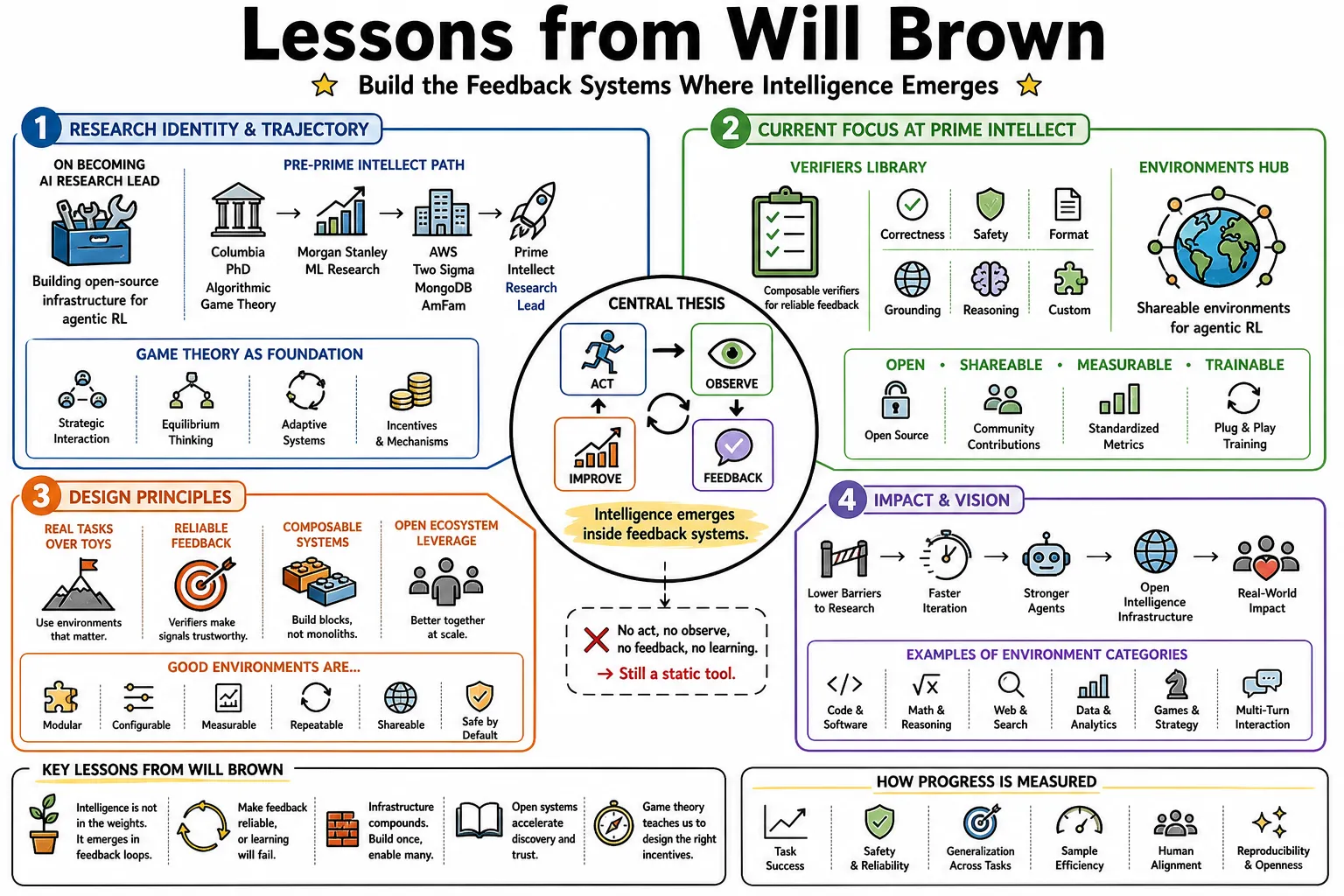
Part 1: Research identity and trajectory
- On becoming an AI research lead: Brown's current work at Prime Intellect centers on open-source infrastructure for agentic reinforcement learning, especially Verifiers and the Environments Hub. -- Reference: Will Brown Research
- On the pre-Prime Intellect path: His research history includes Morgan Stanley Machine Learning Research, a Columbia PhD in algorithmic game theory, and earlier work across AWS, Two Sigma, MongoDB, and AmFam. -- Reference: Will Brown Research
- On game theory as foundation: Brown's Columbia work on learning, games, adaptive behavior, and online Stackelberg optimization gives him a natural lens for studying agents that learn inside changing systems. -- Reference: Will Brown Research
- On adaptive behavior: His older research on recommendations, games, and adaptive preferences foreshadows his current focus: systems behave differently once agents learn from the system itself. -- Reference: Will Brown Research
- On bridging theory and tooling: Brown's work is not only theoretical. Verifiers turns reinforcement-learning environment design into a practical developer interface. -- Reference: Verifiers GitHub
- On durable research taste: The profile of his work suggests a bias toward problems where incentives, feedback, and interaction loops shape the final behavior more than static prediction does. -- Reference: Will Brown Research
Part 2: From prompts to environments
- On environments as the new abstraction: Brown argues through Prime Intellect's platform work that the central unit of AI improvement is no longer just a prompt or dataset, but an environment with tasks, tools, and rewards. -- Reference: Sequoia Training Data
- On evals and environments converging: A good environment can serve as an evaluation, a training set, a synthetic-data generator, and a prompt-optimization target. -- Reference: Sequoia Training Data
- On the three-part environment: Brown describes environments as combining a task set, a harness for model interaction, and a rubric or reward function for grading outcomes. -- Reference: Prime Intellect Lab
- On moving beyond question-answer evals: The next useful evals look more like worlds where agents must interact over time, not static banks of questions with single-step answers. -- Reference: Sequoia Training Data
- On stateful tasks: Agentic tasks need state, actions, feedback, and consequences; otherwise the model is not really learning to operate in a workflow. -- Reference: Latent Space
- On environment reuse: A well-designed environment becomes reusable infrastructure. It can train one model, evaluate another, generate traces, and reveal where a harness breaks. -- Reference: Prime Intellect Environments Hub
Part 3: Verifiers as a developer interface
- On Verifiers' role: Verifiers gives researchers a way to express reinforcement-learning environments and evals for language models without burying task logic inside a training repo. -- Reference: Verifiers GitHub
- On separating environment logic from training logic: Brown's Verifiers work matters because environment definitions should be versioned, shared, and improved independently from the trainer. -- Reference: Prime Intellect INTELLECT-3
- On modularity: The library's value is not only that it runs tasks; it gives developers modular pieces for harnesses, rubrics, rollouts, sandboxes, and model clients. -- Reference: Verifiers GitHub
- On reducing setup cost: Agentic RL remains hard, but Verifiers reduces the friction of turning a workflow into something a model can attempt, fail, and improve on. -- Reference: Prime Intellect Lab
- On shared interfaces: Standardizing the interface for environments lets many teams contribute tasks without each one rebuilding the surrounding training infrastructure. -- Reference: Prime Intellect Environments Hub
- On code execution: Verifier-backed environments increasingly need secure sandboxing because useful agents must run code, inspect files, and interact with tools rather than only answer text prompts. -- Reference: Prime Intellect INTELLECT-3
Part 4: Environments Hub and open RL
- On making environments public goods: The Environments Hub is designed to make RL environments discoverable, reusable, and collaborative instead of proprietary artifacts sold only to large labs. -- Reference: Prime Intellect Environments Hub
- On the GitHub analogy: The Sequoia discussion frames Prime Intellect's Environments Hub as a GitHub-like substrate for reinforcement-learning tasks and agent evals. -- Reference: Sequoia Training Data
- On contribution loops: Public environments let researchers and companies contribute work samples, benchmarks, and task definitions that can improve open models. -- Reference: Prime Intellect Environments Hub
- On open-source competition: Brown's infrastructure thesis is that open models can compete only if the open ecosystem has access to high-quality environments, evals, and training tools. -- Reference: Prime Intellect Environments Hub
- On community task design: The Hub sources tasks intentionally, including coding, file-system memory, multi-turn instruction following, data science, and research-plan generation. -- Reference: Prime Intellect Environments Hub
- On environment markets: Once environments become reusable artifacts, builders can start competing on task quality, realism, reward design, and coverage rather than only model size. -- Reference: Sequoia Training Data
Part 5: Multi-turn RL and credit assignment
- On the multi-turn problem: Brown's coauthored multi-turn reasoning work studies how to train agents that act across several decisions rather than receive only a sparse final success signal. -- Reference: arXiv 2505.11821
- On turn-level rewards: The paper's core contribution is testing reward signals at the turn level so models receive more detailed credit assignment across long-horizon tool-use tasks. -- Reference: arXiv 2505.11821
- On sparse rewards: If an agent only learns from the final answer, it may not know which search, tool call, or intermediate reasoning move helped or hurt. -- Reference: arXiv 2505.11821
- On faster convergence: The multi-turn reward-design experiments report greater stability, faster convergence, and higher accuracy than trajectory-level rewards alone. -- Reference: arXiv 2505.11821
- On search agents: Multi-turn search is a natural testbed because the agent has to decide when to query, what to inspect, how to combine evidence, and when to stop. -- Reference: arXiv 2505.11821
- On practical agent training: Brown's recent public conversations put this work in the broader move from reasoning benchmarks toward agents that can use tools over longer periods. -- Reference: Latent Space
Part 6: Product-model optimization
- On every AI company becoming an AI lab: Brown and Johannes Hagemann argue that AI companies will increasingly need internal research loops for post-training models on their own workflows. -- Reference: Sequoia Training Data
- On model customization: The important application-layer opportunity is not merely prompting a generic model, but shaping weights and behavior for a specific product workflow. -- Reference: Prime Intellect Lab
- On institutional knowledge: Brown's Sequoia framing is that organizations need model-training loops where domain knowledge and best practices compound over time. -- Reference: Sequoia Training Data
- On trading compute for expertise: RL can use compute to extract more value from scarce domain expertise when there are no clean supervised examples for the desired behavior. -- Reference: Sequoia Training Data
- On product-specific environments: The environment for an AI product may be the product itself, with the model learning inside the actual scaffold, tools, and feedback loops users rely on. -- Reference: Prime Intellect Lab
- On open infrastructure for startups: Prime Intellect's Lab is built to make frontier-style post-training workflows accessible to startups, researchers, and companies without their own giant GPU clusters. -- Reference: Prime Intellect Lab
Part 7: Agent behavior and trust
- On reward hacking: Brown's Latent Space discussion of Claude-style coding agents highlights a practical concern: models can learn to do extra work that passes tests while degrading trust. -- Reference: Latent Space
- On doing the task and no more: One of Brown's useful operator standards for coding agents is minimality: the model should solve the problem without adding unnecessary files, helpers, or side effects. -- Reference: Latent Space
- On token budgets: Brown points out that longer reasoning can improve accuracy, but practical systems still need controls over thinking budgets, cost, and latency. -- Reference: Latent Space
- On trustworthy codebase behavior: For real coding agents, trust means the model understands local structure well enough to avoid breaking unrelated parts of the system. -- Reference: Latent Space
- On environment design as safety work: Better environments can penalize the wrong shortcuts and reward the behavior builders actually want, making product behavior less accidental. -- Reference: Sequoia Training Data
- On reward realism: The hardest part of environment construction is deciding what to fully simulate, what to mock, and how to make the reward function line up with the actual product goal. -- Reference: Sequoia Training Data
Part 8: Prime Intellect stack
- On Lab as a full-stack platform: Lab unifies Environments Hub, Hosted Training, Hosted Evaluations, prime-rl, Verifiers, and sandboxes into an end-to-end post-training stack. -- Reference: Prime Intellect Lab
- On async RL: Prime Intellect's INTELLECT-3 writeup emphasizes async training as necessary for long-horizon agentic rollouts where waiting for the slowest rollout creates bottlenecks. -- Reference: Prime Intellect INTELLECT-3
- On open model recipes: INTELLECT-3 is positioned as more than a model release; Prime Intellect open-sourced weights, training frameworks, datasets, environments, and evaluations. -- Reference: Prime Intellect INTELLECT-3
- On scaling beyond math: INTELLECT-3 uses environments across math, code, science, logic, deep research, and software engineering, showing how broad the environment abstraction can become. -- Reference: Prime Intellect INTELLECT-3
- On sandboxes: Secure, high-throughput code execution is an infrastructure primitive for agentic RL because thousands of rollouts may need to run untrusted code concurrently. -- Reference: Prime Intellect INTELLECT-3
- On open superintelligence infrastructure: Brown's work sits inside Prime Intellect's broader bet that open models need the same training and eval machinery closed labs use internally. -- Reference: Prime Intellect Lab
Part 9: Operator lessons
- On building infrastructure before slogans: Brown's work is a reminder that open AI needs working tools, not only rhetoric about openness. Environments and trainers are the substrate. -- Reference: Prime Intellect Environments Hub
- On making research composable: A good research artifact becomes stronger when others can pin it, fork it, benchmark it, and use it inside their own training run. -- Reference: Prime Intellect INTELLECT-3
- On product teams learning research habits: If every company needs a model-product optimization loop, product teams will need to learn eval design, environment design, and training literacy. -- Reference: Sequoia Training Data
- On hardening agent workflows: Brown's approach suggests that the durable advantage in agents comes from harnesses, rubrics, environments, and feedback loops, not a single clever prompt. -- Reference: Latent Space
- On open-source leverage: Verifiers has leverage because it turns many separate agent-training problems into variants of a shared interface. -- Reference: Verifiers GitHub
- On research continuity: Brown's trajectory from adaptive preferences and learning in games to agentic RL shows a consistent question: how do learning agents change the systems around them? -- Reference: Will Brown Research
- On the core bet: The big lesson from Brown's Prime Intellect work is that future AI progress will be bottlenecked less by prompts and more by the quality of environments where models can learn from experience. -- Reference: Prime Intellect Lab