Pim de Witte built Medal into a massive gaming-clips platform, then used that vantage point to start General Intuition, an AI lab focused on world models, agents, and spatial-temporal reasoning. His pattern is unusually consistent: start with the behavior loop, find the data exhaust that actually explains action, and build from the interface where people already reveal intent. This profile covers his thinking on gaming, world models, proprietary datasets, frontier AI, European compute, startup velocity, and the difference between language intelligence and embodied intelligence.
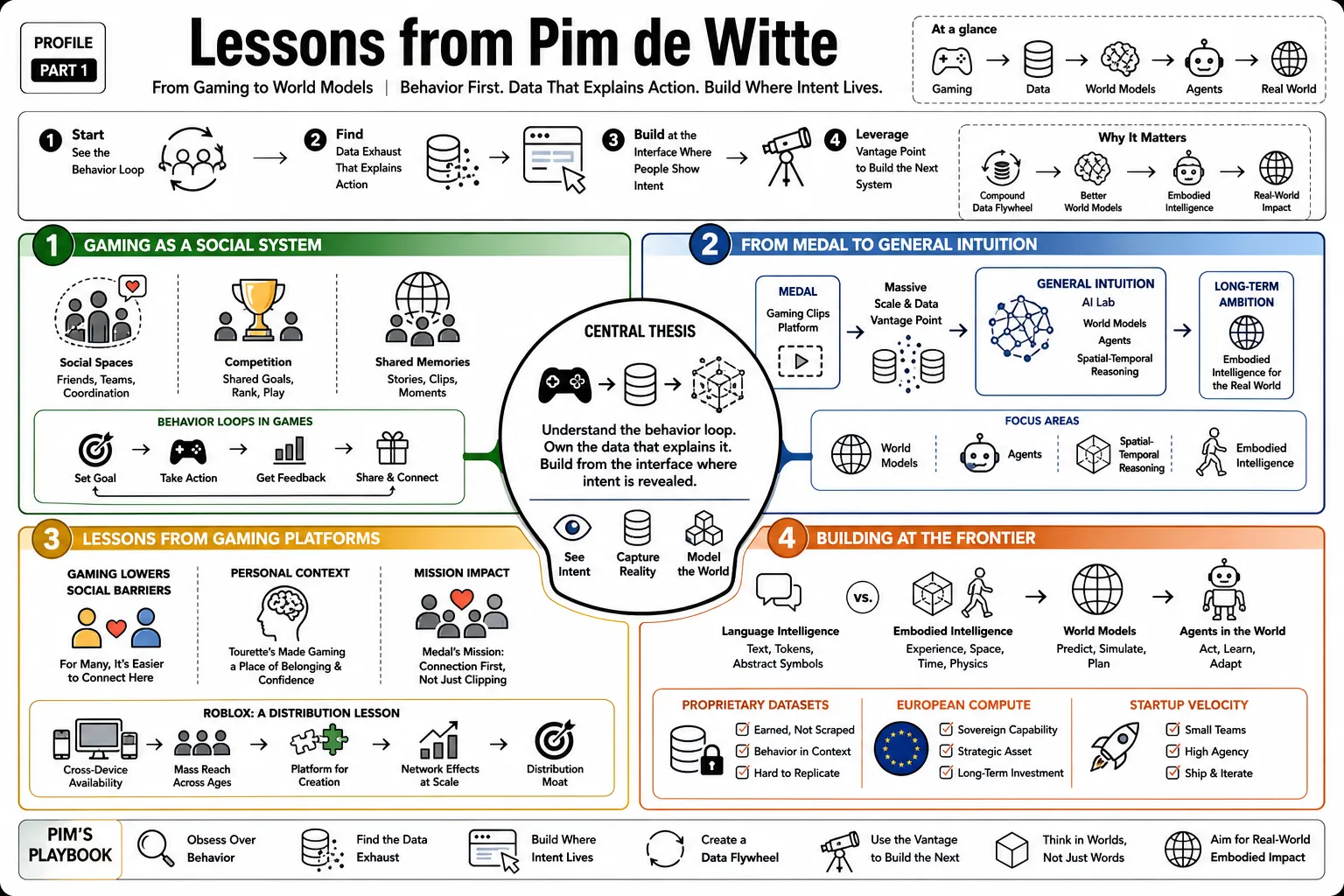
Part 1: Gaming as a Social System
- On Games as Social Space: De Witte treats games less as entertainment software and more as social environments where people make friends, coordinate, compete, and create shared memories across distance. — Reference: The Peel
- On Gaming Reducing Social Barriers: His own experience with Tourette's made gaming feel like a place where the usual social friction disappeared, which helped shape Medal's mission around connection rather than just clipping. — Reference: The Peel
- On Roblox as a Distribution Lesson: He points to Roblox as an example of a platform whose cross-device availability accelerates the invite loop because more invited friends can actually join. — Reference: The Peel
- On Fast-Moving Game Attention: He sees Roblox-style experiences as closer to short-form media than traditional games, with rapid experimentation, low friction creation, and fast shifts in user attention. — Reference: The Peel
- On Content Loops in Games: De Witte argues that user-created game content can become its own acquisition engine when players share experiences that bring others back into the platform. — Reference: The Peel
- On Medal's Core Job: Medal was built around the idea that gamers do not just need recording tools; they need a way to preserve and share the social moments that happen inside games. — Reference: The Peel
Part 2: Founder Formation
- On Learning Through Reverse Engineering: Running a large RuneScape private server as a teenager taught him to learn by taking systems apart, understanding how they worked, and rebuilding them under real user pressure. — Reference: The Peel
- On Early Revenue as Feedback: His teenage server business created real revenue early, which made software feel like a practical operating environment rather than an abstract technical exercise. — Reference: Next Frontier AI
- On Humanitarian Systems Work: His work around Doctors Without Borders and MapSwipe shows a recurring interest in systems where digital coordination has physical-world consequences. — Reference: Next Frontier AI
- On Building From Obsession: He looks for people who are deeply attached to a hard technical problem and willing to chase it through details rather than only selling a broad vision. — Reference: Next Frontier AI
- On Details Proving Vision: For frontier research, he wants teams to connect milestones, people, and technical choices back to the larger ambition, because vision without execution detail is not enough. — Reference: Next Frontier AI
- On Peace of Mind for Research: He argues that deep technical work improves when teams are not constantly distracted by compute bills, fundraising pressure, or contract milestones. — Reference: Next Frontier AI
Part 3: Medal as a Data Moat
- On Gameplay as Action Data: General Intuition's thesis depends on the fact that Medal clips contain not just video but action labels, showing what players did and when they did it. — Reference: TechCrunch
- On Why Action Labels Matter: De Witte argues that video alone is incomplete for physical intelligence because the model must know which actions caused the observed state changes. — Reference: TechCrunch
- On Gameplay as Episodic Memory: Latent Space frames Medal's clip library as episodic memory for simulation, giving General Intuition a record of high-signal human gameplay episodes. — Reference: Latent Space
- On Privacy-Preserving Data Advantage: Medal's controller and action telemetry gives General Intuition useful labels without relying only on invasive real-world observation or expensive robotics data collection. — Reference: Latent Space
- On Not Selling the Dataset Too Early: The decision to keep Medal's data advantage independent rather than simply selling it to a major lab reflects his view that proprietary action data can support a full frontier company. — Reference: TechCrunch
- On Dataset Valuation: He treats data-rich founders as needing a strategic view of their datasets, because the highest-value path may be building the model company, not licensing raw data. — Reference: Latent Space
Part 4: World Models
- On World Models as Interactive Systems: De Witte distinguishes world models from static video generation: the important system responds to actions and predicts how an environment changes. — Reference: Not Boring
- On Spatial-Temporal Intelligence: General Intuition is organized around the belief that the next frontier after language models is intelligence that understands space, time, motion, and causality. — Reference: Slush
- On Language as Incomplete: He sees language as too lossy to describe many real-world dynamics, especially fast physical interactions where action, timing, and feedback matter. — Reference: Not Boring
- On Code as Too Rigid: Traditional simulations require designers to specify too many rules in advance, while learned world models can absorb messy interaction patterns from data. — Reference: Not Boring
- On The Gym, Not The Product: TechCrunch reports that General Intuition's world model acts as the internal training environment, while the intended product is the agentic model trained inside it. — Reference: TechCrunch
- On The Self Versus The Environment: He argues that action-labeled gameplay helps a model distinguish what the agent controls from what the environment does in response. — Reference: TechCrunch
- On Generalization Through Games: General Intuition's bet is that gameplay can train models that transfer from games to simulation and eventually to embodied systems. — Reference: Latent Space
- On Vision-Based Agents: The company is building agents that can see frames and output actions in real time, rather than relying on carefully hand-coded game state. — Reference: Latent Space
Part 5: Embodiment and Robotics
- On The Shift From Bits To Atoms: De Witte expects the next wave of AI value to move from text and code into physical-world systems like robotics, drones, and simulation. — Reference: The Netherlands in the Century of AI
- On Gameplay as a Robotics Shortcut: TechCrunch's office visit showed General Intuition using a model trained through gameplay concepts to control both a game agent and a quadrupedal robot. — Reference: TechCrunch
- On Small Real-World Fine-Tuning: The robot demo suggests his thesis is not that games replace physical data entirely, but that game-trained priors can reduce the amount of real-world data needed. — Reference: TechCrunch
- On Partial Observability: Latent Space highlights his focus on messy perception problems such as smoke, occlusion, camera shake, and incomplete information rather than clean toy environments. — Reference: Latent Space
- On Controller Interfaces: He sees game controllers, wheels, and other familiar input devices as compressed action spaces that can help bridge human intent and machine behavior. — Reference: Not Boring
- On Humanoid Skepticism: He does not assume robots should copy human bodies; the optimal physical form should follow the task, cost structure, and control interface. — Reference: Not Boring
Part 6: AI Strategy and Sovereignty
- On Europe Needing Frontier Infrastructure: De Witte argues that European AI talent needs compute, energy, institutions, and funding if it wants to originate frontier work rather than only consume it. — Reference: Next Frontier AI
- On Sovereign Compute: He describes European compute infrastructure as a central bottleneck and suggests that supporting a CoreWeave-like layer could become a strategic project. — Reference: Next Frontier AI
- On Avoiding The Pretraining Trap: In his Netherlands AI essay, he argues that smaller countries should not waste resources trying to train frontier language models from scratch where they lack an edge. — Reference: The Netherlands in the Century of AI
- On Building What Creates Control: His national AI strategy is to invest in interfaces, models, hardware, data generation, and domain strengths that preserve agency rather than symbolic independence. — Reference: The Netherlands in the Century of AI
- On Frontier Data Leading Frontier Capability: He argues that countries and companies should take proprietary data seriously because capability tends to emerge where the strongest data already exists. — Reference: The Netherlands in the Century of AI
- On Measuring Intelligence Trade: He proposes evaluating national AI autonomy by asking whether a country imports or exports intelligence across interfaces, models, and hardware. — Reference: The Netherlands in the Century of AI
- On The Interface Layer: He sees the company that owns the interface as strategically powerful because it decides which model receives user demand and context. — Reference: The Netherlands in the Century of AI
Part 7: Research Responsibility
- On Evaluation Responsibility: De Witte argues that foundation model builders have to take evaluation, interpretability, and failure analysis seriously because downstream uses will exceed what they can predict. — Reference: Next Frontier AI
- On Partner Choice: He treats partner selection as an ethical design decision because model capabilities propagate through the ecosystem of people and companies that build on top. — Reference: Next Frontier AI
- On Openness With Boundaries: He supports openness in frontier research while recognizing that some details should remain private for security or safety reasons. — Reference: Next Frontier AI
- On Avoiding Lethal Autonomy: TechCrunch reports that General Intuition draws a line against using its technology for agents that harm humans. — Reference: TechCrunch
- On Frontier Ambition Without Recklessness: His stance is not to slow down research by default, but to make sure powerful model classes are paired with serious testing and deployment choices. — Reference: Next Frontier AI
Part 8: Startup Operating Lessons
- On Rapid Iteration: The Medal story emphasizes iteration speed: consumer startups need to learn from usage loops quickly rather than defending the original plan. — Reference: The Peel
- On Customer Focus Over Competitor Focus: De Witte treats competitor obsession as a distraction from the harder job of watching what customers are actually doing. — Reference: The Peel
- On Social Inflection Points: He sees consumer platforms as needing moments where social behavior compounds, because tools alone rarely become durable networks. — Reference: The Peel
- On Multiplayer Liquidity: His gaming analysis shows that multiplayer systems can collapse when enough friends cannot join, which makes accessibility and cross-platform loops strategic. — Reference: The Peel
- On Acquisition Speed: The Peel notes that Medal acquired several startups, and De Witte's operating lesson is that startup deals need speed and clarity or they lose their purpose. — Reference: The Peel
- On Hybrid Work Design: Medal's approach to in-person and remote work reflects his view that operating design should serve the speed and context needs of the company, not a generic workplace ideology. — Reference: The Peel
Part 9: The General Intuition Bet
- On Large-Scale Backing: General Intuition's large funding rounds signal that investors view the Medal-derived action dataset as a possible foundation for a new model category. — Reference: TechCrunch
- On Compute as The Next Constraint: TechCrunch reports that much of General Intuition's capital is directed toward scaling compute, showing that data advantage still has to be matched by training infrastructure. — Reference: TechCrunch
- On APIs For Agents: Latent Space describes General Intuition's near-term business model around APIs, game developer partnerships, and agents that can replace brittle scripted behavior. — Reference: Latent Space
- On World Models As Complementary: De Witte does not frame world models as simply replacing LLMs; he frames them as a complementary model class for action, simulation, and physical-world behavior. — Reference: Latent Space
- On The 2030 Thesis: His long-term bet is that spatial-temporal foundation models will power a large share of future interactions between agents and the physical or simulated world. — Reference: Latent Space