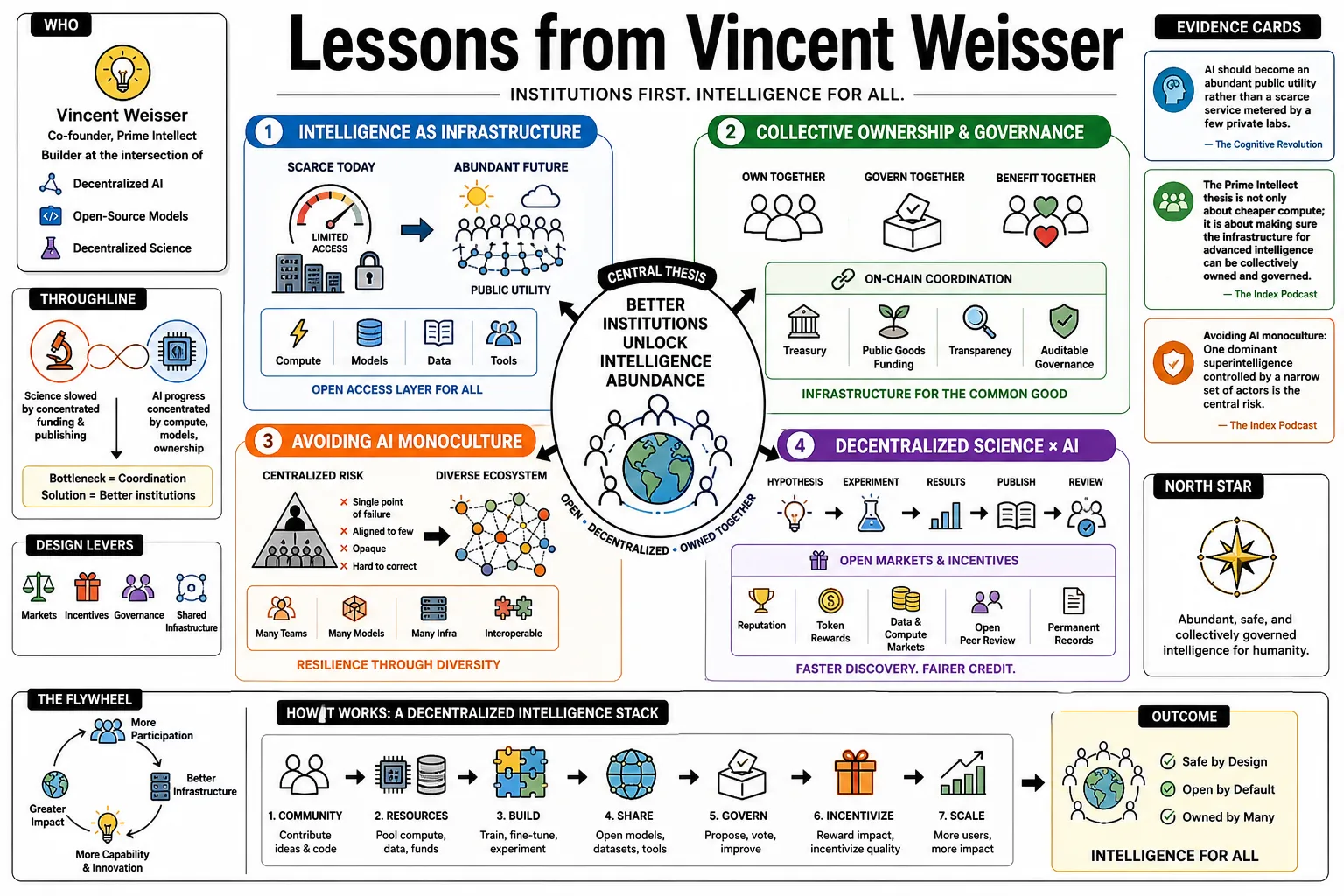
Vincent Weisser is the co-founder of Prime Intellect and a builder at the intersection of decentralized AI, open-source model development, and decentralized science. His work connects two arguments that are often treated separately: scientific progress is slowed by concentrated funding and publishing systems, and AI progress is being concentrated by access to compute, models, and ownership. The throughline is institutional design. If the bottleneck is coordination, then the solution is not just better software. It is better markets, incentives, governance, and shared infrastructure.
Part 1: The Prime Intellect thesis
- On intelligence as infrastructure: Weisser frames Prime Intellect around the idea that AI should become an abundant public utility rather than a scarce service metered by a few private labs. — Reference: The Cognitive Revolution
- On collective ownership: The Prime Intellect thesis is not only about cheaper compute; it is about making sure the infrastructure for advanced intelligence can be collectively owned and governed. — Reference: The Index Podcast
- On avoiding AI monoculture: His strongest safety argument is that one dominant superintelligence controlled by a narrow institution is more dangerous than a plural ecosystem of powerful systems. — Reference: The Generalist
- On decentralization as distribution of power: Open AI is not just a research preference for Weisser; it is a way to prevent model capability, economic upside, and governance authority from concentrating in one place. — Reference: Johns Hopkins Hub
- On making the impossible concrete: Prime Intellect tries to turn a big political thesis into a technical sequence: create a compute market, build distributed training software, train credible open models, then coordinate ownership. — Reference: The Cognitive Revolution
- On positive AI politics: Weisser avoids a purely defensive AI-safety posture. His preferred frame is an affirmative one: abundance, open participation, and broader access to the tools of intelligence. — Reference: The Generalist
Part 2: Compute markets and infrastructure
- On compute as the first bottleneck: Prime Intellect starts with GPUs because compute is the visible constraint that determines who can train, test, and deploy frontier-adjacent models. — Reference: The Index Podcast
- On marketplace strategy: A decentralized compute market lets Prime Intellect aggregate resources without needing to own every machine, data center, or customer relationship itself. — Reference: The Cognitive Revolution
- On idle compute: The core supply-side bet is that unused or underused GPUs can become economically productive when coordinated through a market with trustworthy allocation and payment. — Reference: The Index Podcast
- On price discovery: Distributed compute only matters if buyers can compare cost, reliability, geography, and performance. The market layer has to make scarce hardware legible. — Reference: The Cognitive Revolution
- On competing with hyperscalers: The goal is not to copy the cloud model with smaller branding. It is to build a different coordination layer that can route work across a broader supply base. — Reference: Wired
- On compute sovereignty: Decentralized AI infrastructure is also a geopolitical argument: more countries, labs, and communities should be able to participate without waiting for hyperscaler allocation. — Reference: Johns Hopkins Hub
Part 3: Distributed training as proof
- On distributed training as credibility: INTELLECT-1 matters because it turns decentralized training from a slogan into a working demonstration that a globally distributed network can train a large model. — Reference: The Cognitive Revolution
- On the software layer: The compute market is not enough by itself. Prime Intellect also needs training frameworks that can tolerate latency, heterogeneous hardware, and unreliable global coordination. — Reference: The Cognitive Revolution
- On communication overhead: Distributed training is fundamentally a coordination problem: machines need to learn together without spending all their time synchronizing. — Reference: The Cognitive Revolution
- On milestone selection: A 10B-parameter model is useful as a proof point because it is large enough to be meaningful but small enough to expose bottlenecks without requiring frontier-lab budgets. — Reference: The Cognitive Revolution
- On building in public: Open distributed-training milestones create external trust because other researchers can inspect the model, replicate pieces, and evaluate whether the technical path is real. — Reference: The Index Podcast
- On infrastructure sequencing: Weisser's path is deliberately layered: first make compute accessible, then make training distributed, then make ownership and governance programmable. — Reference: The Cognitive Revolution
Part 4: Open models and agentic systems
- On open weights: Weisser treats open weights as a necessary condition for a competitive AI ecosystem because closed models make audit, adaptation, and independent governance harder. — Reference: The Index Podcast
- On post-training as frontier: As base models become more widely available, he expects important capability gains to move into post-training, reinforcement learning, environments, and evaluation loops. — Reference: The Cognitive Revolution
- On agent environments: Agentic AI requires reproducible tasks and environments where models can practice, fail, receive feedback, and improve under measurable conditions. — Reference: The Cognitive Revolution
- On public evaluation: Open verifiers and shared evaluation systems matter because communities need common ways to tell whether models are improving or merely gaming benchmarks. — Reference: The Cognitive Revolution
- On independent builders: Open RL and training infrastructure lets smaller teams experiment with agents instead of waiting for closed-lab APIs to define the frontier. — Reference: The Index Podcast
- On science models: Weisser connects open AI to biosafety and biology by pointing to scientific models as one of the highest-impact uses of shared compute and training infrastructure. — Reference: The Cognitive Revolution
Part 5: Decentralized science
- On science as a coordination problem: Weisser's DeSci work starts from the view that scientific progress is slowed by funding bottlenecks, publishing friction, closed data, and weak ownership structures. — Reference: Vincent Weisser on DeSci
- On funding beyond panels: Decentralized science tries to route capital around narrow grant committees by letting communities fund research they consider neglected or important. — Reference: Vincent Weisser on DeSci
- On publishing incentives: His critique of science includes the economics of publishing: researchers create and review knowledge while gatekeepers capture too much of the distribution layer. — Reference: Vincent Weisser on DeSci
- On reproducibility: DeSci is partly a response to weak reproducibility. Open data, transparent methods, and persistent storage can make scientific claims easier to inspect and reuse. — Reference: Vincent Weisser on DeSci
- On token incentives: Quadratic funding, DAOs, smart contracts, and tokenized incentives are interesting to Weisser when they solve real coordination failures rather than add crypto theater. — Reference: Vincent Weisser on DeSci
- On patient-led research: DeSci gives patient communities a way to fund, govern, and benefit from research that conventional institutions may underfund. — Reference: Forbes
- On virtual biotech: The decentralized biotech model replaces some centralized institution-building with networks of contributors, service providers, CROs, and shared ownership structures. — Reference: Vincent Weisser on DeSci
Part 6: IP, data, and liquidity
- On IP-NFTs: Weisser helped develop the idea that early-stage scientific intellectual property can be represented as a programmable asset, making it easier to fund and transfer. — Reference: Forbes
- On research assets: The point of tokenizing research assets is not speculation by default; it is to make claims, data, rights, and future upside easier to coordinate. — Reference: Vincent Weisser on DeSci
- On data liquidity: Healthcare and scientific data are valuable but hard to access, combine, or transact around. DeSci tries to make that value more usable without collapsing ownership. — Reference: Forbes
- On ownership terms: Transparent ownership structures can help scientists, patients, funders, and builders understand who controls what before downstream value appears. — Reference: Vincent Weisser on DeSci
- On unconventional research: Weisser's DeSci background is a bet that important research often starts outside consensus institutions, so funding infrastructure needs more variance. — Reference: The Generalist
- On longevity as a proving ground: Longevity research became an early DeSci focus because it has patient demand, scientific uncertainty, long timelines, and funding gaps that conventional channels underserve. — Reference: Vincent Weisser on Longevity
Part 7: AI for science and life sciences
- On AI and biology: Weisser sees AI-enabled biology as a domain where open infrastructure can compound: better models, better data access, and better coordination can reinforce each other. — Reference: Vincent Weisser on AI and Life Sciences
- On scientific acceleration: The AI-for-science opportunity is not merely faster literature review; it is the possibility of compressing experimental cycles and expanding who can contribute. — Reference: Vincent Weisser on AI and Life Sciences
- On biotech as an information problem: His writing connects biotech progress to information flows: data, protocols, feedback, and model-guided hypotheses need to move faster across institutions. — Reference: Vincent Weisser on Biotech
- On neurotechnology: Weisser's interest in neurotech fits the same pattern as his AI and DeSci work: difficult frontier domains need better coordination, capital, and experimentation infrastructure. — Reference: Vincent Weisser on Neurotech
- On cryonics and frontier bets: His attention to cryonics signals a willingness to examine ideas that sit outside mainstream consensus but could matter if assumptions about biology and time horizons change. — Reference: Vincent Weisser on Cryonics
- On neglected scientific infrastructure: Across DeSci and AI, he keeps returning to infrastructure that makes more experiments possible rather than a single bet on one lab or one discovery. — Reference: Founder Debug
Part 8: Governance, safety, and pluralism
- On alignment as power: Weisser's concern is not only that AI may be misaligned with humanity; it is that it may be aligned perfectly with a narrow group that should not control it. — Reference: The Generalist
- On pluralism as safety: Multiple powerful systems, institutions, and communities can create checks and balances that a single centrally controlled superintelligence cannot provide. — Reference: The Generalist
- On governance before capability: Ownership and governance must be built before the largest capabilities arrive, because institutional defaults harden once the economic rewards become enormous. — Reference: Johns Hopkins Hub
- On decentralization limits: His argument does not assume decentralization magically solves every problem. It assumes centralized control creates predictable failure modes that need countervailing structures. — Reference: The Cognitive Revolution
- On open science as safety: Open infrastructure can make capabilities more inspectable, contestable, and improvable, which is part of the safety case rather than a separate political preference. — Reference: The Index Podcast
- On community experiments: Zuzalu and adjacent experiments matter because they test whether communities can coordinate around long-term science, health, governance, and technology questions outside standard institutions. — Reference: The Generalist
Part 9: Founder and operator lessons
- On moving from thesis to stack: Weisser's operator lesson is to translate a philosophical view into infrastructure layers, each of which can be validated independently. — Reference: The Cognitive Revolution
- On using hard demos: A working distributed-training milestone is more persuasive than a manifesto because it forces the market to update on technical feasibility. — Reference: The Index Podcast
- On category bridges: His path from DeSci to Prime Intellect shows how the same coordination lens can move across domains: first science funding, then compute, then intelligence. — Reference: Founder Debug
- On taste as strategy: Weisser's public thinking treats aesthetics, community, and institution design as strategic variables, not soft decoration around the real technical work. — Reference: The Generalist
- On Europe and frontier technology: He sees cultural and institutional differentiation as part of Europe's possible role in an AI-driven world, not only a race to mimic Silicon Valley infrastructure. — Reference: The Generalist
- On building for abundance: The recurring lesson is to build systems that make scarce frontier inputs more abundant: capital for science, compute for AI, ownership for communities, and intelligence for everyone. — Reference: The Cognitive Revolution