American University law professor Hilary Allen studies the intersection of new technology and financial regulation. She coined "driverless finance" to describe how automated algorithms and cryptoassets threaten traditional banking stability. This profile examines her case for preemptive regulation before Silicon Valley's financial experiments trigger the next economic crisis.
Allen's argument is less about predicting which technology will fail than about changing when regulators act. Her Driverless Finance scholarship focuses on how machine-learning systems can increase speed, complexity, and correlation across markets. Those qualities can make a shock harder to understand and contain after it begins. She therefore argues that policymakers should engage while financial algorithms are still developing, instead of waiting until firms and infrastructure are too entrenched to change. Her broader critique of fintech applies the same logic to cryptoassets, digital wallets, and other products that can migrate risk into familiar financial institutions while being marketed as fundamentally new.
That perspective comes from studying the regulatory failures surrounding the 2008 crisis. Allen emphasizes that safeguards often look unnecessary precisely because they are working: once memories of a panic fade, rules designed to prevent another one are recast as obstacles to innovation. Her precautionary approach asks regulators to evaluate a product's economic purpose, the capacity of institutions using it, and its possible systemic effects before widespread adoption. The goal is not to eliminate experimentation. It is to avoid discovering, during a crisis, that private experimentation created losses the public must absorb.
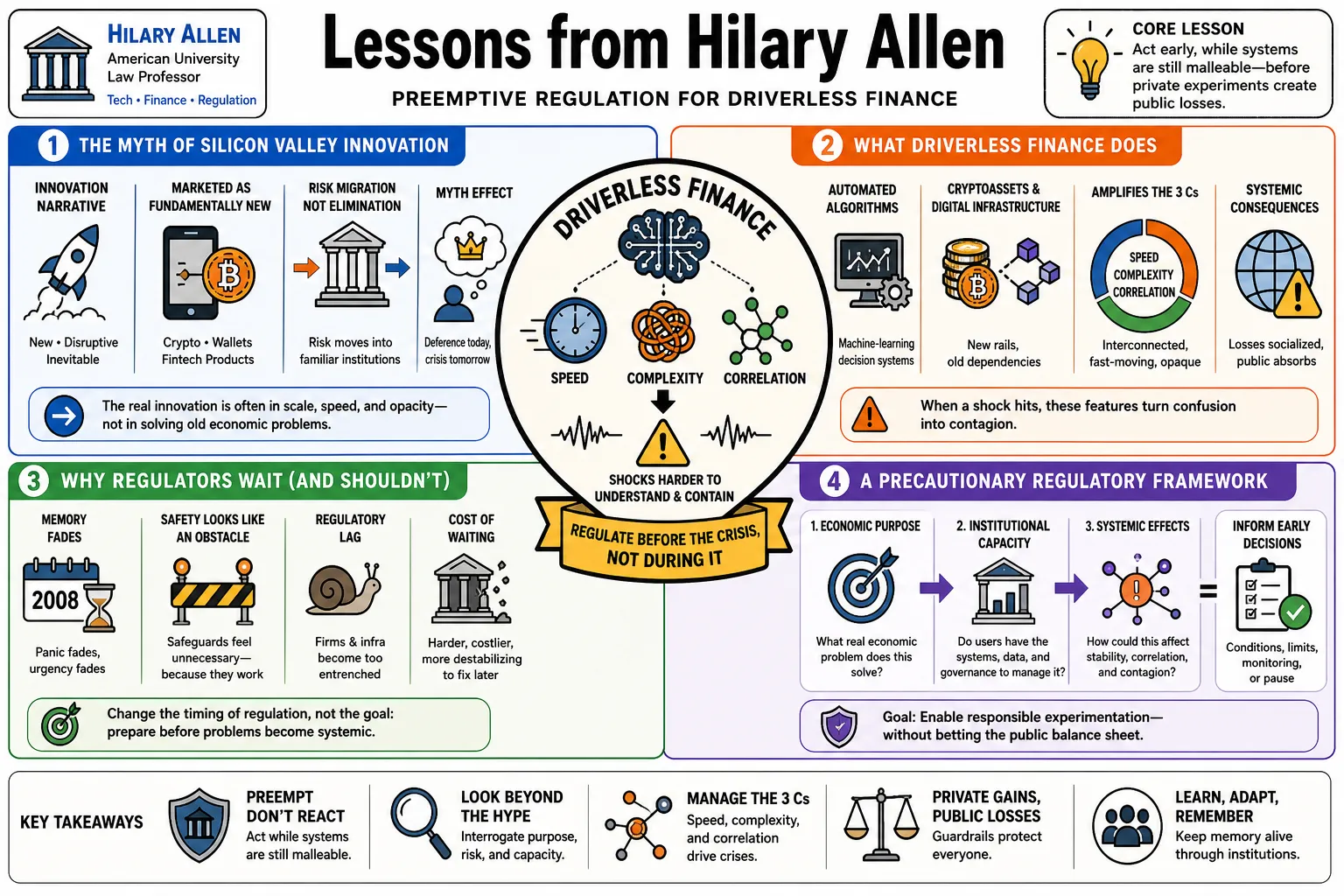
Part 1: The Myth of Silicon Valley Innovation
- On Silicon Valley's true advantage: Much of the competitive edge enjoyed by technology firms stems from manipulating legal frameworks to their benefit rather than delivering actual technological superiority. — Reference: Fintech Dystopia - About
- On the gap between hype and reality: Most financial technology products fail to deliver on their grand promises, often worsening an already problematic financial system instead of improving it. — Reference: Fintech Dystopia - About
- On innovation rhetoric: The technology industry frequently uses the concept of "innovation" as a shield to deflect scrutiny and avoid necessary regulatory oversight. — Reference: Masters in Business
- On expanding tech influence: As Silicon Valley increases its footprint in financial services, its capacity to negatively impact various aspects of daily life grows alongside its power. — Reference: Fintech Dystopia - About
- On communicating fintech risks: There is a strong public hunger to understand the flaws of fintech, which requires accessible explanations that cut through the industry's promotional hype. — Reference: Fintech Dystopia - About
Part 2: The Dangers of "Driverless Finance"
- On automated fragility: The integration of sophisticated financial algorithms, particularly those capable of machine learning, exponentially increases the speed, complexity, and correlation of the financial system, ultimately making it more fragile. — Reference: "Driverless Finance" by Hilary J. Allen
- On the limits of algorithmic foresight: A future financial crisis could easily be triggered by a major bank utilizing unchecked algorithms that automatically assimilate unstable cryptoasset data into mainstream trading programs. — Reference: Could Fintech Crash the Economy?
- On mobile payment risks: Digital wallet services could become a source of systemic instability if consumers continue treating them as bank accounts and storing large, uninsured balances that are susceptible to bank runs based on negative press. — Reference: Could Fintech Crash the Economy?
- On regulatory timing: Policymakers must involve themselves in the development of financial algorithms immediately, while the technology is still young and malleable enough to be influenced by regulation. — Reference: "Driverless Finance" by Hilary J. Allen
- On overriding post-crisis reforms: The unchecked automation of finance threatens to undermine the very regulatory structures implemented to stabilize the economy after the 2008 crash. — Reference: "Driverless Finance" by Hilary J. Allen
Part 3: Regulatory Arbitrage and Crypto Risks
- On exploiting definitions: Cryptocurrency advocates attempt to use broad legislative definitions of digital assets to bypass long-standing restrictions on permissible banking activities. — Reference: American Banker
- On the blockchain loophole: "Anyone who doesn't want to comply with banking activities restrictions can simply whack it on a blockchain." — Source: American Banker
- On legislative threats to banking laws: "It essentially eviscerates the banking laws by saying, basically, if you put anything on the blockchain, it inherently becomes a permissible bank activity" — Source: American Banker
- On the source of future instability: The rapid, unregulated growth of the cryptoasset market possesses the potential to serve as a key catalyst for a broader financial crisis if integrated into the traditional banking system. — Reference: Could Fintech Crash the Economy?
Part 4: Lessons from the 2008 Financial Crisis
- On the value of holistic investigations: Investigating the 2008 crash revealed that systemic changes rarely stem from a single failure, requiring a broad perspective to understand how various complex factors interact. — Reference: Masters in Business
- On the danger of deregulation: Prior to the 2008 crisis, complex derivatives were largely left unregulated because authorities accepted the narrative that sophisticated parties were involved and market evolution should not be hampered. — Reference: Masters in Business
- On institutional amnesia: Once a regulation successfully resolves a crisis, the public and policymakers quickly forget why the rule was established, leading them to view the protection merely as an expensive hindrance. — Reference: Masters in Business
- On the erosion of investor protections: The foundational securities laws that have encouraged trust in the US stock market since the 1930s are currently being peeled back, threatening the integrity of the market. — Reference: Masters in Business
- On the necessity of regulation during panics: In the depths of the 2008 financial crisis, very few observers were complaining that the system was suffering from too much regulation. — Reference: Masters in Business
- On crisis response: The Federal Reserve and other government agencies demonstrated immense creativity and effort to stabilize the economy during the 2007-2009 collapse. — Reference: Could Fintech Crash the Economy?
Part 5: Precautionary Regulation and the Future
- On the justification for intervention: A precautionary regulatory approach to sophisticated financial tools is necessary because the potential social costs of a full-scale financial collapse are simply too enormous to risk. — Reference: "Driverless Finance" by Hilary J. Allen
- On rejecting crisis inevitability: Financial crises should not be accepted as organic, unavoidable components of the business cycle that society must merely endure. — Reference: Could Fintech Crash the Economy?
- On preemptive action: The primary goal of financial stability regulation is to intervene before a crisis can unfold, ensuring institutions remain robust enough to function through unexpected economic shocks. — Reference: Could Fintech Crash the Economy?
- On vetting new products: Financial innovations should face a licensing approval process before entering the market, evaluating their economic purpose, institutional capacity, and systemic effects. — Reference: Could Fintech Crash the Economy?
- On empowering regulatory hubs: The Office of Financial Research should be expanded to act as a centralized hub of scientific and technological expertise capable of identifying and mitigating emerging systemic threats. — Reference: Could Fintech Crash the Economy?