Ilya Sutskever is one of the most influential minds in modern artificial intelligence. As a co-founder and former Chief Scientist of OpenAI, his deep, unwavering belief in the power of neural networks and scaling has been a driving force behind the AI revolution. Renowned for his technical brilliance and profound, almost spiritual, focus on the future of intelligence, his public statements offer a rare glimpse into the thinking that propelled breakthroughs like AlexNet, AlphaGo, and the GPT series. After his departure from OpenAI, he co-founded Safe Superintelligence Inc. (SSI), cementing his commitment to what he sees as the most important problem of our time.
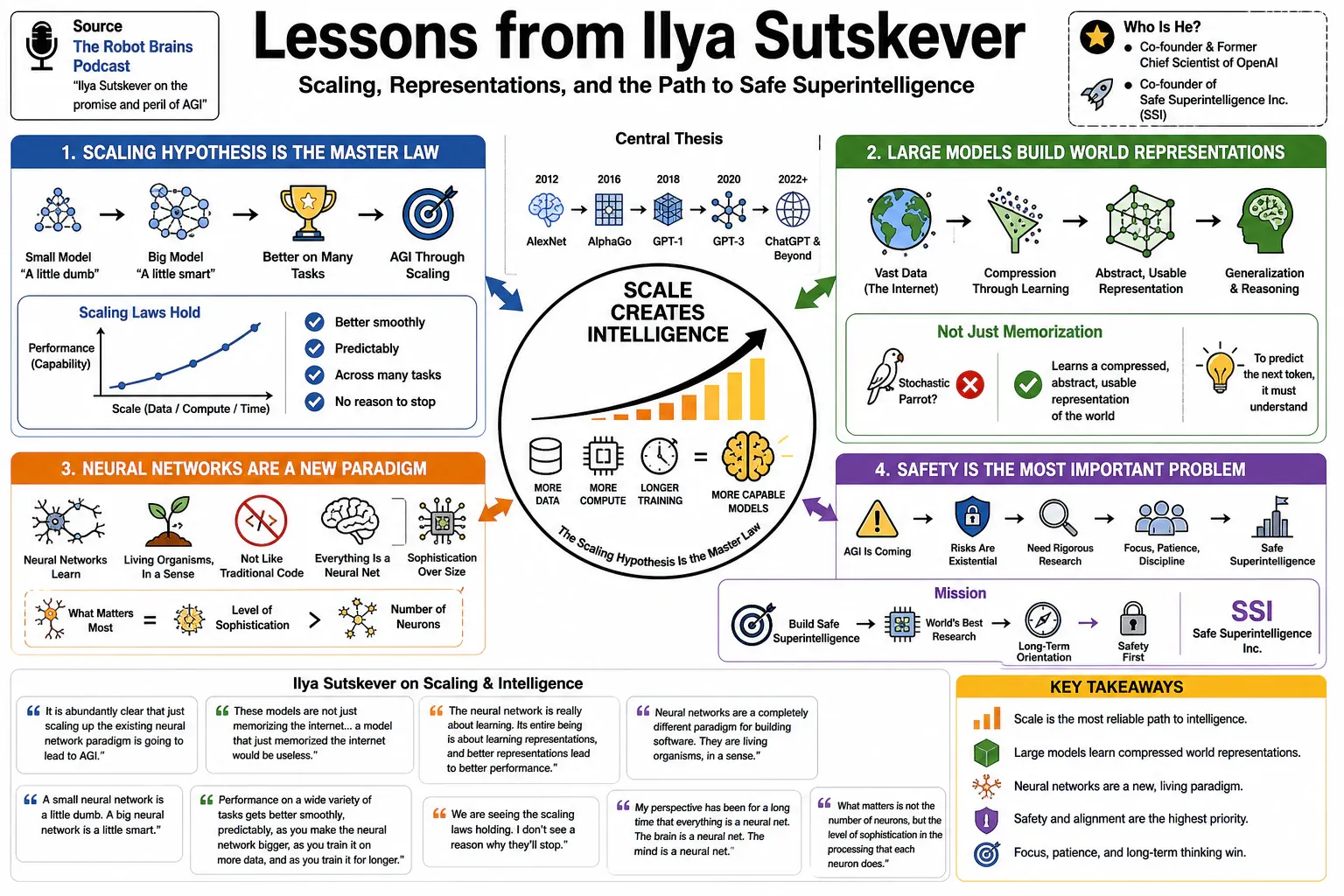
On the Power of Neural Networks and Scaling
Direct Quotes:
- On betting on scale: Sutskever told Jensen Huang that "I had a very strong belief that bigger is better," and that one OpenAI goal was "to figure out how to use the scale correctly." — NVIDIA GTC fireside chat with Jensen Huang (March 2023).
- On prediction and understanding: He argued that "the better a neural network can predict the next word in text, the more it understands it." — NVIDIA GTC fireside chat with Jensen Huang (March 2023).
- On why he chose learning: Starting in 2002–2003, he reasoned that "making progress in learning, in artificial learning and machine learning that would lead to the greatest progress in AI," because computers could not learn at all then. — NVIDIA GTC fireside chat with Jensen Huang (March 2023).
- On programming computers from data: He said neural networks appealed because "we are automatically programming parallel computers": if you could figure out how learning in neural networks works, "you can program small parallel computers from data." — NVIDIA GTC fireside chat with Jensen Huang (March 2023).
- On deep and large networks: Sutskever's argument before AlexNet: "If your neural network is deep and large, then it could be configured to solve a hard task." Most of the field, he said, was looking at Bayesian models and kernel methods that "can't represent a good solution no matter how you configure them." — NVIDIA GTC fireside chat with Jensen Huang (March 2023).
- On how small early networks were: He recalled that "the importance of scale wasn't realized back then": a network with "several hundred neurons" was big and "a million parameters would be considered very large." — NVIDIA GTC fireside chat with Jensen Huang (March 2023).
- On the end of the age of scaling: Asked in 2025 whether 100 times more scale would transform everything, Sutskever said "I don't think that's true. So it's back to the age of research again, just with big computers," after calling 2020 to 2025 the age of scaling. — Dwarkesh Podcast: We're moving from the age of scaling to the age of research (November 2025).
- On what brains imply for networks: Sutskever told MIT Technology Review: "In particular, if the human brain can do something, then a big artificial neural network could do something similar too." — MIT Technology Review: Inside the mind of OpenAI's chief scientist (October 2023).
- On which parts of the brain matter: On borrowing from the brain, he said "the folds probably don't matter. Why do we think that the neurons matter? Because there are many of them." — Dwarkesh Podcast: We're moving from the age of scaling to the age of research (November 2025).
Key Learnings:
- On what to use scale for: Sutskever said OpenAI believed in scale from the very beginning, and that the real issue was what to apply it to: "The question is what to use it for precisely." — NVIDIA GTC fireside chat with Jensen Huang (March 2023).
- On text as a projection of the world: Sutskever rejected the view that models only learn statistical correlations: "This text is actually a projection of the world," and the network "learns a compressed, abstract, usable representation of that." — NVIDIA GTC fireside chat with Jensen Huang (March 2023).
- On scaling as a low-risk recipe: He said "Scaling is just one word, but it's such a powerful word because it informs people what to do," and that companies liked it because it gives "a very low-risk way of investing your resources," unlike open-ended research. — Dwarkesh Podcast: We're moving from the age of scaling to the age of research (November 2025).
- On compression: Describing OpenAI's early idea of unsupervised learning, he said "If you compress the data really well, you must extract all the hidden secrets which exist in it." — NVIDIA GTC fireside chat with Jensen Huang (March 2023).
- On not betting against deep learning: Recalling OpenAI's early uncertainty, he said "one doesn't bet against deep learning. Somehow, every time you run into an obstacle, within six months or a year researchers find a way around it." — MIT Technology Review: Inside the mind of OpenAI's chief scientist (October 2023).
On AGI (Artificial General Intelligence)
Direct Quotes:
- On a before and an after: Sutskever described the coming technology as "monumental, earth-shattering. There will be a before and an after." — MIT Technology Review: Inside the mind of OpenAI's chief scientist (October 2023).
- On defining AGI: He called AGI "a useful threshold, a point of reference" and defined it as "the point at which AI is so smart that if a person can do some task, then AI can do it too." — MIT Technology Review: Inside the mind of OpenAI's chief scientist (October 2023).
- On first using ChatGPT: He said of first trying ChatGPT: "I think it's almost a spiritual experience. You go, 'Oh my God, this computer seems to understand.'" — MIT Technology Review: Inside the mind of OpenAI's chief scientist (October 2023).
- On AGI being built: He predicted "At some point we really will have AGI. Maybe OpenAI will build it. Maybe some other company will build it." — MIT Technology Review: Inside the mind of OpenAI's chief scientist (October 2023).
- On a timeline: Asked in 2025 for a forecast for a system that can learn as well as a human and then become superhuman, Sutskever said "I think like 5 to 20," confirming that he meant years. — Dwarkesh Podcast: We're moving from the age of scaling to the age of research (November 2025).
- On AI doing everything humans can: In his Toronto speech he said AI is still deficient, but "slowly but surely, or maybe not so slowly, AI will keep getting better, and the day will come when AI will do all of the things that we can do, not just some of them, but all of them." — Convocation address (YouTube video, June 2025).
- On AI doing AI research: He said the collective will want to use AI to "Do more work, grow the economy, do R&D, do AI research. So then the rate of progress will become really extremely fast for some time, at least." — Convocation address (YouTube video, June 2025).
- On how hard it is to feel the AGI: He said "in practice, it's very hard to feel the AGI," so a lot of the issues around AGI "stem from the fact that it's very difficult to imagine," and that when something is hard to imagine, "You've got to be showing the thing." — Dwarkesh Podcast: We're moving from the age of scaling to the age of research (November 2025).
- On brains as computers: Sutskever argued: "The brain is a biological computer. So why can't the digital computer, a digital brain, do the same things?" — Convocation address (YouTube video, June 2025).
Key Learnings:
- On how ChatGPT changed the field: He said "AGI stopped being a dirty word in the field of machine learning" after ChatGPT, adding that "ChatGPT has allowed machine-learning researchers to dream." — MIT Technology Review: Inside the mind of OpenAI's chief scientist (October 2023).
- On rapid economic growth: On whether broad deployment of a fast-learning AI would speed things up, he said "I think that it is likely that we will have rapid economic growth," though how rapid is "hard to know" because "the world is just really big." — Dwarkesh Podcast: We're moving from the age of scaling to the age of research (November 2025).
- On whether networks might be conscious: Asked whether a language model might be conscious while it is running, he said: "I don't know for sure, but it's a possibility that's very hard to argue against." — MIT Technology Review: Inside the mind of OpenAI's chief scientist (October 2023).
- On how different future AI will be: He said "Future AI is going to be different. It's going to be powerful," and that today's systems are hard to reason about because they do not yet exist. — Dwarkesh Podcast: We're moving from the age of scaling to the age of research (November 2025).
On AI Safety and the Future
Direct Quotes:
- On superintelligence going rogue: On his shift to superalignment, Sutskever said "It's obviously important that any superintelligence anyone builds does not go rogue. Obviously." — MIT Technology Review: Inside the mind of OpenAI's chief scientist (October 2023).
- On SSI's single goal: SSI's announcement says the lab has "one goal and one product: a safe superintelligence." — Safe Superintelligence Inc. announcement page.
- On pairing safety with capabilities: The announcement says SSI approaches "safety and capabilities in tandem" and plans "to advance capabilities as fast as possible while making sure our safety always remains ahead." — Safe Superintelligence Inc. announcement page.
- On superalignment: Of superalignment he said "It's an unsolved problem," one he thinks too few core machine-learning researchers are working on. — MIT Technology Review: Inside the mind of OpenAI's chief scientist (October 2023).
- On a very powerful system: He said that if a system is "sufficiently powerful" and single-mindedly pursues even a sensible goal such as caring for sentient life, "we might not like the results." — Dwarkesh Podcast: We're moving from the age of scaling to the age of research (November 2025).
- On the problem of power: Sutskever said of AGI: "The whole problem is the power," and that when the power is really big, it is hard to imagine what will happen. — Dwarkesh Podcast: We're moving from the age of scaling to the age of research (November 2025).
- On the stakes: He told graduates that "the challenge that AI poses, in some sense, is the greatest challenge of humanity ever. And overcoming it will also bring the greatest reward." — Convocation address (YouTube video, June 2025).
- On how SSI will make money: Asked how SSI will make money, he said "Right now, we just focus on the research, and then the answer to that question will reveal itself." — Dwarkesh Podcast: We're moving from the age of scaling to the age of research (November 2025).
Key Learnings:
- On the most important technical problem: SSI's announcement states: "Building safe superintelligence (SSI) is the most important technical problem of our time." — Safe Superintelligence Inc. announcement page.
- On fragile values: Sutskever said "your ability to learn human values is fragile. Then your ability to optimize them is fragile," and asked whether these are "all instances of unreliable generalization." — Dwarkesh Podcast: We're moving from the age of scaling to the age of research (November 2025).
- On insulation from commercial pressure: The announcement says SSI's "business model means safety, security, and progress are all insulated from short-term commercial pressures." — Safe Superintelligence Inc. announcement page.
- On convergence among labs: He predicted that as AI becomes more powerful, companies will converge on a strategy: "you need to find some way to talk to each other and you want your first actual real superintelligent AI to be aligned and somehow care for sentient life." — Dwarkesh Podcast: We're moving from the age of scaling to the age of research (November 2025).
On Career, Focus, and Discovery
Direct Quotes:
- On the mountain to climb: Of the idea of a network that does everything, he said: "I didn't always believe that they could. But it was the mountain to climb." — MIT Technology Review: Inside the mind of OpenAI's chief scientist (October 2023).
- On luck in finding a mentor: He called it "one of my life's great strokes of luck" that Geoff Hinton was at his university. — Convocation address (YouTube video, June 2025).
- On hindsight: Looking back at the early years, he said "it wasn't obvious that this was the right question, back then. But in hindsight that turned out to be the right question." — NVIDIA GTC fireside chat with Jensen Huang (March 2023).
- On more companies than ideas: Sutskever said scaling shifted attention so that "we are in a world where there are more companies than ideas by quite a bit." — Dwarkesh Podcast: We're moving from the age of scaling to the age of research (November 2025).
- On top-down belief: He said "The top-down belief is the thing that sustains you when the experiments contradict you," because without it you cannot tell whether to keep debugging. — Dwarkesh Podcast: We're moving from the age of scaling to the age of research (November 2025).
- On research taste: Asked about research taste, he said "One thing that guides me personally is an aesthetic of how AI should be, by thinking about how people are, but thinking correctly." — Dwarkesh Podcast: We're moving from the age of scaling to the age of research (November 2025).
- On early generative models: Recalling Hinton's tiny character-level models, he said "It was the beginning of generative AI right there. It was really cool—it just wasn't very good." — MIT Technology Review: Inside the mind of OpenAI's chief scientist (October 2023).
- On backing an unfashionable field: He recalled that most of the field "wasn't even looking at neural networks at all," preferring elegant Bayesian and kernel methods, while he argued deep and large networks could represent a good solution. — NVIDIA GTC fireside chat with Jensen Huang (March 2023).
- On beauty and simplicity: He said he looks for "almost beauty, beauty and simplicity. Ugliness, there's no room for ugliness." — Dwarkesh Podcast: We're moving from the age of scaling to the age of research (November 2025).
- On accepting reality: His one piece of advice to graduates was "to accept reality as it is and to try not to regret the past and try to improve the situation." — Convocation address (YouTube video, June 2025).