James Dale Davidson is a renowned American investor, author, and co-founder of the National Taxpayers Union, best known for his prescient books on "megapolitics" and economic cycles. Through works like The Sovereign Individual and Blood in the Streets, he has offered provocative insights into the decline of the nation-state, the rise of the cybereconomy, and strategies for achieving true financial autonomy. The following collection distills his core philosophies on power, investing, and the unstoppable shift toward a decentralized future.
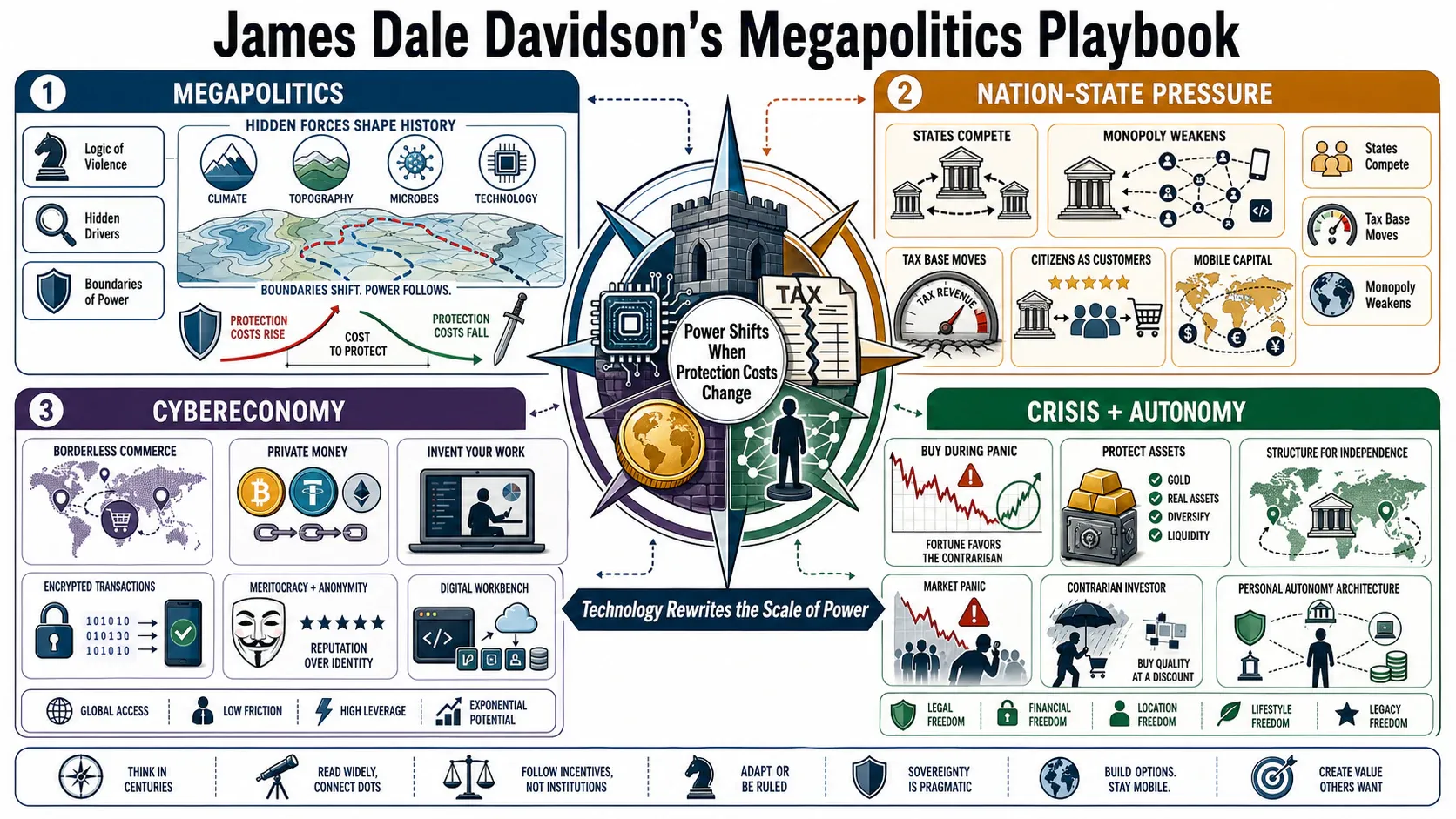
Part 1: The Logic of Violence and Megapolitics
- On Megapolitics: "The most important causes of change are not to be found in political manifestos or in the pronouncements of dead economists, but in the hidden factors that alter the boundaries where power is exercised." — Source: [Goodreads]
- On Hidden Drivers of Change: "Often, subtle changes in climate, topography, microbes, and technology alter the logic of violence." — Source: [Goodreads]
- On Predicting the Future: "Violence is the ultimate boundary force on behavior; thus, if you can understand how the logic of violence will change, you can usefully predict where people will be dropping or picking up the equivalent of one-hundred-dollar bills in the future." — Source: [QuoteFancy]
- On Institutional Decay: "The more apparent it is that a system is nearing an end, the more reluctant people will be to adhere to its laws." — Source: [QuoteFancy]
- On the Boundaries of Power: "They transform the way people organize their livelihoods and defend themselves." — Source: [Goodreads]
- On Technological Drivers: "History is fundamentally shaped by shifts in how violence can be projected and how protection can be afforded." — Source: [Wikipedia]
- On Protection Costs: "When the cost of protection falls, the scale of enterprise rises. When the cost of protection rises, the scale of enterprise falls." — Source: [Goodreads]
- On Forced Reconfiguration: "Market forces, not political majorities, will compel societies to reconfigure themselves in ways that public opinion will neither comprehend nor welcome." — Source: [Goodreads]
- On Systemic Transitions: "The shift from one economic stage to another inevitably involves a change in the megapolitical balance." — Source: [Bookey]
- On Structural Shifts: "Understanding history requires looking past ideology and focusing on the raw mechanics of coercion and defense." — Source: [QuoteFancy]
Part 2: The Decline of the Nation-State
- On the State's Obsolescence: "Faster than all but a few now imagine, microprocessing will subvert and destroy the nation-state, creating new forms of social organization in the process." — Source: [Goodreads]
- On Government as a Racket: "Governments will ultimately have little choice but to treat populations in territories they serve more like customers, and less in the way that organized criminals treat the victims of a shakedown racket." — Source: [Goodreads]
- On Obsolete Concepts: "Citizenship is obsolete." — Source: [Bookey]
- On Predatory Institutions: "The nation-state is a predatory institution that is becoming obsolete in the Information Age." — Source: [Goodreads]
- On Plundering the Productive: "Politics is the art of using the state to plunder the productive." — Source: [Goodreads]
- On Value for Money: "When technology is mobile, and transactions occur in cyberspace, as they increasingly will do, governments will no longer be able to charge more for their services than they are worth to the people who pay for them." — Source: [Goodreads]
- On Ideological Control: "The ideology of the nation-state was that life can and should be regulated in a positive way by subsidizing undesirable outcomes and penalizing desirable ones." — Source: [Goodreads]
- On the Loss of Monopoly: "Nation-states are losing their monopoly on violence and their ability to command arbitrary wealth." — Source: [Bookey]
- On Extortionate Practices: "The rise and fall of union extortion of the capitalists can be readily explained by the changing megapolitics of the production process." — Source: [Goodreads]
- On Inevitable Competition: "Governments will be forced to compete for citizens just as businesses compete for customers." — Source: [Wikipedia]
Part 3: Taxation and Government Overreach
- On Taxpayers as Livestock: "The state has grown used to treating its taxpayers as a farmer treats his cows, keeping them in a field to be milked. Soon, the cows will have wings." — Source: [Ryan A. Ferguson]
- On Subsidizing Failure: "When you subsidize poverty and failure, you get more of both." — Source: [AZQuotes]
- On the True Motive of Politicians: "The politicians don't just want your money. They want your soul. They want you to be worn down by taxes until you are dependent and helpless." — Source: [AZQuotes]
- On the Modern Bureaucrat: "The Don Quixote of the twenty-first century will not be a knight-errant struggling to revive the glories of feudalism but a bureaucrat in a brown suit, a tax collector yearning for a citizen to audit." — Source: [QuoteFancy]
- On the Deficit Danger: "Simply tolerating deficits at ever higher levels is not a viable alternative to tax increases... we cannot be indifferent to the grave dangers posed by the over-reliance on deficits to finance the government." — Source: [National Taxpayers Union]
- On the True Cost of Debt: "Even the most ardent supply-sider should recognize that some level of debt must be worse than even taxes." — Source: [National Taxpayers Union]
- On Liberalism: "A liberal is someone who feels a great debt to his fellow man, which debt he proposes to pay off with your money." — Source: [Douglas Bruce]
- On Representation: "Organizations must exist to represent the unrepresented interests of ordinary taxpayers who bear the brunt of political spending." — Source: [National Taxpayers Union]
- On Fiscal Collapse: "The procedures through which fiscal choices are made are broken, making structural constraints like balanced budget amendments essential." — Source: [National Taxpayers Union]
- On Privatization: "Not only is the government singularly unsuited to running a railroad, but privatization of [entities] the government has no business in... is a very sensible way to reduce the budget deficit." — Source: [National Taxpayers Union]
Part 4: The Information Age and Cyberspace
- On Color-Blind Anonymity: "In the Information Society, no one who is truly able will be detained by the ill-formed opinions of others. It will not matter what most of the people on earth might think of your race, your looks, your age, your sexual proclivities, or the way you wear your hair." — Source: [The Cite Site]
- On True Meritocracy: "In the cybereconomy, they will never see you. The ugly, the fat, the old, the disabled will vie with the young and beautiful on equal terms in utterly color-blind anonymity on the new frontiers of cyberspace." — Source: [The Cite Site]
- On Upward Mobility: "The Information Age will be the age of upward mobility." — Source: [QuoteFancy]
- On the Digital Economy: "The cybereconomy, rather than China, could well be the greatest economic phenomenon of the next thirty years." — Source: [Goodreads]
- On the Metaverse: "As the bandwidth revolution unfolds, it will draw people more and more into the borderless virtual world of online communities and cybercommerce... a world with enough graphic density to become the 'metaverse'." — Source: [The Cite Site]
- On Private Money: "The advent of the Information Age implies a revolution in the nature of money... cybermoney will be issued by private enterprise, not by governments." — Source: [Wikipedia]
- On Inventing Work: "The Information Revolution will liberate individuals as never before. For the first time, those who can educate and motivate themselves will be almost entirely free to invent their own work and realize the full benefits of their own productivity." — Source: [Ryan A. Ferguson]
- On Digital Frontiers: "The transition to the Information Age will fundamentally reorder the way wealth is created and protected globally." — Source: [Goodreads]
- On Virtual Value: "Wealth creation is shifting irrevocably from physical extraction to digital innovation and encrypted transaction." — Source: [Scribd]
Part 5: Investing When Blood is in the Streets
- On Crisis Investing: "The greatest profits can always be had by buying when prices are most depressed by pessimism." — Source: [Quote Investigator]
- On Buying During Panic: "If the streets were not running with blood, you couldn't buy [assets] at present prices." — Source: [Quote Investigator]
- On Extreme Pessimism: "The best investment opportunities are born from the ashes of widespread despair and systemic failure." — Source: [Wikipedia]
- On Market Crashes: "Market crashes and political upheavals are signals for contrarian investors to accumulate undervalued assets." — Source: [Wikipedia]
- On Mispriced Risk: "Financial panics cause the public to misprice risk, leaving significant upside for those willing to act rationally amid chaos." — Source: [QuoteFancy]
- On Asset Protection: "Place 5 percent to 10 percent of your total assets in gold bullion and selected gold and silver coins." — Source: [AZQuotes]
- On Government Confiscation: "The authorities in the United States confiscated private gold holdings in the Depression of the 1930's. They may seek to do so again in the Depression of the 1990's." — Source: [AZQuotes]
- On Geopolitical Triggers: "Natural disasters, wars, and sudden regime changes are megapolitical events that reshape investment landscapes overnight." — Source: [Quote Investigator]
- On Contrarian Strategy: "To achieve exceptional returns, one must have the emotional fortitude to buy precisely when the crowd is selling in terror." — Source: [Wikipedia]
Part 6: Economic Collapse and The Great Reckoning
- On Western Civilization's Model: "I think the entire business model of Western Civilization is kaput." — Source: [YouTube]
- On Illusory Growth: "We've been trying to disguise the absence of growth by printing money... 43% of the government's budget is printed money." — Source: [YouTube]
- On the Savings Deficit: "America today has insufficient savings to finance both crucial investment and its consumption of imports." — Source: [AZQuotes]
- On Housing and Debt: "A lot of [homeowners] will hand the key to the lender and walk away. There will be a lot of empty houses with 'For Sale' signs." — Source: [Blogspot]
- On Inflation vs Deflation: "No one knows with certainty whether the coming depression will be inflationary or deflationary." — Source: [AZQuotes]
- On the Plague of Debt: "The accumulation of unpayable public and private debt will inevitably trigger a massive global reckoning." — Source: [Apple Books]
- On Fake Economies: "Much of modern economic progress is an illusion sustained by fiat currency and central banking interventions." — Source: [Newsmax]
- On Systemic Vulnerability: "Deep economic depressions will be accompanied by severe civil unrest and the breakdown of local infrastructure." — Source: [Blogspot]
- On Overleveraged Nations: "Countries burdened by massive welfare obligations and unserviceable debts face an inevitable financial collapse." — Source: [Goodreads]
Part 7: The Sovereign Individual and Autonomy
- On the Age of the Individual: "The Information Age will be the age of the individual. It will be the age of the sovereign individual." — Source: [Wikipedia]
- On True Independence: "In the future, one of the milestones by which you measure your financial success will be not just how many zeroes you can add to your net worth, but whether you can structure your affairs in a way that enables you to realize full individual autonomy and independence." — Source: [The Cite Site]
- On Offshore Strategy: "Whatever your current residence or nationality, to optimize your wealth you should primarily reside in a country other than that from which you hold your first passport, while keeping the bulk of your money in yet a third jurisdiction, preferably a tax haven." — Source: [Bookey]
- On Intellectual Capital: "Knowledge, experience, and information are the most crucial assets, and unlike physical property, they cannot be seized by failing states." — Source: [Scribd]
- On the Power of Ideas: "To dare a thought is to risk being wrong." — Source: [Goodreads]
- On Jurisdiction Shopping: "Sovereign individuals will treat citizenship merely as a service contract, opting out of jurisdictions that demand more than they provide." — Source: [Goodreads]
- On Self-Reliance: "The transition requires individuals to decouple their prosperity from the fate of their native geographical boundaries." — Source: [The Cite Site]
- On Transnational Living: "Establishing legal and financial footprints across multiple borders is the ultimate hedge against political instability." — Source: [Barber Financial Advisors]
- On Cognitive Elite: "The new global economy will disproportionately reward those with high cognitive abilities who can leverage decentralized networks." — Source: [Bookey]
Part 8: Societal Shifts and the Future
- On Income Inequality: "Incomes will become more unequal within jurisdictions and more equal between them." — Source: [Goodreads]
- On Educational Choice: "Tax credits and school choice are vital to helping disadvantaged communities escape failing public systems." — Source: [National Taxpayers Union]
- On the New American Dream: "Emerging markets, like Brazil, represent new frontiers for upward mobility that the West has slowly abandoned." — Source: [Wikipedia]
- On Post-Soviet Reality: "The collapse of centralized communist systems offered a preview of the fragmentation that awaits over-bureaucratized Western democracies." — Source: [Blogspot]
- On Decentralization: "Technological empowerment will disperse authority away from centralized capitals toward local communities and digital networks." — Source: [Wikipedia]
- On the Knowledge Economy: "Those who fail to adapt their skills to the digital economy will find themselves trapped in the declining remnants of the industrial state." — Source: [The Cite Site]
- On Reshaping Society: "Major paradigm shifts are rarely welcomed; they are forced upon society by the cold arithmetic of technological efficiency." — Source: [Goodreads]
- On Survivalism: "Protecting one's family and wealth in the modern era requires adopting a survivalist mindset tailored to digital and financial frontiers." — Source: [Apple Books]
- On the Inevitable Future: "We are living through a period of historic transition, moving irreversibly from an age of mass coercion to one of sovereign autonomy." — Source: [Wikipedia]