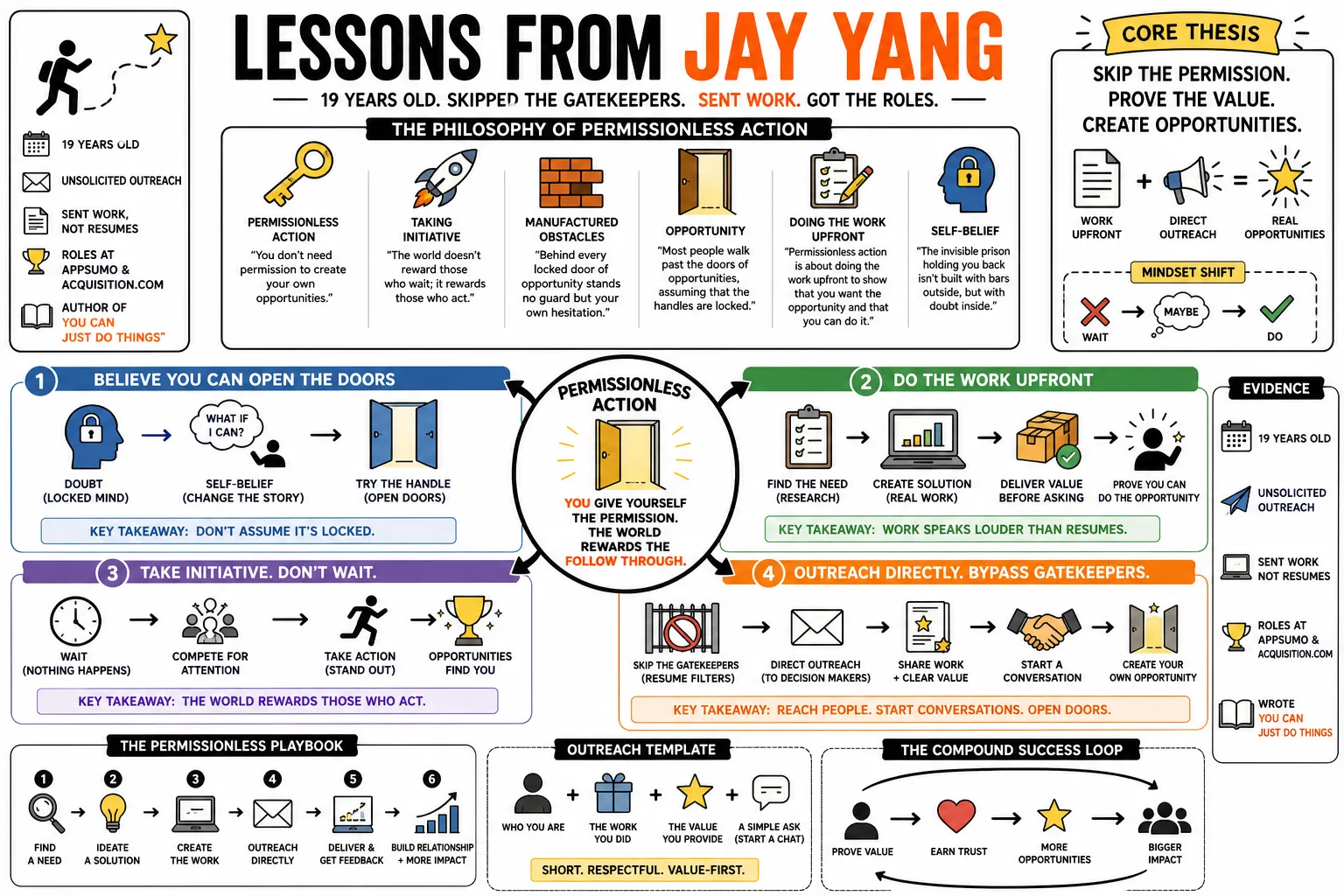
At 19, Jay Yang landed roles at AppSumo and Acquisition.com by sending unsolicited work instead of traditional resumes. His book, You Can Just Do Things, outlines his case for ignoring gatekeepers and proving your value upfront. This profile breaks down his specific tactics for skipping the credential ladder and creating opportunities through direct outreach.
Part 1: The Philosophy of Permissionless Action
- On Permissionless Action: "You don't need permission to create your own opportunities. The only permission you need is the one you give yourself." — Source: [Jay Yang official site]
- On Taking Initiative: "The world doesn't reward those who wait; it rewards those who act." — Source: [You Can Just Do Things official book page]
- On Manufactured Obstacles: "Behind every locked door of opportunity stands no guard but your own hesitation." — Source: [Jay Yang official site]
- On Opportunity: "Most people walk past the doors of opportunities, assuming that the handles are locked. They don't even try the handle." — Source: [Infinite Loops: You Can Just Do Things]
- On Doing the Work Upfront: "Permissionless action is about doing the work upfront to show that other person that you want the opportunity and that you can do the opportunity." — Source: [Infinite Loops: You Can Just Do Things]
- On Self-Belief: "The invisible prison holding you back isn't built with bars but beliefs." — Source: [Jay Yang official site]
- On Removing Gatekeepers: "Stop inventing bosses to subordinate yourself to. You don't need permission from anyone to take your next step." — Source: [You Can Just Do Things official book page]
- On Evidence Over Arguments: "Confidence doesn't come from shouting affirmations in the mirror, but giving yourself an undeniable stack of proof that you are who you say you are." — Source: [You Can Just Do Things official book page]
- On the Permissionless Apprentice: "If you want to have an opportunity, the best way to create it is to show that person that you want the opportunity and that you can do the opportunity." — Source: [Infinite Loops: You Can Just Do Things]
- On Constructed Reality: "Life can be much broader once you discover one simple fact: everything around you that you call life was made up by people that were no smarter than you." — Source: [Jay Yang official site]
Part 2: The TAG Method & Cold Outreach
- On the Burden of Help: "Don't DM someone and ask 'how can I help?' That puts the burden on them. Instead, send them the finished work or a concrete plan." — Source: [Create Your Dream Work: Jay Yang]
- On Targeting Mentors: "Identify who you want to learn from. That's the first step of the TAG method—knowing exactly whose orbit you want to enter." — Source: [MindHack #089: Jay Yang]
- On Auditing Businesses: "Find gaps in their current business or content. Look for the problems they are too busy to fix themselves." — Source: [MindHack #089: Jay Yang]
- On Gifting Solutions: "Send them the solution or the assets ready-to-ship. Make saying 'yes' the easiest decision of their day." — Source: [MindHack #089: Jay Yang]
- On Inexperience: "You don’t have to have any experience or money to get started. All you have to do is put some effort in before you reach out." — Source: [Create Your Dream Work: Jay Yang]
- On Empathy in Outreach: "Empathy is the greatest skill you can have... putting yourself in the other person's shoes and saying, 'What would make it easy for them to say yes?'" — Source: [MindHack #089: Jay Yang]
- On Avoiding the Golden Rule: "A lot of people talk about the Golden Rule—treat others the way you want to be treated. But I think there’s a rule above that: see others the way they want to be treated." — Source: [MindHack #089: Jay Yang]
- On Landing AppSumo: "I didn't ask Noah Kagan for a job. I sent him a 19-page deck analyzing his marketing and handed over the assets to fix it." — Source: [You Can Just Do Things official book page]
- On Standing Out: "Most people send a resume. If you send a finished project that solves a real pain point, you automatically bypass the entire hiring funnel." — Source: [Creator Diaries Q&A with Jay Yang]
- On Asymmetric Upside: "Sending a cold, high-value pitch has zero downside. If they ignore it, you still built your skills. If they respond, it changes your life." — Source: [Jay Yang official site]
Part 3: Value Creation & Pitching
- On the 19-Page Pitch Deck: "The 19-page deck strategy isn't about page count; it's about proving you understand their business better than their current applicants do." — Source: [Noah Kagan: Jay pitch deck]
- On Building a Portfolio: "The work works on you more than you work on it. Even if your pitch gets rejected, the process of creating it leaves you more capable." — Source: [MindHack #089: Jay Yang]
- On Earning the Right to Pitch: "You don't earn the right to pitch by waiting your turn. You earn it by delivering undeniable value upfront." — Source: [You Can Just Do Things official book page]
- On Making It a No-Brainer: "Your pitch shouldn't require them to brainstorm how to use you. It should be a plug-and-play solution to a problem they already know they have." — Source: [Create Your Dream Work: Jay Yang]
- On Identifying Gaps: "The easiest way to provide value to a successful founder is to find the small, annoying tasks they are neglecting and just do them perfectly." — Source: [Creator Diaries Q&A with Jay Yang]
- On Showing vs. Telling: "Don't tell a creator you can edit their videos. Edit three of their videos and send them the Google Drive link." — Source: [Jay Yang official site]
- On High-Signal Outreach: "When you do the work before you are hired, you separate yourself from 99% of people who just want a paycheck." — Source: [Infinite Loops: You Can Just Do Things]
- On Pitching Tyler Denk: "I cold-emailed the CEO of beehiiv with product ideas. I didn't wait for an internship application to open; I just started acting like I worked there." — Source: [You Can Just Do Things official book page]
- On the Power of Specificity: "Generic pitches get generic rejections. Specific pitches that address exact business bottlenecks get meetings." — Source: [Noah Kagan: Jay pitch deck]
Part 4: Content Strategy & "Sawdust Selling"
- On Sawdust Selling: "Sawdust selling is taking the byproducts of your daily work—your notes, your research, your templates—and turning them into content or products." — Source: [Jay Yang official site]
- On Monetizing the Process: "You don't have to be a master to teach. Just document what you are learning and share the sawdust of your building process." — Source: [MindHack #089: Jay Yang]
- On Building in Public: "Sharing your process creates a surface area for luck. It allows people to find you based on the ideas you're actively exploring." — Source: [Creator Diaries Q&A with Jay Yang]
- On Content as a Magnet: "Content isn't just about getting followers; it's a magnet that attracts the right mentors, partners, and opportunities to your doorstep." — Source: [Jay Yang official site]
- On the $100M Money Models Campaign: "The success of Alex Hormozi's campaign wasn't about the launch day alone; it was about the years of goodwill and free value provided beforehand." — Source: [You Can Just Do Things official book page]
- On Million Dollar Weekend: "Promoting a book requires finding the core message that resonates with the audience and repackaging it natively for every platform." — Source: [Infinite Loops: You Can Just Do Things]
- On Media Strategy: "Modern media strategy is less about ads and more about undeniable organic value that people feel compelled to share." — Source: [Jay Yang official site]
- On Newsletter Growth: "A successful newsletter doesn't just curate links; it synthesizes ideas and provides a unique lens on the world." — Source: [Jay Yang official site]
- On Content Quality: "If you wouldn't send it to your smartest friend, don't publish it." — Source: [Jay Yang official site]
Part 5: Navigating Career Paths
- On the Default Script: "Don't accept the standard pace as the pace that you have to go at. A lot of times we grow up thinking you have to follow a specific script." — Source: [Infinite Loops: You Can Just Do Things]
- On Dropping Out: "Leaving college wasn't a rejection of learning; it was a pivot toward an environment where I could learn much faster." — Source: [Creator Diaries Q&A with Jay Yang]
- On the Earning or Learning Rule: "Stay in a role or project only if you are either earning or learning. If both have plateaued, it is time to move on." — Source: [You Can Just Do Things official book page]
- On Ignorance Debt: "Early on in your career, if you can pay down that ignorance debt—invest in yourself, stack skills, and create collisions—the faster you'll be able to earn." — Source: [MindHack #089: Jay Yang]
- On Speed vs. Age: "Your career progression should be determined by your output and your ability to solve problems, not your age." — Source: [Jay Yang official site]
- On Building a Career: "Success isn't about luck, connections, or waiting for the right moment—it's about taking control and creating your own opportunities." — Source: [You Can Just Do Things official book page]
- On Finding Mentors: "The best way to get a mentor is not to ask for one, but to make yourself so useful to someone you admire that they naturally want to guide you." — Source: [Create Your Dream Work: Jay Yang]
- On Bypassing the Ladder: "You don't have to climb the corporate ladder if you can build your own elevator by solving high-leverage problems for the people at the top." — Source: [You Can Just Do Things official book page]
- On the Creator Economy: "The creator economy is the ultimate meritocracy. Nobody cares where you went to school; they only care if you can hold attention and provide value." — Source: [Creator Diaries Q&A with Jay Yang]
Part 6: Mindset, Agency, and Empathy
- On High Agency: "High agency people focus on the outputs. Did I actually get what I wanted out of this? Low agency people think linearly: 'I put this amount of effort in, I should get this amount of stuff out.'" — Source: [Infinite Loops: You Can Just Do Things]
- On Clarity: "Clarity doesn't come before action; clarity comes from action." — Source: [You Can Just Do Things official book page]
- On Empathy as a Tool: "The number one skill you can have as an entrepreneur, marketer, or just human being is empathy." — Source: [MindHack #089: Jay Yang]
- On Fear as a Signal: "Fear is not a stop sign; it is a signal of where your edge is. If a project scares you in an exciting way, it is exactly what you should be doing." — Source: [You Can Just Do Things official book page]
- On Mindful Questioning: "The questions you ask yourself act as guiding lights. If you ask 'Why is this happening to me?', you find excuses. If you ask 'How can I use this?', you find agency." — Source: [Jay Yang official site]
- On Manufacturing Luck: "Hustle luck is created by sheer volume of action and reps. You can't control blind luck, but you can control how many times you roll the dice." — Source: [You Can Just Do Things official book page]
- On Dealing with Rejection: "Rejection is just a data point. It means your pitch wasn't aligned with their current bottleneck. Adjust the pitch and try again." — Source: [You Can Just Do Things official book page]
- On Proving Yourself: "Don't try to convince people with logical arguments. Instead, build a stack of evidence through small wins that make your success undeniable." — Source: [You Can Just Do Things official book page]
- On Taking Responsibility: "Once you realize that no one is coming to save you, you are finally free to save yourself." — Source: [Jay Yang official site]
- On Self-Perception: "We are often the worst judges of our own capabilities because we view our potential through the lens of our past failures." — Source: [Creator Diaries Q&A with Jay Yang]
Part 7: Habits, Speed, and Execution
- On Micro Habits: "Micro habits beat big intentions. Design habits for your hardest days, not your best ones." — Source: [Jay Yang official site]
- On Reading Books: "Avoid shelf-help. Treat books like prescription drugs: identify a specific problem you have right now, find the book that solves it, and apply the lessons immediately." — Source: [You Can Just Do Things official book page]
- On Learning vs. Implementation: "Learning isn’t about memorization. Learning is about behavior change. If you aren’t implementing the books you read or the courses you take, then to me, that’s useless." — Source: [MindHack #089: Jay Yang]
- On Preparation: "Preparation is kind of like Tetris—when you’re well-positioned, any block can fit in, but when you’re poorly positioned, you only need the one right piece to win." — Source: [MindHack #089: Jay Yang]
- On Momentum: "Combat boredom with progress. Momentum is earned and stored to tackle the next phase of learning." — Source: [Jay Yang official site]
- On Volume of Action: "You don't need a perfect strategy if you have an overwhelming volume of action. Speed and iteration will eventually correct your trajectory." — Source: [Jay Yang official site]
- On Imperfect Execution: "A shipped project that is 80% perfect is infinitely more valuable than a 100% perfect project that lives only on your hard drive." — Source: [Creator Diaries Q&A with Jay Yang]
- On Designing for Stress: "Your systems should be small enough to survive stress, low energy, and heavy schedules." — Source: [Jay Yang official site]
- On Time Arbitrage: "The fastest way to accelerate your growth is to spend time around people whose normal operating speed is significantly faster than yours." — Source: [Infinite Loops: You Can Just Do Things]
Part 8: Ambition, Fulfillment, and the Long Game
- On the Process of Building: "The joy isn't in the win. It's in the build." — Source: [Jay Yang official site]
- On the Hedonic Treadmill: "Winning isn't the problem. Chasing isn't the problem. The problem is what we expect those things to give us." — Source: [Jay Yang official site]
- On the Illusion of Permanence: "We expect permanence from something that was never designed to last. When it fades—and it always fades—we think something is wrong. But nothing is wrong. That's just how it works." — Source: [Jay Yang official site]
- On Long-Term Thinking: "Instead of asking 'How do I optimize every year?', ask 'How do I live a life I'll be proud of when I'm 80?'" — Source: [Jay Yang official site]
- On Redefining Success: "True success isn't arriving at a destination; it's earning the right to play a higher stakes version of the game." — Source: [Creator Diaries Q&A with Jay Yang]
- On Outgrowing Environments: "If you find yourself perfectly comfortable in your current room, you've stayed too long. Go find a room where you are the least experienced person." — Source: [You Can Just Do Things official book page]
- On Internal Validation: "The danger of rapid success is that you begin to rely on the applause. You have to learn to evaluate your work based on your own internal scorecard." — Source: [MindHack #089: Jay Yang]
- On Navigating Burnout: "Burnout usually isn't a result of doing too much work; it's a result of doing too much work that feels meaningless." — Source: [Jay Yang official site]
- On the Ultimate Goal: "The point of taking permissionless action isn't just to get a job or make money. It's to prove to yourself that you are fully capable of steering your own life." — Source: [You Can Just Do Things official book page]