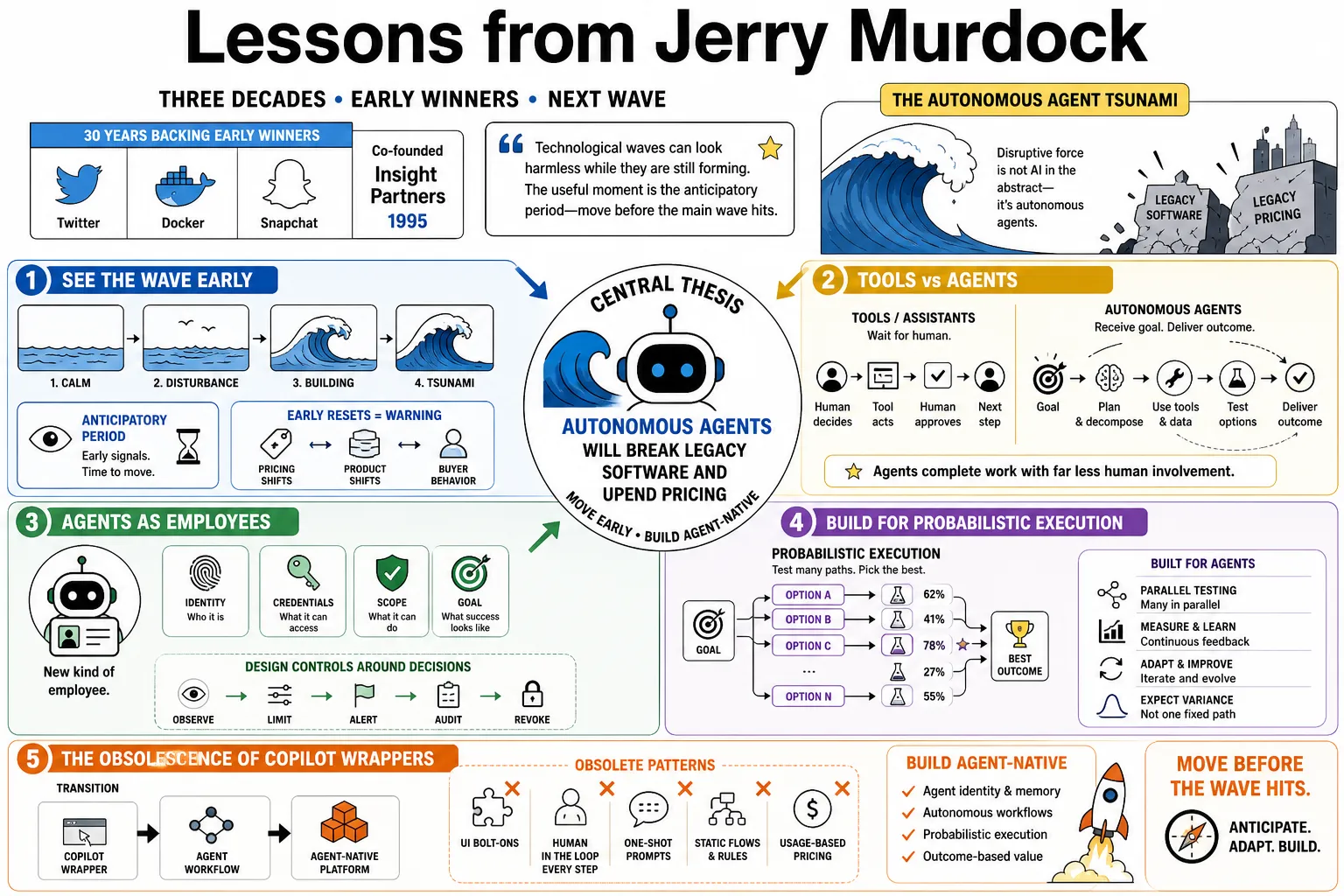
Jerry Murdock co-founded Insight Partners in 1995 and spent three decades backing early tech winners like Twitter, Docker, and Snapchat. He now expects autonomous AI agents to act as an impending "tsunami," breaking legacy software infrastructure and upending corporate pricing. This profile covers his views on venture capital and how to build AI-native products to navigate massive technological shifts.
Part 1: The Autonomous Agent Tsunami
- On the hidden danger of technological waves: Technological waves can look harmless while they are still forming. The useful moment is the anticipatory period, when early disturbances signal a larger shift and leaders still have time to move before the main wave reaches them. — Reference: 20VC video
- On the AI tsunami: The disruptive force is not AI in the abstract but autonomous agents that can complete work independently. Treat early software-market resets as a warning to move toward agent-native products before the shift becomes unavoidable. — Reference: 20VC video
- On tools versus agents: Assistants wait for a person to guide and approve each step. Autonomous agents receive a goal, decompose it, choose tools, test alternatives, and execute the workflow with far less human involvement. — Reference: 20VC video
- On agents as employees: Treat an autonomous agent like a new kind of employee: give it identity, scoped credentials, and a goal, then design controls around the decisions it can make rather than forcing a person into every step. — Reference: 20VC video
- On probabilistic execution: Agents can test many approaches in parallel and select the one that performs best. Products built for them should expect probabilistic experimentation instead of one deterministic path through a workflow. — Reference: 20VC video
- On the obsolescence of copilots: A coding assistant loses strategic value when an agent can take an issue, write and test the code, and complete the delivery loop without anyone opening an editor. Builders must follow where the workflow is going, not defend yesterday's interface. — Reference: 20VC video
- On open-source integration flywheels: Centralized labs can deploy enormous talent and capital, but an open-source community compounds through sheer numbers of contributors building integrations. Every useful contribution expands what the agent ecosystem can do next. — Reference: 20VC video
- On giving strong incumbents a pivot window: A product can be threatened without its company being doomed. A talented team with customers, capital, and time can still redirect itself, provided it accepts where the market is going instead of defending the current product. — Reference: 20VC video
Part 2: Rebuilding the Software Stack
- On adapting your product: Software companies need to design for autonomous agents now. Adding an AI feature may buy time, but becoming genuinely agent-native changes the architecture, customer, and operating model before the market forces the transition. — Reference: 20VC video
- On designing for machines: Infrastructure optimized for human response times will strain when agents launch thousands of tasks in parallel. Agent-first systems must be designed around concurrency, machine-speed decisions, and very different latency expectations. — Reference: 20VC video
- On the death of traditional user interfaces: Interfaces created to help people manipulate data become less central when agents work directly with APIs and underlying records. Product value shifts from the screen toward accessible data, actions, and machine-readable controls. — Reference: 20VC video
- On the shift in software pricing: When agents become the primary software users, annual seat licenses fit poorly. Pricing should move toward consumption, completed work, or other measures tied to what autonomous systems actually use and produce. — Reference: 20VC video
- On the new orchestration layer: The agent stack needs an orchestration layer that can break work apart and route each task to the model best suited to its cost, speed, and reasoning requirements. — Reference: 20VC video
- On hardware evolution: Agent workloads will increase demand for specialized ASICs with memory close to the workload. Incumbent platforms can remain valuable, but only if their software ecosystems adapt to support the new hardware mix. — Reference: 20VC video
- On systems of record: A system of record becomes more valuable when it uses its proprietary data and surrounding ecosystem to power agent workflows. If a new architecture bypasses it, the stored data alone may not protect its position. — Reference: 20VC video
- On the agent stack repeating the LAMP pattern: Open-source infrastructure can unlock a platform shift by making the basic stack cheap and composable. Just as LAMP accelerated the web, a shared agent stack can lower the cost of deploying autonomous workflows. — Reference: 20VC video
- On routing work by task economics: Use expensive frontier reasoning only where it materially improves the result, and route simpler work to cheaper models. Orchestration should optimize the whole workflow rather than standardize every task on one model. — Reference: 20VC video
- On letting agents choose infrastructure empirically: Agents can compare tools and models through repeated trials instead of inheriting a developer's habits. Infrastructure vendors will increasingly compete for selection by machines measuring performance directly. — Reference: 20VC video
Part 3: Investment Strategy & AI-Native Startups
- On AI-native vs. bolt-on strategies: Bolting AI onto a legacy company may produce a short-term outcome, but AI-native companies start with different assumptions about software creation, customer behavior, and operating leverage. That foundation gives them the stronger long-term position. — Reference: 20VC video
- On the timing for new funds: A platform transition is an unusually good time to start a fund because a new investor can build around the emerging model without defending a portfolio optimized for the previous software era. — Reference: 20VC video
- On scaling through product: The fundamental driver of business scalability is the product itself, which must remain a founder's top priority in order to survive unstable times. — Reference: START Summit 2023
- On investing during instability: Provided the broader financial system remains stable, the most ingenious and resilient businesses often emerge during turbulent times defined by inflation, market turmoil, and institutional distrust. — Reference: START Summit 2023
- On evaluating founders: Investors should look for entrepreneurs who clearly understand how their technology practically serves the customer in daily life, rather than focusing on what the founders themselves find interesting to build. — Reference: START Summit 2023
- On execution deciding incumbent value: Installed bases and valuable records buy time, not immunity. An incumbent retains value only if management captures the new architecture before customers and surrounding applications migrate elsewhere. — Reference: 20VC video
- On recognizing platform shifts before consensus: The best venture bets often appear when user behavior is changing faster than conventional valuation frameworks. The Twitter investment illustrates the value of underwriting a new communication platform before its business model looked settled. — Reference: 20VC
Part 4: The Labor Market & Macro Impacts
- On white-collar job displacement: Autonomous agents will first compress work that is repetitive, structured, and data-entry heavy. Leaders should expect hiring to slow in those categories before the broader labor market has agreed on a response. — Reference: 20VC video
- On policy responses to automation: Large-scale automation will force governments to confront income support and retraining sooner than expected. Waiting until displacement is visible at scale leaves too little time to build credible transition policies. — Reference: 20VC video
- On the fate of traditional private equity: Agent-driven companies can produce far more output with much smaller teams. That weakens investment models built primarily around adding people, consolidating operations, and scaling labor-intensive software businesses. — Reference: 20VC video
- On AI extending the runway of human life: AI's most hopeful long-term contribution may be accelerated medical and scientific progress. Even modest gains in healthy longevity can compound by giving people time to benefit from the next generation of discoveries. — Reference: 20VC video
Part 5: Leadership, Failure, & Intuition
- On learning from mistakes: Wisdom comes from crossing the edge, making consequential mistakes, and learning what the boundary actually feels like. Investors should treat failure as information rather than evidence that they must leave the field. — Reference: 20VC video
- On persistence in the game: The durable advantage was not avoiding failure but remaining in the game through it. Staying active across cycles preserves the chance to recognize and back the next exceptional company. — Reference: 20VC video
- On the lack of a playbook: Capital does not arrive with instructions. Having money creates optionality, but judgment still has to be developed through decisions, consequences, and honest reflection. — Reference: 20VC video
- On the timeline of success: Longevity compounds: surviving the next stretch creates access to opportunities that did not exist at the beginning. The same logic applies to careers, firms, and technological progress. — Reference: 20VC video
- On navigating risk: Building a company is much like mountain climbing. It requires leaders who can maintain a clear head, look far ahead on the route, and execute sound decisions even in highly risky moments. — Reference: START Summit 2023
- On civic engagement: Murdock applies his strategic focus to local issues outside the boardroom, previously proposing regulations in Aspen to prohibit formula retail chain stores in an effort to preserve local mom-and-pop businesses from being pushed out by luxury brands. — Reference: Aspen Public Radio
- On cultivating intuition: Founders and investors must actively cultivate their intuition alongside logic and maintain a realistic view of life, learning to distinguish genuine instinct from mere wishful thinking. — Reference: START Summit 2023
- On surviving cycles by staying together: Insight's breakthrough was surviving the dot-com and post-9/11 collapse while many venture partnerships fragmented or became walking dead. Cohesion through the downturn preserved the platform for the next cycle. — Reference: 20VC video
- On parenting through example: Children are always watching. Parenthood is an invitation to put the heart first and practice being the person you want them to learn from, not merely tell them what good behavior looks like. — Reference: 20VC video