Lessons from Mark Scheinberg
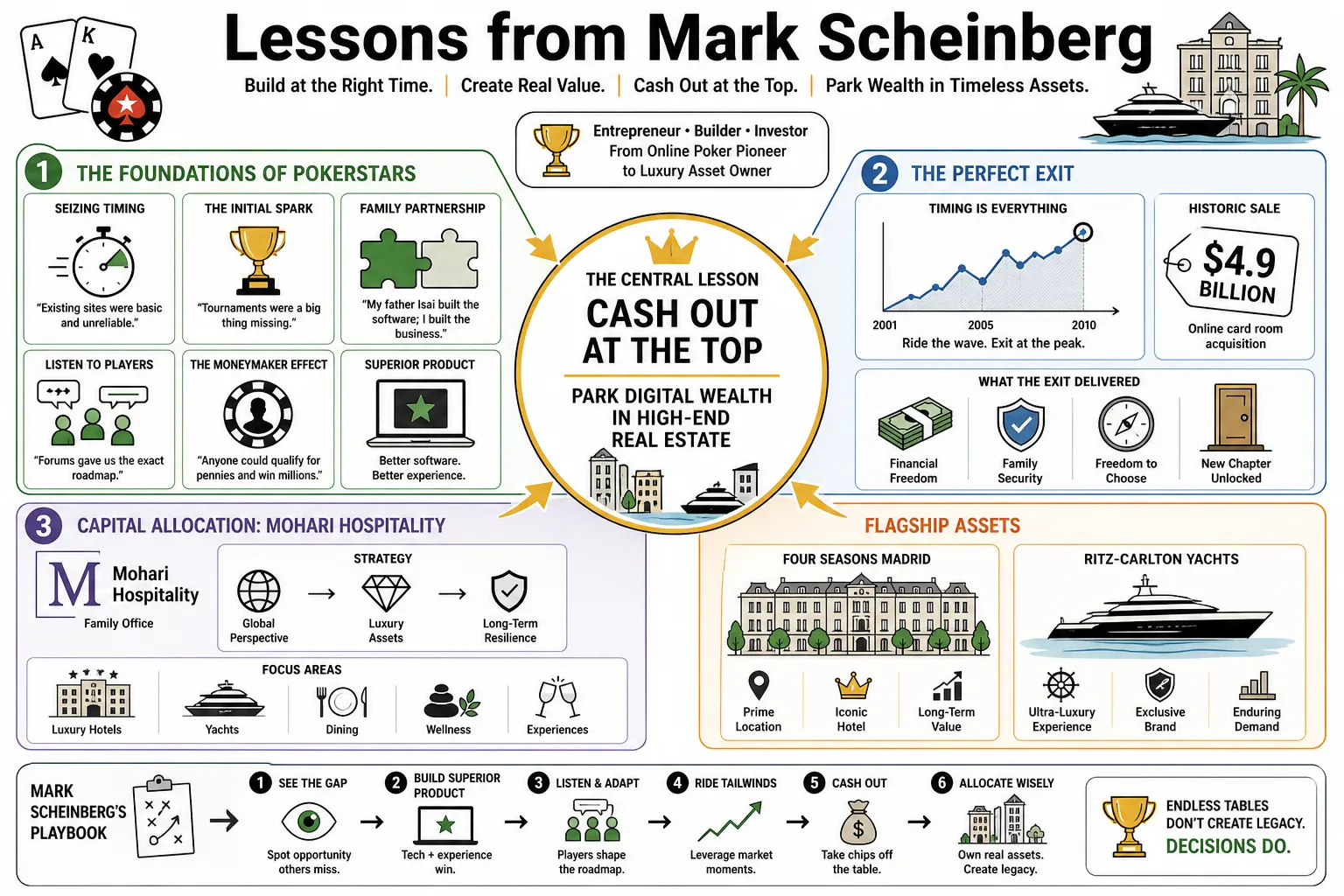
Mark Scheinberg co-founded PokerStars with his father and timed his exit perfectly, selling the online card room for $4.9 billion. He channeled that payout into Mohari Hospitality, a family office that now backs luxury physical assets like the Four Seasons Madrid and Ritz-Carlton yachts. His trajectory is a straightforward lesson in cashing out at the top and parking digital wealth in high-end real estate.
Part 1: The Foundations of PokerStars
- On seizing timing: "We launched when existing sites were basic and unreliable, seeing a clear opening for a superior technical product." — Source: [Poker.org]
- On the initial spark: "I felt tournaments were a big thing missing from early sites; I love to play tournaments, that's why we started it." — Source: [GipsyTeam]
- On family partnership: "My father Isai built the software architecture; my role was to build the business and operations around it." — Source: [Forbes]
- On finding early adopters: "We recognized that listening directly to the most passionate players on forums would give us the exact roadmap for our software." — Source: [HighstakesDB]
- On the Moneymaker effect: "Chris Moneymaker’s 2003 WSOP win proved that anyone could qualify for pennies and win millions, which became our core marketing engine." — Source: [Poker.org]
- On jurisdiction: "Moving the company to the Isle of Man provided the stable regulatory environment we needed to grow a global financial platform." — Source: [IOM Today]
- On continuous iteration: "We never viewed the software as finished; it was a constant cycle of updates based on direct forum feedback." — Source: [HighstakesDB]
- On market position: "By focusing on the reliability of the software, we naturally attracted the high-volume players who demanded stability." — Source: [Poker.org]
- On early scaling: "The goal was always to handle massive multi-table tournaments without the servers crashing, a technical hurdle our competitors failed to clear." — Source: [Grokipedia]
- On defining the category: "We didn't set out to be a casino; we wanted to be the definitive home for tournament poker." — Source: [Poker.org]
Part 2: Product and Player Experience
- On customer obsession: "An absolute obsession with customer satisfaction was the foundation of our growth." — Source: [Medium]
- On the transition to hospitality: "PokerStars was based on people coming together online, and hospitality is all about people interacting with their physical surroundings." — Source: [Poker.org]
- On a unified strategy: "Despite the obvious differences between software and hotels, success is based on offering a best-in-class product with best-in-class service." — Source: [Poker.org]
- On the details: "Meticulous attention to the smallest details of the user interface translates directly to how we view the guest experience in a luxury hotel." — Source: [Commercial Observer]
- On community building: "We built a platform where players felt they belonged, fostering a loyalty that transcended the basic utility of the software." — Source: [HighstakesDB]
- On player security: "Security and random number generation were the core of our brand promise; without it, we had nothing." — Source: [Poker.org]
- On fast payouts: "We made sure players could withdraw their money faster than anywhere else, which became our strongest marketing tool." — Source: [HighstakesDB]
- On experiential value: "Whether it is a digital hand of poker or a stay in Madrid, the user is paying for an unparalleled experience." — Source: [Mohari Hospitality]
- On technological applications: "We invest in tech-enabled hospitality because the digital guest experience is now inseparable from the physical stay." — Source: [PR Newswire]
- On brand trust: "Trust is earned by delivering exactly what you promise, every single time, without exception." — Source: [HighstakesDB]
Part 3: Navigating Crisis and Regulation
- On Black Friday: "When the U.S. DOJ shut down the industry, our immediate priority was proving to our players that their money was safe." — Source: [Forbes]
- On the segregation of funds: "Keeping player funds completely separate from operating capital was a strict internal rule that ultimately saved the company." — Source: [HighstakesDB]
- On competitor failures: "While others used player deposits to fund operations, our financial discipline allowed us to survive the crisis." — Source: [Poker.org]
- On strategic settlements: "We agreed to a $731 million settlement with the DOJ, which included acquiring Full Tilt Poker to pay back their defrauded players." — Source: [Forbes]
- On restoring industry faith: "Bailing out Full Tilt was a requirement to restore public faith in the online poker economy." — Source: [HighstakesDB]
- On regulatory shifts: "You have to accept when the regulatory weather changes and adapt your structure, rather than fighting a losing battle against the state." — Source: [Poker.org]
- On crisis communication: "During a panic, players don't want spin; they want to see their balances and know they can click withdraw." — Source: [HighstakesDB]
- On long-term reputation: "Our actions during the crackdown preserved the brand's integrity, ensuring we retained value for a future sale." — Source: [Medium]
- On father-son alignment: "My father and I were entirely aligned that making the players whole was the only acceptable path forward." — Source: [Forbes]
Part 4: The Strategic Exit
- On the 2014 sale: "I am incredibly proud of the business Isai and I have built over the last 14 years, creating the world's biggest poker company." — Source: [PokerTube]
- On team dedication: "Our achievements and this transaction are an affirmation of the hard work, expertise and dedication of our staff." — Source: [PokerTube]
- On recognizing the peak: "Selling the company for $4.9 billion required accepting that the era of hyper-growth in unregulated online poker was over." — Source: [Forbes]
- On clean breaks: "By selling 100% of the Rational Group to Amaya, we ensured a clean break, allowing me to start fresh in a new sector." — Source: [Poker.org]
- On capital transition: "The exit provided the ultimate liquid capital to build a family office with institutional firepower." — Source: [Commercial Observer]
- On leaving the spotlight: "The sale allowed me to step back from the intense scrutiny of the gaming industry and operate as a private investor." — Source: [HighstakesDB]
- On legacy: "I am confident the new ownership will continue to drive the company's success and maintain the platform we built." — Source: [PokerTube]
- On shifting focus: "The transition from digital bytes to physical bricks was a deliberate choice to seek long-term, tangible value." — Source: [Mohari Hospitality]
- On patience: "Having secured generational wealth, there was no rush to deploy it; the focus shifted to finding the absolute right assets." — Source: [Commercial Observer]
Part 5: The Pivot to Luxury Real Estate
- On Mohari's mandate: "We established Mohari Hospitality as a patient, high-conviction investment platform focused solely on luxury lifestyle and real estate." — Source: [Mohari Hospitality]
- On asset selection: "We target trophy locations in prime urban markets and exclusive resort destinations where scarcity guarantees value." — Source: [Commercial Observer]
- On Madrid's Centro Canalejas: "Investing €225 million into seven historic Madrid buildings was a bet on the revitalization of the Spanish luxury market." — Source: [Iberian Property]
- On structural advantages: "As a single-family office, we operate without external fund structures or fixed exit timelines, giving us immense agility." — Source: [Mohari Hospitality]
- On adaptive reuse: "Transforming heritage properties, like our work in Madrid and Venice, requires a tolerance for complexity that many investors lack." — Source: [Hospitality Net]
- On ground-up development: "Projects like the Waldorf Astoria in Miami represent our willingness to back skyline-altering developments from the ground up." — Source: [Commercial Observer]
- On distressed opportunities: "We actively look for iconic properties whose current owners are facing financial pressure but where the underlying asset remains pristine." — Source: [Mohari Hospitality]
- On concentration: "Unlike family offices that diversify across everything, we maintain deep concentration in the hospitality sectors we understand." — Source: [Mohari Hospitality]
- On the long view: "We are prepared to hold these flagship assets through multiple market cycles, ignoring short-term hospitality fluctuations." — Source: [Commercial Observer]
- On holding firm: "During asset splits, such as our arrangement with OHLA in Madrid, we ensure we retain 100% of the core hotel and luxury retail." — Source: [El Economista]
Part 6: Hospitality and Experiential Investment
- On the Tao Group acquisition: "Acquiring Tao Group for $550 million was a strategic milestone to integrate world-class dining and nightlife into our real estate." — Source: [PR Newswire]
- On lifestyle branding: "Modern luxury is no longer just about the room; it requires high-energy food, beverage, and entertainment." — Source: [Restaurant Business]
- On ultra-luxury travel: "Taking a 30% stake in the Ritz-Carlton Yacht Collection was a bet on taking the resort experience onto the ocean." — Source: [Mohari Hospitality]
- On tech-enabled stays: "Our $35 million investment in Mint House bridges my tech background with the future of long-stay residential hospitality." — Source: [PR Newswire]
- On brand separation: "Deciding to spin Hakkasan out of Tao Group allows us to re-establish it as a highly focused, standalone fine-dining entity." — Source: [Wikipedia]
- On wellness and nature: "The Peninsula Papagayo development in Costa Rica proves that sustainable master-planning and ultra-luxury can coexist." — Source: [Hospitality Net]
- On shifting consumer habits: "We are investing in the reality that affluent consumers value curated, exclusive experiences over static material goods." — Source: [Mohari Hospitality]
- On maritime hospitality: "Vessels like the Evrima and Ilma redefine cruising by offering the intimacy and service of a private superyacht." — Source: [Mohari Hospitality]
- On experiential adjacencies: "We don't buy empty hotels; we buy the restaurants, the nightlife, and the operational teams that bring the property to life." — Source: [PR Newswire]
- On the future of luxury: "The properties that will win the next decade are those that seamlessly integrate digital convenience with high-touch physical service." — Source: [Commercial Observer]
Part 7: Partnerships and Vertical Integration
- On hiring expertise: "Bringing in J. Allen Smith, the former CEO of Four Seasons, gave Mohari immediate operational credibility at the highest level." — Source: [Hospitality Investor]
- On strategic alliances: "Our partnership with the Omnam Group allows us to scale our European pipeline by combining our capital with their local sourcing." — Source: [Boutique Hotel News]
- On co-investment: "We are comfortable investing independently, but we prefer to co-invest alongside top-tier operators like Four Seasons and Rosewood." — Source: [Mohari Hospitality]
- On vertical integration: "Mohari is designed to be involved in every phase, from the initial off-market acquisition to hands-on asset management." — Source: [Mohari Hospitality]
- On board presence: "Securing board seats at companies like Mint House ensures we help drive the strategic direction." — Source: [PR Newswire]
- On mutual benefit: "When we acquired Tao Group from MSG, we structured a multi-year agreement to continue providing consulting for the Sphere, ensuring a smooth transition." — Source: [Total Food Service]
- On finding the right operators: "A beautiful building fails without an operator who understands the precise demands of the local high-end market." — Source: [Commercial Observer]
- On European expansion: "Partnering on projects like the Hôtel Saint-James & Albany in Paris demonstrates our focus on securing heritage assets in impossible-to-enter markets." — Source: [IPE Real Assets]
- On alignment of interests: "Every joint venture we enter requires the development partner to have significant skin in the game alongside us." — Source: [Mohari Hospitality]
Part 8: Stealth Wealth and Philanthropy
- On maintaining privacy: "Operating outside the public eye is a deliberate strategy that removes the distractions of celebrity culture from capital allocation." — Source: [Forbes]
- On pandemic response: "We established the $50 million Scheinberg Relief Fund to provide immediate, high-impact relief to the communities where we do business." — Source: [IOM Today]
- On localized giving: "Instead of broad global mandates, our relief efforts targeted specific needs, like providing laptops to digitally disadvantaged students in the Isle of Man." — Source: [Three FM]
- On protecting the vulnerable: "In Madrid, we repurposed the Four Seasons kitchens to prepare 1,000 meals a day for families devastated by the lockdowns." — Source: [Slideserve]
- On environmental conservation: "Through initiatives like the Wildlife Ranger Challenge, we focus on protecting conservation efforts that rely heavily on vulnerable tourism revenues." — Source: [Mohari Hospitality]
- On community economies: "In Costa Rica, we funded home garden projects so displaced tourism workers could grow their own food and supply local markets." — Source: [Guanacaste a la Altura]
- On animal welfare: "A consistent pillar of our family foundation has been securing the operating costs for animal rescues, from Spain to Central America." — Source: [Slideserve]
- On the purpose of wealth: "The ultimate value of a successful exit is the ability to shape physical communities and provide a safety net for them during crises." — Source: [IOM Today]