Avery Pennarun is the co-founder and CEO of Tailscale and a former Google engineer who worked on Google Fiber. His essays and interviews explore software systems, management, and making connectivity easier to use. — Stratechery — Avery Pennarun Interview.
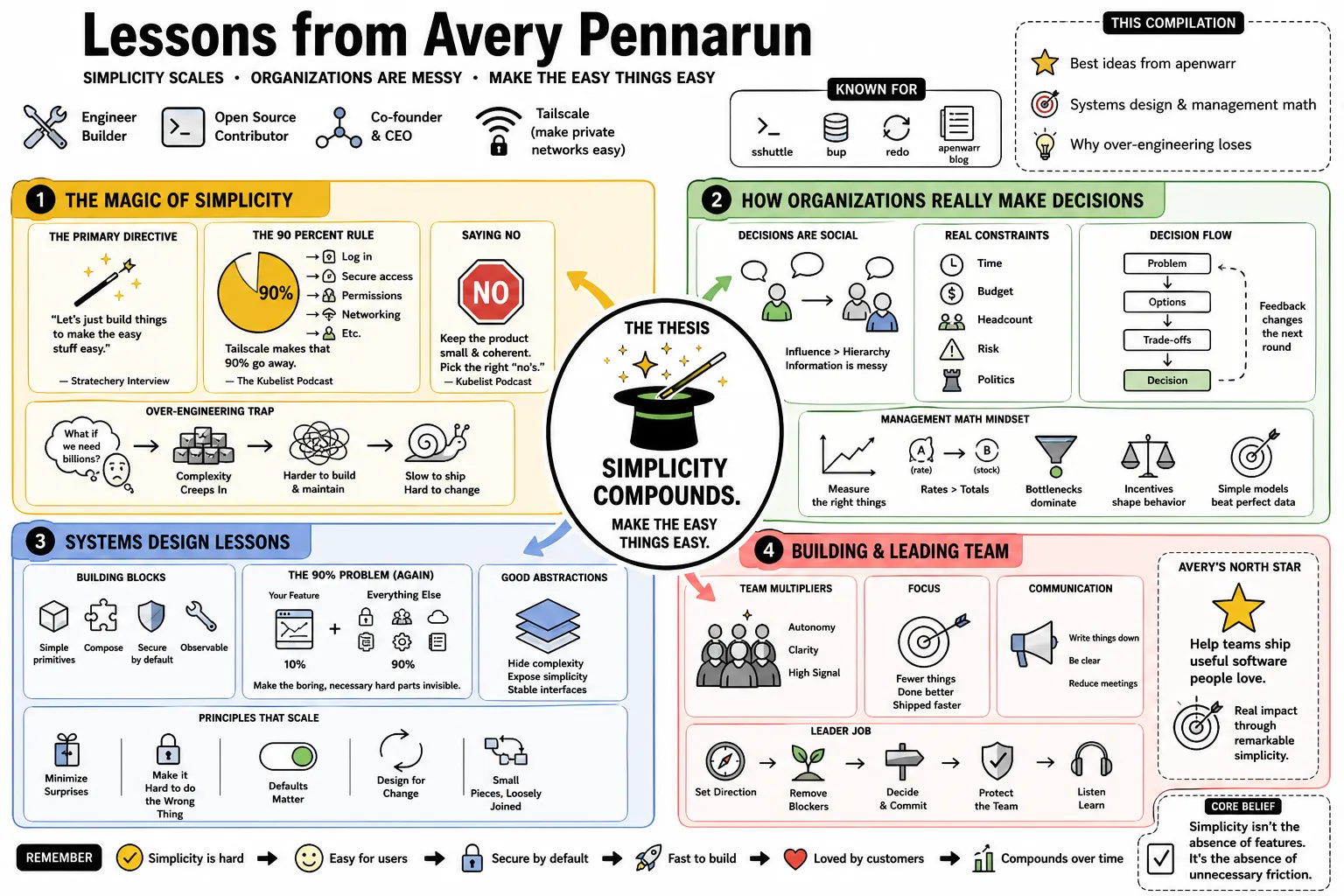
Part 1: The Magic of Simplicity
- On the primary directive: Design for ordinary projects, not just billion-user workloads. Pennarun wants infrastructure that makes modest applications easy to build. — The Kubelist Podcast — Tailscale with Avery Pennarun.
- On the 90 percent rule: Authentication and connectivity can consume work unrelated to an application’s purpose. Tailscale aims to remove that plumbing; the claimed 90 percent is not a measured guarantee. — The Kubelist Podcast — Tailscale with Avery Pennarun.
- On saying no: Keep the product coherent by declining features and protecting existing customers’ workflows. — Pulse 2.0 — Avery Pennarun Interview.
- On making users feel something: Separate bad, neutral, and excellent experiences. Pennarun argues that an average score can obscure these different emotional responses. — NPS, the Good Parts.
- On bottom-up adoption: Preserve developer-led adoption while adding necessary enterprise controls, rather than turning the product into a complicated security suite. — Pulse 2.0 — Avery Pennarun Interview.
- On magical technology: Technology can feel magical when its workings are unclear to the user. Pennarun distinguishes that experience from understanding its mechanisms. — Systems Design 2: What We Hope We Know.
- On developer alignment: Developers value simplicity; security buyers need control. Product design must accommodate both without sacrificing ease of use. — Pulse 2.0 — Avery Pennarun Interview.
- On the burden of legacy: Tailscale grew from connecting existing identity systems to WireGuard for a bank’s legacy application, avoiding an application rewrite. — Pulse 2.0 — Avery Pennarun Interview.
Part 2: Systems Thinking and Architecture
- On defining systems design: Systems design connects components to solve business problems, not merely individual bugs. Pennarun describes it as thinking in boxes and arrows. — Systems Design Explains the World.
- On real engineering: Measure failures and design around them. Pennarun treats error monitoring, reliability targets, and tested failure paths as signs of genuine software engineering. — Systems Design 2: What We Hope We Know.
- On Layer 3 supremacy: Working at the network layer lets existing applications communicate without bespoke integrations for each application. — Screaming in the Cloud — Tailscale’s Evolution.
- On batch processing: Persist incoming logs before processing them. His logging design buffered bursts in storage and used a simple processing stage; the alleged log-line count is omitted. — Logs: The Lumberjack Story.
- On distributed systems: Pennarun views markets and governments through distributed-systems principles: coordination and constraints matter. This is his political analogy, not proof that every decentralized system fails. — 100 Years of Whatever This Will Be.
- On organizational drag: Approval layers add waiting time, not just effort. His tenfold slowdown is an experiential rule of thumb, explicitly not a demonstrated law. — Every Layer of Review Makes You 10x Slower.
- On review latency: Make recurring review comments unnecessary by correcting their root causes. Removing review stages without replacement quality controls is not his recommendation. — Every Layer of Review Makes You 10x Slower.
- On semantic communication: Pennarun sees LLMs as enabling translation between systems through meaning, beyond fixed syntax. His essay treats this as a promising but unreliable new interoperability layer. — Systems Design 3: LLMs and the Semantic Revolution.
- On interfaces: Smaller teams and clearer module boundaries can reduce coordination overhead. Pennarun proposes experimenting with interfaces rather than simply abandoning reviews. — Every Layer of Review Makes You 10x Slower.
Part 3: The Myth of "Google Scale"
- On copying giants: Match infrastructure to the project’s actual scale instead of copying Google’s systems by default. — Stratechery — Avery Pennarun Interview.
- On naming his company: The name Tailscale reflects Pennarun’s interest in the opposite of Internet-scale infrastructure: manageable projects rather than only enormous ones. — The Kubelist Podcast — Tailscale with Avery Pennarun.
- On the DevOps tax: Large-scale infrastructure brings operational work. Pennarun argues that much smaller projects should not inherit that burden unnecessarily. — Stratechery — Avery Pennarun Interview.
- On simulated annealing: Small changes protect mature systems, but can trap them in local optima. Larger jumps sometimes help, provided testing and review match the risk. — Software Industry Annealing.
- On over-engineering: Before adopting distributed processing, test whether a simpler pipeline meets the actual workload. His logging example did not require a distributed processing cluster. — Logs: The Lumberjack Story.
- On the long tail: Smaller projects collectively offer worthwhile problems to solve. Pennarun’s market focus is that long tail, not only products serving billions of users. — The Kubelist Podcast — Tailscale with Avery Pennarun.
Part 4: Management, Estimation, and "Agile"
- On hoping: Meetings and speeches can resemble a strategy without supplying one. Pennarun’s essay is satire, not an endorsement of hoping harder. — Hope Is Not a Strategy? Nonsense.
- On forecasting failure: Extra deadline padding may be wasted when work starts later. Pennarun criticizes deadline-driven behavior, not every possible forecasting method. — Scheduling, Bug Tracking, and Triage.
- On story points: Estimate relative effort, make priorities visible, and limit simultaneous work. Pennarun values those mechanisms more than Agile ceremony. — Scheduling, Bug Tracking, and Triage.
- On Deming: Distinguish ordinary variation from exceptional breakdowns. In discussing Deming, Pennarun says improving the former and preventing the latter require different interventions. — Books That Explain How the World Works.
- On management's true job: Management can improve autonomous decisions by helping people develop a shared way of thinking, rather than prescribing every action. — Holistic Management.
- On the decision gap: In larger organizations, let informed people negotiate decisions before executives ratify them. Pennarun distinguishes this from a founder choosing a young company’s strategy. — What Do Executives Do, Anyway?.
- On executive function: For established organizations, executives define and enforce values and ratify decisions. Pennarun credits Andy Grove’s management framework rather than claiming to have invented it. — What Do Executives Do, Anyway?.
- On reorganizations: Reorganizations can discard accumulated knowledge, just as software rewrites discard fixes for edge cases. Their apparent initial simplicity can hide costly relearning. — Restructuring.
- On predicting outcomes: Improve the process that determines delivery instead of inventing arbitrary deadlines. Pennarun contrasts that work with merely demanding a number. — Scheduling, Bug Tracking, and Triage.
- On simulating teams: His simulations illustrate how repeated priority changes waste unfinished work. They are models of scheduling behavior, not proof that most projects must fail. — Scheduling, Bug Tracking, and Triage.
Part 5: Smart People, Ego, and Leadership
- On the trap of intellect: Intelligence can make rationalizations more convincing. Pennarun warns that confidence in reasoning does not compensate for bad inputs. — The Curse of Smart People.
- On impostor syndrome: Pennarun values questioning one’s assumptions over confident self-deception. This personal perspective is not a clinical treatment for impostor syndrome. — The Curse of Smart People.
- On inconvenient facts: Seek facts that challenge an appealing explanation. Internally consistent reasoning can still mislead when important information is missing. — The Curse of Smart People.
- On the engineering ladder: Engineering ladders can undervalue work connecting technical decisions to business needs. Pennarun argues that this coordinating work matters even when it looks less technically glamorous. — Systems Design Explains the World.
- On people problems: Becoming CEO required Pennarun to develop judgment about people and relationships, not only technology. This does not establish that every organizational problem is a people problem. — From Developer to CEO — Avery Pennarun.
- On Wi-Fi and ego: Reliable Wi-Fi depended on understanding hardware and firmware behavior, not only writing elegant higher-level software. Pennarun recounts that constraint from Google Fiber. — Stratechery — Avery Pennarun Interview.
- On company purpose: Give employees a consistent basis for decisions by defining and enforcing company values. Pennarun treats that responsibility as central to executive leadership. — What Do Executives Do, Anyway?.
- On vendor trust: Test vendor claims under real operating conditions. Pennarun found that idealized benchmarks could miss behavior on lossy networks. — Open-Source Drivers and Vendor Benchmarks.
- On the gift economy: Do not treat volunteered free software as a purchased service. Pennarun distinguishes a gift from commercial support obligations; not every open-source project follows one model. — The Gift of It’s Your Problem Now.
Part 6: Startups, Markets, and "Enshittification"
- On market segments: Choose a segment with a specific desire, then satisfy the needs that block its adoption. Pennarun’s model separates attractive wants from mandatory prerequisites. — Wants, Needs, and Crossing the Chasm.
- On strange failures: A business can be profitable and useful yet fail its founder’s own goals. Pennarun recounts a growing product whose work he disliked. — A Profitable, Growing, Useful, Legal, Well-Loved Failure.
- On enshittification: Preserve incentives to make users happy rather than extract short-term value. Pennarun argues that control and growth pressures influence product deterioration, without making it inevitable. — The Evasive Evitability of Enshittification.
- On billionaire math: Pennarun describes funding his independence through earlier savings, not treating paper startup wealth as spendable cash. This is his personal history, not general financial advice. — Billionaire Math.
- On word of mouth: Pennarun describes word-of-mouth adoption moving from personal use into workplaces. Enterprise sales followed that adoption; they were not unnecessary. — From Developer to CEO — Avery Pennarun.
- On traditional pitch decks: His early fundraising discussions benefited from a working product and customer experience. He recalls not starting with a conventional pitch deck, not a universal rule against decks. — From Developer to CEO — Avery Pennarun.
- On TAM theater: Pennarun frames Tailscale’s opportunity around devices needing identity and connectivity. His broad market view is a thesis, not proof of attainable revenue. — Pulse 2.0 — Avery Pennarun Interview.
- On acquisitions: Pennarun prefers Tailscale remaining independent and worries acquisitions can blur product direction. This is his opinion, not an empirical claim that all acquisitions fail. — Pulse 2.0 — Avery Pennarun Interview.
- On crossing the chasm: Solve all adoption obstacles for a small segment before pursuing a fraction of a huge market. Pennarun explicitly credits Geoffrey Moore’s framework. — Books That Explain How the World Works.
Part 7: Open Source, Networks, and Building Blocks
- On legacy code survival: Older software can remain useful when newer alternatives fail a continuing need. Pennarun explains WvDial’s persistence through modem and mobile-connection reliability. — WvDial’s Staying Power.
- On backups: bup combines content-defined chunks with Git’s storage format to reuse unchanged data. Its design reduces repeated storage without assuming files remain identical. — bup 0.01.
- On build systems: Comparing timestamps alone can miss changes. Pennarun explains why redo tracks prior state and dependencies rather than assuming newer always means changed. — mtime Considered Harmful.
- On poor man's tools: sshuttle offers VPN-like access through an existing SSH connection without installing server-side VPN software. Client-side privileges and a suitable remote environment are still needed. — sshuttle on macOS.
- On early networking: Pennarun’s early networking work began with sharing a modem over ARCnet. The connectivity problems preceded Tailscale; this is a career example, not proof networking never changes. — Stratechery — Avery Pennarun Interview.
- On the WireGuard advantage: WireGuard supplies the encrypted data plane; Tailscale adds coordination, identity, and connectivity management. Pennarun distinguishes the two layers. — The Kubelist Podcast — Tailscale with Avery Pennarun.
- On NAT traversal: Tailscale tries to connect peers directly through NAT rather than requiring manual port forwarding. Direct connections are not possible through every firewall. — The Kubelist Podcast — Tailscale with Avery Pennarun.
- On identity as the network: Reuse established identity providers for network access instead of inventing another password system. This was part of Tailscale’s original approach. — Pulse 2.0 — Avery Pennarun Interview.
- On incremental updates: His bupdate design reused local file chunks and fetched missing ranges through a static HTTP server. The client carried the incremental-download logic. — Misadventures in Process Containment.
- On protocol tunneling: sshuttle forwards reconstructed streams over SSH rather than nesting raw TCP packets inside TCP. Pennarun designed it to avoid problematic nested transport behavior. — sshuttle on macOS.
Part 8: Security, AI, and The Future of Work
- On accidental AI infrastructure: Pennarun says developers brought familiar Tailscale tooling into AI companies. He describes discovering that adoption after it happened, not predicting it in advance. — From Developer to CEO — Avery Pennarun.
- On forcing simplicity: Pennarun hopes AI tools will encourage simpler, more usable software platforms. It is an optimistic prediction, not a demonstrated security guarantee. — AI Changes People.
- On zero trust: Make the convenient deployment path a safer one. Pennarun presents this as Tailscale’s product goal, not proof that combining connectivity and security automatically achieves zero trust. — Screaming in the Cloud — Tailscale’s Evolution.
- On enterprise readiness: Private connectivity can help AI deployments avoid exposing sensitive interfaces publicly. Pennarun presents networking as supporting infrastructure, not a complete enterprise-readiness solution. — Securing AI’s Future — Web Summit Vancouver.
- On the real internet: Pennarun endorses a customer’s description of Tailscale making connectivity work as expected. The original striking wording belonged to the customer, not Pennarun. — Stratechery — Avery Pennarun Interview.
- On key management: Automate key distribution and membership changes rather than configuring each peer manually. Pennarun describes this as Tailscale’s coordination layer, not the only secure architecture. — The Kubelist Podcast — Tailscale with Avery Pennarun.
- On the singularity: Pennarun doubts that faster computation alone yields a singularity. Waiting and coordination latency remain constraints on recursive improvement. — Every Layer of Review Makes You 10x Slower.