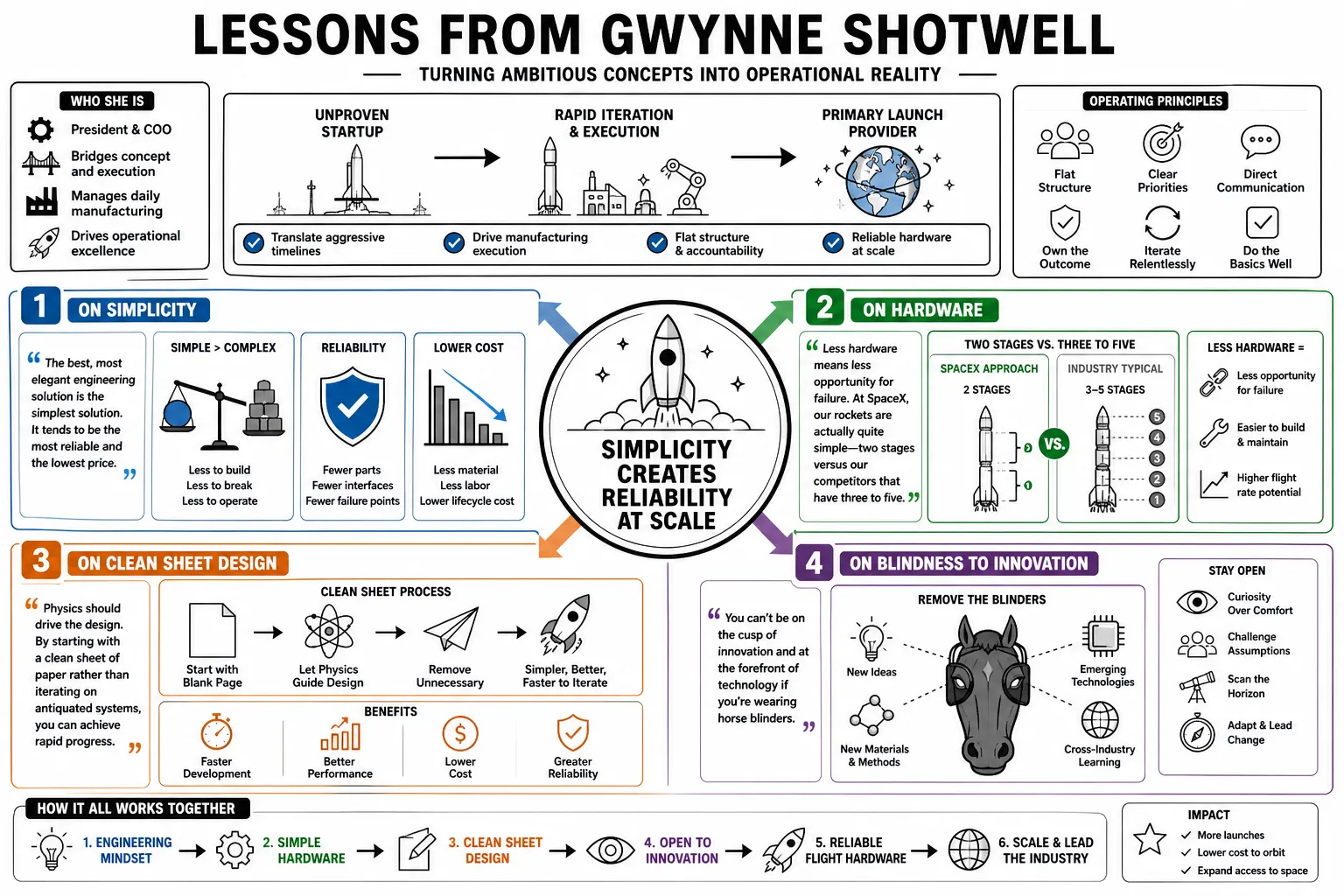
Gwynne Shotwell is the President and Chief Operating Officer of SpaceX, where she bridges the gap between ambitious concepts and daily manufacturing execution. By translating aggressive timelines into operational reality and maintaining a flat organizational structure, she scaled the company from an unproven startup into the primary launch provider for the global space industry. The following collection details her specific mechanics for managing production floors, framing hardware failures, and guiding engineering teams.
Part 1: The Engineering Mindset
- On Simplicity: "The best, most elegant engineering solution is the simplest solution. It tends to be the most reliable and the lowest price." — Source: [TEDxChapmanU]
- On Hardware: "Less hardware means less opportunity for failure. At SpaceX, our rockets are actually quite simple—two stages versus our competitors that have three to five." — Source: [Business Insider]
- On Clean Sheet Design: "Physics should drive the design. By starting with a clean sheet of paper rather than iterating on antiquated systems, you can achieve rapid progress." — Source: [TED 2018]
- On Blindness to Innovation: "You can't be on the cusp of innovation and at the forefront of technology if you're wearing blinders. You have to explore your world here on Earth, underwater, and in space." — Source: [YourStory]
- On Technical Literacy: "Whether you want to be an engineer or a technical person or not, I think it's important that everybody going forward understands the basics. You don't have to code to understand how code is put together." — Source: [LMU Magazine]
- On Testing: "There is nothing so scary that you can't go solve it with hard work and a little bit of knowledge. Test things until they break." — Source: [TEDxChapmanU]
- On Perfection: "All the time and all the money in the world does not yield the best solution. Putting pressure on the team to move quickly is really important." — Source: [Stanford View From The Top]
- On Stagnation: "Frankly, when you're in first place for too long, you get complacent. There's no place for complacency when you're doing that kind of work." — Source: [Satellite Today]
- On Iteration: "We are much more focused on production, building the system that will build the system, than we are on the rocket technology itself." — Source: [Business Insider]
- On Innovation: "Restlessness and discontent are the first necessities of progress. You have to be willing to tear up what works to find what works better." — Source: [TEDxChapmanU]
Part 2: Managing Ambitious Timelines
- On Setting Goals: "Aim high. We have always achieved what we wanted to, never in the timeline." — Source: [Stanford View From The Top]
- On the Right Kind of Failure: "We fail on timeline, but that feels like the right fail to make as opposed to not achieving what you are trying to achieve technically." — Source: [Stanford View From The Top]
- On Absurd Targets: "You have to set absolutely absurd goals. It forces people to rethink the fundamental physics of the problem rather than just making incremental improvements." — Source: [Northwestern Commencement]
- On Impossible Timelines: "When Elon says something, you have to pause and not blurt out 'Well, that's impossible.' You zip it, you think about it and you find ways to get it done." — Source: [TED 2018]
- On Translation: "I've always felt like my job was to take these ideas and turn them into company goals, to make them achievable." — Source: [TED 2018]
- On Pressure: "Putting that pressure on the team to move quickly is really important. It forces constraints that breed creativity." — Source: [ThomasNet]
- On Doubt: "I have learned over my 15 years of working with him to not bet against him and not question whether something can be done." — Source: [YourStory]
- On Early Deadlines: "It was a little Wild West early on, but candidly I think that those beginnings and those roots are critically important to our success." — Source: [Business Insider]
- On Momentum: "We have to keep doing better than what we were doing. You can never let the organization rest on its last successful launch." — Source: [Satellite Today]
Part 3: Leadership and Culture
- On Flat Organizations: "SpaceX is a flat organization. Anyone gets to talk to anyone, and the best idea wins—even if it comes from an intern." — Source: [YourStory]
- On Workplace Toxicity: "At SpaceX, we have a 'no a--hole' policy. They interrupt others and shut down conversations, creating a hostile environment where no one wants to contribute." — Source: [Business Insider]
- On Listening: "You can't be a good leader if you are not a good listener. You will be able to understand what the employees' needs are only when you listen." — Source: [WOMLead Magazine]
- On Employee Autonomy: "We need people to self-check their workloads and focus on simplifying their jobs and making the task easier instead of putting their heads down and being a hero." — Source: [YourStory]
- On Diversity of Thought: "If everybody in the room looks the same, thinks the same, came from the same university, had the same background, they're gonna come up with the same answer." — Source: [Stanford View From The Top]
- On Finding the Best Answer: "It's sure better to have ten different opinions in the room, and ten different perspectives. That is how you avoid blind spots." — Source: [Stanford View From The Top]
- On Morale: "It's really important to have these big moments where you can bring your teams together. It cures a lot of ills, it really helps with morale, and it's incredible for team building." — Source: [Stanford View From The Top]
- On Connection: "When you don't have a rocket to sell, what's really important is selling your team. Leadership is about relationships." — Source: [ThomasNet]
- On Employee Motivation: "I don't think I need to remind my employees how important this is. They remind themselves, and they are helpful in reminding me." — Source: [Associated Press]
Part 4: Problem Solving and Communication
- On Finding Solutions: "In short, the best way to find solutions to hard problems is to listen harder, not talk louder." — Source: [Northwestern Commencement]
- On Facing Adversity: "You face adversity and I think the only way to get through it is to understand the situation to the greatest extent you can and then be honest with yourself." — Source: [YourStory]
- On Decision Making: "Pick a path and do it and don't be afraid to say you made a mistake if you make a mistake." — Source: [YourStory]
- On Crisis Management: "I think the most important thing when you suffer a failure is you focus everybody on the job, the task at hand." — Source: [Stanford View From The Top]
- On Transparency: "I always encourage employees to feel free to raise any issues that prevent them from getting good work done." — Source: [WOMLead Magazine]
- On Technical Interpretation: "Communication and relational leadership are strategic capabilities. You have to bridge the gap between engineering reality and customer expectations." — Source: [Polygon Health Analytics]
- On Honesty in Sales: "You have to be brutally honest with your customers. In the early days, I won contracts by negotiating terms that were highly favorable to the customer if we failed." — Source: [LA Times]
- On Embracing Dissent: "Encourage leaders to embrace ideas from fellow workers, especially when they differ from their own." — Source: [Northwestern Commencement]
- On Simplification: "If you can't explain a complex engineering problem simply, you don't understand it well enough to solve it." — Source: [TEDxChapmanU]
- On Focus: "There are a thousand reasons why a launch might fail. You have to systematically isolate the variables until the truth is obvious." — Source: [Business Insider]
Part 5: Reframing Failure and Risk
- On Rebranding Failure: "We really need to rebrand this concept of failure. You should be totally willing to invest something, build something, test it, and fail it." — Source: [TEDxChapmanU]
- On the Value of Explosions: "While the media criticized the early rocket explosions, we viewed hitting the tiny target in the ocean as a source of pride. It was a step toward making reusability routine." — Source: [Northwestern Commencement]
- On Risk as Progress: "If you aren't failing occasionally, you aren't pushing the boundaries of physics hard enough." — Source: [TED 2018]
- On Taking the Plunge: "Not taking that job at SpaceX would have been the fail. The trying part is more important than the fear of failing." — Source: [Northwestern Commencement]
- On Iterative Testing: "Spectacular failures in testing are the fastest way to perfect a design." — Source: [TEDxChapmanU]
- On Planetary Risk Management: "SpaceX’s mission is risk management for humanity—ensuring humans can go elsewhere in case of a disaster on Earth." — Source: [What Should I Read Next]
- On Surviving Bankruptcy: "We were weeks away from bankruptcy in 2008. We survived because we were completely transparent with NASA about what went wrong and how we would fix it." — Source: [Polygon Health Analytics]
- On the Illusion of Safety: "Playing it safe in aerospace is the fastest way to become obsolete." — Source: [Stanford View From The Top]
- On Learning from Mistakes: "Never waste a good failure. The data you get from a vehicle breaking up is infinitely more valuable than a simulation." — Source: [Business Insider]
- On Operationalizing the Impossible: "We have operationalized the ability to land rockets, refurbished them, and refly them. Our goal is to be able to do that like an airplane." — Source: [Stanford View From The Top]
Part 6: Career Advice and Preparation
- On Taking Risks: "Don't take the safe path, because then you'll wind up with a safe career." — Source: [LMU Magazine]
- On Preparation: "You have no control over whether you are going to be the smartest person in the room... but you do have control on how prepared you are." — Source: [LMU Magazine]
- On Being the Smartest: "At SpaceX, when I am in a room, I'm never the smartest person in the room. You don't have to be the smartest person, but you can be the most prepared." — Source: [ThomasNet]
- On Work-Life Stability: "To me, work-life balance means stable, not necessarily 50-50. It is not about striking the perfect 50-50, but about putting your time in the aspect of life that needs the most attention." — Source: [YourStory]
- On Seizing Opportunities: "I was dithering around... I was driving on the freeway in L.A. and thought, 'Like what an idiot. Say yes.' I told Elon, 'I've been a f**ing idiot. I'll take the job.'" — Source: [LA Times]*
- On Visibility: "Representation matters. Seeing a female engineer who looked and sounded like me made the career feel possible." — Source: [Northwestern Commencement]
- On the Nerd Identity: "I was terrified of being tagged as a nerd in the 70s, but I am now super proud to be one." — Source: [Northwestern Commencement]
- On Hard Work: "Genius is 1% inspiration and 99% perspiration. Work hard, and you can solve any problem." — Source: [TEDxChapmanU]
- On Career Growth: "You want to take risks in your career. You absolutely want to take risks... I almost said no to Elon. It would have been the one thing that I would go back and regret." — Source: [YourStory]
Part 7: The Vision for Space Exploration
- On Multi-Planetary Life: "I definitely see that humans will be able to go live on the moon and Mars." — Source: [Business Insider]
- On Mars: "Mars is a fixer-upper planet." — Source: [Business Insider]
- On Beyond the Solar System: "This is the first time I might out-vision Elon: I want to meet people, or whatever they call themselves, in another solar system." — Source: [TED 2018]
- On Earth-to-Earth Travel: "With the Starship system, you could fly from New York to Shanghai in about 40 minutes. Most long-distance trips will take under an hour." — Source: [TED 2018]
- On the Future of Humanity: "We need a backup drive for humanity. We backup our computers; we should backup the human race." — Source: [TED 2018]
- On Starlink: "Satellite constellations will provide global high-speed internet to rural and underserved areas, and eventually help fund the Mars missions." — Source: [TED 2018]
- On Restoring Pride: "The one accomplishment that we have that I am most proud of is helping to get our country flying astronauts again on American-made rockets and spaceships." — Source: [Northwestern Commencement]
- On Routine Spaceflight: "We want space travel to feel as routine as commercial air travel. That requires fundamental shifts in how we view rocket lifespans." — Source: [Stanford View From The Top]
- On Making History: "Today, we make history again — and we have a history of making history." — Source: [Nasdaq IPO Ceremony]
Part 8: Operational Reality and Execution
- On the Role of Operations: "You have to bridge the gap between grand visions and the day-to-day realities of manufacturing and supply chain." — Source: [Business Insider]
- On the NASA Relationship: "What I think is important to take away from that relationship with NASA is how it evolved from skepticism to a true partnership." — Source: [Satellite Today]
- On Production: "We are building the factory that builds the rockets. The factory is the actual product." — Source: [Business Insider]
- On Selling the Dream: "In 2007, I had to sell the Falcon 9 before we had even successfully reached orbit. You sell the team and the engineering rigor, not just the hardware." — Source: [LA Times]
- On Surviving Crises: "When things go wrong, you don't panic. You put your head down, you analyze the data, and you get back to the launch pad." — Source: [Stanford View From The Top]
- On Continuous Execution: "You don't win by having the best idea once. You win by executing on that idea relentlessly for decades." — Source: [Satellite Today]
- On Government Contracts: "You have to prove that commercial enterprise can deliver on government timelines with far less money. That changes the entire paradigm of the industry." — Source: [Polygon Health Analytics]
- On Launch Cadence: "The ultimate metric of success in aerospace is launch cadence. How fast can you safely turn a vehicle around?" — Source: [Stanford View From The Top]
- On The Long Game: "We are not doing this for short-term profit. We are doing this to fundamentally alter the trajectory of human civilization." — Source: [TED 2018]