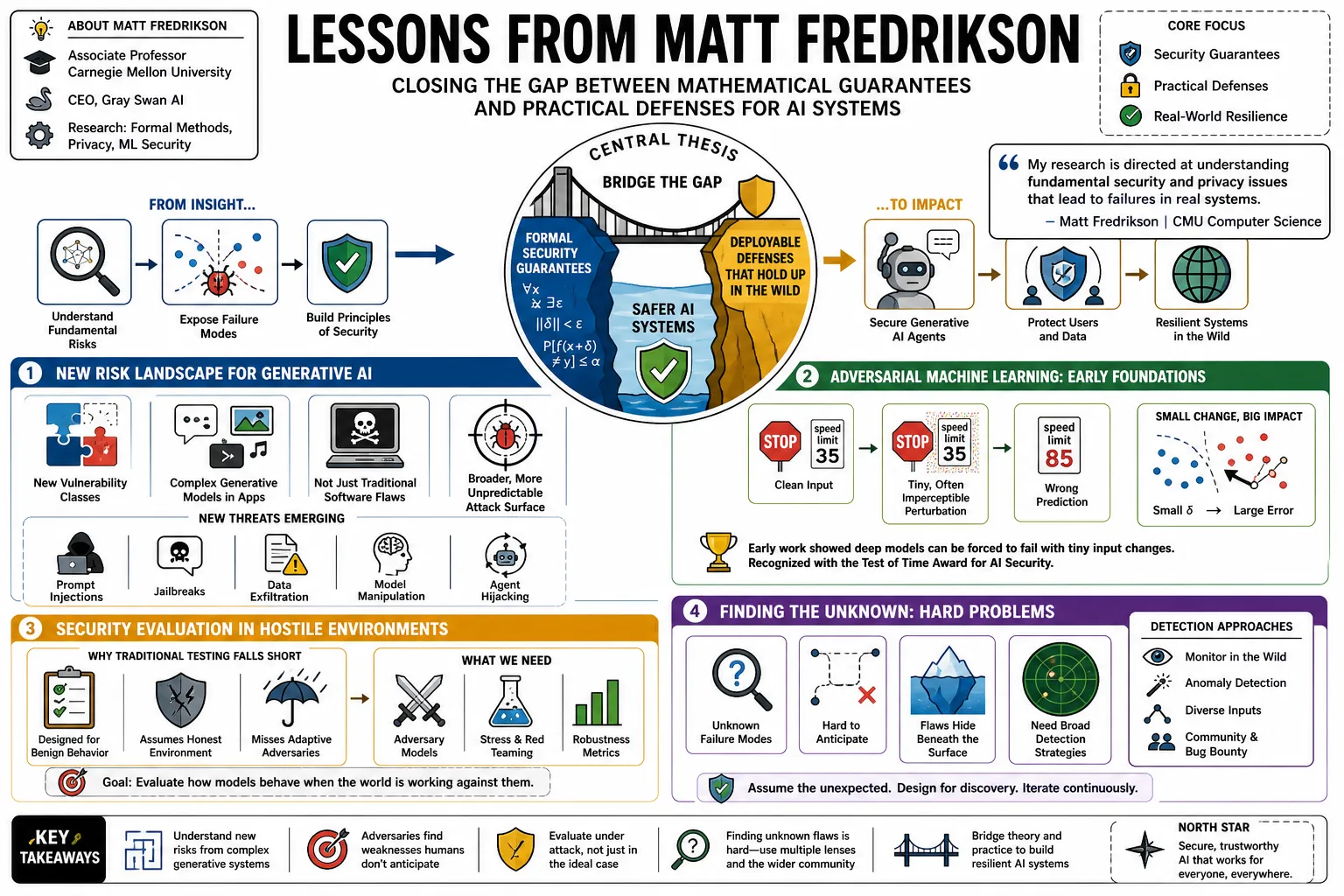
Matt Fredrikson is an associate professor at Carnegie Mellon University and the CEO of Gray Swan AI, where his research examines the intersection of formal methods, privacy, and machine learning security. His early work helped define the field of adversarial machine learning by demonstrating how slight input manipulations can force models to fail, and he currently focuses on securing generative AI agents against emerging threats like prompt injections. The lessons below map his ongoing efforts to close the gap between mathematical security guarantees and practical, deployable defenses for AI systems.
Part 1: The Foundations of AI Security and Vulnerability
- On the nature of generative AI risks: Integrating complex generative models into applications introduces entirely new vulnerability classes compared to traditional software flaws like memory safety issues. — Reference: LinkedIn Interview with John Hammond
- On diagnosing real-world failures: "My research is directed at understanding fundamental security and privacy issues that lead to failures in real systems." — Source: Matt Fredrikson | Carnegie Mellon University Computer Science Department
- On adversarial machine learning: Early research established that deep learning models could be forced into making incorrect predictions by introducing small, often imperceptible alterations to their inputs. — Reference: Fredrikson Earns Test of Time Award for AI Security
- On evaluating models in hostile environments: Conventional approaches to software correctness are insufficient for evaluating the security risks that arise when trained machine learning models operate in adversarial settings. — Reference: Matt Fredrikson - Software and Societal Systems Department
- On detecting unknown flaws: It is especially difficult to uncover the vulnerabilities unique to generative applications when developers are not even aware that such flaws exist. — Reference: LinkedIn Interview with John Hammond
- On model opacity: Integrating an AI model into a standard application is like dropping an opaque, wildly complex black box into the system, making it difficult to detect embedded risks. — Reference: LinkedIn Interview with John Hammond
- On the lag in defensive knowledge: In the realm of privacy and data confidentiality, scientific understanding continues to fall significantly behind the urgent demand for reliable defensive strategies. — Reference: Matt Fredrikson | Carnegie Mellon University Computer Science Department
- On the unpredictability of AI inputs: Generative AI models act as massively complex programs that take completely freeform, unstructured inputs, making it difficult to anticipate how they will interpret adversarial data. — Reference: LinkedIn Interview with John Hammond
- On defending against current risks: Because organizations are actively deploying generative AI now, researchers must deliver immediate, practical mitigation technologies rather than waiting for hypothetical future fixes. — Reference: LinkedIn Interview with John Hammond
Part 2: Privacy and Data Confidentiality in Machine Learning
- On model inversion: Attackers can exploit machine learning models to infer confidential facts about the sensitive data originally used to train the system. — Reference: Matt Fredrikson - Software and Societal Systems Department
- On training data exposure: While researchers have extensively studied the risks of leaking source data directly, the vulnerabilities introduced when machine learning models trained on that data are embedded in applications remain less understood. — Reference: Matt Fredrikson | Carnegie Mellon University Computer Science Department
- On adversarial uncertainty: Effectively reasoning about privacy within software systems requires methods to define and restrict what an adversary can infer or remain uncertain about. — Reference: Matt Fredrikson | Carnegie Mellon University Computer Science Department
- On privacy-aware programming: Equipping developers who lack domain expertise with formal methods and language-based techniques is essential for creating correct, privacy-conscious code. — Reference: Matt Fredrikson | Carnegie Mellon University Computer Science Department
- On mathematical privacy frameworks: Although frameworks like differential privacy offer underlying mathematical guarantees, it is frequently difficult to translate those guarantees into protections against tangible privacy threats in actual applications. — Reference: Matt Fredrikson | Carnegie Mellon University Computer Science Department
- On logic and counting problems: Applying automated reasoning techniques for logics with counting can help reduce adversarial uncertainty about confidential information to constrained, manageable problems. — Reference: Matt Fredrikson | Carnegie Mellon University Computer Science Department
- On probabilistic programming: Using probabilistic programming languages allows developers to write formal assumptions that make it possible to reason thoroughly about the security properties of trained generative models. — Reference: Matt Fredrikson | Carnegie Mellon University Computer Science Department
- On secure code generation: The integration of differential privacy with automated code generation tools provides a new pathway to producing safer software from AI systems. — Reference: dblp: Matt Fredrikson
Part 3: Adversarial AI and Prompt Injection
- On automated red-teaming: Automated adversarial testing tools can discover model vulnerabilities and break alignment controls more consistently within fixed timeframes than human red-teamers. — Reference: AI Agent Security Is an Infrastructure Problem — Not a Model Problem
- On generating adversarial inputs: Appending incomprehensible gibberish or specific text suffixes to prompts can successfully bypass guardrails and compromise even less sophisticated open-source models. — Reference: LinkedIn Interview with John Hammond
- On indirect prompt injections: AI agents face significant vulnerabilities to indirect prompt injections, highlighting the need for robust defensive measures against stealthy attacks embedded in the environment. — Reference: dblp: Matt Fredrikson
- On model size and safety: There is no correlation between a model's advanced reasoning capabilities and its robustness against adversarial prompt injection; frontier models can break as easily as smaller ones. — Reference: AI Agent Security Is an Infrastructure Problem — Not a Model Problem
- On mitigating jailbreaks: Constructing applications that are genuinely resilient to prompt injections and jailbreak attacks is a formidable challenge that currently lacks perfect technological solutions. — Reference: LinkedIn Interview with John Hammond
- On discovering new exploit modes: Security researchers should expect to continually uncover new methods of jailbreaking and breaking models as generative systems are deployed in novel scenarios. — Reference: LinkedIn Interview with John Hammond
- On red teaming efficiency: Researchers are discovering Pareto optimal approaches for red teaming, balancing the effectiveness of jailbreaking large language models against the computational resources required to test them. — Reference: dblp: Matt Fredrikson
- On stealthy sabotage: Adversaries can hide Trojan attacks directly within an LLM's vocabulary, leading to the covert corruption of model composition. — Reference: dblp: Matt Fredrikson
- On community red teaming: Prize-backed challenges can translate a model developer's concrete safety objectives into diverse human attacks while returning useful data and signals to the upstream lab. — Reference: Latent Space — Red-Teaming after Mythos
- On testing models and agents: Adversarial evaluations should cover both base chat models and tool-using agents because the added tools and autonomy create different attack surfaces. — Reference: Latent Space — Red-Teaming after Mythos
- On honest automation benchmarks: Automated red teaming can find more breaks than people within a fixed task and time window without proving that it is universally superhuman. — Reference: Latent Space — Red-Teaming after Mythos
- On evaluation realism: Safety tests built from obviously artificial websites, addresses, or scenarios can make models recognize the simulation and behave differently from real deployments. — Reference: Latent Space — Red-Teaming after Mythos
- On different failure modes: Humans and browser agents should not be ranked on a single notion of robustness because phishing and prompt injection exploit fundamentally different weaknesses. — Reference: Latent Space — Red-Teaming after Mythos
Part 4: AI Agents and System-Level Architecture
- On infrastructure over models: Securing AI agents relies on designing robust infrastructure and deterministic guardrails rather than depending solely on the internal safety of a language model. — Reference: AI Agent Security Is an Infrastructure Problem — Not a Model Problem
- On the "lethal trifecta": Prompt injection succeeds when an agent ingests untrusted data, accesses private information, and has an exfiltration path; eliminating any one of these architectural legs neutralizes the attack. — Reference: AI Agent Security Is an Infrastructure Problem — Not a Model Problem
- On agent refusal boundaries: Establishing clear refusal mechanisms for AI agents requires setting principled criteria so agents know when to reject harmful offensive security tasks. — Reference: A New Framework for Cybersecurity Refusals in AI Agents
- On the dual-use dilemma: "Unlike many safety domains, offensive security tools have legitimate uses—the same techniques used by attackers are essential for defensive security testing, vulnerability research, and red teaming." — Source: A New Framework for Cybersecurity Refusals in AI Agents
- On evaluating refusal behavior: Current frontier models show poor contextual awareness when deciding what tasks to refuse, resulting in either near-zero refusal rates or excessive overrefusal in legitimate cybersecurity contexts. — Reference: A New Framework for Cybersecurity Refusals in AI Agents
- On isolating execution authority: Critical agent actions, such as file system modifications or code execution, must be handled through strict, deterministic rules and separated from the LLM's direct judgment. — Reference: AI Agent Security Is an Infrastructure Problem — Not a Model Problem
- On continuous red teaming: Subjecting agents to automated adversarial pressure should be an essential milestone before rolling them out to production, as scaling up the model will not patch an underlying architectural flaw. — Reference: AI Agent Security Is an Infrastructure Problem — Not a Model Problem
- On agentic capabilities: As language models gain the ability to perform complex, long-horizon tasks autonomously, they simultaneously introduce severe new risks in cybersecurity domains. — Reference: A New Framework for Cybersecurity Refusals in AI Agents
- On cybersecurity utility: Applying blanket refusal training to language models often diminishes their value for benign, defensive security testing and general utility. — Reference: A New Framework for Cybersecurity Refusals in AI Agents
- On enforcing actions, not sightings: A guardrail should stop an agent when its planned action violates policy, not automatically halt a long-running task merely because the agent encountered a prompt injection. — Reference: Latent Space — Red-Teaming after Mythos
- On agent identity and consent fatigue: Agent-specific identities and role policies remain immature, and repeatedly asking users to grant exceptions risks training them to approve unsafe access reflexively. — Reference: Latent Space — Red-Teaming after Mythos
- On private red-team arenas: Enterprises can preserve the confidentiality of unreleased agents by testing them with a vetted subset of red teamers rather than exposing them to an unrestricted public arena. — Reference: Latent Space — Red-Teaming after Mythos
Part 5: Bridging Theoretical Guarantees and Practical Defenses
- On theoretical versus practical security: "Some of the key outstanding challenges in security and privacy lie in figuring out why promising theoretical approaches oftentimes do not translate into effective defenses." — Source: Matt Fredrikson - Software and Societal Systems Department
- On actionable formal analysis: Formal analysis should provide deep insights into a system's potential flaws and contribute to countermeasures that offer provable, mathematically sound guarantees. — Reference: Matt Fredrikson | Carnegie Mellon University Computer Science Department
- On implementation pitfalls: "The main appeal of these frameworks is their ability to provide rigorous guarantees, but subtle implementation mistakes often obviate these guarantees in practice." — Source: Matt Fredrikson - Software and Societal Systems Department
- On real-world measurement: Alongside developing provable countermeasures, researchers must evaluate and measure the actual effectiveness of these solutions when deployed in real, complex environments. — Reference: Matt Fredrikson - Software and Societal Systems Department
- On hybrid enforcement models: Studying the implementation flaws of cryptographic primitives highlights the need for hybrid enforcement frameworks that handle stateful security policies in modern web applications. — Reference: Matt Fredrikson - Software and Societal Systems Department
- On making code security measurable: By using tools like process reward models for code security, defenders can better quantify and optimize the security alignment of AI-generated code. — Reference: dblp: Matt Fredrikson
- On evolving remediation: Unlike patching a conventional buffer overflow, fixing an AI vulnerability rarely has one obvious code-level remedy, so defenses must improve alongside continuing research into model robustness and policy enforcement. — Reference: Latent Space — Red-Teaming after Mythos
- On hidden incidents: The absence of a publicized AI-security breach does not prove safety; damaging incidents may already have occurred without disclosure. — Reference: Latent Space — Red-Teaming after Mythos