# Lessons from Michael I. Jordan
Michael I. Jordan is a computer scientist and statistician who connected probabilistic graphical models with machine learning. His recent work uses microeconomics to design reliable, decentralized data systems. This profile collects his arguments on the reality of artificial intelligence, the math of decision-making, and the need for a new engineering discipline.
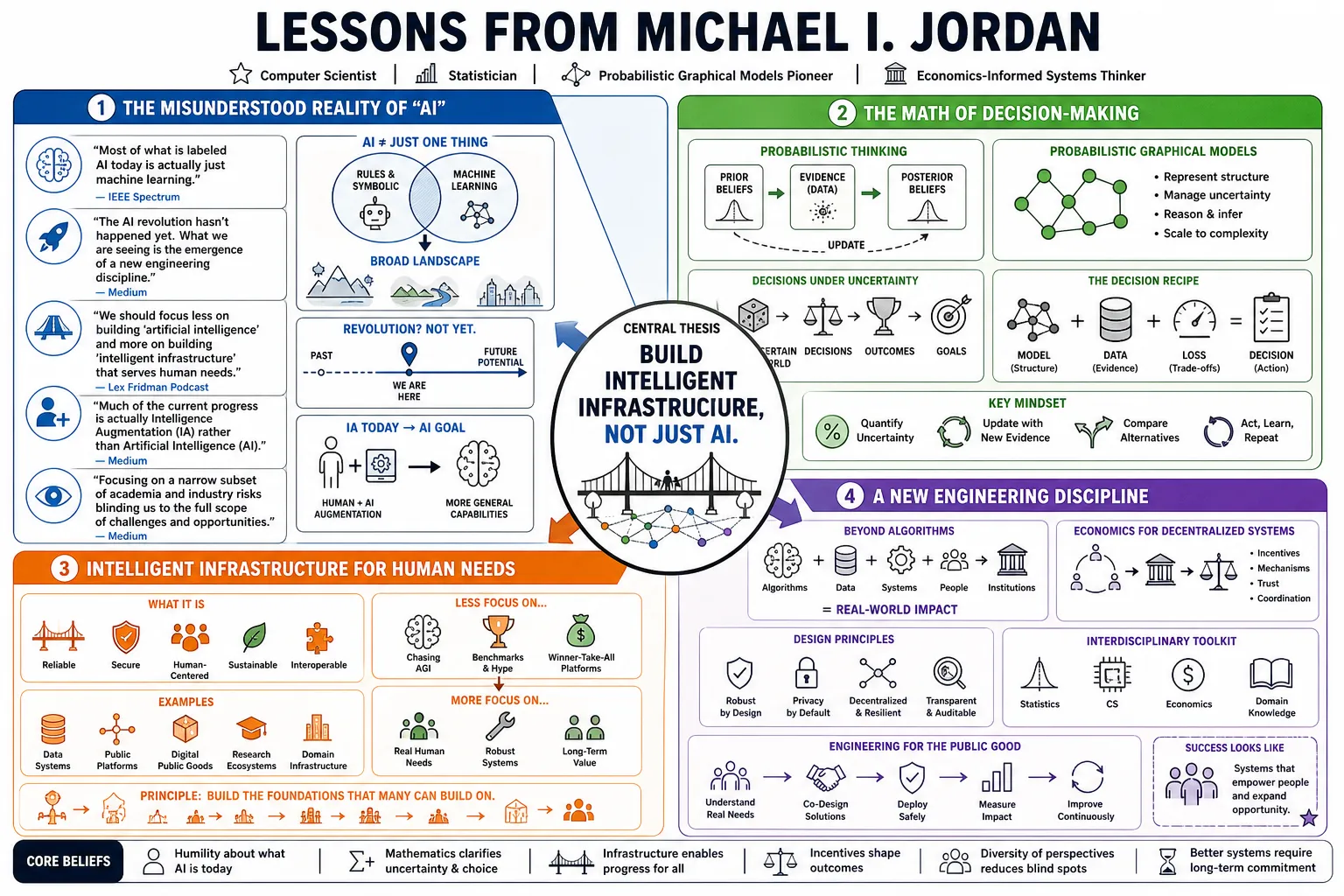
Part 1: The Misunderstood Reality of "AI"
- On the term AI: "Most of what is labeled AI today is actually just machine learning." — Source: IEEE Spectrum
- On the AI revolution: "The AI revolution hasn't happened yet. What we are seeing is the emergence of a new engineering discipline." — Source: Medium
- On intelligent infrastructure: "We should focus less on building 'artificial intelligence' and more on building 'intelligent infrastructure' that serves human needs." — Source: Lex Fridman Podcast
- On intelligence augmentation: "Much of the current progress is actually Intelligence Augmentation (IA) rather than Artificial Intelligence (AI)." — Source: Medium
- On the danger of narrow focus: "Focusing on a narrow subset of academia and industry risks blinding us to the full scope of challenges and opportunities." — Source: NRI Digital
- On public dialogue: "The current public dialog about AI is highly constrained and often misses the fundamental realities of what the technology actually does." — Source: Harvard Business Review
- On the imitation game: "The Turing Test set the field back by framing intelligence as human imitation rather than system-level problem-solving." — Source: Lex Fridman Podcast
- On science fiction: "The narrative of AI has been too heavily influenced by science fiction, leading to unrealistic expectations." — Source: IEEE Spectrum
- On systemic thinking: "Intelligence is a property of multiple agents interacting in a structured environment, rather than a process confined to a single brain." — Source: Inria
Part 2: Machine Learning as a New Engineering Discipline
- On engineering maturity: "Machine learning is currently where civil engineering was before the invention of the right mathematical tools to guarantee bridges wouldn't fall down." — Source: Medium
- On guarantees: "We need an engineering discipline built on principles that provide guarantees about performance, fairness, and privacy." — Source: AMSTAT News
- On scale and reliability: "Building large-scale, reliable systems requires mathematical rigor that goes beyond simply training models on large datasets." — Source: IEEE Spectrum
- On the chemical engineering analogy: "Before chemical engineering, there was just chemistry. Now, we are moving from basic algorithms to the chemical engineering of data." — Source: Lex Fridman Podcast
- On trial and error: "We cannot rely on trial and error when deploying systems that affect millions of human lives." — Source: Inria
- On system design: "The true challenge spans the entire pipeline—from data collection to decision-making to feedback loops—rather than stopping at the algorithm." — Source: AMSTAT News
- On infrastructure: "Intelligent infrastructure requires designing systems that are resilient to shifting environments and unexpected human behavior." — Source: Harvard Business Review
- On safety: "Safety in AI is an engineering problem, requiring the same kind of safety margins and testing protocols found in aerospace." — Source: Medium
- On pragmatism: "We must replace the magical thinking around AI with pragmatic engineering solutions." — Source: IEEE Spectrum
Part 3: Markets, Economics, and Intelligence
- On markets as intelligence: "Markets are a form of collective intelligence that are often far more reliable than centralized algorithms." — Source: Amazon Science
- On mechanism design: "Machine learning needs to integrate deeply with microeconomics and mechanism design to function in the real world." — Source: Lex Fridman Podcast
- On two-sided markets: "The most impactful applications of ML are in two-sided markets, connecting producers and consumers dynamically." — Source: Inria
- On scarcity: "Traditional ML assumes infinite resources; real-world ML must account for scarcity and competition." — Source: AMSTAT News
- On incentives: "If you don't model the incentives of the humans providing the data, your learning system will eventually break down." — Source: ICLR
- On decentralized decision-making: "Centralized AI is a bottleneck. The future lies in decentralized networks of agents making localized decisions." — Source: Amazon Science
- On value creation: "Data derives its value directly from the economic context in which it is used." — Source: Lex Fridman Podcast
- On signaling: "Algorithms must help market participants signal their preferences and willingness to pay, creating new economic vocabularies." — Source: AMSTAT News
- On recommendation systems: "A recommender system must manage the resulting market dynamics when thousands want the same thing, instead of merely predicting individual desires." — Source: ICLR
- On collective well-being: "We should use ML to design economic mechanisms that internalize externalities and promote social welfare." — Source: Inria
Part 4: The Limitations of Human Imitation
- On human-like AI: "The obsession with building a single, human-like intelligence distracts us from building highly useful, specialized systems." — Source: IEEE Spectrum
- On natural language: "Deep understanding of language remains an amazingly interesting scientific challenge that current LLMs only scratch the surface of." — Source: Lex Fridman Podcast
- On pattern recognition: "Current deep learning systems are exquisite pattern recognizers, but they are not reasoning entities." — Source: Medium
- On semantics: "We have built systems that manipulate syntax masterfully, but true semantic grounding in the physical world is still largely missing." — Source: Lex Fridman Podcast
- On cognition: "It is a category mistake to equate the computational capacity of a neural network with human cognition." — Source: El País
- On replacing humans: "The goal of technology has always been to augment human capabilities as opposed to replacing the human mind." — Source: Medium
- On artificial autonomy: "Autonomy in machines is useful in narrow domains, but general autonomy is a poorly defined and potentially dangerous goal." — Source: IEEE Spectrum
- On anthropomorphism: "Anthropomorphizing algorithms leads to poor policy decisions and misplaced public anxiety." — Source: Harvard Business Review
- On specific intelligence: "We should celebrate the specific, non-human intelligence of algorithms, just as we celebrate a calculator's ability to divide." — Source: Lex Fridman Podcast
- On the brain metaphor: "The brain is an inspiration for machine learning, but it is not the blueprint. We are building airplanes, not flapping wings." — Source: Reddit AMA
Part 5: Statistics, Data, and Uncertainty
- On statistics: "Machine learning is fundamentally a statistical discipline; ignoring the principles of statistics leads to brittle models." — Source: AMSTAT News
- On uncertainty: "A system that cannot express its uncertainty is inherently unsafe for critical decision-making." — Source: ICLR
- On data quality: "We are drowning in data but starving for high-quality, unbiased, and representative data." — Source: IEEE Spectrum
- On inference: "Statistical inference is the mathematical foundation of turning raw data into actionable knowledge." — Source: Medium
- On error bars: "Every prediction output by a machine learning model should come with a calibrated error bar." — Source: Lex Fridman Podcast
- On big data: "Big data is not a substitute for good experimental design and causal reasoning." — Source: Reddit AMA
- On causality: "Discovering correlations is easy; establishing causality is the central challenge of modern data science." — Source: AMSTAT News
- On optimization vs inference: "Optimization finds a minimum, but inference tells you how much you can trust that minimum." — Source: Reddit AMA
- On nonparametrics: "The next frontier for applied nonparametrics is to get real about real-world, large-scale applications." — Source: Reddit AMA
- On graphical models: "Graphical models provide a necessary language for bridging probability theory and graph theory to handle complex dependencies." — Source: Lex Fridman Podcast
Part 6: Distributed Systems and Collective Intelligence
- On cloud computing: "The integration of machine learning with cloud computing distributed systems is the actual revolution of our era." — Source: Medium
- On federated learning: "We must move computation to the data, rather than gathering all data into a central repository, to preserve privacy." — Source: Amazon Science
- On the Internet of Things: "The true power of AI will be felt when it acts as the invisible intelligence coordinating the Internet of Things." — Source: Harvard Business Review
- On multi-agent systems: "We are shifting from single-agent reinforcement learning to complex, multi-agent systems that model entire economies." — Source: ICLR
- On local computation: "Edge computing allows devices to learn locally and share only the updates, reducing latency and increasing security." — Source: Inria
- On coordination: "The hardest problems in intelligent infrastructure are problems of coordination among distributed components." — Source: IEEE Spectrum
- On emergent behavior: "Intelligence is an emergent property of millions of simple algorithms interacting across a network." — Source: Lex Fridman Podcast
- On data silos: "Breaking down data silos while maintaining strict access controls is an essential systems engineering challenge." — Source: AMSTAT News
- On open source: "The open-source community is the true engine of progress in distributed machine learning infrastructure." — Source: Reddit AMA
Part 7: Hubris, Hype, and the Tech Industry
- On hubris: "There’s a little too much hubris in the world of AI right now." — Source: El País
- On terminology: "Calling every statistical model 'AI' does a disservice to both the history of the field and the public understanding of the technology." — Source: IEEE Spectrum
- On corporate narratives: "Tech companies have a financial incentive to oversell the capabilities of their algorithms." — Source: Medium
- On media representation: "The media cycle oscillates between utopian fantasies and apocalyptic fears, neither of which accurately reflects the science." — Source: Harvard Business Review
- On basic research: "We must protect funding for fundamental research from being entirely swallowed by the commercial pursuit of artificial general intelligence." — Source: Lex Fridman Podcast
- On regulation: "Effective regulation requires policymakers who understand the difference between a pattern-matching algorithm and a reasoning system." — Source: El País
- On the Turing Test: "The Turing Test is an intellectual dead end that encourages trickery over genuine technical progress." — Source: Lex Fridman Podcast
- On intellectual honesty: "Researchers have a responsibility to be transparent about the limitations and failure modes of their models." — Source: ICLR
- On historical cycles: "The AI winter taught us what happens when hype dramatically outpaces actual technical capabilities." — Source: Reddit AMA
Part 8: The Philosophy of Research and Learning
- On failure: "I've had way more failures than successes. Trying out existing ideas in new mathematical contexts is fruitful, but mostly it's fool's gold." — Source: Reddit AMA
- On balance: "I spend half of each day minimizing entropy and half of each day maximizing entropy. The precise calibration of that number determines my happiness." — Source: Reddit AMA
- On cross-pollination: "The most exciting breakthroughs occur when you borrow a concept from control theory or physics and apply it to statistics." — Source: Lex Fridman Podcast
- On foundational math: "Students should spend less time chasing the latest deep learning architecture and more time understanding linear algebra and optimization." — Source: Reddit AMA
- On problem selection: "Don't work on a problem just because everyone else is; work on the problems that will still matter in twenty years." — Source: AMSTAT News
- On collaboration: "Science is a deeply social process. The myth of the lone genius fundamentally misunderstands how modern computational research happens." — Source: Inria
- On continuous learning: "The field moves so quickly that the only sustainable advantage is a deep, principled understanding of the underlying mathematics." — Source: Lex Fridman Podcast
- On curiosity: "True research is driven by a dissatisfaction with the current explanations of how the world works." — Source: ICLR
- On the future: "We are at the dawn of a new discipline. The most important work in machine learning hasn't even been formalized yet." — Source: Medium