Mike Mentzer was a competitive bodybuilder and trainer who developed Heavy Duty, his approach to high-effort, low-volume bodybuilding. He adapted ideas from Arthur Jones and explained how he changed training volume and frequency in his work with clients. — Mike Mentzer’s Last Interview.
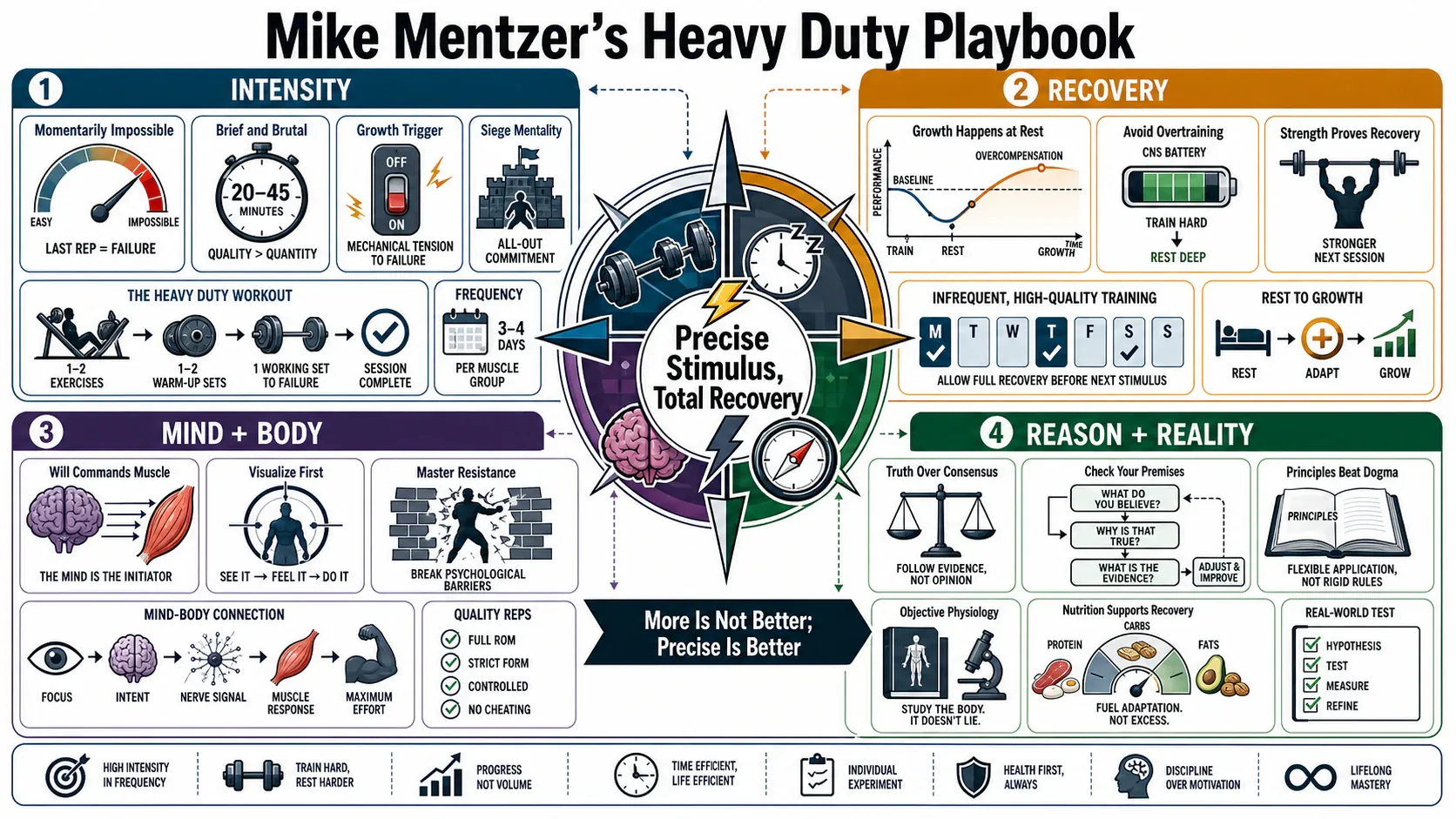
Part 1: The Heavy Duty Philosophy & Intensity
- Distinguish a hard last rep from rest-pause training: Mentzer described the last repetition of a conventional Heavy Duty set as the one that required maximal effort. His rest-pause method instead separated hard individual repetitions with brief breaks. — Heavy Duty: Rest/Pause Training, Part 1.
- Understand how Mentzer sequenced pre-exhaustion sets: Mentzer recalled pairing an isolation exercise with a compound movement in his competitive routine. For his legs, he went directly from leg extensions to leg presses, an example of the sequence he called pre-exhaustion. — Mike Mentzer’s Most Productive Routine
- Consider effort, volume and frequency together: Mentzer thought designing a Heavy Duty routine required three decisions: how hard the exercise should be, how much to do, and how often to repeat it. — Mike Mentzer’s Last Interview.
- Keep high-effort sessions brief in Heavy Duty: Mentzer made brief workouts a feature of Heavy Duty. He recalls reducing the number of sets and spacing sessions further apart as he refined his approach with clients. — Mike Mentzer’s Last Interview.
- Distinguish beginners from experienced lifters: Mentzer observed that starting resistance training can present a new challenge even at moderate effort. He drew a distinction between that starting point and the training demands he associated with more experienced lifters. — Heavy Duty: Rest/Pause Training, Part 1.
Part 2: Recovery, Frequency, and Overcompensation
- Treat recovery as part of the program: Mentzer distinguished the stress of a workout from the recovery that followed it. In Heavy Duty he treated time between workouts as part of the program. — Heavy Duty: Reach Your Potential In One Year.
- Consider the demands of a workout beyond the target muscle: Mentzer used the squat to illustrate why he looked at the demands of a workout beyond the muscle being trained. He pointed to the higher demands on breathing and circulation during a hard working set. — As the Body Changes, Training Requirements Change.
- Adjust how often sessions recur: Mentzer reports using longer breaks between sessions for some clients as he experimented with lower-frequency versions of Heavy Duty. — Mike Mentzer’s Last Interview.
- Reassess workload as the weights increase: Mentzer argued that a routine could become more demanding even if the number of sets stayed the same. In Heavy Duty he responded by reassessing volume and the time between sessions. — As the Body Changes, Training Requirements Change.
- Track performance over successive sessions: Mentzer used changes in the weight lifted and the repetitions completed to track progress on the same exercise. — Heavy Duty: Reach Your Potential In One Year.
Part 3: The Mind-Body Connection & Willpower
- Connect each workout to a longer-term goal: Mentzer argued that a long-term goal could make individual workouts feel more meaningful. He used preparing for Mr. Olympia as his example. — High-Intensity Training the Mike Mentzer Way.
- Rehearse a goal mentally: Mentzer recalls mentally rehearsing his performance and the announcement of the winner before a contest. He used those images to keep the goal concrete during preparation. — High-Intensity Training the Mike Mentzer Way.
- Review the last session before setting the next goal: Mentzer says he reviewed the weights, sets and repetitions from the previous session and wrote down his targets for the next one. — High-Intensity Training the Mike Mentzer Way.
Part 4: Objectivism, Logic, and Reason
- Judge training ideas by the reasoning behind them: Mentzer criticized training advice that leaned on a champion’s reputation. He wanted readers to ask what evidence and reasoning supported a routine. — Actualize Your Muscular Potential, Part 1.
- Use a theory to decide what to test: Mentzer illustrated his reasoning with a question: if a routine of 20 sets fails, should the lifter try more or fewer? In his own method he used one set as the starting point for that inquiry. — Mike Mentzer’s Last Interview.
- Set standards that matter to you: Mentzer encouraged bodybuilders to hold on to a demanding personal ideal and connect the pursuit of achievement with self-esteem. — High-Intensity Training the Mike Mentzer Way.
- Apply philosophical ideas to practical choices: Mentzer described himself as a student of Ayn Rand’s Objectivism. He saw a commitment to reason and reality as part of how he approached practical questions, including training. — Mike Mentzer’s Last Interview.
- Revisit a routine when progress stalls: When his clients’ progress stalled on his original program, Mentzer revisited the set count and schedule and tried a lower-volume, less frequent routine. — Mike Mentzer’s Last Interview.
- Ask why a training convention exists: Mentzer questioned the convention of performing every repetition in immediate succession. He used rest-pause to explore what changed when he broke up a set. — Heavy Duty: Rest/Pause Training, Part 1.
Part 5: Nutrition, Fuel, and Calories
- Start a nutrition discussion with what the person actually eats: In his seminar, Mentzer asked trainees to record their ordinary food intake before discussing changes. He used the record to start from each person’s habits. — Heavy Duty Seminar, Part 2.
- Estimate maintenance intake before changing it: Mentzer treated the average intake of a trainee whose weight was stable as a starting estimate for maintenance. He used the example to explain why different people begin with different calorie budgets. — Heavy Duty Seminar, Part 2.
- Carbohydrates had a place in Mentzer’s bodybuilding diet: Mentzer defended carbohydrates as a source of energy for hard training and argued against excluding them categorically. — Heavy Duty Nutrition, “The Essential Nutrients”.
- Separate the role of training from the role of food: Mentzer saw hard training and adequate nutrition as distinct parts of his program. He argued that simply eating more did not make up for a workout he considered insufficient. — Heavy Duty Seminar, Part 2.
- Question protein marketing: Mentzer criticized bodybuilding marketing that encouraged trainees to assume they needed ever more protein. He discussed protein in the context of the overall diet. — Heavy Duty Nutrition, “The Essential Nutrients”.
- Describe diet as a mix of macronutrients: In his contest-preparation writing, Mentzer described a diet that included carbohydrate, protein and fat from several food groups. He proposed a particular split for that context. — High-Intensity Training the Mike Mentzer Way.
- Question restrictive contest diets: Mentzer criticized the practice of relying on nothing but tuna and water when preparing for a bodybuilding contest. — Mike Mentzer: Losing Bodyfat.
Part 6: Individuality and Self-Actualization
- Compare your posing with your own earlier work: Mentzer used the mirror during posing practice to compare his current condition and presentation with his own earlier work. — High-Intensity Training the Mike Mentzer Way.
- Separate self-esteem from competitive approval: Mentzer warned that relying on other people’s expectations could make competition feel like a threat to self-esteem. He emphasized developing competence for one’s own satisfaction. — High-Intensity Training the Mike Mentzer Way.
- Interpret progress in light of the lifter’s starting point: Mentzer used two clients’ progress on the same leg-extension machine to illustrate how starting experience and individual potential complicate comparisons. — Heavy Duty: Reach Your Potential In One Year.
- Find motivation in the work itself: Mentzer encouraged athletes to draw motivation from developing their own competence rather than relying on other people’s expectations. — High-Intensity Training the Mike Mentzer Way.
Part 7: Critiques of High Volume & The Establishment
- Understand why Heavy Duty used fewer sets: Mentzer’s later Consolidation Program emphasized compound movements so trainees could cover several muscle groups with fewer total sets. — As the Body Changes, Training Requirements Change.
- Ask how commercial incentives shape training advice: Mentzer argued that supplement sales and celebrity endorsements could shape what bodybuilding magazines promoted. He urged readers to scrutinize the reasoning behind the advice they saw. — Actualize Your Muscular Potential, Part 1.
- Distinguish effort from the amount of weight lifted: Mentzer described his version of high-intensity training as using deliberate, controlled repetitions. He distinguished working hard from relying on extremely heavy weights. — Mike Mentzer’s Last Interview.
- Distinguish the pump from evidence of progress: Mentzer noted that several rapid repetitions can produce a satisfying pump. He cautioned against treating that sensation as evidence that the workout stimulated growth. — Heavy Duty: Rest/Pause Training, Part 1.
Part 8: Intellectualism and Life Beyond the Gym
- Cultivate interests beyond bodybuilding: Mentzer urged competitors to develop interests outside the sport. He pointed to his own magazine writing as one activity he continued after retiring. — Mike Mentzer’s Last Interview.
- Read across the subjects that inform your practice: John Little describes Mentzer marking up books on philosophy and science. In his copy of Hans Selye’s The Stress of Life, Mentzer made notes linking ideas about stress to training and recovery. — Inside the Mind of Mike Mentzer.