Molson Hart is the CEO of Viahart and the creator of Brain Flakes, known for his deep expertise in e-commerce, global supply chains, and manufacturing. His insights offer a pragmatic, unfiltered look at the realities of selling on Amazon, operating in China, and building a resilient business infrastructure. Through his writing and podcast appearances, he advocates for operational excellence, reshoring American manufacturing, and rigorous decision-making frameworks.
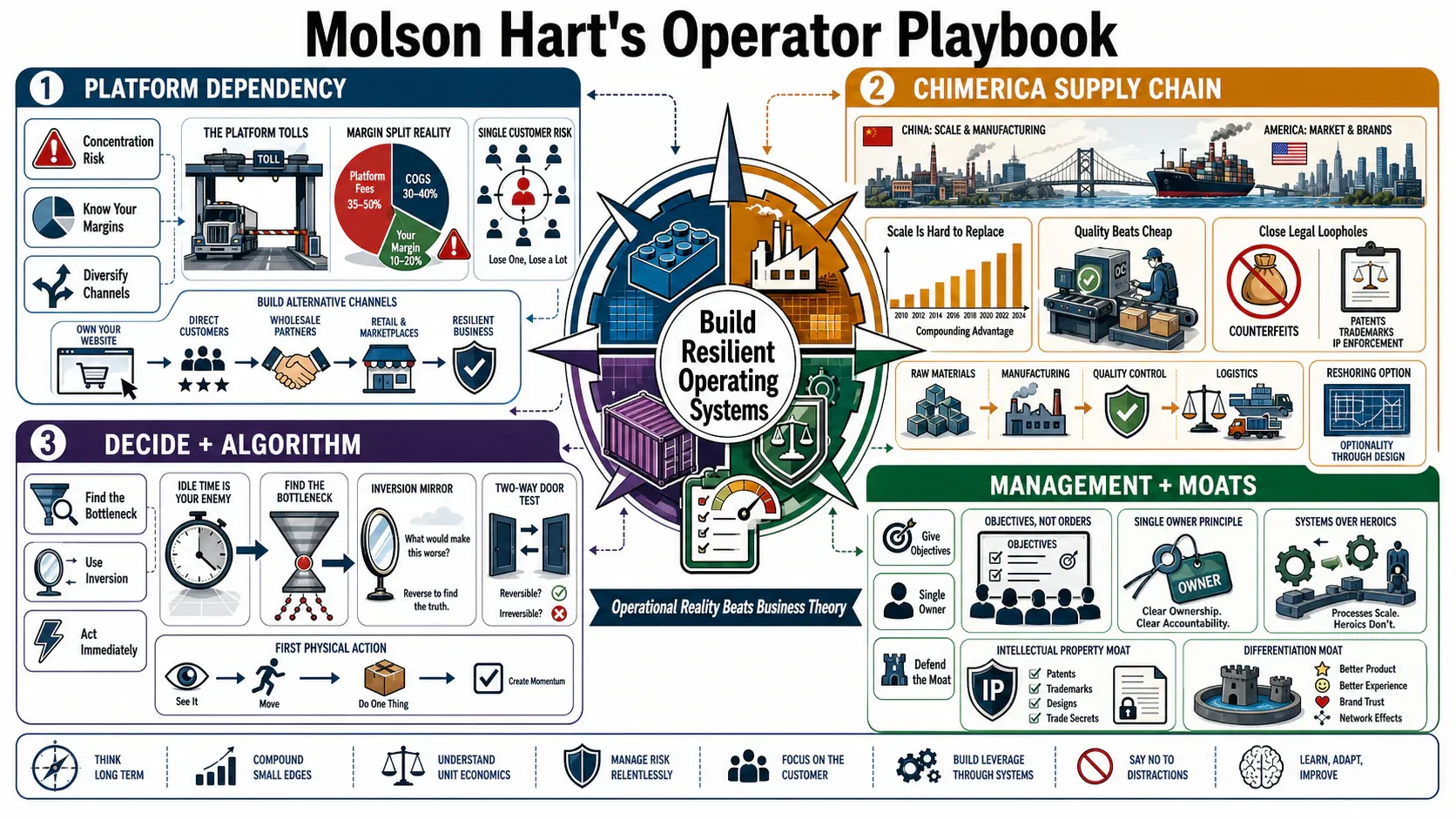
Part 1: The Realities of Amazon & E-Commerce
- On Platform Dependency: "In the e-commerce world, we call it being Amazon's bitch." — Source: [Medium]
- On Vendor Concentration: "You don't want too many sales concentrated with a single customer because if they change their mind about you, your business can evaporate overnight." — Source: [MolsonHart.com]
- On Bankruptcy Risk: "Were we to be suspended from selling on Amazon.com, it would probably take 3–6 months before we'd be bankrupt." — Source: [Medium]
- On Platform Costs: "Amazon is the most expensive e-commerce platform to sell on." — Source: [MolsonHart.com]
- On Profit Margins: "If we sell $100 worth of product on our Amazon store, on average, we get $48.25 back... On our website... we get $83.10 back!" — Source: [MolsonHart.com]
- On Advertising Fees: "Even when a customer searches for your brand, if you want to be seen before your competition, you need to pay Amazon." — Source: [MolsonHart.com]
- On Pricing Parity: "Amazon prohibited us from listing products on our own website for less than we sold that same product for on Amazon." — Source: [Medium]
- On Monopoly Power: "Amazon's share of the US e-commerce market is over 50%... the US Department of Justice should investigate Amazon's pricing parity and buyer diversion policies." — Source: [Medium]
- On Boycotting Amazon: "I will be boycotting Amazon's advertising next week to protest the company's greed." — Source: [MediaPost]
- On Diversification: "For us, the best way to diversify our revenue away from Amazon has been through wholesale sales." — Source: [MolsonHart.com]
Part 2: The "Chimerica" Supply Chain
- On Chimerica: "While the two nations are deeply interdependent, they are culturally and politically drifting apart." — Source: [Unsupervised Learning]
- On Cultural Asymmetry: "China is unique among major U.S. trading partners for being culturally less aware of the U.S., creating significant insulation." — Source: [Unsupervised Learning]
- On Pragmatism: "The Chinese business environment is driven by extreme pragmatism and rapid pivoting, contrasting with the slower, more rigid planning common in U.S. business." — Source: [Unsupervised Learning]
- On Manufacturing Quality: "Chinese labor isn't just cheaper; it's better. We need to fix that." — Source: [MolsonHart.com]
- On Corruption: "I experienced the dark side of Chinese manufacturing firsthand, including being shaken down by corrupt police." — Source: [Reddit]
- On Counterfeiting: "Two of my own Chinese employees counterfeited my products, leading to significant financial losses." — Source: [Reddit]
- On Replacement Fallacies: "I am skeptical that other nations like Vietnam or India can easily replace China as the world's factory in the near term due to China's massive scale and integrated logistics." — Source: [The Fort Podcast]
- On Structural Advantages: "China's manufacturing infrastructure is world-class, making the breakup incredibly difficult." — Source: [Bring It Home Podcast]
- On Easy Money: "U.S. easy money and debt-driven policies enable bad foreign policy and bailouts of failing firms, weakening the U.S. position." — Source: [Unsupervised Learning]
- On Legal Loopholes: "Outdated laws allow unaccountable Chinese retailers to flood the U.S. market with unsafe or infringing products." — Source: [Medium]
Part 3: The Decision-Making Algorithm (DECIDE)
- On Idle Time: "Convert idle time—like commuting or waiting in line—into productive action and high-quality decision-making." — Source: [MolsonHart.com]
- On Identifying the Bottleneck: "Identify the single biggest problem currently hindering your happiness or progress." — Source: [MolsonHart.com]
- On Inner Monologue: "Explicitly announce the problem to yourself using your inner monologue to focus the mind and simplify the problem." — Source: [MolsonHart.com]
- On Clearing Distractions: "Remove external stimuli. Put away your phone, find a quiet space, and stay on the mission until a solution is reached." — Source: [MolsonHart.com]
- On Mental Models: "Apply specific cognitive tools to the problem, such as first principles or inversion." — Source: [MolsonHart.com]
- On Inversion: "Ask yourself, 'How would I not solve this?' to avoid common pitfalls." — Source: [MolsonHart.com]
- On Two-Way Doors: "Determine if a decision is reversible; if so, don't overanalyze it." — Source: [MolsonHart.com]
- On Firm Choices: "After considering options, make a firm choice and verbalize the decision to yourself." — Source: [MolsonHart.com]
- On Immediate Execution: "Immediately identify and perform the first physical action required. If you cannot act immediately, create a specific, time-bound note." — Source: [MolsonHart.com]
Part 4: Management & The 10 Commandments
- On Problem Solving: "Thou shalt not solve thy subordinates' problems. Encourage them to find solutions themselves to foster growth." — Source: [Luca Dellanna Principles]
- On Objectives Over Orders: "Thou shalt not give orders; thou shalt give objectives. Focus on the what and why, letting the team decide the how." — Source: [Luca Dellanna Principles]
- On Accountability: "Thou shalt ensure every task has a single owner to avoid diffusion of responsibility." — Source: [Luca Dellanna Principles]
- On Clarity: "Thou shalt make expectations explicit. Vague instructions lead to poor results and frustration." — Source: [Luca Dellanna Principles]
- On Metrics: "Thou shalt measure what matters. Use data to track progress toward objectives." — Source: [Luca Dellanna Principles]
- On Feedback: "Thou shalt provide immediate and objective feedback. Correct course quickly rather than waiting for annual reviews." — Source: [Luca Dellanna Principles]
- On Systems: "Thou shalt prioritize systems over heroics. Build processes that work even when people make mistakes." — Source: [Luca Dellanna Principles]
- On Culture: "Thou shalt foster a culture of mutual trust and respect. Management should be a support function, not a police force." — Source: [Luca Dellanna Principles]
- On Fairness: "Thou shalt be consistent in discipline and rewards. Fairness is essential for morale and predictability." — Source: [Luca Dellanna Principles]
- On Development: "Thou shalt invest in the development of thy team. The manager's primary job is to make their team better." — Source: [Luca Dellanna Principles]
Part 5: Legal Battles & Intellectual Property
- On Early Defense: "Physical product companies must get a lawyer early to defend their intellectual property." — Source: [Medium]
- On Trademark Litigation: "I spent 7 years and over $1 million dollars fighting a lawsuit over the Brain Flakes trademark." — Source: [MolsonHart.com]
- On Wars of Attrition: "The U.S. legal system allows larger companies to bully smaller ones through prolonged litigation and wars of attrition." — Source: [MolsonHart.com]
- On Hidden Keywords: "Competitors will rebrand but continue to use your trademark as a hidden keyword in Amazon search results to divert customers." — Source: [VitalLaw]
- On Recovery Limitations: "I am skeptical that I will ever recover damages due to the defendants' use of multiple corporate entities and bankruptcy filings." — Source: [MolsonHart.com]
- On Systemic Legal Flaws: "My lawsuit experience highlights the systemic flaws in the U.S. legal system regarding intellectual property defense." — Source: [MolsonHart.com]
- On Discovery Tactics: "Defendants often fail to produce documents, turning discovery into an expensive, protracted dispute." — Source: [MolsonHart.com]
- On Patent Improvements: "Patenting an improvement—like making building discs easier to click together—is crucial for product differentiation, but defending it is costly." — Source: [BrainFlakes.com]
- On Bankruptcy Shields: "Corporate defendants will file for Chapter 11 bankruptcy to effectively stay ongoing trademark litigation and avoid paying damages." — Source: [Westfair Online]
Part 6: Strategy, Moats & The Metal Adage
- On Durable Goods: "The adage says never invest in anything made of metal because, in hard times, its durability causes people to not replace it." — Source: [Medium]
- On the Metal Fallacy: "The idea that durable goods are inherently worse investments than non-durable goods is a poor rule of thumb." — Source: [Medium]
- On Commoditization: "If a product lasts twice as long but costs the same to produce, competition in a commoditized market will eventually drive the price down, halving the industry's value." — Source: [Medium]
- On True Moats: "Brand power, patents, and market share are far more important than whether a product is made of metal or is otherwise durable." — Source: [Medium]
- On Economic Downturns: "During economic downturns, consumers don't need to replace durable goods, leading to stagnant sales for undifferentiated products." — Source: [Medium]
- On Recurring Revenue: "While non-durable goods provide recurring revenue, dominant durable brands like Luxottica prove that durability doesn't preclude massive success." — Source: [Medium]
- On Tinkering: "I advocate for owning two businesses—one for scale and profit, and one for risk diversification—and emphasize tinkering at a small scale before growing." — Source: [The Fort Podcast]
- On Over-Analysis: "Execution is more important than over-analysis; convert idle time into productive planning." — Source: [MolsonHart.com]
- On Self-Censorship: "Self-censorship inhibits the free discussion necessary for innovation and problem-solving." — Source: [Medium]
Part 7: Reshoring & The Future of Manufacturing
- On Reshoring Difficulties: "America underestimates the difficulty of bringing manufacturing back from China; it requires specialized skills and infrastructure." — Source: [Medium]
- On Tariffs: "Escalating trade tensions and high tariffs on Chinese imports make the China-centric model existential for small toy companies." — Source: [YouTube]
- On Local Oversight: "Moving production closer to headquarters allows for better oversight of manufacturing and quality control." — Source: [Bring It Home Podcast]
- On Automation Density: "While China has a higher robot density, the U.S. can become competitive through structural reforms and targeted investments in automation." — Source: [Shanghai Daily]
- On the Bullwhip Effect: "Spikes in demand lead to over-ordering and subsequent troughs. Local manufacturing can help mitigate these fluctuations." — Source: [Bring It Home Podcast]
- On Breaking Up with China: "Breaking up with China is difficult, but the geopolitical and legal risks have made it untenable for many business models." — Source: [X/Twitter Commentary]
- On Supply Chain Fragility: "The U.S. relies too heavily on Chinese manufacturing, which is vulnerable to global trade wars and political shifts." — Source: [Unsupervised Learning]
- On Capital Investment: "I am actively investing in equipment to bring the production and assembly of plush toys back to U.S. shores." — Source: [Bring It Home Podcast]
- On Logistics Savings: "Bringing manufacturing back saves on shipping costs and avoids potential tariffs, despite the challenges of building a small factory." — Source: [Bring It Home Podcast]
Part 8: Entrepreneurial Mindset & Execution
- On the Hardest Part of Business: "The hardest part of business by far is people and people management." — Source: [Luca's Podcast]
- On Non-Consensus Opinions: "I believe in the right to a non-consensus opinion to foster open discussion." — Source: [Medium]
- On Cognitive Load: "Reduce the cognitive load on workers by creating clear procedures and checklists." — Source: [Luca's Podcast]
- On Hiring: "Hire for trajectory, not just experience." — Source: [X/Twitter Commentary]
- On Firing: "Fire fast when values are not aligned." — Source: [X/Twitter Commentary]
- On Micromanagement: "Managers should be freed from running after emergencies by empowering employees." — Source: [Luca's Podcast]
- On Transparency: "I share my company's internal Manager's Handbook and financial data publicly to demonstrate transparency in action." — Source: [MolsonHart.com]
- On The Quality of Decisions: "A person's standing in life is a function of the quality and quantity of the decisions they make." — Source: [MolsonHart.com]
- On Personal Drive: "I am driven by an intense personality that pushes for continuous improvement and scale." — Source: [Manifold Podcast]