Neil Chilson is a lawyer, computer scientist, and the Head of AI Policy at the Abundance Institute. Drawing on his time as the FTC's Chief Technologist, he approaches tech regulation by watching how complex systems actually react to top-down rules. This profile breaks down his thinking on AI, privacy, and leading through unpredictability.
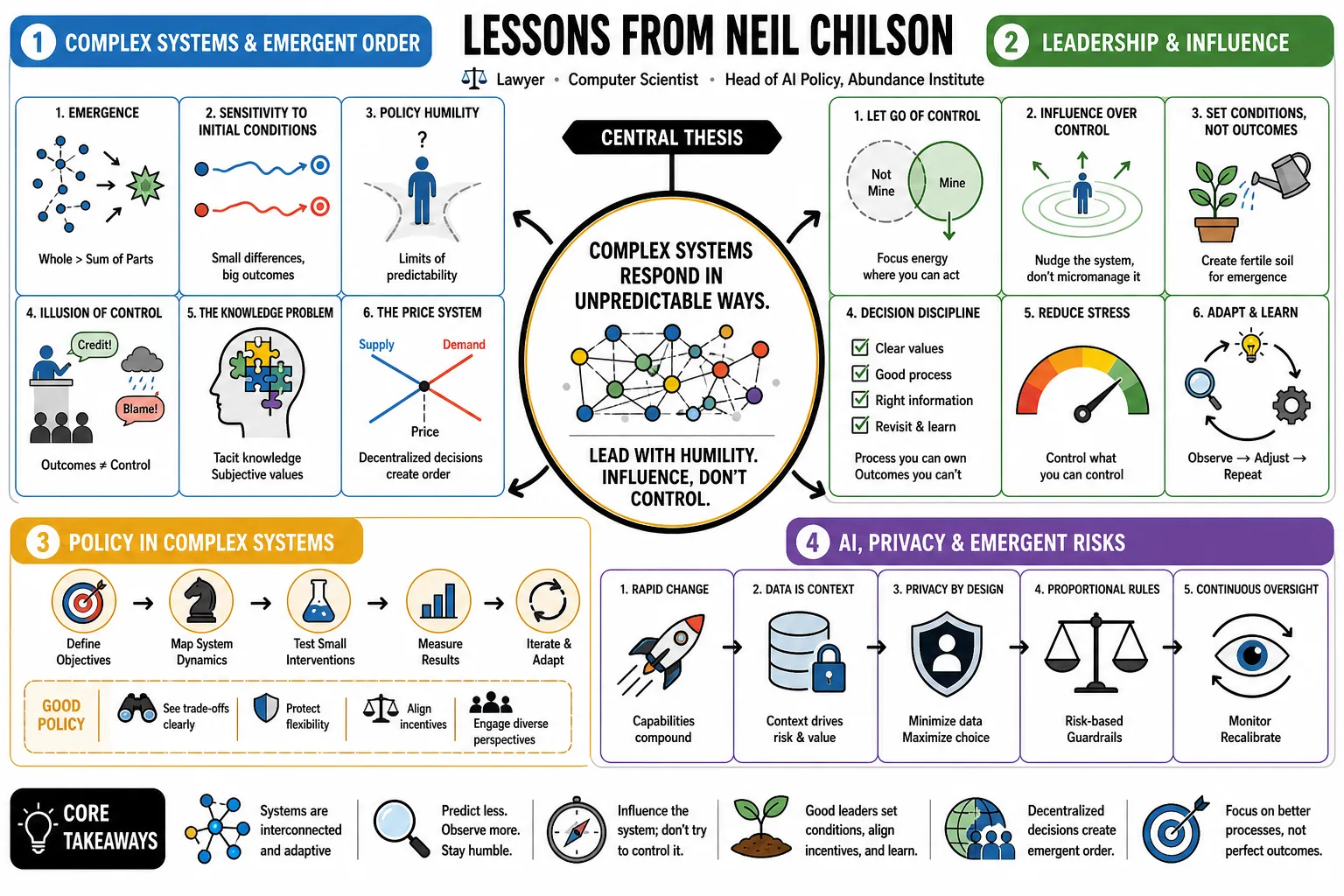
Part 1: Complex Systems and Emergent Order
- On emergence: The whole of a complex system is greater than the sum of its parts, where interactions create outcomes beyond the direct result of any single element. — Reference: youtube.com
- On sensitivity to initial conditions: Complex systems are inherently difficult to model because even fractional differences in data collection can lead to vastly different real-world outcomes. — Reference: youtube.com
- On policy humility: Decision-makers interacting with complex systems should maintain appropriate humility regarding their ability to predict the actual outcomes of their interventions. — Reference: youtube.com
- On the illusion of control: Politicians often claim credit when outcomes are positive, which naturally leads to them being blamed for negative outcomes, even when they lack direct control over the complex systems involved. — Reference: youtube.com
- On the knowledge problem: Central planners struggle to make effective decisions because necessary knowledge is tacit and individual values are subjective. — Reference: music.youtube.com
- On the price system: Free price-setting is essential for generating an emergent order driven by rational, decentralized individual decisions rather than top-down design. — Reference: music.youtube.com
Part 2: Leadership and Influence
- On letting go of control: Leaders can reduce their stress by focusing on the decisions they can control rather than attempting to exert control over uncontrollable aspects of complex systems. — Reference: youtube.com
- On planning: "our plans don't matter our goals do" — Source: youtube.com
- On distributed decision-making: The individuals closest to a problem typically possess the best information to solve it, and leaders should empower them to make the critical decisions. — Reference: youtube.com
- On self-improvement: Individuals have the power and responsibility to improve the world by focusing on improving themselves and the institutions they are a part of. — Reference: youtube.com
- On constraints: Thoughtfully navigating constraints helps leaders make better present choices and builds habits for better future decisions. — Reference: youtube.com
- On influence versus control: Influence involves contributing to an outcome without pulling the strings, contrasting sharply with the expectation of predictable control. — Reference: youtube.com
Part 3: Law, Regulation, and Policymaking
- On regulatory failure: Policy interventions are traditionally justified by market failures where incentives are misaligned, such as when a polluting factory does not suffer the negative externalities it creates. — Reference: issues.org
- On the limits of legislation: "Law is not like code. You don’t just write it, and then it works the way that you wrote it." — Source: issues.org
- On ex post regulation: Policymakers should focus on assigning liability for negative outcomes after they occur rather than attempting to write preventative rules for rapidly changing technologies. — Reference: music.youtube.com
- On the nature of software: Software and artificial intelligence operate as technologies that remain relatively unencumbered by excessive regulatory overreach. — Reference: music.youtube.com
- On political agendas: Some policymakers view the internet negatively and may use the perceived risks of artificial intelligence as an opportunity to further regulatory capture. — Reference: music.youtube.com
- On measuring progress: While philanthropies and policies aim to improve society, measuring that progress is difficult because it depends on subjective and often competing visions of a good society. — Reference: issues.org
Part 4: AI Legislation and Red Teaming
- On legislative red teaming: The practice of red teaming should be applied to AI legislation, systematically probing proposed laws to uncover vulnerabilities and potential misuses. — Reference: outofcontrol.substack.com
- On the permanence of law: "Red teaming legislation might be even more important than red teaming technology, because technology is easier to update." — Source: outofcontrol.substack.com
- On enforcer incentives: Under public choice theory, it is essential to remember that law enforcers are incentivized to bring successful cases and target larger defendants to advance their careers. — Reference: outofcontrol.substack.com
- On settlement pressure: Enforcers wield immense power by securing out-of-court settlements from defendants who wish to avoid expensive litigation, even when the law actually supports the defendant. — Reference: outofcontrol.substack.com
- On naive assumptions: Proponents of AI legislation frequently fail to consider how bad actors or overzealous enforcers might exploit broad statutory language like "reasonable" or "good faith." — Reference: outofcontrol.substack.com
- On role-playing laws: Bringing diverse groups together to role-play the effects of proposed AI bills can help uncover how different stakeholders might actually apply the statute. — Reference: issues.org
- On legislative volume: Hundreds of state-level AI bills have been introduced rapidly, often attempting to address issues that are already covered by existing laws. — Reference: issues.org
Part 5: Artificial Intelligence in Political Discourse
- On defining AI: The definition of artificial intelligence is fluid, making it most useful to categorize technologies functionally based on their actions rather than their inherent nature. — Reference: thecgo.org
- On human intelligence: Intelligence is humanity's most vital resource, enabling the massive collaboration required for every scientific, artistic, and business breakthrough. — Reference: thecgo.org
- On AI abundance: Generative AI creates conditions of abundance by lowering the time and financial costs of producing high-quality creative content. — Reference: thecgo.org
- On truth in elections: While AI will increase the overall volume of political speech, it is unlikely to materially alter the ratio of truth to lies in political campaigns. — Reference: thecgo.org
- On strengthening democracy: "AI tools will enable real-time fact-checking, cheaper voter education, and messages tailored to voter needs. These tools can strengthen democracy." — Source: thecgo.org
- On free speech pretexts: Concerns about artificial intelligence should not be leveraged as an excuse to limit political speech or create novel regulatory regimes. — Reference: thecgo.org
- On the inevitability of AI integration: Modern media production heavily relies on algorithms for tasks like image stabilization, meaning most political ads are already generated in part by artificial intelligence. — Reference: thecgo.org
- On deepfake detection: AI tools have the potential to scan the internet more efficiently than humans to label deepfakes and combat misinformation. — Reference: Federal Testimony: The Integral Role of AI Tools in Modern Political Discourse
Part 6: Technology, Privacy, and Data
- On obfuscation tactics: Some argue for obfuscation—adding confusing or misleading data—as a way for average users to thwart surveillance, but this tactic is often more potent for the powerful. — Reference: issues.org
- On obscurity vs. privacy: For the average person, obscurity provides the bulk of their privacy, while prominent individuals lack this natural defense and may benefit more from active obfuscation. — Reference: issues.org
- On weaponizing information: Obfuscation strategies have been historically utilized by powerful entities, such as pro-government bots drowning out activist protests or corporations faking orders to sabotage rivals. — Reference: issues.org
- On contextual surveillance: Disruption tools fail to account for the difference between commercial data use, like Netflix recommendations, and targeted political surveillance. — Reference: issues.org
- On the value of sharing data: Opting out of data collection entirely comes with massive costs because the societal and personal benefits of sharing information are enormous. — Reference: issues.org
- On the Amish trade-off: The benefits of participating in the data economy are so vast that completely refusing to share personal information equates to a drastic lifestyle choice akin to asceticism. — Reference: issues.org
- On data deserts: Widespread data obfuscation could create data deserts where underrepresented populations miss out on the social benefits derived from accurate data usage. — Reference: issues.org
Part 7: The Federal Trade Commission and Enforcement
- On the FTC's UDAP standard: The Federal Trade Commission's mandate to prosecute unfair or deceptive acts or practices is extremely broad and demonstrates how general enforcement principles can go astray. — Reference: outofcontrol.substack.com
- On writing rules: Regulations must clearly delimit the subset of practices prohibited by their authorizing statute rather than relying on the statute to rein in an overly broad rule. — Reference: Chilson Testifies Before Federal Trade Commission
- On broad impersonation rules: Broadly written anti-impersonation rules could theoretically outlaw comedians mimicking politicians or children dressing up as historical figures if not properly constrained. — Reference: Chilson Testifies Before Federal Trade Commission
- On assuming abuse of power: "rules should be written assuming that some future leadership might seek to abuse them" — Source: Chilson Testifies Before Federal Trade Commission
- On secondary liability: Enforcement agencies must not use broad statutory language like means and instrumentalities as a backdoor to prosecute aiding and abetting if they lack clear authority. — Reference: Chilson Testifies Before Federal Trade Commission
- On antitrust lawsuits: The FTC's claims that major tech companies have abused their market power may prove difficult to substantiate in court. — Reference: What the FTC's antitrust lawsuit means for Amazon
Part 8: Philanthropy, Innovation, and Society
- On science philanthropy: Private foundations possess greater flexibility and risk tolerance than government funders, allowing them to support fundamental research with longer horizons. — Reference: issues.org
- On government risk aversion: Government agencies avoid risky research endeavors because the bureaucratic incentive structure does not reward success and officials fear public backlash for failures. — Reference: issues.org
- On scaling solutions: Effective philanthropy goes beyond issuing grants by providing partners with management consulting, communications support, and holistic scaling strategies. — Reference: issues.org
- On the Trump administration's AI policy: The change in administration marked a significant shift from a focus on frontier AI safety oversight toward accelerating technology and pursuing deregulation. — Reference: lawfaremedia.org
- On international AI competitiveness: U.S. leaders have emphasized that maintaining global dominance in artificial intelligence requires prioritizing investment and innovation over strict safety regulations. — Reference: lawfaremedia.org
Part 9: AI Competition and Open Source
- On AI as an ecosystem: Artificial intelligence is a general-purpose technology spanning hardware, cloud infrastructure, models, tools, and applications, so treating it as a single market obscures how competition actually works. — Reference: The Vibrant AI Competitive Landscape
- On different economics across the stack: Foundation models can serve additional users at very low marginal cost, while chips and data centers remain constrained by the cost of manufacturing physical infrastructure. — Reference: The Vibrant AI Competitive Landscape
- On cross-layer competition: Weak competition in one layer can provoke investment and substitution in another, as model developers build infrastructure and hardware leaders cut training costs to defend their position. — Reference: The Vibrant AI Competitive Landscape
- On disruptive entrants: The speed with which ChatGPT and DeepSeek forced established firms to adapt shows why static market-share snapshots are poor guides to competition in a fast-moving technical ecosystem. — Reference: The Vibrant AI Competitive Landscape
- On open weights as competitive infrastructure: Open models lower entry barriers by giving startups and smaller organizations access to capable systems without requiring the resources needed to train frontier models themselves. — Reference: The Vibrant AI Competitive Landscape
Part 10: Public-Sector AI and Infrastructure
- On the software-hardware policy divide: AI software benefits from permissionless development, while its physical foundation depends on energy, data centers, chips, and infrastructure that face very different regulatory bottlenecks. — Reference: Building the Launchpad for an AI Moonshot
- On regulating outcomes rather than techniques: Sector-specific laws can require safe medical devices, fair financial services, or nondiscriminatory conduct without creating a single agency empowered to regulate all software. — Reference: Building the Launchpad for an AI Moonshot
- On the federal deployment gap: Thousands of federal AI projects exist, but only a small fraction of operating systems directly target fraud, waste, or abuse, leaving substantial room for practical deployment. — Reference: Improving Government Efficiency with AI Technologies
- On layered fraud detection: Procurement oversight improves when predictive analytics flag risky contracts, anomaly detection catches unusual payments, graph analysis exposes collusion, and automation handles repetitive comparisons. — Reference: Improving Government Efficiency with AI Technologies
- On learning without pooling sensitive data: Federated learning can share patterns across institutions without centralizing their underlying records, improving fraud detection while limiting new privacy and compliance risks. — Reference: Improving Government Efficiency with AI Technologies
Part 11: Federalism and Cybersecurity
- On the state-law patchwork: Conflicting state AI rules force companies to track and reconcile dozens of regimes, imposing costs that fall especially hard on startups, mid-sized firms, and open-source developers. — Reference: Clearing the Path for AI
- On the compliance ratchet: When a large state adopts the strictest rule, firms often apply it nationwide rather than maintain separate systems, allowing one jurisdiction to set policy for users elsewhere. — Reference: Clearing the Path for AI
- On the interstate nature of model training: Frontier models rely on data and compute spread across jurisdictions and are too expensive to retrain state by state, making model-development rules a poor fit for local regulation. — Reference: Clearing the Path for AI
- On approval regimes as incumbent moats: Pre-release government approval favors firms able to sustain long reviews and large compliance teams while delaying startups, university labs, and open-source developers. — Reference: How Anthropic lost a battle but could win the war
- On security as an iterative system: Cybersecurity improves through continuous testing and patching, with labs, infrastructure operators, agencies, law enforcement, and open-source communities dividing the work rather than relying on one pre-release certification. — Reference: How Anthropic lost a battle but could win the war