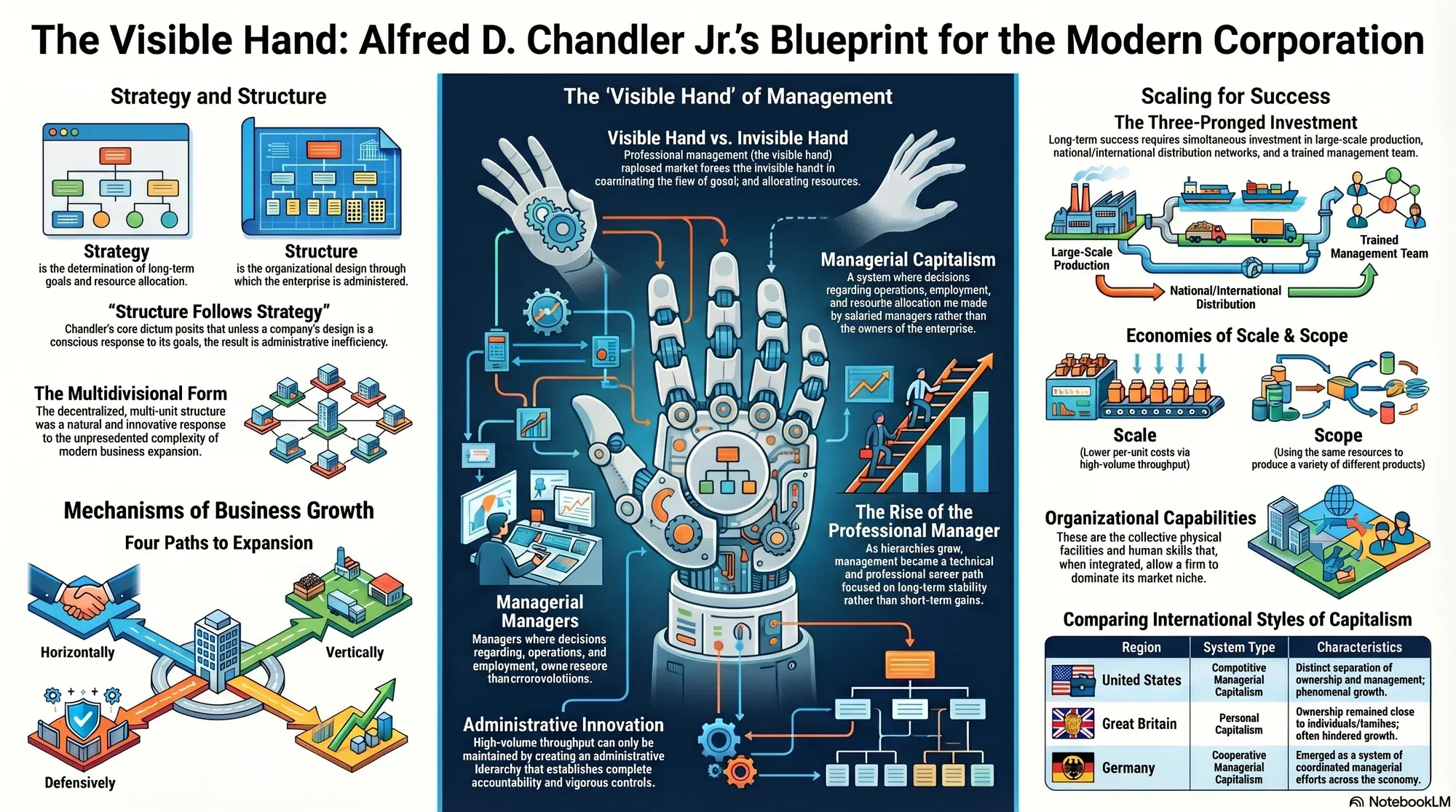
Alfred D. Chandler Jr., the Pulitzer Prize-winning business historian, revolutionized our understanding of the modern corporation. His seminal works, including "The Visible Hand," "Strategy and Structure," and "Scale and Scope," laid the groundwork for modern business strategy and organizational theory. Chandler's core assertion was that the "visible hand" of management had replaced Adam Smith's "invisible hand" of the market in coordinating the activities of the economy and that a company's structure must follow its strategy for success.
On Strategy and Structure
Chandler's most famous dictum, "Unless structure follows strategy, inefficiency results," remains a cornerstone of business education. He argued that a company's organizational design must be a conscious and deliberate response to its strategic goals.
Key Quotes and Learnings:
- "Unless structure follows strategy, inefficiency results."[Strategy and Structure (1962)][The Visible Hand (1977)][YouTube: Alfred Chandler Analysis]
- "Strategy can be defined as the determination of the long-term goals and objectives of an enterprise, and the adoption of courses of action and the allocation of resources necessary for carrying out these goals." Reference: Strategy and Structure (1962, p. 13)
- "Structure is the design of organization through which the enterprise is administered." Reference: Strategy and Structure (1962, p. 14)
- The modern, multidivisional structure was an inevitable, natural response to the unprecedented complexity of the business.[strategy+business: The Thought Leader: Alfred Chandler]
- Changes in strategy can be successful only if managers are willing to wrench their organizations into new forms.[EH.net: Review of The Visible Hand]
- In developing their early administrative structures, companies often followed accepted practices in American industry, learning from others' successes and failures.[Strategy and Structure (1962)]
- A new design for administration is required with each move into new lines of business or significant expansion.[Strategy and Structure (1962)]
- Organizational innovation is a critical component of successful growth and adaptation. Reference: Strategy and Structure (1962)
- The administrative history of a company reveals two key parts: the initial creation of an organizational structure and its subsequent reorganization to meet the needs of further expansion.[Strategy and Structure (1962)]
- The decentralized, multidivisional form of organization was a significant innovation in American industry.[Strategy and Structure (1962)]
The Visible Hand and Managerial Capitalism
Chandler's groundbreaking work, "The Visible Hand," argued that from the 1850s to the 1920s, a new form of capitalism emerged—managerial capitalism—where professional managers became the most influential group of economic decision-makers.
Key Quotes and Learnings:
- "The visible hand of management has replaced the invisible hand of market forces."[EH.net: Review of The Visible Hand]
- "The market remained the generator of demand for goods and services, but modern business enterprise took over the functions of coordinating flows of goods and services through existing processes of production and distribution, and of allocating funds and personnel for future production and distribution."[Strategy and Structure (1962)][The Visible Hand (Wikipedia Overview)]
- "As modern business enterprise acquired functions hitherto carried out by the market, it became the most powerful institution in the American economy and its managers the most influential group of economic decision makers."[Strategy and Structure (1962)][The Visible Hand (Wikipedia Overview)]
- "The rise of modern business enterprise in the United States, therefore, brought with it managerial capitalism."[Strategy and Structure (1962)][The Visible Hand (Wikipedia Overview)]
- Managerial capitalism is a system "in which the decisions about current operations, employment, output, and the allocation of resources for future operations were made by salaried managers who were not owners of the enterprise."[Strategy and Structure (1962)]
- "Multi-unit business enterprise replaced small traditional enterprise when administrative coordination permitted greater productivity, lower costs, and higher profits than coordination by market mechanisms."[Strategy and Structure (1962)][The Visible Hand (Wikipedia Overview)]
- The fundamental shift toward managers running large enterprises exerted a far greater influence in determining size and concentration in American industry than other factors.[The Visible Hand (1977)][JSTOR: Alfred D. Chandler Jr. Retrospective]
- The managerial revolution was the story of how the visible hand of management replaced what Adam Smith called the "invisible hand" of market forces.[The Visible Hand (1977)][EH.net: Review of The Visible Hand][JSTOR: Alfred D. Chandler Jr. Retrospective]
- Modern multi-unit business enterprises replaced small, traditional, sole-proprietary businesses.[YouTube: Alfred Chandler Analysis]
- A managerial hierarchy was essential for the success of a multi-unit business enterprise.[Wikipedia: Alfred D. Chandler Jr.]
- This new class of salaried managers had to be recruited and organized to coordinate and monitor the various business functions.[Strategy and Structure (1962)]
- "The careers of salaried managers became increasingly professional and technical."[Wikipedia: Alfred D. Chandler Jr.]
- Over time, professional management structures tend to become separate from ownership. Reference: The Visible Hand (1977)
- "Professionals prefer long-term stability and growth to short-term gains." Reference: The Visible Hand (1977, p. 10)
Scale, Scope, and Organizational Capabilities
Chandler emphasized the importance of economies of scale (producing at a lower cost per unit through higher volume) and scope (using the same resources to produce a variety of products). He argued that successful firms made a "three-pronged investment" in production, distribution, and management.
Key Quotes and Learnings:
- "Increase on productivity and decrease in unit costs (often identified with economies of scale) resulted far more from the increases in the volume and velocity of throughput then from a growth in the size of the factory and plant."[Strategy and Structure (1962)][The Visible Hand (Wikipedia Overview)]
- First-mover advantages were gained by firms that made significant investments in production facilities large enough to exploit a technology's potential for economies of scale and scope.[Strategy and Structure (1962)]
- A crucial second investment was in national and international marketing and distribution networks.[Strategy and Structure (1962)]
- The third essential investment was in the recruitment and organization of a team of managers.[Strategy and Structure (1962)]
- Organizational capabilities are the collective physical facilities, human skills, and the way these resources are organized within the enterprise. Reference: Scale and Scope / Cambridge: Organizational Capabilities
- Only firms that could coordinate and integrate these critical resources were able to achieve the needed economies of scale and scope to be competitive in national and international markets. Reference: Scale and Scope / Cambridge: Economies of Scale and Scope
- Once a managerial hierarchy was established and successfully carried out its functions of administrative coordination, the hierarchy itself became a source of power, permanence, and continued growth.[Wikipedia: Alfred D. Chandler Jr.]
- Long-term success for large industrial enterprises came from the ability of their salaried managers to exploit the firm's organizational capabilities. Reference: Scale and Scope / Cambridge: Exploiting Capabilities
- The functional and administrative capabilities developed by a large group of managers not only intensified the separation between ownership and management but also made the sustained growth of their firms possible. Reference: Scale and Scope / Cambridge: Administrative Capabilities
- "The key theme for any business is learning its boundaries: relating the firm, the markets, and the technology to your particular strengths."[strategy+business: The Thought Leader: Alfred Chandler][JSTOR: Alfred D. Chandler Jr. Retrospective]
- Success comes to companies that cultivate an "integrated learning base," which are the capabilities needed to lead in a particular business niche.[strategy+business: The Thought Leader: Alfred Chandler]
On Business Growth and Modern Institutions
Chandler's historical analysis provided a framework for understanding how and why large industrial enterprises grew and evolved, shaping the modern economic landscape.
Key Quotes and Learnings:
- "The modern joint stock firm is the outcome of innumerable decisions made by individual entrepreneurs, owners and managers."[YouTube: Alfred Chandler Analysis]
- The growth of industrial enterprises occurred in four ways: horizontally (merging with competitors), vertically (controlling production and distribution), defensively, and by expanding into new product lines and markets.[Strategy and Structure (1962)]
- "To maintain and continue a high volume of flow demanded organizational innovation. It would be achieved only by creating an administrative hierarchy operated by many full-time salaried managers."[Strategy and Structure (1962)][The Visible Hand (Wikipedia Overview)]
- The multi-unit business enterprise first appeared when the volume of economic activities reached a level that made administrative coordination more efficient than market coordination.[Wikipedia: Alfred D. Chandler Jr.]
- "Modern factory management... had the genesis in the United States in the Springfield Armory."[Strategy and Structure (1962)][The Visible Hand (Wikipedia Overview)]
- "Effective coordination of throughput required the placing of vigorous management controls over these despots."[Strategy and Structure (1962)][The Visible Hand (Wikipedia Overview)]
- "Complete accountability is established and enforced throughout; and if there is any error committed, it will be discovered on a comparison with the books and can be traced to its source."[Strategy and Structure (1962)][The Visible Hand (Wikipedia Overview)]
- "Men's mind and abilities grow and expand with use of responsibilities."[Strategy and Structure (1962)][The Visible Hand (Wikipedia Overview)]
- In the United States, "competitive managerial capitalism" with its distinct separation of ownership and management was responsible for phenomenal growth. Reference: Scale and Scope / Cambridge: Competitive Managerial Capitalism (US)
- In Great Britain, "personal capitalism" often hindered the growth of industrial enterprises. Reference: Scale and Scope / Cambridge: Personal Capitalism (UK)
- In Germany, a system of "cooperative managerial capitalism" emerged. Reference: Scale and Scope / Cambridge: Cooperative Managerial Capitalism (Germany)
- Big businesses grew to dominate sectors of the economy, and in doing so, altered the structure of the economy as a whole. Reference: JSTOR / Chandler: Transformation of Economic Structure
- Chandler's work provided a unifying theory that explained the growth of modern capitalism.[Cambridge Enterprise & Society: Alfred Chandler]
- He shunned the debate about whether tycoons were good or bad, instead arguing that the emergence of professional management propelled modern capitalism.[Cambridge Enterprise & Society: Alfred Chandler]
- "All I know is that the Internet will transform the world."[Strategy and Structure (1962)][The Visible Hand (1977)][YouTube: Alfred Chandler Analysis] This late-in-life quote demonstrates his enduring focus on the transformative power of technological and organizational change.
Sources
- Strategy and Structure (1962)
- The Visible Hand (1977)
- YouTube: Alfred Chandler Analysis
- strategy+business: The Thought Leader: Alfred Chandler
- EH.net: Review of The Visible Hand
- Strategy and Structure (1962)
- The Visible Hand (Wikipedia Overview)
- JSTOR: Alfred D. Chandler Jr. Retrospective
- Wikipedia: Alfred D. Chandler Jr.
- Cambridge Enterprise & Society: Alfred Chandler