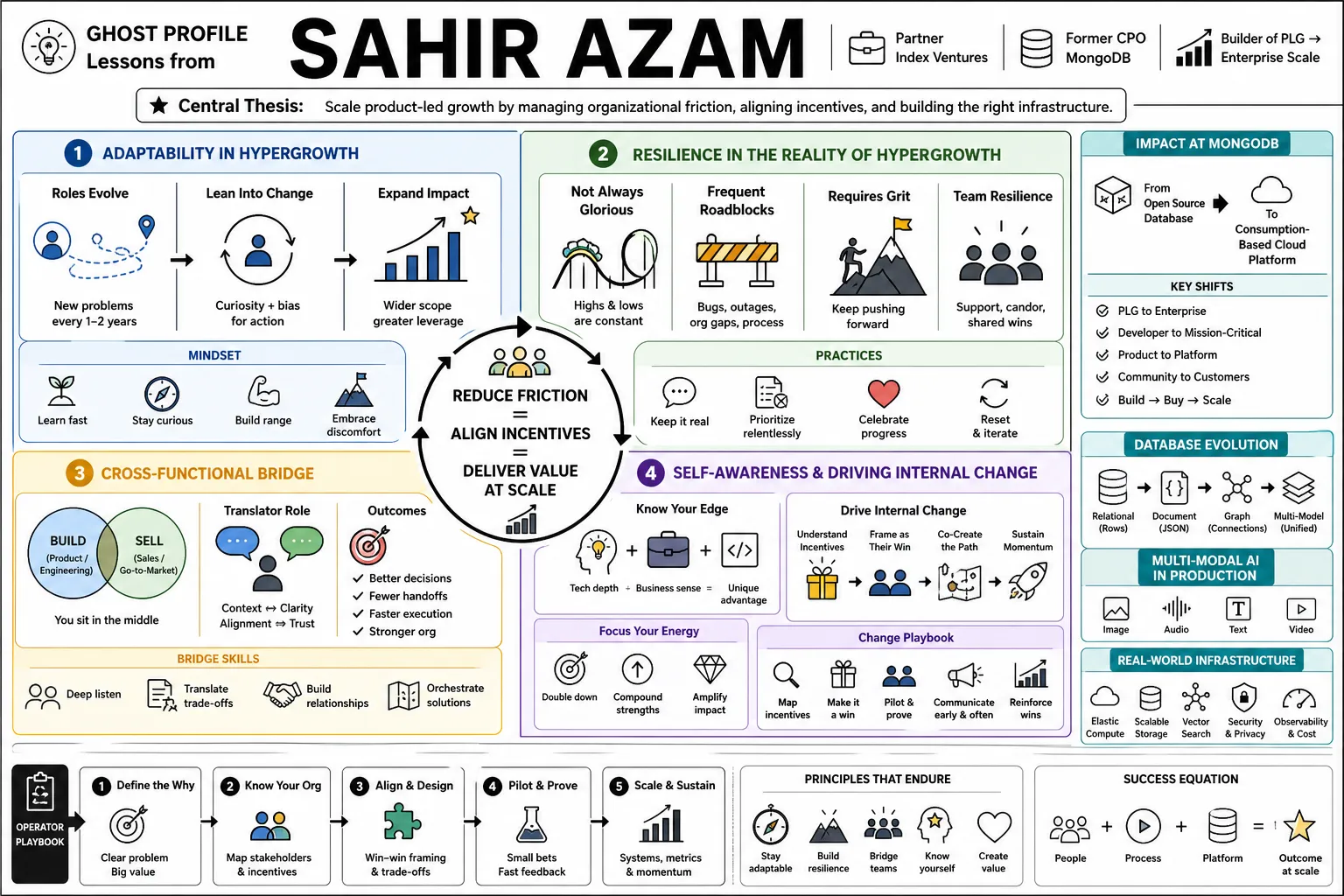
Sahir Azam is a partner at Index Ventures and the former Chief Product Officer at MongoDB, where he helped shift the company from an open-source database to a consumption-based cloud platform. This profile collects his advice on managing the organizational friction that comes with scaling product-led growth. It also outlines his pragmatic views on database evolution and the real-world infrastructure needed to put multi-modal AI into production.
Part 1: Career Growth & Adaptability
- On adaptability in hypergrowth: Working at a rapidly scaling tech company requires you to intentionally lean into how your role changes, as your job will likely evolve significantly every year or two. — Reference: The Discipline Behind Scaling from PLG to Enterprise
- On resilience: It is easy to romanticize working at a hypergrowth company, but people often underestimate the frequent challenges and roadblocks that demand grit to continually push the business forward. — Reference: The Discipline Behind Scaling from PLG to Enterprise
- On cross-functional strengths: You can find tremendous power by positioning yourself between the teams that build products and the teams that sell them, acting as the translator who keeps the organization connected and coherent. — Reference: The Discipline Behind Scaling from PLG to Enterprise
- On self-awareness: Identifying your core strengths early in your career, such as combining business and technical skills, allows you to focus your energy on amplifying those specific advantages. — Reference: Hunters + Unicorns
- On driving internal change: Introducing a major strategic shift requires internal selling; you must understand the incentives of various functional leaders and frame the new initiative as a win for their specific teams. — Reference: The Discipline Behind Scaling from PLG to Enterprise
Part 2: Product-Led Growth & Organizational Change
- On transitioning to the cloud: Shifting an open-source software company to a consumption-based cloud model demands massive organizational change, altering how teams operate, set goals, and collaborate to meet users on their preferred buying journey. — Reference: Endgame
- On open-source monetization: "Open-source is about driving developer adoption, but enterprise sales is only going to monetize a fraction of those users. Product-led monetization fills the gap." — Source: Endgame
- On unified growth teams: Scaling a product-led motion effectively involves merging analytics, product marketing, performance marketing, and engineering into a single unified growth team that is measured with the same rigor as traditional sales. — Reference: Endgame
- On self-serve north stars: The primary metric for a self-service go-to-market engine should not just be revenue traction, but the sheer volume of customers and workloads being successfully acquired. — Reference: Endgame
- On holistic business transformation: Transitioning an enterprise requires more than technical updates; every department from sales and customer success to financial modeling must adapt and buy into the change. — Reference: Sequoia Capital
- On community investment: Maintaining a freemium strategy and nurturing a developer community is essential, as the open-source user base forms the outer ring of a funnel that eventually connects to the cloud business. — Reference: Endgame
Part 3: Sales, Pre-sales, and Cross-Functional Alignment
- On the role of pre-sales: Treating pre-sales as a true partner rather than just a technical support resource creates a foundational culture of mutual respect that is necessary for closing complex deals. — Reference: Hunters + Unicorns
- On diversifying sales channels: Transitioning to a SaaS model requires opening up multiple sales channels—such as self-service, inside sales, and enterprise field sales—to align with different buyer behaviors and lower the barrier to entry globally. — Reference: SaaStr
- On mitigating channel conflict: To prevent enterprise sales reps from cannibalizing the self-serve business, compensation models should be adjusted to only pay commissions on revenue that exceeds the organic self-serve run rate. — Reference: Endgame
- On optimizing go-to-market strategies: The goal of leadership should be matching buyer behavior to the correct go-to-market motion, which requires constant iteration and alignment between the CMO, CRO, and product leaders. — Reference: Endgame
- On continuous structural iteration: As a business scales and uncovers new needs, leaders must be willing to continually tune their organizational structure, shared metrics, and cross-functional collaboration models. — Reference: Endgame
- On breaking silos for alignment: Bringing diverse perspectives together—such as a high-touch seller and a data-focused product manager—through in-person workshops like journey mapping is an effective way to drive consensus in a matrix organization. — Reference: Endgame
Part 4: The Evolution of Database Infrastructure
- On multi-cloud reality: For large enterprises, deploying across multiple clouds is no longer just an accident of acquisition; it is often a deliberate strategy from the C-suite to balance availability, leverage unique cloud services, and expand geographic reach. — Reference: AWS re:Invent
- On decoupling data from infrastructure: The hardest part of implementing a multi-cloud strategy is transactional data; to succeed, platforms must decouple the data layer from the underlying cloud provider so developers can seamlessly utilize different services. — Reference: AWS re:Invent
- On database proliferation: The idea that a single database vendor can serve all use cases is obsolete, but forcing development teams to cobble together 15 different bespoke databases is an inefficient distraction from building core application features. — Reference: Screaming in the Cloud
- On general-purpose foundations: Most organizations are better served by using a few key database technologies for the vast majority of their needs, reserving highly specialized niche databases only for specific, complex requirements. — Reference: Screaming in the Cloud
- On modern performance constraints: Hardware costs and storage limitations are no longer the primary constraints for modern software; the focus has shifted entirely to architecting systems that maximize developer productivity and efficiency. — Reference: MongoDB.local NYC
- On integrating search capabilities: Rather than forcing developers to stand up separate search clusters and duplicate data, merging full-text indexing directly into the core database platform dramatically simplifies the architecture. — Reference: AWS re:Invent
- On legacy relational models: The traditional relational database was designed decades ago for back-office applications and expensive hardware, making it ill-suited for the complex experiences developers are trying to build today. — Reference: MongoDB.local NYC
Part 5: AI Infrastructure and the Future of Software
- On AI as a new interaction paradigm: The way we interact with technology is moving away from clicks and screens toward voice, video, augmented reality, and robotics, demanding new infrastructure built specifically for low latency and continuity. — Reference: Index Ventures
- On vector search evolution: Vector capabilities have evolved from simple semantic search engines to becoming the memory and state layer that powers complex AI applications. — Reference: Sequoia Capital
- On probabilistic software quality: In an era of probabilistic AI software, achieving enterprise reliability requires sophisticated integrations of embedding models, retrieval architectures, and real-time business data. — Reference: Sequoia Capital
- On AI state management: As AI moves beyond basic chat interfaces into sophisticated agent workflows, databases must persist complex states and coordinate the real-time "world state" that these agents interact with. — Reference: Sequoia Capital
- On vector data as a primitive: Vector search should not be viewed as a standalone database category, but rather as a fundamental primitive for managing unstructured data, much like how text indexes operate for structured data. — Reference: Sequoia Capital
- On the AI production gap: There remains a massive chasm between what open-source AI models can achieve in theory and the practical difficulty of deploying them with speed, scale, and reliability in real-world production environments. — Reference: Index Ventures
- On the shift to specialized models: As generative AI model spending continues to skyrocket, teams are moving away from generic APIs toward specialized and fine-tuned models that offer more control, lower latency, and cost efficiency. — Reference: Index Ventures
- On the complexity of choice: "But with more choice comes more complexity: different models, providers, and deployment environments to manage. Most teams don’t want to become model ops experts. They just want their app to work and keep getting better." — Source: Index Ventures
- On the "future scaling law": When deploying AI models, teams constantly struggle to balance quality, speed, and concurrency; optimizing for one of these factors almost always requires sacrificing another. — Reference: Index Ventures
- On infrastructure value accrual: As AI foundation models become commoditized, the bulk of the value in the ecosystem will shift to the infrastructure layers that gracefully solve complex networking, compute, and real-time integration challenges. — Reference: Index Ventures
- On software creation speed: AI is making it easier and more efficient to generate software, which will inevitably lead to an explosion in the sheer volume of software in the world, creating new demands on data persistence and processing. — Reference: Sequoia Capital
- On multi-modal AI integration: The highest quality AI applications achieve their performance by blending multiple data modalities in a single system, combining metadata filtering, keyword search, and semantic vector search. — Reference: Sequoia Capital
- On AI agents and the physical world: As robotics and autonomous systems expand, the backend infrastructure requirements for real-time voice and video agents will also apply to systems navigating the physical world through sensors and cameras. — Reference: Index Ventures
Part 6: Operating Systems for Leadership and Growth
- On continuous learning: High performers maintain the mindset that they do not know everything. Regularly exploring unfamiliar topics helps them connect their own work to the wider organization and make better decisions. — Reference: Office Hours
- On acting like an owner: Ownership means addressing problems beyond a narrow remit, helping colleagues succeed, and being intellectually honest about what is and is not working instead of waiting for formal permission. — Reference: Office Hours
- On scaling leadership behavior: A leader cannot remain the person doing everything as a company grows. Coaching individuals, modeling the expected behavior, and embedding it in processes allows ownership to compound through the organization. — Reference: Office Hours
- On taking early-career risks: Early in a career, the perceived stakes of an unfamiliar opportunity are often much higher than the actual downside. Staying open-minded and taking a measured leap can create paths that planning alone would miss. — Reference: Office Hours
- On technical credibility in enterprise sales: Technical buyers have little patience for sellers who cannot understand how a product works in the customer's environment. Credibility begins with enough curiosity to connect the technology to the business problem. — Reference: Revenue Builders
- On orchestrating expertise: The best enterprise sellers do not try to remain the face of every interaction. They bring pre-sales engineers, executives, product leaders, and other specialists into the deal at the moments when each can create the most value. — Reference: Revenue Builders
- On listening before mobilizing resources: Strong sellers ask questions that uncover the buyer's business, champion, and priorities before they rally the organization around a response. Resource orchestration is only useful when discovery has identified the right problem. — Reference: Revenue Builders
- On qualifying complex engagement: Enterprise scale requires a documented engagement model with stages, exit criteria, and qualification standards. Without it, scarce specialists get consumed by weak opportunities and the sales motion cannot become repeatable. — Reference: Revenue Builders
- On accountability culture: Operational mechanics are not enough if teams explain misses by blaming marketing, consumption pricing, or forecasting complexity. High-performing sales organizations make ownership of the outcome a cultural expectation. — Reference: Revenue Builders
- On enablement as a scaling system: Hiring talented sellers does not create repeatability by itself. Leaders must define the ideal customer, teach the technology, capture what top performers learn, and turn that knowledge into a program that ramps the next cohort. — Reference: Revenue Builders
- On using AI for legacy modernization: Models can help teams understand old applications whose original developers have left, analyze query patterns, propose new data models, and reduce the discovery burden before a migration begins. — Reference: MongoDB.local NYC
- On creating trust in migrations: Code conversion is only part of modernization. Generating tests from the existing application and reusing them against the new system gives teams a concrete way to validate that behavior survived the transition. — Reference: MongoDB.local NYC
- On compounding platform improvements: Large performance gains often come from a series of small changes across a complex system. Product leaders should keep investing in security, resilience, durability, and price-performance even when newer features command more attention. — Reference: MongoDB.local NYC
- On governing experimentation without stopping it: Enterprise AI governance should establish safe tools, data boundaries, and clear constraints, then let teams experiment quickly inside them. The goal is to enable responsible speed, not default to prohibition. — Reference: MongoDB.local NYC
- On being an accessible investor: Founder support works best when the investor is approachable outside formal board meetings—available to brainstorm, troubleshoot, and work through unfinished ideas as a genuine operating partner. — Reference: Index Ventures