Lou Shipley is a three-time software CEO who turned struggling compliance tools like Black Duck into high-value security acquisitions. He now teaches sales and entrepreneurship at Harvard Business School, drawing directly on his own time running companies. This profile breaks down his frameworks for validating startup ideas and navigating the shift from founder-led deals to a structured go-to-market team.
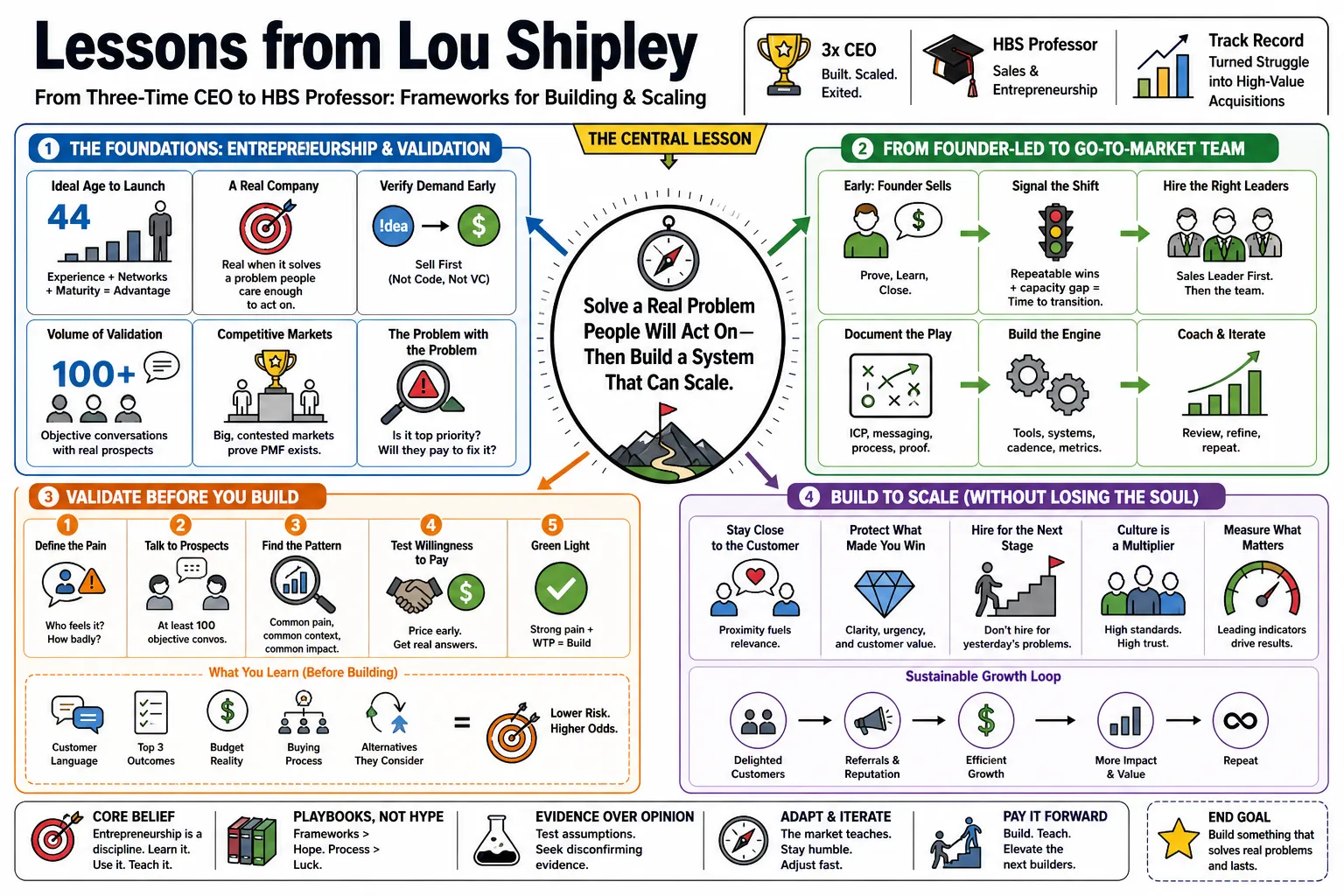
Part 1: The Foundations of Entrepreneurship & Validation
- On the ideal age to launch: Data indicates that 44 is the optimal age to start a company because older founders bring accumulated experience, networks, and the maturity to identify actual market pain points. — Reference: The B2B Podcast Index
- On defining a real company: "A company does not become real because it raised money, built a product, or hired a team. It becomes real when it solves a problem people care enough about to act on." — Source: Predictable Revenue
- On verifying demand early: Founders should invert the standard startup sequence by proving that an idea can sell before they ever write code or raise venture capital. — Reference: The B2B Podcast Index
- On volume of validation: Before committing to a product build, founders should conduct at least 100 objective conversations with real prospects to ensure the problem warrants a standalone business rather than a simple feature. — Reference: The B2B Podcast Index
- On competitive markets: Entering large, heavily contested markets is often safer than trying to create new categories because the presence of paying customers proves that product-market fit actually exists there. — Reference: The B2B Podcast Index
- On "the problem with the problem": Founders must rigorously evaluate whether their solution addresses a top-priority issue that customers will actually spend money to fix, avoiding the trap of confusing friendly feedback with actual market demand. — Reference: Predictable Revenue
- On speed as a differentiator: When evaluating a new business idea, the most important metric of success is your ability to secure customers faster than your competitors. — Reference: Harvard Business School
Part 2: Founder-Led Sales & The Customer Reality
- On early sales goals: The primary objective when securing your first customers is not to generate immediate revenue, but to recognize patterns in usage, engagement, and actual feedback. — Reference: GTMnow
- On taking the chief salesperson role: Founders cannot delegate their early sales efforts because they need direct exposure to the buyer's journey to understand their own positioning and to build an aligned company culture. — Reference: The B2B Podcast Index
- On pre-hiring validation: Before officially accepting the CEO role at Reflectent, Shipley tested the product's viability by taking it directly to Wall Street CIOs and securing three pilot programs. — Reference: Wave AI Podcast Notes
- On observing unexpected use cases: Customers will frequently use your product in ways you never anticipated, which makes direct interviewing essential for understanding actual market application. — Reference: Wave AI Podcast Notes
- On adapting to buyer demands: While selling Avid hardware in Japan, Shipley sat in a karaoke bar with a notepad to understand exactly what features a client needed, resulting in the largest order in the company's history. — Reference: Wave AI Podcast Notes
- On outsourcing sales too soon: Hiring experienced sales representatives early in a company's life cycle often fails because they attempt to apply a playbook from an established company to a startup product that lacks repeatability. — Reference: Founder's Journey
- On connecting emotionally: Sales become significantly easier when the customer is emotionally invested in solving the core problem your product addresses. — Reference: Wave AI Podcast Notes
Part 3: Structuring the Go-To-Market & Sales Teams
- On sales as the core system: Sales should never be treated as a downstream function that happens after product development; it is the central organizing discipline of a successful business. — Reference: Apple Podcasts
- On understanding salespeople: Technical founders often fail to realize that sales professionals operate with a different mindset and are heavily motivated by monetary rewards. — Reference: Founder's Journey
- On specializing sales roles: Shipley improved efficiency by breaking the traditional sales role into four distinct functions: outbound cold calling, inbound marketing leads, closing small deals, and closing large deals. — Reference: The B2B Podcast Index
- On narrowing the ideal customer profile: Reducing the scope of your target audience is never a limitation, but rather the fastest method for achieving actual revenue growth. — Reference: Apple Podcasts
- On distribution as a competitive moat: Once a company reaches a certain scale, product features become less important than having a highly efficient distribution machine. — Reference: GTMnow
- On team sizing: A small, high-quality team of exceptional individuals will consistently outperform a large, bloated organization. — Reference: GTMnow
Part 4: Listening to Customers & Managing Experience
- On direct executive feedback: During his time at Black Duck, Shipley configured their CustomerGauge system so that any Net Promoter Score between zero and six routed directly to his desk for personal follow-up. — Reference: The B2B Podcast Index
- On confronting detractors: When Amazon, one of Black Duck's top five customers, submitted a zero NPS score, Shipley personally called them to uncover the underlying product gaps. — Reference: The B2B Podcast Index
- On identifying pivot opportunities: A conversation with JP Morgan revealed they were manually tracking open-source vulnerabilities daily for Jamie Dimon, prompting Shipley to pivot Black Duck from a compliance tool to a security platform. — Reference: Wave AI Podcast Notes
- On breaking down organizational silos: Sharing unfiltered sales call recordings directly with engineering teams, instead of having sales reps summarize the feedback, prevents defensive reactions and aligns the whole company around real buyer needs. — Reference: The B2B Podcast Index
- On measuring product-market fit over time: High customer churn is a lagging indicator of a problem; active usage is the true leading indicator of whether product-market fit is holding steady. — Reference: GTMnow
- On the nature of selling: Sales should be taught and practiced as an exercise in listening and problem-solving, never as a process of pitching or coercing the buyer. — Reference: The B2B Podcast Index
- On bypassing internal dashboards: Listening to actual customers directly cuts through operational noise and exposes growth opportunities much faster than reviewing internal metrics and reports. — Reference: Podbean
Part 5: Security, Resilience, & Culture
- On owning cyber resilience: Startup founders cannot relegate cybersecurity to their IT departments; they must personally adopt the role of chief security officer from the company's first day. — Reference: MIT Sloan
- On why startups are targeted: Cybercriminals specifically attack small-to-medium businesses because they view them as weak entry points to infect the larger supply chain partners they work with. — Reference: MIT Sloan
- On crisis planning: Companies must prepare a cybersecurity crisis communications plan in advance, answering logistical questions like how to contact clients if the main email system is taken offline. — Reference: MIT Sloan
- On cyber fire drills: Just as businesses practice physical evacuations, teams should simulate cyberattacks and run through their step-by-step recovery roles. — Reference: MIT Sloan
- On analog redundancies: Critical continuity plans should be saved to thumb drives and printed out, as digital versions become inaccessible if the company's network is compromised. — Reference: MIT Sloan
- On gamifying security: Founders should reward employees who successfully identify fake links, phishing emails, and fraudulent vendor invoices to build a culture of vigilance. — Reference: MIT Sloan
- On executive signaling: Starting executive meetings with a cybersecurity moment to discuss news and practices signals to the entire workforce that security is a core business priority. — Reference: MIT Sloan
Part 6: Leadership, Coaching, & Culture
- On learning from failure: Strong entrepreneurs do not merely tolerate failed bets; they examine what broke and use those losses to improve the next decision. — Reference: The VentureFizz Podcast
- On athletics as leadership training: Team sports prepare CEOs to make decisions under pressure, work through uncertainty, and adjust their play to the strengths of the people around them. — Reference: The VentureFizz Podcast
- On changing a turnaround culture: A turnaround requires an explicit break from comfortable habits; leaders must tell the board what will change and build a team suited to the new growth expectations. — Reference: VentureFuel
- On combining performance with learning: A healthy growth culture can set demanding performance standards while still giving people room to learn, improve, and enjoy the work. — Reference: VentureFuel
- On assigning cultural ownership: Culture becomes more actionable when a senior leader is explicitly responsible for protecting it instead of everyone assuming someone else will. — Reference: VentureFuel
- On building an internal talent farm: Sales organizations should develop people through progressively harder roles, creating a loyal bench for larger markets instead of relying only on expensive outside hires. — Reference: Gong
- On embedding enablement: Enablement works best when it sits close to the sales team and turns product knowledge into repeatable behavior rather than operating as a distant training function. — Reference: Gong
- On coaching from real calls: Managers should review calls frequently and use what they hear both to coach representatives and to feed unfiltered market learning back into product and marketing. — Reference: Gong
- On trading cash for equity value: Moving from a successful sales career into the CEO seat can require accepting less current income in exchange for responsibility for the company's long-term equity value. — Reference: Sales-to-CEO Q&A
- On delegating your strongest function: A sales-oriented CEO must still hand sales to a capable leader, especially when that person can run the function better than the CEO can. — Reference: Sales-to-CEO Q&A
- On the CEO as chief salesperson: The CEO's selling job expands beyond customers to employees, investors, directors, and other stakeholders who must believe in the company's direction. — Reference: Sales-to-CEO Q&A
- On preparing through rotations: Aspiring CEOs should seek assignments outside sales so they learn how finance, operations, product, and the rest of the organization work together. — Reference: Sales-to-CEO Q&A
- On coachability at the top: Leadership potential includes the willingness to accept help, keep using coaches late in a career, and actively invite candid feedback from independent directors. — Reference: Talent Take Five