Brian Robertson created Holacracy, a constitutional management framework that replaces manager-held authority with explicit roles, rules, and distributed decision-making. — Holacracy Constitution 5.0.
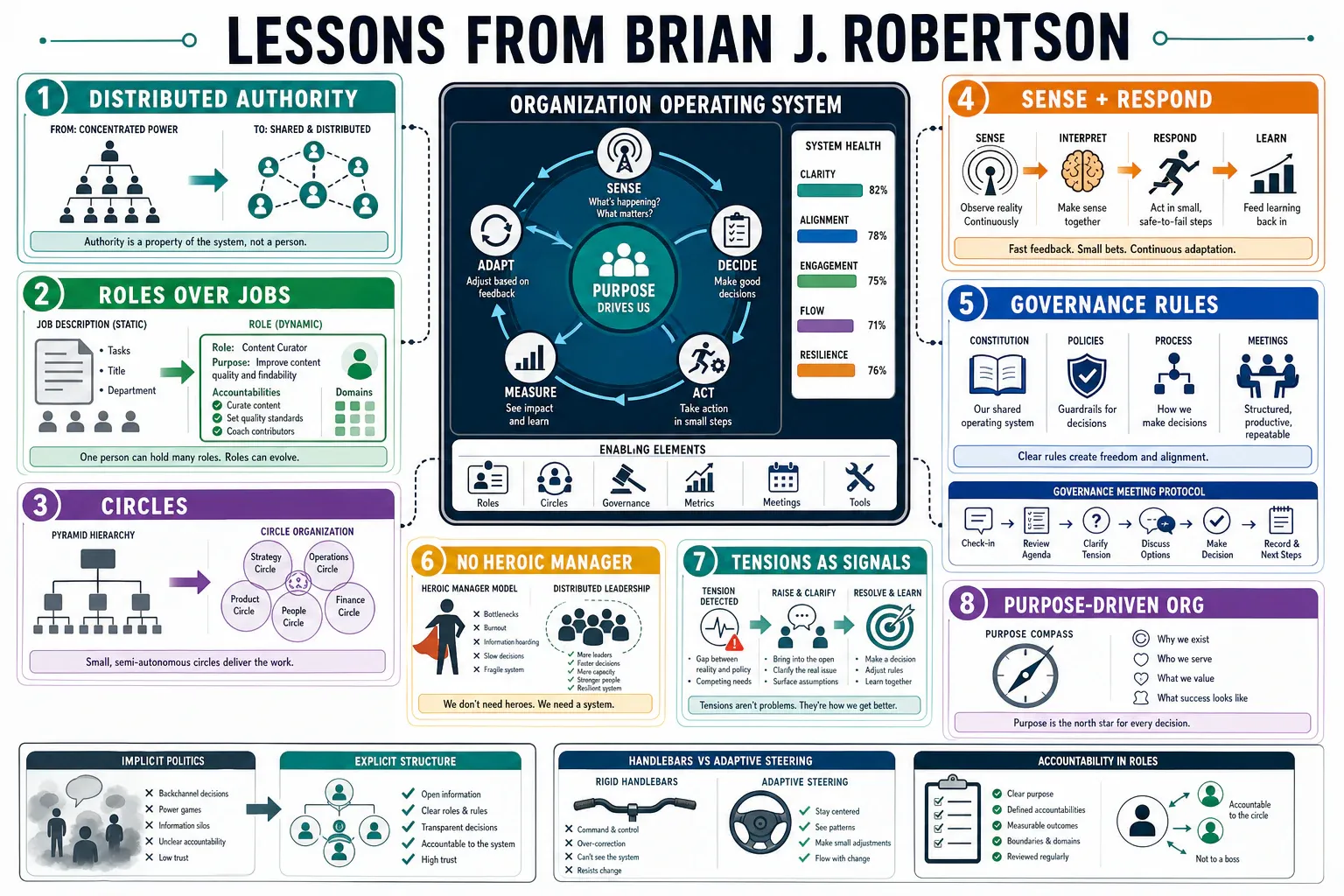
On the Flaws of Traditional Hierarchy
Robertson argues that conventional command-and-control structures centralize too much sensing and authority for complex, fast-changing work. — Kosmos Journal — Holacracy, an Emergent Order System.
Key Quotes and Learnings:
- Managerial hierarchy can pull adults into a parent-child dynamic; explicit authority and limits let people take fuller responsibility for their work. — Kosmos Journal — Holacracy, an Emergent Order System.
- Every role can detect tensions between current reality and what could work better; governance gives those signals a defined path into organizational change. — Cultivating Flows — Interview with Brian Robertson.
- When authority and expectations remain implicit, influence shifts into informal politics; explicit governance makes the real rules visible and revisable. — Brian Robertson — Obsoleting Organizational Politics.
- Distributing leadership reduces dependence on one heroic figure at the top; the system can keep functioning even when that person is absent or having a bad day. — Cultivating Flows — Interview with Brian Robertson.
- On Roundabouts Over Stoplights: Self-management resembles a roundabout: it asks participants to exercise more judgment, while reducing the delay created when every move requires central permission. — Work 20XX — Brian Robertson on Authority, Clarity, Limits, and Systems
- On Why Companies Lose Scale Advantages: Robertson contrasts cities, which can gain innovative capacity as they grow, with companies whose centralized control often reduces productivity per person at scale. — Work 20XX — Brian Robertson on Authority, Clarity, Limits, and Systems
The Core Principles of Holacracy
Holacracy does not remove structure; it replaces implicit managerial authority with a more explicit and changeable system for organizing work. — Cultivating Flows — Interview with Brian Robertson.
Key Quotes and Learnings:
- The Holacracy Constitution is the rulebook that defines the organization’s authority structure and the processes used to change it. — Holacracy Constitution 5.0.
- Work is organized into roles and circles, with authority assigned to the roles responsible for specific purposes and accountabilities. — Holacracy Constitution 5.0.
- Holacracy removes managers in the classic command sense while retaining explicit structure and distributing managerial functions across roles and processes. — Bob Morris — Interview with Brian Robertson.
- Holacracy is not consensus management: proposals move forward unless an objection identifies a concrete reason they would harm the circle’s capacity. — Cultivating Flows — Interview with Brian Robertson.
- Governance is designed to evolve from sensed tensions rather than relying on leaders to predict and control every future need. — Cultivating Flows — Interview with Brian Robertson.
- On Rules That Explain Their Own Evolution: A useful constitution defines not only today’s rules but also the process by which participants can change those rules tomorrow. — Brian Robertson — Decoding the Holacracy Constitution
- Separate Governance From Operations: Governance changes roles, policies, and authority; operations uses that structure to prioritize and execute work. Keeping the two modes distinct prevents every operational issue from becoming a redesign debate. — Holacracy Constitution 5.0
- Test Objections for Concrete Harm: An objection is valid because a proposal would create a specific risk or reduce a circle’s capacity—not simply because someone dislikes the proposal—allowing integration without requiring consensus. — Holacracy Constitution 5.0
- Use Emergency Authority With Accountability: A role may take necessary action during an emergency, but must explain the impact and restore ordinary governance once the emergency has passed. — Holacracy Constitution 5.0
- Keep the Core Stable So Everything Else Can Adapt: A stable constitutional process can make the surrounding organization more adaptable because hiring, compensation, budgeting, and other practices can evolve without falling back to unilateral CEO authority. — Leadermorphosis — Brian Robertson on Self-Management, Part 2
- Treat Holacracy as a Meta-Framework, Not a Complete Operating Manual: Holacracy does not prescribe how every company should hire, fire, pay, budget, or manage projects; it supplies the governance framework through which those practices can be designed and changed. — Leadermorphosis — Brian Robertson on Self-Management, Part 1
- Distinguish Definitional Hierarchy From Command Hierarchy: Broader circles may define boundaries for sub-circles, but they do not gain a general right to command their work; the hierarchy defines authority rather than creating a chain of bosses. — Leadermorphosis — Brian Robertson on Self-Management, Part 1
Dynamic Roles Over Static Job Descriptions
Holacracy replaces fixed job descriptions with dynamic roles whose purposes, accountabilities, and authority can evolve with the work. — Holacracy Constitution 5.0.
Key Quotes and Learnings:
- Separating people from roles makes conflicts easier to process as questions about work, authority, or expectations rather than personal disputes. — Cultivating Flows — Interview with Brian Robertson.
- Each role is defined by a purpose, domains it controls, and ongoing accountabilities, creating a concrete basis for autonomy. — Holacracy Constitution 5.0.
- Role holders may take actions they reasonably believe serve their role unless the constitution, governance, or another valid constraint limits them. — Holacracy Constitution 5.0.
- Roles are dynamic: governance can create, amend, or remove them as tensions reveal that the current structure no longer fits the work. — Holacracy Constitution 5.0.
- A tension is treated as usable information about a gap between current reality and a sensed potential, not merely as a complaint to suppress. — Cultivating Flows — Interview with Brian Robertson.
- People are not reduced to a single job description; one person may energize several roles and use different authority in each. — Work 20XX — Brian Robertson on Authority, Clarity, Limits, and Systems.
- On Domains as Property Rights: Domains function like delegated property rights: they give a role control over a resource while making the boundary of that control explicit. — Brian Robertson — Rule of Law and Property Rights in Organizations
- On Authority as Stewardship: Authority belongs to the role and is exercised in service of its purpose; it is not personal territory owned by the role-filler. — Brian Robertson — Rule of Law and Property Rights in Organizations
- On Making Expectations Governable: Recurring expectations should be converted into explicit accountabilities so they can be examined and changed without relying on personality or politics. — Brian Robertson — Obsoleting Organizational Politics
On Leadership, Authority, and Empowerment
Leadership becomes a distributed function of people exercising authority in their roles rather than a personal trait reserved for managers. — Bob Morris — Interview with Brian Robertson.
Key Quotes and Learnings:
- Empowerment depends on a system that clearly states both authority and limits; without those boundaries, people still have to guess when permission is required. — Work 20XX — Brian Robertson on Authority, Clarity, Limits, and Systems.
- Leadership shifts from directing people toward designing and improving the system in which people can lead their own work. — Work 20XX — Brian Robertson on Authority, Clarity, Limits, and Systems.
- The default is permission to act within a role’s authority, rather than waiting for approval whenever the rules do not explicitly forbid an action. — Holacracy Constitution 5.0.
- Distributed authority asks each role holder to use judgment and take responsibility instead of escalating ordinary decisions up a management chain. — Holacracy — Distributed Authority.
- Clear role authority reduces the need to tiptoe around decisions or manufacture broad buy-in before acting within a defined domain. — Bob Morris — Interview with Brian Robertson.
- On Managing Work Rather Than People: Manage the work by clarifying roles, priorities, and constraints instead of treating the manager’s job as controlling the person doing it. — Transforming Work — Brian Robertson on Managing Work, Not People
- On Championing Vision Without Reclaiming Control: A CEO can remain a strong champion of purpose and vision while giving up the habit of using positional authority to force alignment. — Brian Robertson — The CEO’s Challenge in Adopting Holacracy
- Expect Adoption to Challenge Identity and Habits: Moving away from manager-held power can unsettle identity and status, triggering fear, resistance, or confusion; adoption therefore requires deliberate training, coaching, and practice. — Bob Morris — Interview with Brian Robertson
- Change Behavior Before Waiting for Mindset: For entrenched organizational habits, reinforce the behaviors required by the new system first; sustained experience inside the new rules can produce the deeper mindset shift. — Bob Morris — Interview with Brian Robertson
On Culture, Meetings, and Organizational Evolution
Holacracy changes formal structure and decision processes; cultural effects follow from repeatedly working inside those clearer rules. — Brian Robertson — Decoding the Holacracy Constitution.
Key Quotes and Learnings:
- Greater clarity can initially feel rigid or awkward, but it reduces the ambiguity that drives hidden expectations and interpersonal friction. — Brian Robertson — Obsoleting Organizational Politics.
- Governance and tactical meetings use distinct, structured processes so role design and operational coordination do not collapse into one unfocused discussion. — Holacracy Constitution 5.0.
- Operational practice emphasizes explicit next actions and relative priorities instead of turning every forecast into a rigid personal promise. — Holacracy Constitution 5.0.
- Lowering the cost of safe mistakes lets more people experiment and learn faster without putting the whole organization at risk. — Bob Morris — Interview with Brian Robertson.
- The aim is an organization that can evolve through many local signals and small governance changes rather than occasional top-down redesigns. — Cultivating Flows — Interview with Brian Robertson.
- On Freeing Relationships From Politics: Explicit governance protects relationships by moving organizational expectations out of persuasion, consensus games, and force of personality. — Brian Robertson — Obsoleting Organizational Politics
- Use Metrics as Signals, Not Verdicts: Metrics can provide transparency and useful feedback, but hitting or missing a target alone is a poor verdict on performance and should not substitute for judgment. — London Business School — Interview with Brian Robertson
- Replace the Single Career Ladder With Multiple Paths: When there is no management hierarchy to climb, organizations need more organic development paths that recognize growth across different roles and contributions. — London Business School — Interview with Brian Robertson
Learn more: