Aaron Cort is a distinguished tech executive and Operating Partner at Craft Ventures, best known for his pivotal role in scaling ClickUp from $4M to over $150M ARR. As a master of Product-Led Growth (PLG) and operational systems, he has embedded within breakout companies like Replit and Supabase to transform viral momentum into predictable revenue engines. This collection synthesizes his most impactful insights on growth strategy, marketing infrastructure, and the power of building community-driven moats.
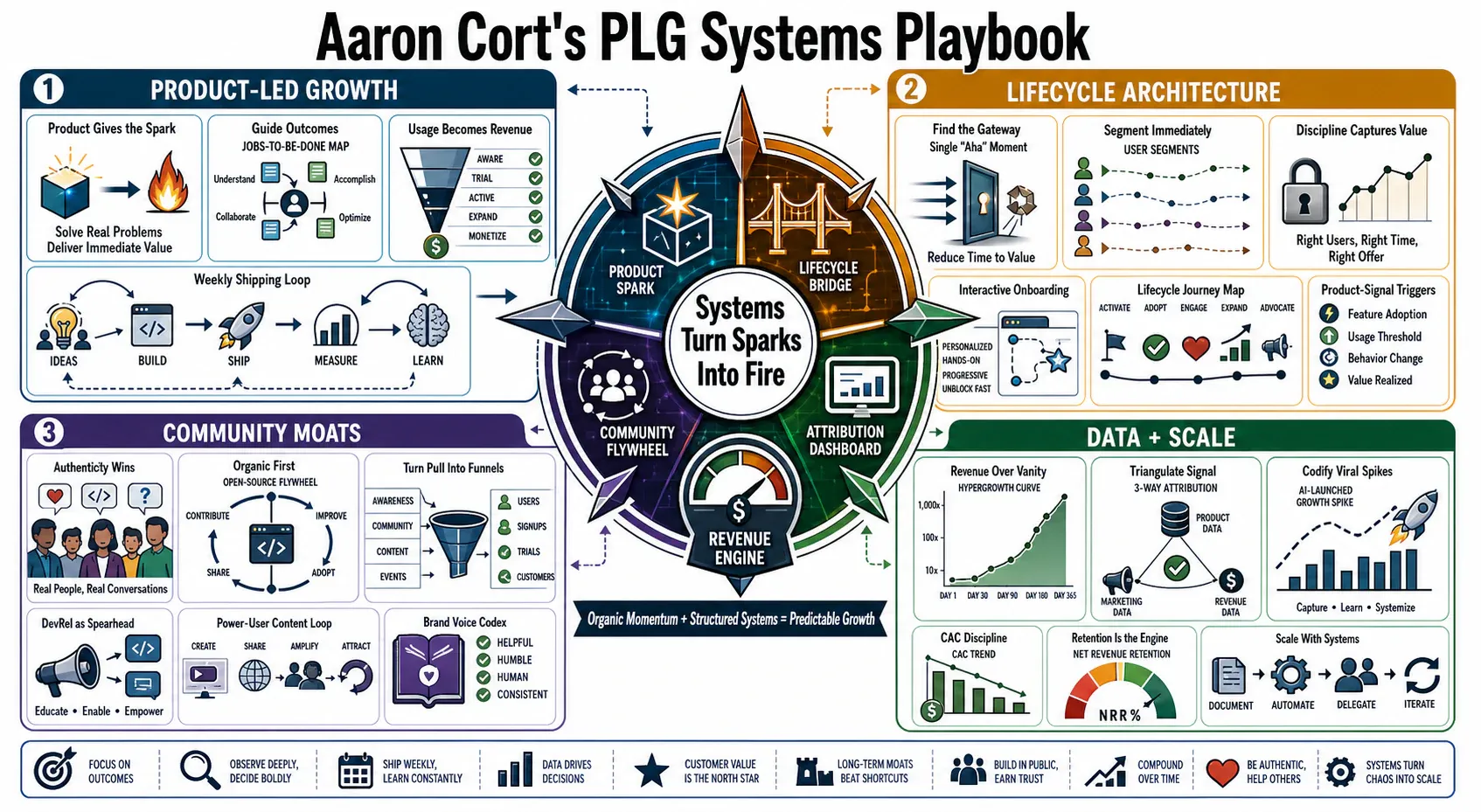
Part 1: The Core Philosophy of Product-Led Growth (PLG)
- On the Essence of PLG: "Product-led growth is the unlock — if your product resonates, the right systems compound it." — Source: [Craft Ventures]
- On Marketing's Role: "Marketing only works when it amplifies what people are already doing in the product." — Source: [Craft Ventures]
- On Sparks vs. Fire: "In PLG, the product gives you the spark, but systems turn sparks into fire." — Source: [Craft Ventures]
- On Speed and Value: "Speed without systems leaks value — launches and campaigns must be codified to sustain scale." — Source: [Craft Ventures]
- On Jobs to be Done: "Our turning point came when we shifted from promoting features to focusing on jobs to be done — guiding users toward outcomes they already wanted." — Source: [Craft Ventures]
- On Frictionless Experience: A "free-forever" product model allows users to experience value without friction, creating natural expansion loops into paid plans. — Source: [Craft Ventures]
- On the Growth Engine: The product must act as the primary vehicle for growth, centering the user experience to enable amplification across all business areas. — Source: [Craft Ventures]
- On Relentless Shipping: Align engineering to ship new features weekly based on active user feedback to fuel continuous product-led momentum. — Source: [Craft Ventures]
- On Product Signals: The most effective marketing campaigns in a PLG model are triggered by real-time product signals rather than arbitrary calendar dates. — Source: [Craft Ventures]
- On Enduring Value: Investors and boards don't care about vanity spikes; they care about how product usage translates to revenue growth and net dollar retention. — Source: [Craft Ventures]
Part 2: Architecting Growth and Lifecycle Marketing
- On the Role of Lifecycle Marketing: "Marketers should view lifecycle as the bridge between community energy and product adoption." — Source: [Craft Ventures]
- On Activation Events: Identify the critical "gateway" action in your product; for some, it's getting a database created, which serves as the ultimate unlock for downstream growth. — Source: [Craft Ventures]
- On the Rule of Two: In developer marketing, split content into two tracks: simplified step-by-step guides for beginners and deep technical documentation for experts. — Source: [Craft Ventures]
- On Immediate Segmentation: Improve performance by immediately segmenting users by use-case (e.g., personal vs. business) right after sign-up. — Source: [Craft Ventures]
- On ICP Precision: "Bifurcating your core ICP groups is essential" to ensure that distinct user personas receive tailored lifecycle paths. — Source: [Craft Ventures]
- On Interactive Tutorials: Treat complex onboarding steps not just as documentation, but as interactive experiences that guide the user to their first "aha moment." — Source: [Craft Ventures]
- On Sustained Usage: Lifecycle marketing is the operating system that turns the goodwill of a viral movement into sustained daily usage. — Source: [Craft Ventures]
- On Velocity and Discipline: "Velocity without lifecycle discipline actually works against you." — Source: [Craft Ventures]
- On Guiding Outcomes: Stop convincing users to buy and start guiding them toward the specific outcomes they signed up to achieve. — Source: [Craft Ventures]
- On Mapping the Journey: Effective growth architecture requires a deep understanding of multi-touch attribution and full lifecycle journey mapping. — Source: [Craft Ventures]
Part 3: Lessons from Scaling ClickUp
- On Rapid Scaling: It is possible to scale a SaaS company from $4M to $70M ARR in just two years by rigorously combining PLG with organic marketing. — Source: [SaaStr]
- On Zero Paid Spend Early On: In the early stages, it is entirely viable to grow to $4M ARR with zero spend on paid marketing, relying solely on product strength. — Source: [SaaStr]
- On Organic Compounding: As a company scales past $100M ARR, organic content can and should continue to drive the vast majority—often up to 65%—of new revenue. — Source: [SaaStr]
- On Performance Marketing as a Multiplier: Use paid and performance marketing only after organic channels are working, treating them as multipliers instead of crutches. — Source: [Craft Ventures]
- On Brand Voice and Humor: Utilizing platforms like LinkedIn for "corporate humor" can effectively humanize a B2B brand and build trust with enterprise buyers. — Source: [HubSpot for Startups]
- On Executive Branding: B2B buyers increasingly trust personal networks over corporate noise, making executive branding a critical component of Account Based Marketing. — Source: [HubSpot for Startups]
- On Managing Hypergrowth: Transitioning from 200 to over 1,000 employees requires building robust PMO, people, and finance operations to support the marketing engine. — Source: [Craft Ventures]
- On the "Free-Forever" Catalyst: A generous free tier is not a cost center; it is the most efficient customer acquisition channel when paired with a strong product. — Source: [Craft Ventures]
- On Aligning Teams: True scale happens when marketing, operations, and engineering operate in lockstep around weekly feature ships and user feedback. — Source: [Craft Ventures]
- On Out-of-Home Advertising: Once digital organic loops are established, strategic out-of-home brand building can dramatically amplify a software company's market presence. — Source: [SaaStr]
Part 4: Insights from Replit and the AI Wave
- On Category Creation: Scaling from $2.8M to $150M ARR requires establishing strong SEO foundations while simultaneously pioneering new categories like "vibe coding." — Source: [Craft Ventures]
- On Launching AI Products: "The Agent wasn't just another launch; it was a new entry point into the product's value." — Source: [Craft Ventures]
- On AI as a Growth Driver: Every successful marketing motion during a major AI product rollout should start with the AI assistant acting as the core driver inside the product. — Source: [Craft Ventures]
- On Codifying Viral Spikes: An AI launch will generate massive organic interest, but without codified systems, that viral spike will quickly leak value. — Source: [Craft Ventures]
- On the Developer Audience: When marketing AI tools to developers, it is crucial to avoid vanity metrics and focus intensely on how the tool solves complex technical problems. — Source: [Craft Ventures]
- On Product Innovation: Product-led growth is fueled by constant product innovation, and AI agents represent the next major frontier for embedded growth loops. — Source: [Craft Ventures]
- On User-Led Amplification: Empowering developers to share their AI-generated projects organically is far more effective than traditional top-down software marketing. — Source: [Craft Ventures]
- On Sustaining AI Momentum: The product gives you the spark, but turning an AI product launch into a lasting business requires rigorous operational infrastructure. — Source: [Craft Ventures]
- On Shifting Paradigms: The introduction of advanced AI agents shifts marketing from promoting a tool's capabilities to showcasing the autonomous outcomes it can achieve. — Source: [Craft Ventures]
Part 5: Building Community as a Moat
- On Authenticity: "Devs have a high bar for community. Supabase proved that authenticity, open-source ethos, and developer-first culture aren't just nice-to-haves, they're moats." — Source: [Craft Ventures]
- On Tone and Credibility: "For developers especially, tone is everything: too salesy and you lose credibility, too dry and you lose attention." — Source: [Craft Ventures]
- On Turning Pull into Funnels: "Community and virality aren't 'intangible.' Supabase shows how to turn organic pull... into structured funnels, lifecycle paths, and monetization." — Source: [Lenny's Newsletter]
- On Developer Relations (DevRel): DevRel is the tip of the spear in the "organic first, then structure" playbook, essential for building initial trust and momentum. — Source: [Craft Ventures]
- On Orchestrating Ecosystems: Modern growth is less about in-house content production and more about empowering power users, consultants, and agencies to create content for you. — Source: [Lenny's Newsletter]
- On Open Source Ethos: Embracing open-source principles creates a natural feedback loop that accelerates both product development and organic user acquisition. — Source: [Craft Ventures]
- On Leveraging Intermediaries: Partnering with trusted intermediaries and incubators can provide a massive initial distribution advantage within tight-knit tech communities. — Source: [Lenny's Newsletter]
- On Codifying Brand Voice: One of the most important early marketing moves is to codify the brand's voice and ensure it is consistent across all community touchpoints. — Source: [Craft Ventures]
- On Community Goodwill: The ultimate goal of lifecycle marketing is to capture the goodwill generated by a vibrant community and translate it into measurable product adoption. — Source: [Craft Ventures]
Part 6: Data, Attribution, and Measuring Success
- On Simplicity in Attribution: "If your attribution model takes more time to explain than it does to use, it's probably too complex." — Source: [SaaStr]
- On Triangulating Data: "If you're not ready for data-driven models, triangulate. Compare three models and find signal in the overlap." — Source: [SaaStr]
- On Accelerating Decisions: The purpose of attribution data is to accelerate strategic marketing decisions, not to stall teams in endless "dashboard debates." — Source: [SaaStr]
- On Closing the Loop: Sales activity and demo-to-trial paths must be fed back into the attribution model so marketing receives proper credit for pipeline generation. — Source: [SaaStr]
- On Finding the Signal: Comparing First-Touch, Last-Touch, and Linear attribution models helps uncover the true drivers of conversion when perfect data is unavailable. — Source: [SaaStr]
- On Revenue Over Vanity: True growth leaders ignore vanity metrics and social spikes in favor of hard data on revenue growth, CAC payback, and retention. — Source: [Craft Ventures]
- On Defining Activation: Activation metrics must be tied to a specific, measurable event that historically correlates with long-term user retention. — Source: [Craft Ventures]
- On Data Infrastructure: Building a scalable data infrastructure early is a prerequisite for executing complex, multi-touch Account Based Marketing campaigns. — Source: [Craft Ventures]
- On Predictable Growth: The ultimate goal of marketing data analysis is to transform unpredictable viral growth into a predictable, mathematically sound revenue engine. — Source: [Craft Ventures]
Part 7: Organic Momentum vs. Structured Systems
- On the Growth Buckets: Successful scaling relies on three pillars: user-led growth, product-led growth, and content-led growth. — Source: [Craft Ventures]
- On User-Led Growth: The most resilient form of organic momentum is driven entirely by community advocacy and word-of-mouth. — Source: [Craft Ventures]
- On Content-Led Growth: Sustainable organic traffic requires building a foundation of SEO-optimized articles, comprehensive tutorials, and robust social proof. — Source: [Craft Ventures]
- On the "Organic First" Playbook: Build a strong foundation of organic, community-driven buzz before attempting to layer on complex, structured marketing systems. — Source: [Craft Ventures]
- On Founder-Led Marketing: Founders should remain at the "epicenter" of marketing; startups with the strongest conversion rates feature their executives prominently in content. — Source: [Craft Ventures]
- On Enduring Sales: Founder-led sales never end, as the unique passion and authority of a founder cannot be fully replicated by a marketing team. — Source: [Craft Ventures]
- On Securing Social Proof: Aggressively gathering social proof on platforms like G2 is a critical step in turning early organic momentum into enterprise credibility. — Source: [Craft Ventures]
- On Structuring the Unpredictable: The art of modern growth marketing is taking the chaotic, unpredictable energy of social media and channeling it into structured acquisition funnels. — Source: [Craft Ventures]
- On the Ecosystem Shift: Stop trying to create all content internally; instead, build systems that encourage and reward your users for creating content about your product. — Source: [Lenny's Newsletter]
Part 8: Career, Leadership, and Operations
- On the Operator-in-Residence Model: Acting as an embedded interim executive allows for the rapid, hands-on implementation of proven high-growth playbooks within portfolio companies. — Source: [Craft Ventures]
- On Building the Foundation: Early marketing leadership is less about running campaigns and more about building the foundational infrastructure for data, lifecycle, and attribution. — Source: [Craft Ventures]
- On Operational Breadth: A successful tech executive must be willing to expand their purview beyond marketing to oversee global PMO, people, and finance operations as the company scales. — Source: [Craft Ventures]
- On Early Stage Hustle: Being among the first 25 employees at a startup requires a willingness to touch every part of the go-to-market motion, from demand generation to product feedback. — Source: [Craft Ventures]
- On the Value of an MBA: Formal business education, such as an MBA, provides the structural frameworks necessary to manage the chaos of hyper-growth SaaS companies. — Source: [Craft Ventures]
- On Transitioning Roles: Moving from Head of Marketing to VP of Operations highlights the deep interconnectedness between acquiring users and actually running the business that serves them. — Source: [Craft Ventures]
- On Startup Versatility: Experience across different sectors—from fintech mobile payments to demand generation platforms—builds a versatile playbook applicable to any SaaS business. — Source: [Craft Ventures]
- On Leading by Example: The best marketing leaders do not just delegate; they actively embed themselves in the trenches to understand exactly how the product is being used. — Source: [Craft Ventures]
- On Sustained Excellence: Achieving true breakout growth is never an accident; it is the result of applying relentless discipline, clear systems, and a deep respect for the user experience over many years. — Source: [Craft Ventures]