Christopher Payne held senior roles at Microsoft, Amazon, eBay and DoorDash, where he helped scale a delivery marketplace. His operating approach combines customer observation, local-market execution and attention to the economics of moving physical goods. — First Round Executive Function.
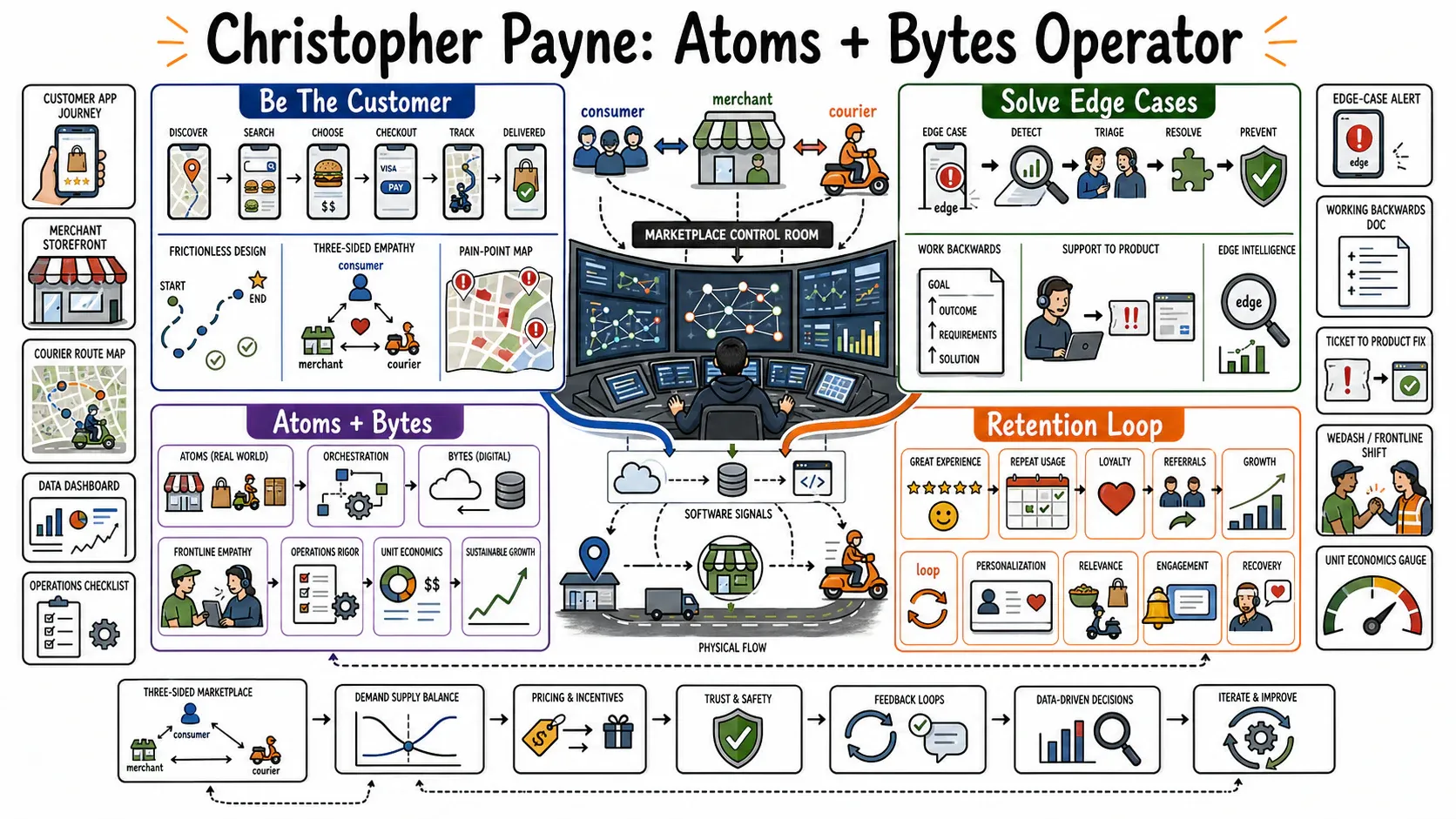
Part 1: Customer Obsession & Empathy
- On Being the Customer: Payne regularly used DoorDash himself to spot customer pain points and help prioritize fixes. — Helena Seo Interview.
- On Edge Cases: A missing grocery item led Payne to recreate an order as a Dasher, trace the store-layout problem, then check whether it affected other products. — First Round Executive Function.
- On the Retention Loop: Payne argues that better meeting customer needs can improve retention and the company’s competitive position. — Thought Economics Interview.
- On Active Listening: Payne valued written customer feedback because it explained why customers were satisfied or dissatisfied, beyond the headline NPS score. — Helena Seo Interview.
- On Customer-First Design: Payne describes understanding the customer’s need before designing the product and operating system around it. — Helena Seo Interview.
- On Working Backwards: Across his companies, Payne says he started with customers and worked backward from what they needed. — Thought Economics Interview.
- On the WeDash Program: DoorDash’s WeDash program let employees make deliveries themselves and learn how the delivery system worked. — Helena Seo Interview.
- On Designing for Pain Points: Payne describes design, product, engineering and operations working together on menu photography and pickup flows, then testing designs against customer response. — Helena Seo Interview.
- On Multi-Sided Marketplaces: Payne says DoorDash must provide affordable, high-quality delivery that works for customers, Dashers, merchants and the company’s economics. — Thought Economics Interview.
Part 2: Operational Excellence & The "Atoms" Business
- On Atoms vs. Bytes: Payne says a physical-delivery business demands close attention to unit economics as volume and local-market density grow. — First Round Executive Function.
- On Living the Data: Payne combined dashboard anomalies with firsthand investigation of grocery orders rather than treating either data or personal observation as sufficient alone. — First Round Executive Function.
- On Physical Friction: Recreating an order in the store exposed a physical shelf-layout problem that the app had not explained to Dashers. — First Round Executive Function.
- On Strategy vs. Execution: Payne credits DoorDash’s rise to an artful blend of strategy and execution, not one magical competitive move. — Helena Seo Interview.
- On Relentless Consistency: Payne says a delivery platform has to execute well in each locality, day after day, because customers judge the service they actually receive nearby. — Helena Seo Interview.
- On Local Excellence: National scale cannot substitute for a good local delivery experience: a customer in one suburb is unaffected by excellent service in another city. — Helena Seo Interview.
- On the "Boring" Stuff: Payne identifies restaurant selection, on-time delivery and order accuracy as operational drivers of the customer experience. — Helena Seo Interview.
- On Scaling the Launch Model: DoorDash replaced an in-person city-launch model with a repeatable remote approach when the old process could no longer support its expansion goals. — First Round Executive Function.
Part 3: Speed, Execution, and Bias for Action
- On Low-Cost Experiments: Payne says technology lets teams try small experiments and learn without staking the entire company on one idea. — Thought Economics Interview.
- On Goals That Change the Method: Payne argues that a much more ambitious target can force a team to rethink its approach rather than extrapolate current growth. — First Round Executive Function.
- On Overcoming Analysis Paralysis: Payne cautions against waiting for an elaborate experiment when practical judgment already identifies an obvious problem to fix. — First Round Executive Function.
- On Adapting Fast: Payne says prior industry habits can hinder reinvention, while rapidly scaling companies require executives to keep changing their methods. — First Round Executive Function.
- On Ambitious Goals: Payne sets ambitious goals from the top, asks teams to work through a resource-constrained plan, and rewards strong learning even when a stretch target is missed. — First Round Executive Function.
- On Iterative Learning: Payne treated a promising pickup-map design as a hypothesis to test against how consumers actually responded. — Helena Seo Interview.
Part 4: Leadership, Conflict, and Decision Making
- On the Founder's Drumbeat: Payne says a founder’s long-term vision can set a steady direction while employees throughout a company continue to invent and build. — Thought Economics Interview.
- On Founder Mode vs. Manager Mode: Payne argues that senior executives should retain the ability to investigate operational details and then test whether a local observation signals a broader problem. — First Round Executive Function.
- On Cross-Functional Empathy: Payne values leaders who understand enough of marketing, product, business development and engineering to align functions around a coherent strategy. — First Round Executive Function.
- On Scaling Executive Attention: When an initiative struggled, Payne sometimes joined the team temporarily to work through the problem and help people carry it forward. — First Round Executive Function.
Part 5: Scaling Teams & Hiring Superpowers
- On the Cost of Great Teams: Payne treats interviews as imperfect, then looks for whether hires can execute and first asks whether they need clearer goals or more support. — First Round Executive Function.
- On Hiring for Superpowers: Payne probes how candidates built something and asks them to propose a useful product feature, looking for hands-on product judgment. — First Round Executive Function.
- On the COO as a Force Multiplier: Payne views a COO’s core work as building a viable business: finding product-market fit, setting goals and scaling what works. — First Round Executive Function.
- On Pro-Innovation Talent: Payne prefers leaders who can build from first principles and work through details; domain experience can help, but may also constrain reinvention. — First Round Executive Function.
- On Empowering Builders: Payne expects employees across the company to innovate, meet customer needs and build, not leave entrepreneurship solely to founders. — Thought Economics Interview.
- On Eliminating Growth Barriers: Payne says managers should ask what each person needs to succeed and examine whether goals, information or guidance are missing before blaming a poor result. — First Round Executive Function.
Part 6: Strategy, Profitability & Market Dominance
- On Profitability Funding Innovation: Payne says new businesses must eventually earn money so they can continue creating value and fund further innovation. — Thought Economics Interview.
- On Validating the Market: Payne treats competitors entering a category as a sign that it may have meaningful customer value, not as proof a company will win. — Thought Economics Interview.
- On the Suburban Playbook: Payne says DoorDash’s often-cited suburb strategy grew out of learning how to expand economically into many markets, rather than a single preordained suburban playbook. — First Round Executive Function.
- On Market Share as a Byproduct: Payne attributes DoorDash’s growth partly to broad restaurant selection and reliable, accurate delivery rather than one magic market-share tactic. — Helena Seo Interview.
- On Selection and Delivery Quality: Payne links restaurant selection with reliable delivery, requiring both software and operations to work together for repeat use. — Helena Seo Interview.
- On Protecting the New: Payne says leaders should protect resources for small new businesses because the established operation otherwise tends to consume them. — First Round Executive Function.
- On Avoiding Complacency: Payne says DoorDash cannot rest on its lead because food delivery remains a changing, competitive category. — Thought Economics Interview.
- On Capital Allocation: Payne says proving the economics in one market gave DoorDash a basis to expand while watching how volume changed delivery costs and contribution margins. — First Round Executive Function.
- On Scaling Nuance: Payne found that local markets needed a common playbook plus adaptations for the differences between large cities and suburbs. — First Round Executive Function.
Part 7: The Product & Innovation Playbook
- On Product-Market Fit: Payne says a new business needs room and resources to find product-market fit before it is held to the same goals as a mature operation. — First Round Executive Function.
- On the Role of Product Teams: Payne argues that product and operational design must begin with a clear customer segment and need, then bring design, product, engineering and operations together. — Helena Seo Interview.
- On Commerce 3.0: In his Commerce 3.0 keynote, Payne described mobile commerce as shifting attention from the physical store toward the consumer wherever they are. — eBay Commerce 3.0 Keynote.
- On Online-Offline Convergence: Payne described Commerce 3.0 as combining online shopping tools with physical-store experiences through mobile technology. — eBay Commerce 3.0 Keynote.
- On Software Complexity: Payne describes DoorDash as a software problem, an operational scaling challenge and a marketplace that must work locally. — Helena Seo Interview.
- On Search-Ranking Incentives: At eBay, Payne learned that optimizing search for purchases alone could miss sales value and marketplace trust, so the ranking system needed better constraints. — First Round Executive Function.
- On Open Platforms: Payne argued that merchants and platforms should collaborate because no single company could deliver every innovation customers wanted. — eBay Commerce 3.0 Keynote.
Part 8: Career Resilience & Personal Philosophy
- On Taking Risks: Payne says he took career risks to learn and build, including leaving Microsoft for the then-underrated Amazon. — Thought Economics Interview.
- On Failing at Tinder: Payne describes being fired from Tinder after six months as painful, but still part of a career of taking risks and learning from what fails. — Thought Economics Interview.
- On Work-Life Balance: Payne says family is more important to him than work alone and believes balance across family, work and other pursuits helps people perform well. — Thought Economics Interview.
- On Intrapreneurship: Payne says a person can be entrepreneurial within an existing company by innovating, experimenting and meeting customer needs. — Thought Economics Interview.
- On the "Yes! Both!" Mindset: When asked to choose between growth and profit at DoorDash, Payne’s answer was “yes, both”: the service must grow and work economically. — Thought Economics Interview.
- On Human Versatility: In a 2022 interview, Payne expected delivery automation to advance but argued the first and last stretches of a trip still required versatile human work in the near term. — Thought Economics Interview.
- On Navigating Transitions: Payne says executives moving into a fast-growing physical-operations business need to work through details and be willing to build, not just supervise. — First Round Executive Function.
- On Leaving a Legacy: Payne describes helping the next generation of employees and passing on what he has learned as a satisfying part of his later career. — Thought Economics Interview.