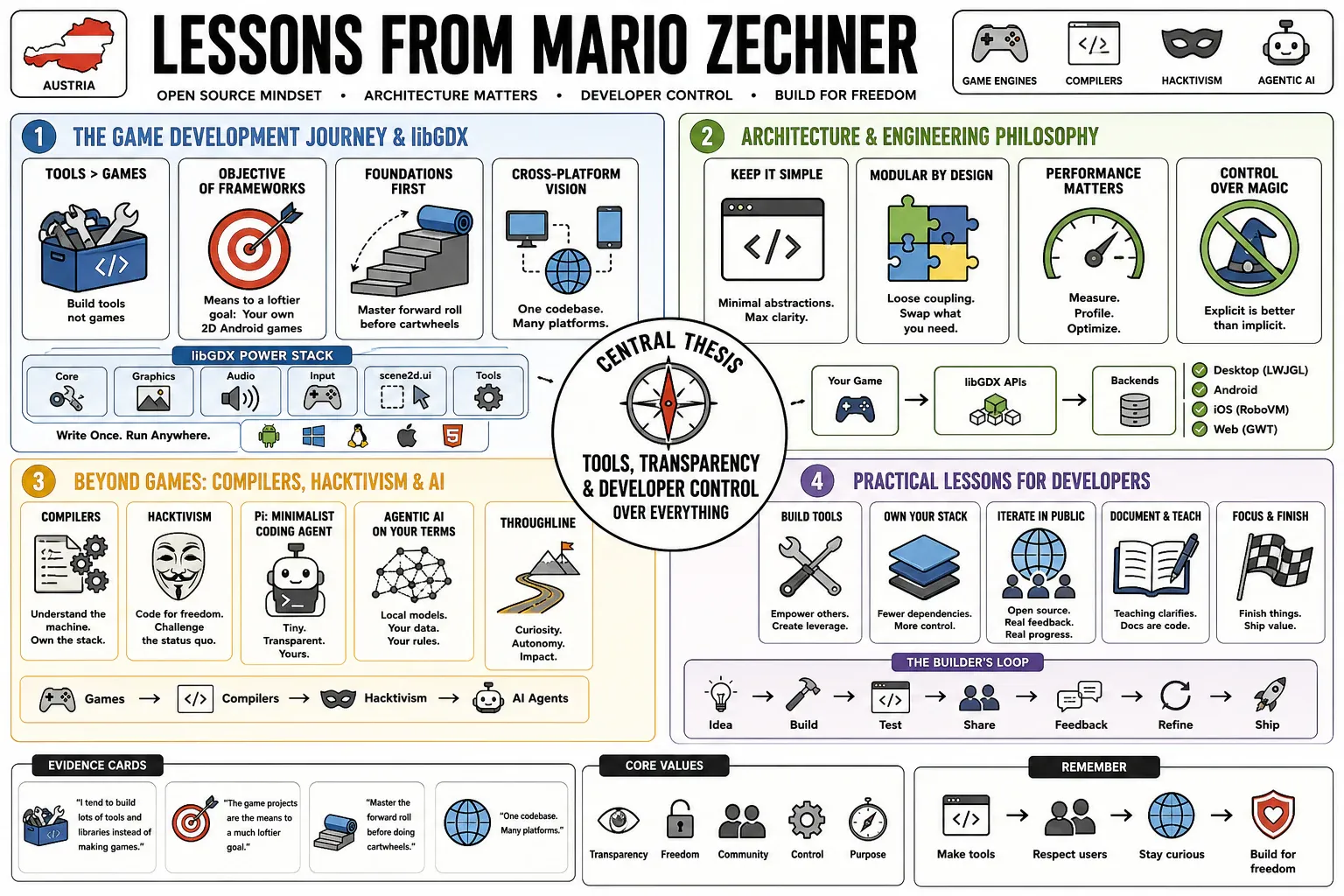
Mario Zechner is an Austrian software engineer best known for creating the libGDX game development framework and pioneering the minimalist coding agent "Pi." Moving seamlessly from game engines to compilers, hacktivism, and agentic AI, his career reflects a relentless pursuit of transparency and developer control. This collection distills his core philosophies on open source, software architecture, and navigating the complexities of the modern tech landscape.
## Part 1: The Game Development Journey & libGDX
- On Tools vs. Games: "As you can see, I tend to build lots of tools and libraries instead of making games." — Source: [Mario's Lab]
- On The Objective of Frameworks: "The game projects themselves are not the objective of the book but the means to a much loftier goal. By the end of the book, you will be able to design and implement your own 2D Android games." — Source: [Beginning Android Games]
- On Foundations First: "We will not always approach the working game examples in a 'by-the-book' manner. This is to avoid the problem of doing cartwheels before mastering the forward roll." — Source: [Beginning Android Games]
- On Cross-Platform Vision: "Spine could actually run on all those platforms! The key to making UIs with libgdx is scene2d.ui... Along with an auto update mechanism in the app, with one button press I can build and deploy an update to all users." — Source: [Esoteric Software Blog]
- On The Game Loop: "You'll start with game design fundamentals and programming basics, and then progress toward creating your own basic game engine... This will give you everything you need to branch out." — Source: [Beginning Android Games]
- On Accessibility in Coding: "Anyone can learn to program... If you have an idea for a killer Android app, this fully revised and updated edition will help you build your first working application in a jiffy." — Source: [Beginning Android Games]
- On Platform Trade-offs: "While there is a minor speed penalty, the productivity gains and the evolution of the Android Runtime make Java the ideal choice for most developers." — Source: [Beginning Android Games]
- On Feature Creep: "It was very, very hard to keep feature creep in check, to stay on track and implement only the basic features. So many of my own ideas had to get shot down." — Source: [Esoteric Software Blog]
- On Low-Level Abstractions: "I prefer raw access to APIs like OpenGL rather than heavy wrappers. It forces you to understand the hardware you are targeting." — Source: [GameDev Days Graz]
- On The Legacy of libGDX: "I never commercialized libGDX... Zero regrets, worked out beautifully, opened many doors, and got me in touch with a lot of very interesting and kind people." — Source: [Mario's Lab]
## Part 2: The Philosophy of Tools & Architecture
- On Human Architecture: "Anything that defines the gestalt of your system, that is architecture, API, and so on, write it by hand." — Source: [Mario's Lab]
- On Tool Constraints: "The project's core concept is to tailor an AI assistant to the specific needs of a programmer, rather than forcing humans to conform to the rigid constraints of existing software." — Source: [0xSero Podcast]
- On Progressive Disclosure: "Encourage progressive disclosure—reading a README only when a tool is actually needed. Don't front-load complexity." — Source: [Mariozechner.at]
- On Minimal Surface Area: "I prefer building directly on provider SDKs to maintain full control and keep APIs small." — Source: [Inside AI #29]
- On Understanding the Stack: "If you do anything important, write it by hand... don't let the machine make the decisions for you." — Source: [Syntax Podcast]
- On Manual Review: "Read the Code. I am a staunch advocate for manual review. If you don't read it, you don't own it." — Source: [Mariozechner.at]
- On Programming Videos: "I'm not a fan of 'programming videos', as I can consume text way faster... Like Bob Ross, but for programmers. Nice to see other folks' processes, though." — Source: [Mastodon @badlogic]
- On Rendering Fundamentals: "Recreate 90s-era tech like software rasterizers to truly understand the fundamentals of graphics." — Source: [Mario's Lab]
- On Spine 2D's Workflow: "Spine has a sweet build system... stability over flashy features is how you build a lasting tool that professionals can rely on." — Source: [Esoteric Software Blog]
## Part 3: The RoboVM Era & The Reality of Open Source
- On Corporate Acquisition: "Long story short: we sold RoboVM to Xamarin. A short while later Xamarin closed-sourced our open-source RoboVM core." — Source: [Mariozechner.at]
- On The Fallout: "Quickly followed by Xamarin selling to Microsoft. Then Microsoft shut down RoboVM immediately. While there was some monetary gain, everything about this fucking sucked." — Source: [Mariozechner.at]
- On Being the Messenger: "As the 'OSS guy'... I was also the guy who had to write the 'Sorry, no more OSS, suckers' blog post." — Source: [Mariozechner.at]
- On Internet Backlash: "You cannot imagine what people called me on social media and via email, despite me having zero control over the situation." — Source: [Mariozechner.at]
- On VC-Funded Startups: "RoboVM going closed-source was devastating, and it made me sour on both VC-funded startups and OSS." — Source: [Mariozechner.at]
- On Competitor Exploitation: "We have seen competitors actively exploiting our good faith by using our open source code to compete with us directly in commercial products." — Source: [The Register]
- On The Illusion of Contributions: "On the flip side, we have received almost no meaningful contributions to our open source code... we had hoped our initial business model of OSS with proprietary extensions would work." — Source: [The Register]
- On Delayed Open Source (DOSP): "I use 'Fair Source' licenses for value-add features, which eventually convert to full open source after a set period." — Source: [Mariozechner.at]
- On The Ultimate Safety Valve: "The core of my projects remains MIT licensed and forkable. The 'fork button' is the ultimate safety valve for the community." — Source: [Mariozechner.at]
## Part 4: Radical Minimalism & "YOLO" Engineering
- On Bash Independence: "Bash is all you need. I opted for extreme minimalism, giving my agent only four tools: read, write, edit, and bash." — Source: [Mastodon @badlogic]
- On The Strict Rule: "If I don't need it, it won't be built. The ultimate feature is the one you leave out." — Source: [Mariozechner.at]
- On YOLO Security: "I dislike 'permission popups' for shell commands, preferring to give the user enough rope to build their own security flow." — Source: [Syntax Podcast]
- On Extensibility: "Build the thing I like to use... and if others like it too, make it extensible enough so they can make it their own." — Source: [Syntax Podcast]
- On Over-engineered Tools: "I critique modern, overloaded tools like Claude Code. Simple, transparent tools often outperform complex, black-box agent systems." — Source: [YouTube Tech Talks]
- On Black-Box Agents: "I criticize tools that spawn sub-agents with zero visibility. I prefer linear, transparent logs where the user can see every source the agent looked at." — Source: [Mariozechner.at]
- On Collaborative Planning: "Planning should happen in markdown files that both the human and the agent can edit, rather than in a hidden internal state." — Source: [Inside AI #29]
- On Friction in Learning: "Friction is necessary for learning. When we remove all friction with abstraction, we remove the opportunity to deeply understand the system." — Source: [Sentry Podcast]
- On Simplicity: "I wanted something that fits my workflow which is very minimalist. I stripped away all the things I don't need." — Source: [Syntax Podcast]
## Part 5: The Rise of Agentic AI & The "Pi" Coding Agent
- On Creating Pi: "I didn't expect it to become this autonomous... being able to take an instruction and figure things out, coming back to me and asking 'is this what you want?'" — Source: [Sentry Podcast]
- On LLM Capabilities: "LLMs aren't magic... they can shit out code real well but that code is mostly bad." — Source: [0xSero Podcast]
- On The Acceleration of AI: "I don't care if it's slop... you accelerate so much by just using these tools, provided you verify the output." — Source: [0xSero Podcast]
- On The Brownfield Problem: "Where it falls apart is when you have a brownfield project. AI struggles immensely with massive existing complexity and context." — Source: [0xSero Podcast]
- On Token Addiction: "Modern developers have a token addiction, building features just because an AI agent can." — Source: [Future Weekly #492]
- On Agent Security Risks: "Credential exfiltration is a massive risk. You have to run agents locally in YOLO mode but inside a safe container to isolate them." — Source: [0xSero Podcast]
- On Minimalist Harnesses: "I prefer minimalist harnesses over complex frameworks. The agent just needs to read, write, and execute commands." — Source: [Inside AI #29]
- On The Future of Software: "Manual programming isn't dead, but the way the next generation learns engineering will fundamentally change." — Source: [Future Weekly #492]
- On Context Protocols: "Features like MCP consume too many tokens and reduce model performance. Keep it simple and focused." — Source: [Mariozechner.at]
- On Tailored AI: "Tailor an AI assistant to the specific needs of a programmer, rather than assuming a one-size-fits-all model." — Source: [Sentry Podcast]
## Part 6: The Danger of "Slop" & Cognitive Debt
- On Destroying Open Source: "AI agents are destroying Open Source Software by flooding repositories with unverified slop." — Source: [Building Pi Talk]
- On Slowing Down: "Slow the fuck down. Use agents as surgical tools rather than autonomous replacements for careful thought." — Source: [Building Pi Talk]
- On The Merchants of Complexity: "AI agents, if left unchecked, act as merchants of complexity, shitting out thousands of lines of code that humans can no longer reason about." — Source: [Simon Willison's Weblog]
- On Cognitive Debt: "It’s so easy to let the codebase evolve outside of our abilities to reason clearly about it. Cognitive debt is real and compounding." — Source: [Simon Willison's Weblog]
- On Setting AI Limits: "Set yourself limits on how much code you let the clanker generate per day, in line with your ability to actually review the code." — Source: [Simon Willison's Weblog]
- On The Vibe Tunnel: "It’s still far from being perfect, but it feels much more streamlined... because that’s all we have, vibes instead of rigorous metrics." — Source: [Mario's Lab]
- On Token-Maxing Desires: "I warn against token-maxing desires. Just because you have a million token window doesn't mean you should use it." — Source: [YouTube Tech Talks]
- On Humongous Codebases: "Over-reliance on agents leads to humongous codebases that neither the human nor the agent can eventually understand or fix." — Source: [Building Pi Talk]
- On Surgical AI: "Use AI as a surgical instrument, not a blunt force weapon that rewrites your entire repository at once." — Source: [Building Pi Talk]
## Part 7: Hacktivism & Public Good
- On The Purpose of Hacktivism: "Exploit these tools to create things for the public good, projects that would be too tedious to build manually." — Source: [Mariozechner.at]
- On Heisse Preise: "I started Heisse Preise as a reaction to the high food prices in Austria and the lack of a state price comparison portal." — Source: [Heisse Preise Platform]
- On Transparency: "The goal is to track price changes at supermarkets to create real transparency about inflation." — Source: [Heisse Preise Platform]
- On Open Data: "Web scraping is necessary because there is a fundamental lack of Open Data in the retail sector." — Source: [Mariozechner.at]
- On Political Analysis: "I hosted leaked coalition negotiation protocols to make them accessible to the broader public." — Source: [Mariozechner.at]
- On Using AI for Analysis: "I used LLMs to compare political documents and highlight similarities in the phrasing of different negotiation groups." — Source: [Mariozechner.at]
- On Parliamentary Tools: "Tools like 'woswormeileistung' analyze parliamentary data to show what politicians are actually doing and saying in parliament." — Source: [Mario's Lab]
- On Niche Projects: "AI lowers the barrier to entry for journalistically niche projects that serve the public interest." — Source: [Future Weekly #492]
- On The Duty of Developers: "We have a responsibility to use our skills to keep institutions and corporations honest." — Source: [Future Weekly #492]
- On Open Access: "If the government won't provide the data, engineers have the tools to scrape it and publish it themselves." — Source: [Mariozechner.at]
## Part 8: Reflections, Community & The Developer Lifestyle
- On The Value of Community: "But ultimately, none of this bullshit mattered. What did matter was the community." — Source: [Mariozechner.at]
- On Community Resilience: "Companies can close-source code, but they cannot easily kill a community that is willing to fork and maintain a project." — Source: [Mariozechner.at]
- On The Startup Dance: "The startup dance in compilers and mobile tools was a wild ride, but often left developers feeling burned." — Source: [GameDev Days Graz]
- On History Rhyming: "History in tech rhymes. The current AI gold rush feels remarkably similar to the early days of mobile OSS." — Source: [Mariozechner.at]
- On The Nomadic Lifestyle: "I transitioned from a corporate job to a nomadic lifestyle, coding Spine and libGDX from places like a small island in Croatia." — Source: [Esoteric Software Blog]
- On The "Childhood Dream": "Building your own tools and seeing people make incredible games with them is a childhood dream come true." — Source: [Esoteric Software Blog]
- On Staying Grounded: "Don't let the tech hype cycle dictate your self-worth or your architectural decisions." — Source: [Mario's Lab]
- On Learning from Failure: "You learn more from a devastating shutdown like RoboVM than you do from a smooth exit." — Source: [Mariozechner.at]
- On The Ultimate Goal: "At the end of the day, I just want to build cool shit and share it with people who care." — Source: [Mario's Lab]