Part 1: The Contrarian Mindset and Value
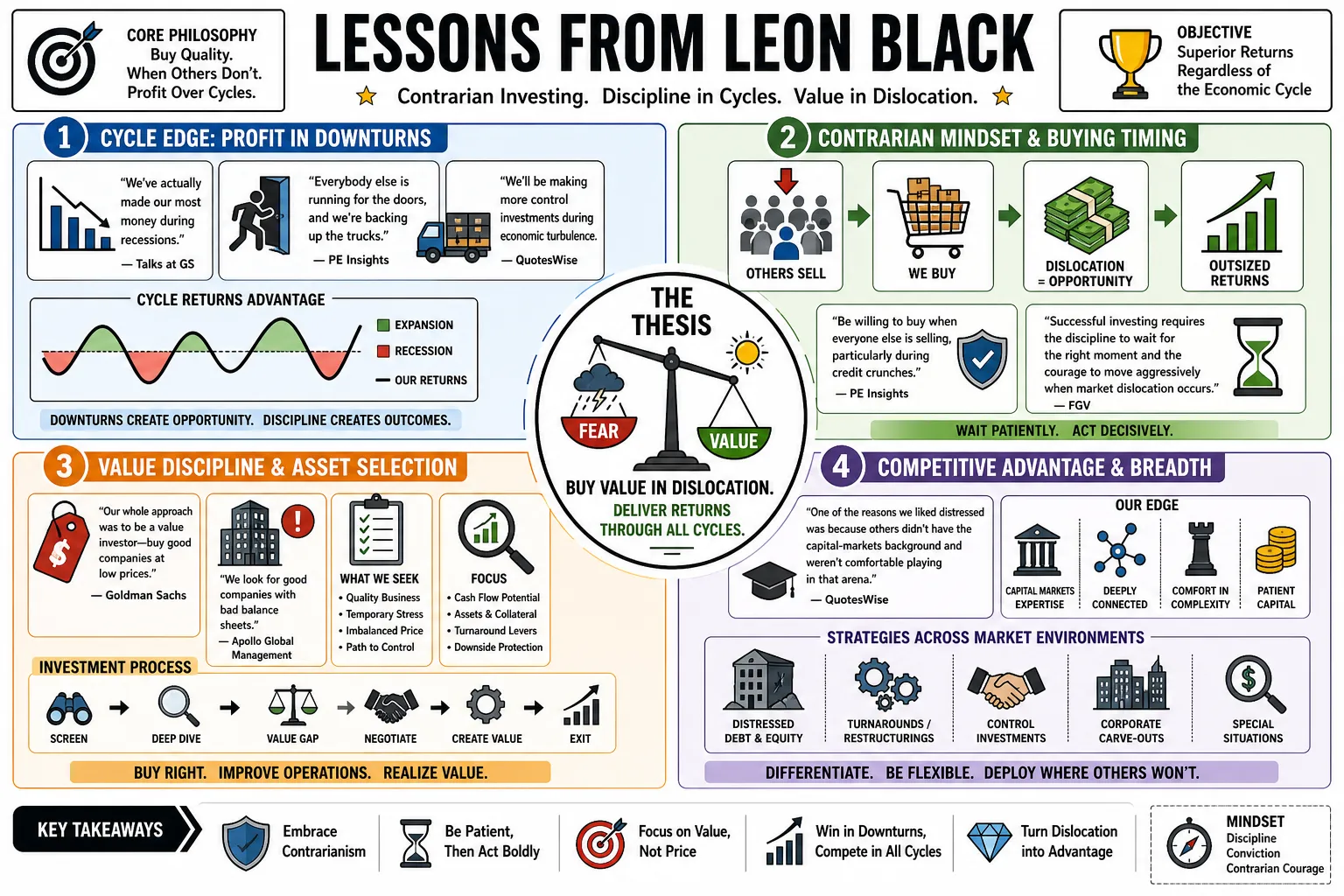
- On Market Cycles: "We’ve actually made our most money during recessions." — Source: Talks at GS
- On Buying Timing: "Everybody else is running for the doors, and we're backing up the trucks." — Source: PE Insights
- On Entry Prices: "Our whole approach was to be a value investor—buy good companies at low prices." — Source: Goldman Sachs
- On Contrarianism: "Be willing to buy when everyone else is selling, particularly during credit crunches." — Source: PE Insights
- On a Fund for All Seasons: "We wanted to create a firm that could generate high returns regardless of the economic cycle." — Source: Milken Institute
- On Patience: "Successful investing requires the discipline to wait for the right moment and the courage to move aggressively when market dislocation occurs." — Source: FGV
- On Asset Selection: "We look for good companies with bad balance sheets." — Source: Apollo Global Management
- On Competitive Advantages: "One of the reasons we liked distressed was because others didn't have the capital-markets background and weren't comfortable playing in that arena." — Source: QuotesWise
- On Economic Turbulence: "We'll be making more control investments as the stock market falls, and more distressed as the economy weakens." — Source: The Street
- On Long-term Horizon: "If you have the capital and the stomach, the best time to buy is when the news is at its worst." — Source: SuperReturn International
Part 2: Navigating Complexity and Distressed Assets
- On Dealing with Trouble: "We often like to deal with aggravation if it will get us a better price." — Source: Buyouts Insider
- On Distressed Success Rates: "When we do distressed-debt investing, we have made money in 98 percent of those deals." — Source: QuotesWise
- On Complexity as a Moat: "We specialize in complex deals that other firms avoid because they don't want the headache of the restructuring." — Source: Milken Institute
- On Deleveraging: "Distressed investing is essentially a delevering process, where the goal is to fix a company's balance sheet to unlock its underlying value." — Source: The Street
- On Finding Opportunities: "You don't need a global recession to find good distressed opportunities." — Source: Buyouts Insider
- On Loan-to-Own: "By buying debt at a discount, you can eventually gain equity control and participate in the full recovery of the company." — Source: Apollo Global Management
- On the LyondellBasell Trade: "It was about understanding the chemical cycle and knowing that the assets were sound even if the debt was mispriced." — Source: Buyouts Insider
- On Legal Puzzles: "I view business as a series of logical puzzles rather than just numbers." — Source: Puck News
- On Market Dislocation: "Market dislocations are the best time to deploy capital because they separate the true value of an asset from its temporary price." — Source: Milken Institute
- On Strategic Flexibility: "We move between equity and debt depending on where the best risk-reward exists in the capital structure." — Source: Talks at GS
Part 3: Risk Management and Downside Protection
- On the Core Philosophy: "If you cover your downside and keep the discipline, the reward side will take care of itself." — Source: PE Insights
- On Speculation: "A hope and a prayer is not a strategy." — Source: Buyouts Insider
- On Avoiding Loss: "Know what you are doing, avoid get-rich-quick schemes, do your homework, don't bet the ranch." — Source: PE Insights
- On Risk Measurement: "From a risk/reward point of view, we have the best game in town." — Source: Milken Institute
- On Capital Protection: "If you protect the floor, the ceiling will eventually take care of itself as the market recovers." — Source: SuperReturn International
- On Learning from Failure: "I saw what worked on the way up; I also saw what didn't work on the way down." — Source: Goldman Sachs
- On Early Trading Mistakes: "Losing two-thirds of a $75,000 inheritance trading commodities was the best money lesson I ever had." — Source: PE Insights
- On Margin of Safety: "Buying debt at a significant discount creates a built-in margin of safety that equity investors often lack." — Source: Apollo Global Management
- On Risk Management: "We are getting best-in-class returns, but we are also taking the least risk because of where we sit in the capital structure." — Source: QuotesWise
- On Due Diligence: "Sustainable success requires deep analytical homework; there are no shortcuts to understanding a company's true value." — Source: FGV
Part 4: The Drexel Legacy and Capital Structure
- On Credit-First Thinking: "Coming from the house that Milken built, our approach is rooted in credit analysis rather than just equity." — Source: PE Insights
- On Capital Structures: "You have to learn to read balance sheets from the bottom up to see where the real value is hidden." — Source: FGV
- On Information Sharing: "Drexel’s success came from different departments constantly communicating, which is why we built an integrated platform at Apollo." — Source: Talks at GS
- On the Drexel Diaspora: "Being in the middle of that 1980s rocket ship taught me more about deal flow than any other environment could." — Source: David Rubenstein Show
- On Market Observation: "Having a front-row seat to the entire private equity industry at Drexel allowed me to see which business models were superior." — Source: FGV
- On High-Yield Influence: "Understanding the junk bond market was critical to learning how to finance and restructure the companies of the future." — Source: Milken Institute
- On Financial Necessity: "The financial necessity of supporting my family after my father's death drove me into finance, even though I had other interests." — Source: PE Insights
- On the Power of Networks: "Relationships built during times of crisis are often the most enduring and valuable in business." — Source: David Rubenstein Show
- On Structural Advantage: "Most people focus on the top of the capital structure; we found that the real opportunities were often in the neglected middle layers." — Source: Talks at GS
Part 5: Building a High-Performance Culture
- On Talent: "Your greatest assets are your people... we are in the talent business." — Source: Milken Institute
- On the Integrated Platform: "We always felt we would be better investors if there was an informational library built up where different departments talked to each other all the time." — Source: Goldman Sachs
- On Retention: "In private equity, the spread between the best and worst firms is driven almost entirely by the quality of the people you keep." — Source: PE Insights
- On Organizational Design: "An integrated platform allows credit and equity teams to share insights that others miss by working in silos." — Source: Talks at GS
- On Corporate Governance: "The demand for better transparency and governance from limited partners has been very healthy for the industry." — Source: Goldman Sachs
- On Luck: "Sometimes luck is more important than anything else... we were fortunate to have a big bank approach us right after Drexel's collapse." — Source: Talks at GS
- On Professional Environments: "Start your career in environments with high deal flow and smart people who understand risk and reward." — Source: FGV
- On Performance Spread: "The difference between average and exceptional returns is the discipline to stick to your process when everyone else is panicking." — Source: SuperReturn International
- On Alignment of Interest: "Real alignment between GPs and LPs is what allows for long-term value creation in the private equity model." — Source: Goldman Sachs
Part 6: The Humanities and the "Philosopher King"
- On Business Education: "Most of what I learned about how to do business I learned from Shakespeare, not Harvard Business School." — Source: PE Insights
- On Human Nature: "Shakespeare provides a deeper understanding of greed, ambition, and betrayal—the true drivers of business—than any technical textbook." — Source: PE Insights
- On Analytical Foundations: "My studies in philosophy and history provided the analytical foundation for my career in finance." — Source: Dartmouth College
- On Intellectual Curiosity: "Graduates should maintain a sense of intellectual curiosity to navigate complex global challenges." — Source: Dartmouth College
- On Liberal Arts: "A liberal arts education teaches you how to think, which is far more valuable than learning a specific set of rules that will eventually change." — Source: Dartmouth College
- On Dreaming Big: "We hope students use this space to dream big, be courageous, and take artistic risks." — Source: Dartmouth College
- On Mistakes: "It is important to have a welcoming home where students feel it's okay to make mistakes in the process of discovering themselves." — Source: Dartmouth College
- On the Utility of Philosophy: "Philosophy teaches you to break down complex problems into their logical components, which is exactly what dealmaking is." — Source: Puck News
- On Imagination: "If an institution can help generations of young people find their imagination and curiosity, it is a success." — Source: Dartmouth College
Part 7: The Art of Acquisition and Connoisseurship
- On Collecting: "I am an obsessive compulsive sicko collector." — Source: Puck News
- On the Appeal of Art: "I like everything about collecting... I like what you learn researching... I love the art of acquisition too and chasing down deals." — Source: Puck News
- On Living with Art: "Late at night... I wander around and I rehang things in the apartment. And that’s a form of relaxation." — Source: Puck News
- On Human Distinction: "Art and culture are what distinguishes us from other species." — Source: Forbes
- On the Portfolio Approach to Art: "I apply my private equity training to art, viewing my collection as a diversified portfolio of high-value assets." — Source: Scribd
- On "The Scream": "The unfairness of so many great investments we lead and how our stock is undervalued. That’s most worth screaming about, I think." — Source: Observer
- On Collecting Influence: "My mother was an artist... her sister owned an art gallery... I actually had no escape from the arts." — Source: Puck News
- On Trophy Hunting: "I look for 'A+' quality—historically significant works that define their respective movements." — Source: Scribd
- On Persistence in Acquisition: "Chasing down deals is as much about persistence and research in the art world as it is in the boardroom." — Source: Puck News
Part 8: Venture Philanthropy and Responsibility
- On Medical Research: "We fund the most innovative researchers to get them to the stage where pharmaceutical companies or government agencies will pick up the baton." — Source: Forbes
- On Venture Philanthropy: "I apply a portfolio approach to philanthropy, funding high-risk, high-reward research that might otherwise struggle to find government funding." — Source: Forbes
- On Personal Commitment: "Had Debra not been diagnosed, I don't believe the research would be as far along today." — Source: Forbes
- On Efficiency in Giving: "We underwrite 100% of the MRA’s administrative costs so that every dollar donated goes directly to scientific research." — Source: Cure Melanoma
- On Social Purpose: "Private equity helps public workers—this is what's helping teachers, firemen, and government workers fund their retirements." — Source: Goldman Sachs
- On Climate Responsibility: "Climate change is a reality, and we have to change with it and be a help in problem-solving by example and with new products." — Source: Goldman Sachs
- On Philanthropic Breadth: "I don't think I'm the type of person that gives it all away to one thing... that's my training in private equity, which is a portfolio approach." — Source: Milken Institute
- On Cultural Responsibility: "Art and literature are what differentiate us from barbarians, and supporting them is a fundamental human responsibility." — Source: Forbes
- On Legacy and Crises: "I referred to myself as a 'schmuck' for requesting the investigation into my own ties, believing it would clear my name, only to face the consequences of transparency." — Source: Puck News