Abby Joseph Cohen spent more than three decades at Goldman Sachs, where she served as Chief Investment Strategist and became known for identifying the structural shifts behind the 1990s bull market. Now a Professor of Business at Columbia Business School following her 2022 retirement from Goldman Sachs, she focuses on valuation fundamentals, long-term global risks, and the economic weight of human capital. — Columbia Business School — Trump’s Tariffs and Market Chaos. — Columbia Business School — Inflation, AI, and Shifting U.S. Policy.
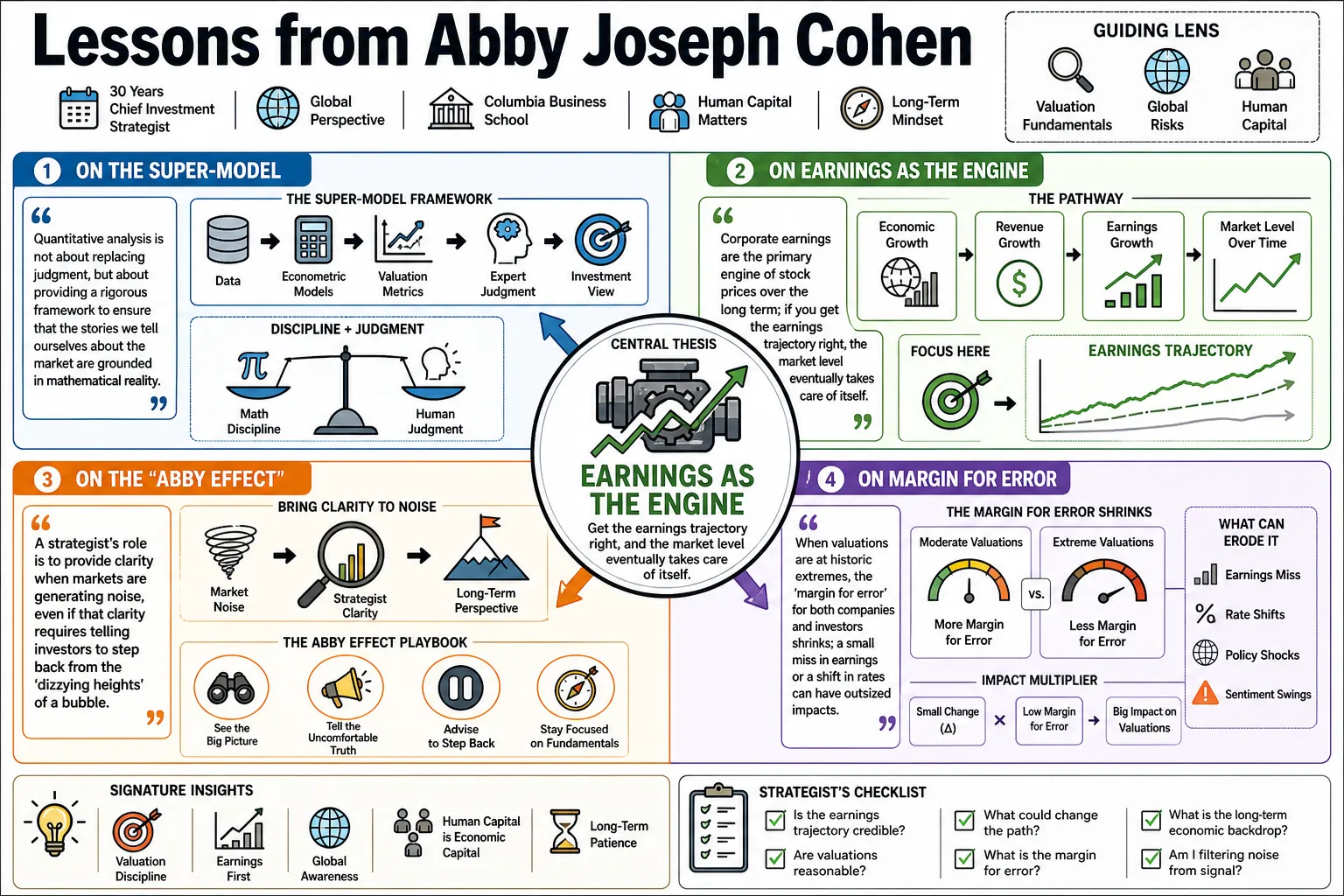
Lessons from Abby Joseph Cohen
Part 1: Market Strategy and Valuation
- On the Super-Model: Use quantitative analysis as a disciplined framework, but test its assumptions and combine arithmetic with judgment. — Columbia Business School — A Thoughtful Approach to Economic Data
- On Earnings as the Engine: Long-run valuation should be anchored in corporate earnings, cash flow, inflation, and interest rates rather than a market story alone. — Wall Street Week — Abby Cohen on the Market
- On Margin for Error: When stocks are fully priced, investors have little margin for error because disappointment can compress already-demanding valuations. — Barron’s Roundtable — 2024 Midyear Outlook
- On Fully Priced Markets: A fully priced market embeds favorable expectations, so policy or earnings disappointments can create disproportionate downside. — Barron’s Roundtable — 2025 Midyear Outlook
- On Flow of Funds: Track flows of funds to see whether prices are being reinforced by new money chasing assets that have already performed well. — Columbia Business School — A Thoughtful Approach to Economic Data
- On Concentration Risk: Heavy index concentration in a handful of AI-linked winners creates vulnerability and makes reasonably valued sectors and smaller companies worth examining. — Barron’s Roundtable — 2024 Midyear Outlook
- On Investing Against Momentum: When valuation expansion has already delivered much of the market’s return, shift attention toward earnings growth, absolute value, and businesses that can operate under higher interest rates. — What Lies Ahead for Investors in 2025?
- On Credit Spreads as Complacency: Extraordinarily tight credit spreads can reveal complacency in fixed-income markets even when equity investors are focused elsewhere. — What Lies Ahead for Investors in 2025?
Part 2: The 1990s Bull Market & Economic Cycles
- On Structural Shifts: The 1990s bull market still rested on ordinary fundamentals: earnings, cash flow, inflation, interest rates, and company strength. — Wall Street Week — Abby Cohen on the Market
- On Exceptional Durability: The U.S. economy’s post-pandemic resilience has rested on productive workers, sustained capital expenditure, job creation, and strong corporate profits. — WealthTrack — Abby Joseph Cohen’s Outlook for Economy and Markets
- On Long-Term Shifts: Evaluate structural shifts over long horizons: demographics, labor-force growth, immigration, technology, and changing industry weights develop across years rather than headlines. — Columbia Business School — A Thoughtful Approach to Economic Data
Part 3: Macroeconomic Forecasting & Data
- On Econometrics: Before forming a strong view, examine what a dataset samples, when its weights were set, and whether its measurement period still fits the economy. — Columbia Business School — A Thoughtful Approach to Economic Data
- On Data-First Discipline: Look beyond a single headline release: revisions, sampling assumptions, and monthly, rolling, or year-over-year windows can point to different conclusions. — Columbia Business School — A Thoughtful Approach to Economic Data
- On Economic Modeling: After building a model or completing an analysis, spend serious time identifying where it could be wrong. — Hadassah Magazine — Profile: Abby Joseph Cohen
- On the 2022 Recession Call: Cohen’s 2022 no-recession view rested on robust household balance sheets, a healthy corporate sector, continued capital expenditure, and a vigilant Federal Reserve. — WealthTrack — Abby Joseph Cohen’s Outlook for Economy and Markets
- On Inflation vs. Sticker Shock: Falling inflation does not mean falling prices; households can continue to feel high grocery and housing costs after the rate of increase has slowed. — WealthTrack — Abby Joseph Cohen’s Outlook for Economy and Markets
- On the Cooling Rate of Inflation: Measure inflation across several time windows because a sharp three-month deceleration may not yet appear in year-over-year data. — Columbia Business School — A Thoughtful Approach to Economic Data
- On Asking Why the Fed Is Cutting: Do not treat an unusually large rate cut as automatically bullish; it may signal that economic data are weaker than expected or that confidence in central-bank independence is eroding. — Inflation, AI, and Shifting U.S. Policy
- On the Limits of Short-Rate Cuts: A cut in the federal funds rate may not materially lower the borrowing costs that matter most because households and companies generally borrow farther out on the yield curve. — Inflation, AI, and Shifting U.S. Policy
- On Reading Guidance Through a Slowdown: When growth and margins are under pressure, company guidance for coming quarters can be more informative than the headline results for the quarter just completed. — Inflation, AI, and Shifting U.S. Policy
- On the Freeze Before the Layoff: Policy uncertainty often appears first as frozen capital spending and hiring; if it persists, workforce reductions become the next step. — Trump’s Tariffs and Market Chaos
- On Pull-Forward Data Traps: Inventory building and anticipatory purchases can temporarily flatter economic data before tariffs bite, so short-term strength may conceal weaker intermediate and long-term demand. — Trump’s Tariffs and Market Chaos
- On Jobs as a Fundamental Test: Judge economic momentum with both growth and job creation, paying attention to their direction and rate of change rather than treating deceleration as contraction. — WealthTrack — Abby Joseph Cohen’s Outlook for Economy and Markets
Part 4: Education, Labor, and Human Capital
- On Education as Economic Policy: Treat education, workforce quality, and research capacity as economic infrastructure rather than as separate social-policy concerns. — Columbia Business School — Trump’s Tariffs and Market Chaos
- On Math and Science Underinvestment: Weakening mathematics, science, university, and basic-research investment puts long-run U.S. economic leadership at risk. — Columbia Business School — Trump’s Tariffs and Market Chaos
- On Immigration and Growth: Immigration has helped the United States expand its workforce faster than peer economies and attract high-achieving people. — Columbia Business School — Trump’s Tariffs and Market Chaos
- On a Skilled Workforce: U.S. productivity depends partly on sustained hardware and software investment together with a skilled workforce. — Columbia Business School — What Lies Ahead for Investors in 2025?
- On Scientific Leadership: Basic scientific research requires patient public funding, often delivered through universities that can explore a wider range of ideas. — Columbia Business School — Trump’s Tariffs and Market Chaos
- On Labor Force Demographics: Labor-force growth is a structural economic advantage; policies that deter immigrants and international students can weaken it. — Columbia Business School — Trump’s Tariffs and Market Chaos
Part 5: Trade Policy and Geopolitics
- On Tariff Skepticism: Broad tariffs are paid largely by domestic consumers, slow growth, and add inflationary pressure. — Columbia Business School — Trump’s Tariffs and Market Chaos
- On the Regressive Nature of Tariffs: Tariffs operate like a consumption tax and fall especially hard on middle-income households. — Columbia Business School — Trump’s Tariffs and Market Chaos
- On Erratic Trade Policy: Erratic trade policy prevents companies from forming stable capital-spending, hiring, and supply-chain plans. — Columbia Business School — Trump’s Tariffs and Market Chaos
- On the Weakening Dollar: When the dollar, bonds, and stocks fall together, the signal is a broader loss of confidence in U.S. assets rather than routine market volatility. — Columbia Business School — Trump’s Tariffs and Market Chaos
- On 'Opening Bids' in Trade: Treating tariffs as a negotiating tactic does not erase the immediate damage to confidence, prices, and business planning. — Columbia Business School — Trump’s Tariffs and Market Chaos
- On the Lack of Economic Rationale: Trade policy should be tested against its weighted economic effects, not defended through simplistic headline tariff comparisons. — Columbia Business School — Trump’s Tariffs and Market Chaos
- On Corporate Planning Disruption: Consistent policy is itself economic infrastructure because consumers, companies, and governments need stable assumptions to plan. — Columbia Business School — Trump’s Tariffs and Market Chaos
- On Dangerous Economic Thinking: In an integrated economy, tariff increases can simultaneously raise prices and weaken growth, leaving the central bank with conflicting pressures. — Columbia Business School — Trump’s Tariffs and Market Chaos
- On Policy Consistency as Economic Infrastructure: Consumers, business leaders, and governments can plan around many policies if they are consistent; erratic policy destroys the planning framework itself. — Trump’s Tariffs and Market Chaos
- On Cross-Asset Confidence Signals: When stocks, bonds, and the dollar fall together, the message is broader than ordinary risk-off trading: investors are stepping away from a country’s assets and the usual balanced-portfolio hedge is failing. — Trump’s Tariffs and Market Chaos
- On Self-Inflicted Stagflation: Tariffs can create a policy-made version of stagflation by raising prices while slowing growth, leaving the central bank with no clean choice between its mandates. — Trump’s Tariffs and Market Chaos
- On Globalization Moving Around the United States: Globalization is not disappearing; erratic U.S. policy gives other countries an opening to become the partners, markets, and institutions others rely on. — Inflation, AI, and Shifting U.S. Policy
Part 6: Career, Leadership, and Trailblazing
- On Work-Life Balance: Cohen treated her family as her most important client, putting school plays and camp visiting days on her business calendar. — Hadassah Magazine — Profile: Abby Joseph Cohen
Part 7: The Future of the Global Economy
- On AI and Labor: Prepare workers for technological change by retraining displaced people and helping others use new tools to move into higher-value work. — Columbia Business School — Inflation, AI, and Shifting U.S. Policy
- On Schedule F Risk: Reclassifying career civil servants as political appointees risks replacing subject-matter expertise with political loyalty. — Columbia Business School — What Lies Ahead for Investors in 2025?
- On Crypto Instability: Do not treat stablecoins as risk-free cash: they are security-like claims whose safety depends on backing assets and institutional resilience. — Columbia Business School — Inflation, AI, and Shifting U.S. Policy
- On De-globalization: Treat globalization as an evolving system rather than declaring it over; changes in its form still require global economic analysis. — Value Investing with Legends — Abby Joseph Cohen
- On AI as Retrieval Before Intelligence: Much of today’s AI is extremely fast retrieval over broader databases rather than independent intelligence; hallucinations make human subject-matter guardrails essential. — Inflation, AI, and Shifting U.S. Policy
- On Domain Expertise as the AI Career Moat: Build durable career leverage through domain expertise and use AI to remove repetitive work, freeing attention for broader judgment and higher-value thinking. — Inflation, AI, and Shifting U.S. Policy
- On Stablecoins Not Being Cash: A stablecoin may move faster and sound safer than volatile crypto, but it remains a security-like claim on backing assets, not risk-free cash. — Inflation, AI, and Shifting U.S. Policy
Part 8: Investment Discipline & Global Outlook
- On Fighting the Fed: Adjust valuation assumptions when monetary conditions change, but continue testing prices against inflation, rates, earnings, and cash flow. — Wall Street Week — Abby Cohen on the Market
- On Mid-Cap Undervaluation: Mid-cap equities can offer lower valuations, broader industrial exposure, and greater stability than small caps without the concentration of the largest indexes. — WealthTrack — Abby Joseph Cohen’s Outlook for Economy and Markets
- On International ETFs: Broad international exposure can reduce U.S. technology concentration while adding pharmaceuticals, industrials, and consumer businesses. — WealthTrack — Abby Joseph Cohen’s Outlook for Economy and Markets
- On Balance Sheet Strength: Once a company is an operating business rather than a story, test its business model, operating margins, and balance sheet with conventional measures. — Columbia Business School — A Thoughtful Approach to Economic Data
- On Providing Clarity: Keep market analysis centered on a small set of fundamentals—economic conditions, company strength, earnings, cash flow, and valuation. — Wall Street Week — Abby Cohen on the Market
Learn more: