Lessons from Martin Whitman
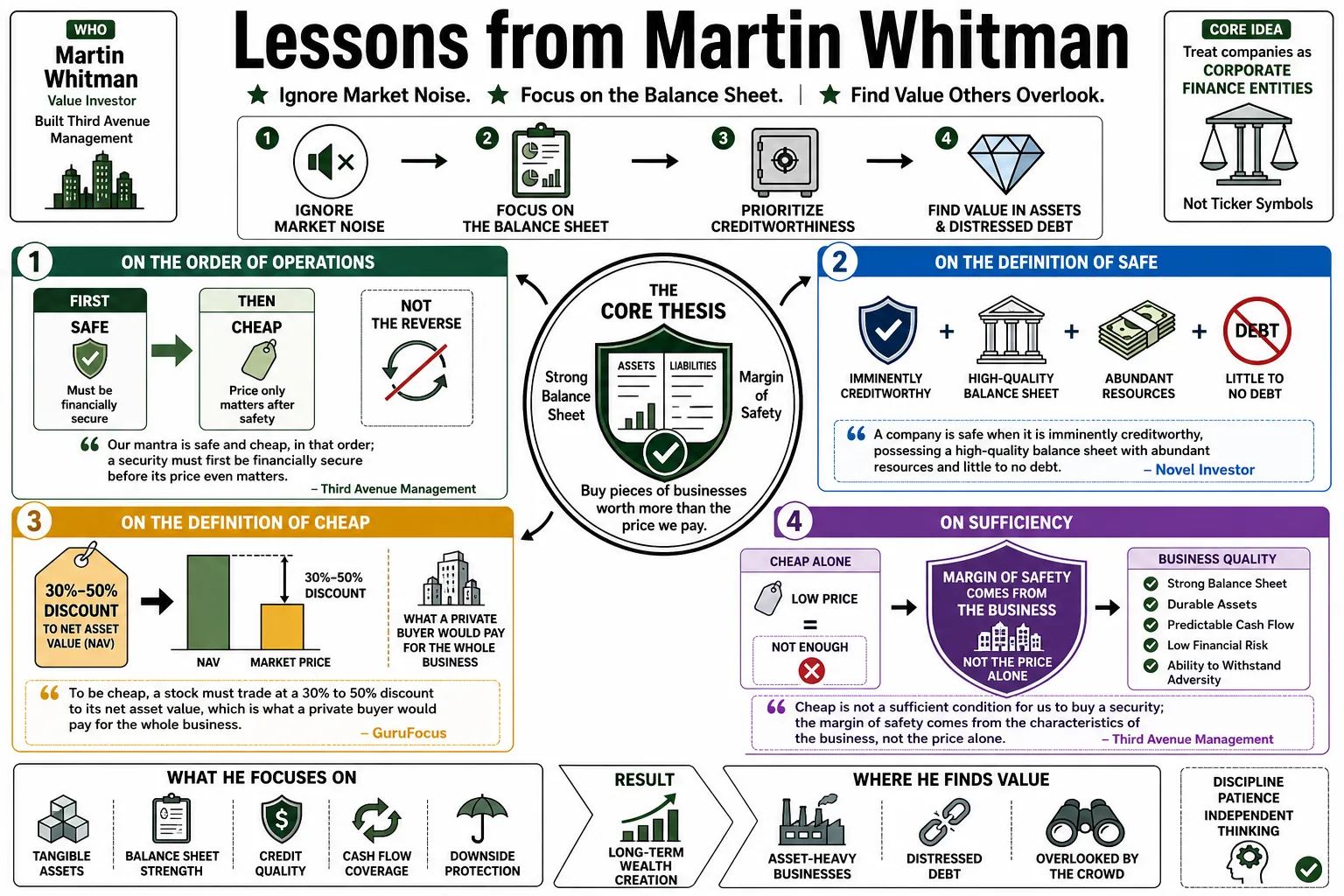
Martin Whitman built Third Avenue Management by ignoring market noise to focus strictly on the balance sheet. He treated companies as corporate finance entities rather than ticker symbols, finding value in the asset-heavy businesses and distressed debt that others overlooked. These lessons show how to build wealth by prioritizing creditworthiness and the literal value of corporate assets.
Part 1: The "Safe and Cheap" Philosophy
- On the Order of Operations: "Our mantra is safe and cheap, in that order; a security must first be financially secure before its price even matters." — Source: Third Avenue Management
- On the Definition of Safe: "A company is safe when it is imminently creditworthy, possessing a high-quality balance sheet with abundant resources and little to no debt." — Source: Novel Investor
- On the Definition of Cheap: "To be cheap, a stock must trade at a 30% to 50% discount to its net asset value, which is what a private buyer would pay for the whole business." — Source: GuruFocus
- On Sufficiency: "Cheap is not a sufficient condition for us to buy a security; the margin of safety comes from the characteristics of the business, not the price alone." — Source: Third Avenue Management
- On Risk and Price: "The lower the price one pays for an investment, the higher the potential returns and the lower the investment risk." — Source: Value Investor India
- On the Four Pillars: "Any investment must meet four requirements: financial strength, reasonably honest management, adequate disclosure, and a bargain price." — Source: The Investors Podcast
- On Staying Power: "Safe companies have the staying power to survive any economic environment, which allows time for the market to eventually recognize their value." — Source: YouTube
- On Paying to Play: "When the outlook for a company or industry stinks, that is exactly when you may not have to pay a premium to participate in its future growth." — Source: Value Investor India
- On Growth at a Discount: "We buy growth; we just don’t pay for it by ensuring the current assets alone justify the purchase price." — Source: Third Avenue Management
- On Price-Consciousness: "Most investors are outlook-conscious, but the successful value investor must be obsessively price-conscious above all else." — Source: Third Avenue Management
Part 2: Balance Sheet Mastery and Asset Valuation
- On the Income Statement: "Earnings are vastly overrated and easily manipulated; the only way to know you've covered all bases is to look at the balance sheet." — Source: Third Avenue Management
- On Asset Protection: "A strong balance sheet allows a company to control its own destiny rather than being at the mercy of banks or capital markets." — Source: Novel Investor
- On Net Asset Value (NAV): "Value should be measured by the readily ascertainable net asset value of the company’s holdings, not just its current profit-making capacity." — Source: GuruFocus
- On Off-Balance Sheet Value: "True security analysis requires looking beyond reported numbers to find hidden assets like real estate, timberland, or tax-loss carryforwards." — Source: Novel Investor
- On Creditworthiness: "Creditworthiness is the most important factor in appraising a company because it defines the company’s ability to survive and act opportunistically." — Source: Emerald Insight
- On Earnings vs. Assets: "While Wall Street focuses on earnings per share, real wealth is built through the appreciation and growth of the underlying asset base." — Source: Fundamental Finance Playbook
- On Debt Levels: "A company with high debt is a prisoner to its creditors; a company with no debt is a free agent in the marketplace." — Source: Third Avenue Management
- On the 'Gestalt' View: "An investor must understand the whole accounting cycle—how the balance sheet, income statement, and cash flows interact as a single unit." — Source: Fundamental Finance Playbook
- On Liquidity: "Cash on the balance sheet is not just a safety net; it is a weapon that can be used to acquire competitors during a crisis." — Source: Third Avenue Management
- On Conservative Appraisal: "Appraising assets conservatively ensures that even if the business operations fail, the salvage value protects the investor's capital." — Source: YouTube
Part 3: Wealth Creation and Resource Conversion
- On the Four Ways: "Wealth is created through operating cash flow, earnings, resource conversions, and attractive access to capital markets." — Source: Fundamental Finance Playbook
- On Resource Conversion: "Massive changes in a company’s assets, such as mergers, spinoffs, or liquidations, are often more important for wealth creation than daily operations." — Source: Third Avenue Management
- On Spinoffs: "Spinoffs create value by allowing a buried asset to be valued by the market on its own merits, often leading to a higher total valuation." — Source: Medium
- On Mergers and Acquisitions: "A savvy management team uses M&A as a tool for resource conversion, trading lower-value assets for those with higher growth potential." — Source: Novel Investor
- On Capital Market Access: "Simply having the ability to raise money on favorable terms is a form of wealth creation that provides a massive competitive advantage." — Source: Fundamental Finance Playbook
- On Cash Consumption: "Most growing companies are cash consumers; their 'earnings' are only real if the company maintains constant access to credit." — Source: Novel Investor
- On the Exit Potential: "Investors should focus on the price a private buyer would pay for the entire company, as this represents the ultimate resource conversion." — Source: GuruFocus
- On Buybacks: "Stock buybacks are only a good use of capital if the shares are trading at a significant discount to the company's net asset value." — Source: Third Avenue Management
- On Dividend Policy: "Dividends should be viewed as a residual; they should only be paid if there are no better opportunities for reinvestment or acquisition." — Source: YouTube
- On Wealth vs. Income: "Wall Street is obsessed with income, but the 'aggressive conservative' investor is obsessed with the growth of total wealth." — Source: Third Avenue Management
Part 4: The OPMI vs. The Control Investor
- On the OPMI Definition: "The Outside Passive Minority Investor (OPMI) lacks access to inside information and has no say in how the business is run." — Source: GuruFocus
- On the OPMI Requirement: "Because they cannot influence the business, OPMIs must be much more demanding on price and buy only at massive discounts." — Source: GuruFocus
- On Control Investors: "Control investors create value by forcing changes in management, capital structure, or asset allocation that passive investors cannot." — Source: Novel Investor
- On Thinking Like Control: "The passive investor should analyze a company exactly like a control investor would, even if they cannot personally force a change." — Source: GuruFocus
- On Fair Price: "A control investor can afford to pay a fair price because they can unlock value; an OPMI must always hold out for a bargain price." — Source: GuruFocus
- On Riding the Bus: "OPMIs ride the bus but don't drive it, which means they must ensure the bus is built like a tank to survive the driver's potential mistakes." — Source: GuruFocus
- On Value Realization: "While a control investor forces value to be realized, the OPMI is dependent on the market or a takeover event to close the price gap." — Source: GuruFocus
- On the Owner’s Mindset: "If a business is not worth owning in its entirety, it is not worth owning as a single share." — Source: GuruFocus
- On Market Dependence: "Passive investors often mistakenly believe they are at the mercy of market prices, when they should be focused on the underlying business value." — Source: Third Avenue Management
Part 5: Modern Security Analysis and Accounting
- On GAAP Limitations: "Generally Accepted Accounting Principles (GAAP) are merely objective benchmarks, not an absolute reflection of a company’s economic truth." — Source: Sobrief
- On Accounting for Creditors: "Standard accounting is designed primarily for creditors to assess liquidation value, not for investors to value a going concern." — Source: Sobrief
- On Transparency: "Plain English disclosure is a requirement for investment; complexity is often a mask for poor financial health or management greed." — Source: Third Avenue Management
- On Short-termism: "Conventional analysis is far too focused on quarterly fluctuations rather than the long-term compounding of net asset value." — Source: Hedge Fund Alpha
- On the Income Account Primacy: "Wall Street's obsession with the income account leads people to ignore the foundational strength of the balance sheet." — Source: E-Book Shelf
- On Information Overload: "Rarely do more than three or four variables really count in any investment; everything else is just distracting noise." — Source: Third Avenue Management
- On Sophisticated Analysis: "Real security analysis requires a corporate finance perspective that looks at how all parts of the business create total value." — Source: Third Avenue Management
- On Market Efficiency: "The belief that markets are always efficient is the refuge of those who do not want to do the hard work of fundamental analysis." — Source: Third Avenue Management
- On Forecasting Failure: "We ignore outlooks because we're lousy at it, and we know everyone else is lousy at it too, even if they won't admit it." — Source: Third Avenue Management
Part 6: Distressed Debt and Reorganization
- On Bankruptcy Survival: "The biggest misconception is that a company goes out of business in bankruptcy; the business usually survives while the stockholders are wiped out." — Source: YouTube
- On Vulture Investing: "Distressed investing is about buying the senior debt of a reorganization-likely company to gain a safe claim on its underlying assets." — Source: Joshua Kennon
- On Reorganization as Conversion: "Bankruptcy is simply a massive resource conversion where debt is traded for equity, often leaving the new owners with a very cheap entry point." — Source: Third Avenue Management
- On Senior Claims: "In distressed situations, the 'aggressive conservative' investor prioritizes being a senior creditor to ensure they are first in line for the assets." — Source: Joshua Kennon
- On the 'Good House in a Bad Neighborhood': "The best distressed investments are fundamentally good businesses with temporarily broken capital structures." — Source: Third Avenue Management
- On Legal Expertise: "Distressed investing is as much about understanding bankruptcy law as it is about understanding financial statements." — Source: Third Avenue Management
- On Patience in Reorgs: "Reorganizations take years to play out; the investor must have the capital and the temperament to wait for the legal system." — Source: Third Avenue Management
- On Buying Panic: "Distress often creates a forced selling environment, allowing the calm investor to pick up valuable assets at prices far below their replacement cost." — Source: Third Avenue Management
- On the Safety of Debt: "Buying distressed debt can be safer than buying common stock because you have a contractual claim on the company’s liquidation value." — Source: Joshua Kennon
Part 7: Risk, Volatility, and Diversification
- On Volatility: "Security price volatility is not synonymous with investment risk; a drop in price is often a reduction in risk, not an increase." — Source: Economic Times
- On Real Risk: "The only real risk in investing is the permanent loss of capital caused by a company’s fundamental financial failure." — Source: Economic Times
- On Diversification as a Surrogate: Whitman argued in his Third Avenue shareholder letters that diversification is a poor substitute for actually having deep knowledge of a company, some measure of control, and discipline about the price you pay. — Source: AZ Quotes
- On Concentration: "The real value investor is lucky if they can find ten truly great investments at a time; anything beyond that is dilution of expertise." — Source: Value Investor India
- On Knowing What You Own: "Broad diversification is for people who don't know what they are doing; concentration is for those who have done the work." — Source: Third Avenue Management
- On the Margin of Safety: "A margin of safety exists when you pay so little for the assets that even a bad business outcome leaves your capital intact." — Source: Third Avenue Management
- On Modern Portfolio Theory: "MPT is a disaster because it treats the stock market as a casino rather than a place where ownership of businesses is traded." — Source: Third Avenue Management
- On Risk Appraisal: "An investment operation focuses on the appraisal and avoidance of investment risk, not just the pursuit of high returns." — Source: Third Avenue Management
- On Blue Chips: "The purchase of a blue chip stock at any price is not an investment; it is a speculation that the price will go higher." — Source: Third Avenue Management
Part 8: The Discipline of the Aggressive Conservative
- On Ignoring Macro: "We ignore interest rates, GDP, and the Fed because they are unpredictable and usually irrelevant to a strong, well-capitalized business." — Source: GuruFocus
- On Market Timers: "Market timers are amateurs; the professional investor focuses on the business value and lets the market timing take care of itself." — Source: Value Investor India
- On Success and Failure: "In the Darwinian world of business, success breeds success; in the world of investments, failure often sows the seeds of future profit." — Source: Third Avenue Management
- On Free Lunches: "In finance, it is misleading to say there is no free lunch; the reality is that someone always has to pay for it." — Source: Hedge Fund Alpha
- On Complacency: "As I got older and richer, I got lazier; the lesson of the 2008 crisis was that complacency is the ultimate enemy of the value investor." — Source: Novel Investor
- On Reasonable Scenarios: "Decisions should be based on reasonable worst-case scenarios, where emphasis is placed on the word 'reasonable' to avoid paralyzing fear." — Source: GuruFocus
- On the Long Game: "Wealth is not made by trading; it is made by owning high-quality assets at a bargain price and allowing time to do the heavy lifting." — Source: Third Avenue Management