Aaron Dignan is the founder of The Ready, an organizational design and transformation firm, and Murmur, a software platform for collaborative decision-making. He is also the author of the bestselling book Brave New Work. His work is a modern critique of traditional, bureaucratic management. He argues that the way we work is governed by a hidden “Operating System” (OS)—a collection of assumptions, principles, and practices that dictates behavior. He believes the old, legacy OS is failing in a world of increasing complexity and that modern organizations must become more Complex & People Positive. — Penguin Random House — Brave New Work.
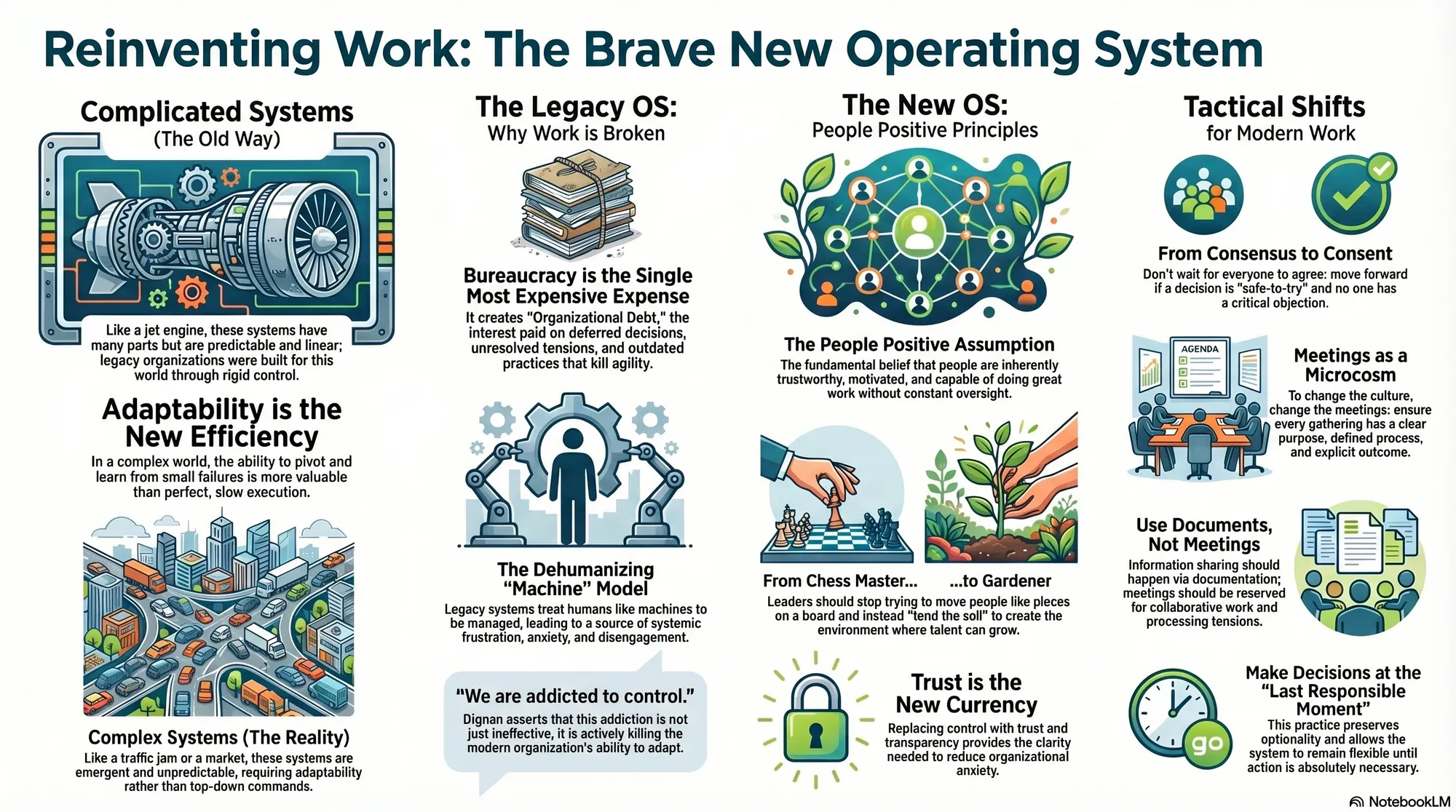
Core Concepts: The Operating System, Complexity, and People Power
- Organizational Operating System: This is the underlying set of beliefs and defaults that shape how an organization functions. It covers everything from how meetings are run to how decisions are made and how people are promoted. The key idea is that you cannot change the culture without changing this underlying system. — The Ready — The OS Canvas.
- Complexity vs. Complicated: Dignan emphasizes the difference. Complicated systems have many parts but operate in predictable ways (like a jet engine). Complex systems are unpredictable and emergent (like a traffic jam or a market). Legacy organizations are designed for a complicated world, but today's world is complex, requiring adaptability over rigid control. — Leadermorphosis Podcast Transcript.
- People Positive: This is the belief that people are inherently trustworthy, motivated, and capable of doing great work. It's the opposite of a "parent-child" dynamic where employees are seen as resources to be managed and controlled. A People Positive approach favors autonomy, trust, and transparency. — Leadermorphosis Podcast Transcript.
Key Learnings and Quotes
On the Broken Way of Work
- Bureaucracy Immobilizes Work: Dignan argues that bureaucracy has become dehumanizing and prevents people and organizations from moving effectively. — Leadermorphosis Podcast Transcript.
- Update the Operating System for Today: Dignan argues that many organizations still run on an inherited operating system designed more than a century ago for efficiency and compliance—an increasingly poor fit for complexity and rapid change. — Aaron Dignan — The OS Canvas.
- Pay Down Organizational Debt: Structures and policies create compounding costs when they remain fixed or accumulate while the environment changes. — Aaron Dignan — How to Eliminate Organizational Debt.
- Question the Operating System You Inherited: Many organizational assumptions feel natural only because they are pervasive and were inherited rather than consciously chosen. — The Ready — The OS Canvas.
- Fix the System Before Blaming People: Persistent cultural friction often comes from the organization’s operating system, not simply from having the wrong leaders or employees. — The Ready — The OS Canvas.
- Trade Control for Better Conditions: Leaders can replace direct control with systems that give people the context and conditions needed to exercise judgment. — Leadermorphosis Podcast Transcript.
- Change the System Through Experiments: Dignan favors participatory, continuous experiments over episodic top-down change programs. — Leadermorphosis Podcast Transcript.
- Treat Organizations as Human Systems: Mechanistic management can become dehumanizing because organizations are complex systems made of people, not machines to be optimized like engines. — Leadermorphosis Podcast Transcript.
- On Metrics Becoming Distortions: When a proxy metric becomes the goal, optimization shifts away from the underlying reality the metric was meant to represent. — The Knowledge Project #158
- On Permission Culture: A permission culture makes inaction the default by requiring people to ask before they can move. — The Knowledge Project #158
On the Organizational Operating System (OS)
- Make the Invisible Operating System Visible: An organization’s assumptions and practices are so pervasive that people often stop noticing them, even though they shape daily work. — The Ready — The OS Canvas.
- Define How Work Actually Happens: The operating system is the collection of implicit and explicit constraints that determines how a team operates. — The Ready — The OS Canvas.
- Use the OS Canvas as a Thinking Tool: The canvas makes twelve connected dimensions of organizational design explicit so teams can examine what they believe and do. — Leadermorphosis Podcast Transcript.
- Trace Practices Back to Assumptions: Organizational practices and policies express deeper principles and beliefs, so changing work requires examining the layers underneath it. — The Ready — The OS Canvas.
- Change the System, Not Just the Culture Story: Dignan’s framework directs teams toward the practices and constraints producing behavior rather than treating culture as a standalone target. — The Ready — The OS Canvas.
- Build an Operating System That Can Evolve: Rather than treating organization design as a one-time answer, Dignan advocates systems that can learn, change, and edit themselves as circumstances shift. — Aaron Dignan — The Last Re-Org You’ll Ever Do.
- Understand Principles Before Copying Practices: Because organizations are complex and context-dependent, another company’s practice should be understood as a choice and tradeoff rather than a universal answer. — Leadermorphosis Podcast Transcript.
- Treat the OS as a Theory of Work: A team’s operating system encodes what it assumes about people, authority, information, motivation, and coordination. — The Ready — The OS Canvas.
- On Agent Workflows as Organizations: Once an AI workflow contains specialized roles, handoffs, tools, and decision rights, designing it becomes an organization-design problem rather than merely a software problem. — Forward Deployed: Brave New Work for Agents
- On Living Role Agreements: Define every human or software role through a living agreement covering its purpose, responsibilities, decision rights, inputs, outputs, and boundaries. — Forward Deployed: Brave New Work for Agents
- On Revealed Preferences: A leader's prior decisions reveal actual preferences more reliably than abstract instructions about what they value. — Forward Deployed: Brave New Work for Agents
- On Software as Organizational Leverage: Use software as a lever for changing how work happens, and be willing to pivot the product when a new enabling capability materially changes what is possible. — Aaron Dignan — Plumb
- On Aligning Ownership With the Mission: When stewardship matters beyond a founder's tenure, an employee-owned structure can align the organization's ownership model with its operating philosophy. — Aaron Dignan — The Ready
On Complexity and Adaptability
- Prepare to Learn Instead of Pretending to Predict: Complex systems are uncertain and can surprise us, so teams must interact with them, sense results, and keep steering. — Leadermorphosis Podcast Transcript.
- Replace the Illusion of Control With Continuous Steering: Complexity-conscious organizations influence outcomes through sensing and adjustment rather than assuming linear control. — Leadermorphosis Podcast Transcript.
- Lead Complex Systems Like a Gardener: Dignan compares organizations to gardens and weather—systems that can be nurtured but not permanently fixed. — Leadermorphosis Podcast Transcript.
- Distribute Authority With Context: Giving teams more power works only when they also receive the information needed to make sound decisions. — Leadermorphosis Podcast Transcript.
- Distinguish Fatal Risks From Safe-to-Try Moves: Constraints should prevent failures that would sink the system while leaving broad room for experimentation. — The Knowledge Project #158.
- Prefer Small, Continuous Experiments: In uncertain environments, measured tests and frequent sensing are more useful than infrequent, monolithic change programs. — Lean Startup Interview.
- Use “Safe to Try” as the Decision Test: A proposal can proceed unless someone identifies a material reason it is unsafe, shifting power from gatekeeping to reasoned objection. — Levels Podcast Transcript.
- Optimize for Adaptation, Not Only Efficiency: Dignan contrasts standardized, efficiency-oriented bureaucracy with organizations designed to vary, learn, and adapt rapidly under uncertainty. — Aaron Dignan — The Last Re-Org You’ll Ever Do.
- On Constraints Creating Thinking Space: Eliminating fatal failure modes creates room for thought because teams no longer spend their attention defending against every possible risk. — The Knowledge Project #158
- On Containing Capable Systems: Even highly capable AI needs traceability, focus, and containment; intelligence does not remove the need to understand how an outcome was produced. — Forward Deployed: Brave New Work for Agents
- On Self-Reinforcing Optimization: Automated systems need safeguards against self-reinforcing optimization loops that amplify their own assumptions. — Forward Deployed: Brave New Work for Agents
- On Two Kinds of Intelligence: The strongest organizational design may combine embodied human judgment with the consistency and scale of machine intelligence rather than treating either as a complete substitute. — Forward Deployed: Brave New Work for Agents
On Being People Positive and Empowering Teams
- Build on Trust and Autonomy: Dignan’s people-positive model assumes people are generally trustworthy, capable, motivated to grow, and worthy of meaningful responsibility. — Leadermorphosis Podcast Transcript.
- Pair Authority With Information: Empowerment without shared information produces poor decisions and can falsely appear to prove that people cannot be trusted. — Leadermorphosis Podcast Transcript.
- Create Clarity Through Transparency: Sharing the information people need is part of making distributed authority workable rather than anxiety-producing. Be radically transparent. — Leadermorphosis Podcast Transcript.
- Shift Management Toward Mentorship: In a responsive operating model, Dignan says management should focus less on controlling people and more on developing skills, sharing knowledge, and removing roadblocks. — Aaron Dignan — The Operating Model That Is Eating the World.
- Expect Capability From Unexpected Places: During organizational change, Dignan cautions against assuming who will struggle and notes that standout contributors may emerge from places leaders least expect. — Aaron Dignan — The Last Re-Org You’ll Ever Do.
- Ask What Is Blocking Great Work: Dignan recommends asking teams what stops them from doing the best work of their lives, then following the tensions revealed by their answers. — Leadermorphosis Podcast Transcript.
- Let Decisions Move Unless There Is a Valid Objection: Consent-based governance gives participants the power to identify why a proposal is not safe to try without requiring unanimous enthusiasm. — Levels Podcast Transcript.
- On Feedback as Vitality: Treat feedback as the tension that keeps a system adaptive and alive, not as an occasional performance ritual. — The Knowledge Project #158
On Meetings, Process, and Practice
- Design Meetings as Part of the Operating System: Meetings are one of the connected dimensions through which teams coordinate, distribute authority, and express how work gets done. — The Ready — The OS Canvas.
- Give Complex Issues Enough Depth: Dignan argues that oversimplified updates and compressed meetings strip away context; a few pages of thoughtful prose or a strong visual can create the depth needed for better discussion and decisions. — Aaron Dignan — Why We Dumb Things Down.
- Use Process to Enable Better Work: Organizational rules and practices should be examined as constraints that either help or hinder people from delivering value. — The Ready — The OS Canvas.
- Use Minimum Viable Structure: Dignan points to meeting systems with a small, well-understood amount of structure that is sufficient to coordinate work without reproducing bureaucratic overload. — Aaron Dignan — The OS Canvas.
- Treat Feedback as System Vitality: Dignan describes feedback as tension and dynamism that keeps a living system responsive rather than as an occasional performance ritual. Create clear channels for processing tensions. — The Knowledge Project #158.
- On Coordination Becoming the Bottleneck: When AI breaks the linear relationship between production capacity and headcount, shared context, coordination, and deciding what matters become the limiting constraints. — Forward Deployed: Brave New Work for Agents
- On Work Running on Exhaust: Design automation around the exhaust of existing work so it can assemble context for the moments where human sense-making is still required. — Forward Deployed: Brave New Work for Agents
- On Durable Artifacts Over Chat: Chat alone is a weak container for sustained agent collaboration; durable artifacts, checklists, and feedback loops preserve shared understanding. — Forward Deployed: Brave New Work for Agents
- On Narrowing Agent Decision Rights: Reduce an agent's decision surface by routing work to specialized roles with only the tools and authority they actually need. — Forward Deployed: Brave New Work for Agents
Sources and Links
The vast majority of Aaron Dignan's philosophy is captured in his book and the work of his consultancy, The Ready.
- Book: Brave New Work: Are You Ready to Reinvent Your Organization? - This is the primary source for the OS Canvas, the principles of being People Positive and Complex-ready, and a deep dive into all the concepts above.
- Consultancy Website: The Ready - The website is a rich source of articles, case studies, and tools, including a free download of the OS Canvas.
- Podcast: Brave New Work Podcast - Aaron and his colleague Rodney Evans discuss the ideas from the book, interview other thinkers, and answer audience questions. It's a great way to hear the concepts applied to real-world situations.
- Talks and Interviews: Numerous talks and podcast interviews with Aaron Dignan are available on YouTube and other platforms. A search for "Aaron Dignan talk" will yield many excellent results.
- Example Link: TNW Conference — Aaron Dignan
Learn more: