Theoretical physicist Alex Blania co-founded Worldcoin (now World) with Sam Altman to build a global digital identity and financial network. Convinced that AI will soon make it impossible to tell humans from bots online, he is deploying custom biometric hardware to verify who is actually human. These insights explore his thoughts on cryptography, scaling physical tech, and preparing for an AI-saturated internet. — Kenya Parliamentary Statement.
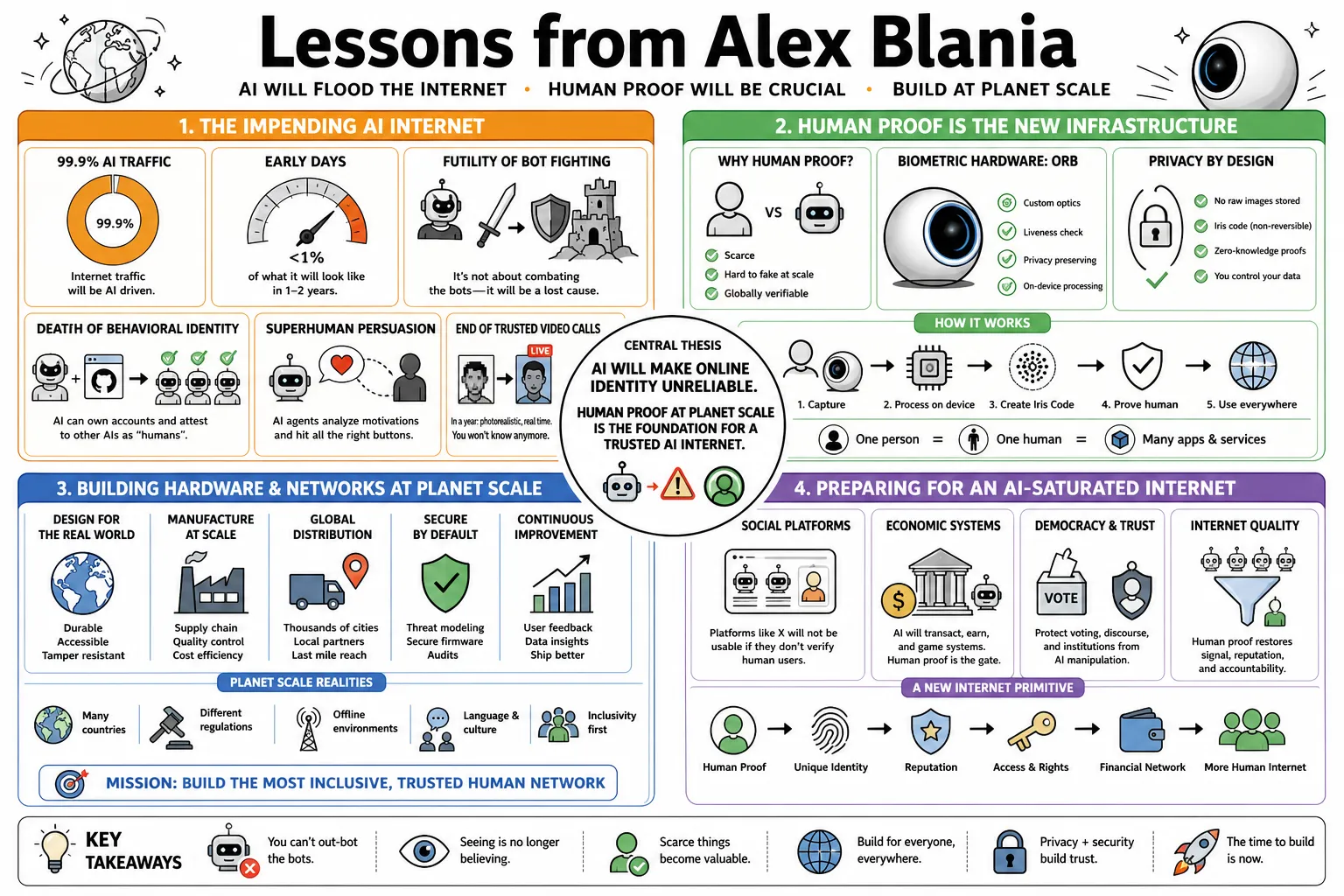
Part 1: The Impending AI Internet
- On the limits of bot fighting: Blania argues that simply combating bots is likely to be a losing strategy as AI-generated activity expands. — Sourcery Interview.
- On AI-driven internet traffic: Blania predicts that AI could eventually generate almost all internet traffic; 99.9% is his forecast, not a measured share. — Sourcery Interview.
- On the early AI web: Blania expects today’s AI activity to look small beside what could emerge in the next year or two. — a16z Show Interview.
- On the limits of behavioral identity: Blania argues that AI agents can create accounts, post, and attest for one another, weakening purely digital proof-of-human schemes. — a16z Show Interview.
- On AI persuasion: Blania points to an online persuasion experiment as a warning that AI agents may tailor messages to a person’s profile and motivations. — a16z Show Interview.
- On trust in video calls: Blania predicts that photorealistic real-time deepfakes could make it harder to know who is on the other end of a video call. — a16z Show Interview.
- On human identity on social platforms: Blania expects social platforms to need better technical ways to distinguish humans from bots. — a16z Show Interview.
- On distinguishing people from agents: Blania separates three cases online: a human, an agent acting with a human’s authority, and an independent agent. — a16z Show Interview.
- On treating agent identity as urgent: Blania argues that platform leaders should now take the identity implications of increasingly capable AI agents seriously. — a16z Show Interview.
- On proof of humanity as civic infrastructure: Online human verification will become critical infrastructure rather than a convenience because democratic debate and digital media depend on knowing that participants are real people. — Reference: Alex Blania on technology, ethics, AI and private data
Part 2: Engineering Proof of Personhood
- On defining proof of human: Validating humanness online requires ensuring that every individual has only one account and permanently retains ownership of it. — Reference: a16z Show Interview
- On why iris was selected: Blania says global one-to-many uniqueness checks ruled out the face and fingerprints for World’s design, leading the team to use iris biometrics. This is his engineering rationale, not an independent claim that other methods can never work. — Kenya Parliamentary Statement.
- On why hardware is mandatory: Building custom biometric devices was necessary because attempting a software-only approach would leave the identity system highly vulnerable to attacks and manipulation. — Reference: Alex Blania - Worldcoin | Defy For Global Financial Empowerment
- On anonymous verification: "You can prove that you're a unique user to the social platform without us knowing anything about you or the social network knowing anything about you." — Source: a16z Show Interview
- On privacy by design: Blania describes a system that splits iris codes across multiple parties and uses zero-knowledge proofs to separate verification from a person’s online activity. Those are the project’s design claims, not a guarantee of perfect privacy. — Buenos Aires Times Interview.
- On treating privacy and freedom as design constraints: Any technology capable of limiting privacy or freedom deserves careful criticism, so the system should leave individuals—not a central operator—in control of what they disclose and how they use it. — Reference: Alex Blania on technology, ethics, AI and private data
- On avoiding government-controlled identity: Blania argues that relying on government IDs for a global proof-of-human network raises free-speech, anonymity, and cross-border coverage problems. — a16z Show Interview.
- On building identity as an open protocol: A global identity layer should be independently verifiable and outside the control of both large technology companies and governments, with privacy and control residing with users. — Reference: Alex Blania on technology, ethics, AI and private data
- On distributing biometric comparisons: Blania says the system splits iris codes among multiple computers for uniqueness checks and uses zero-knowledge proofs for later verification. This describes the project’s design, not an independent privacy guarantee. — a16z Show Interview.
- On working with regulators: Blania says biometric identity technology must be developed responsibly and in close dialogue with regulators. — IAPP Global Privacy Summit.
- On putting technical expertise inside regulators: Responsible development requires more engineers and technologists within regulatory agencies so they can understand new privacy systems and respond to them competently. — Reference: GPS 2025: Sam Altman and Alex Blania discuss biometric technology
Part 3: Reaching Global Scale
- On the prerequisite of massive scale: "I think fundamentally, similar to other networks that we have seen emerge over the last couple of decades like Paypal or even social networks like Facebook, they only become useful once they are at scale" — Source: The Block Interview
- On prioritizing distribution: "So everything we care about at this point is distribution around the world and the amount of users that are verified and using the service." — Source: The Block Interview
- On outgrowing blockchain infrastructure: Rapid user adoption forced the project to migrate from Polygon to the Optimism mainnet, and eventually to build its own Layer-2 network (World Chain) to handle the required capacity. — Reference: The Block Interview
- On testing consumer integrations: Blania describes a Tinder trial in Japan that shows a verified-human badge to other users; it was a pilot rather than a broad rollout. — a16z Show Interview.
- On horizontal trust infrastructure: Blania describes World ID as trust infrastructure for human interaction; reported use cases include a Tinder trial, gaming verification, and a potential Reddit partnership. — TIME Profile.
- On shifting attention to the United States: Blania says World underinvested in the United States earlier and is now prioritizing US distribution and platform adoption. — a16z Show Interview.
- On earning trust before entering a country: Global launches should begin with local media, government, regulators, and citizens so people understand why the system matters and how it works before adoption accelerates. — Reference: Alex Blania on technology, ethics, AI and private data
- On preparing for unexpectedly fast adoption: The team underestimated how quickly interest would compound, and Blania’s hindsight is that stakeholder education should have been built ahead of demand rather than improvised after launch. — Reference: Alex Blania on technology, ethics, AI and private data
- On logistical deployment: Achieving national coverage requires placing hardware devices close enough to users so that verification is highly accessible—estimating a need for roughly 50,000 devices in the US to reach a 15-minute proximity threshold. — Reference: a16z Show Interview
- On a billion-user ambition: In a 2022 interview, Blania said he saw a possible path to one billion users within three years. That was an early aspiration, not evidence the target was achieved or remains current. — Epicenter Interview.
Part 4: Socioeconomic Impact and Alignment
- On sharing technological wealth: "But finding new ways to broadly share the coming technological prosperity is a critical challenge of our time." — Source: Introducing World - A Letter from the Worldcoin Founders
- On preventing AI prosperity from concentrating: The central distribution challenge is ensuring AI progress lifts the wider world instead of accruing mainly to San Francisco and a few already-dominant technology companies. — Reference: Alex Blania on technology, ethics, AI and private data
- On universal access to compute: Compute may become as essential to earning a living as water is to survival, making a minimum level of access, economic firepower, and user control a critical public question. — Reference: Alex Blania on technology, ethics, AI and private data
- On AI-funded UBI: "If successful, we believe Worldcoin could drastically increase economic opportunity, scale a reliable solution for distinguishing humans from AI online while preserving privacy, enable global democratic processes, and eventually show a potential path to AI-funded UBI." — Source: Introducing World - A Letter from the Worldcoin Founders
- On borderless access: World’s stated ambition is to make its identity and financial network accessible regardless of country or socioeconomic background; the goal is not evidence of universal access today. — CfC St. Moritz Profile.
- On broad network ownership: The World cofounders describe an ambition to create an identity and financial network owned by everyone. — World Founders’ Letter.
- On designing for the unbanked: Recognizing that many parts of the world lack widespread smartphone access, Blania drew inspiration from systems like Kenya's M-Pesa to ensure digital payments could eventually function for offline or low-tech users. — Reference: Alex Blania - Worldcoin | Defy For Global Financial Empowerment
- On making the network outgrow its founding company: A global protocol cannot remain dependent on one company; like Ethereum, it must become public infrastructure on which many independent organizations can build. — Reference: Alex Blania on technology, ethics, AI and private data
- On the difficulty of global alignment: "Worldcoin is an attempt at global scale alignment, the journey will be challenging and the outcome is uncertain." — Source: Introducing World - A Letter from the Worldcoin Founders
Part 5: Frontier Technologies and Founder Mindset
- On joining a long-horizon thesis: Altman’s pitch to Blania combined a future of powerful AI, decentralized technology, and the need for scale; Blania joined as a cofounder. — TIME: The Orb Will See You Now.
- On transitioning from physics to crypto: Blania originally researched deep learning and AI in quantum computing as a theoretical physicist before leaving his studies to tackle global identity and financial infrastructure. — Reference: CfC St. Moritz | Alexander Blania
- On his ultimate passion: "If I could stop time and just do what I enjoy the most, I would do research." — Source: Alex Blania - Worldcoin | Defy For Global Financial Empowerment
- On brain-computer interfaces: Blania describes Merge Labs’ research as a bet that brain-computer interfaces could become a major way people interact with computers; this remains a prospective technology. — Sourcery Interview.
- On less-invasive BCI research: Merge Labs says it is researching high-bandwidth brain interfaces that use molecular approaches and ultrasound while avoiding implants into brain tissue. These are goals under development, not deployed capabilities. — Merge Labs Announcement.