Alex Imas, the Roger L. and Rachel M. Goetz Professor of Behavioral Science, Economics, and Applied AI at UChicago Booth and Director of AGI Economics at Google DeepMind, studies how people depart from standard economic models and what those departures mean when choices are delegated to AI. His work connects risk, discrimination, market design, social learning, and the changing value of human involvement as cognitive tasks become easier to automate.
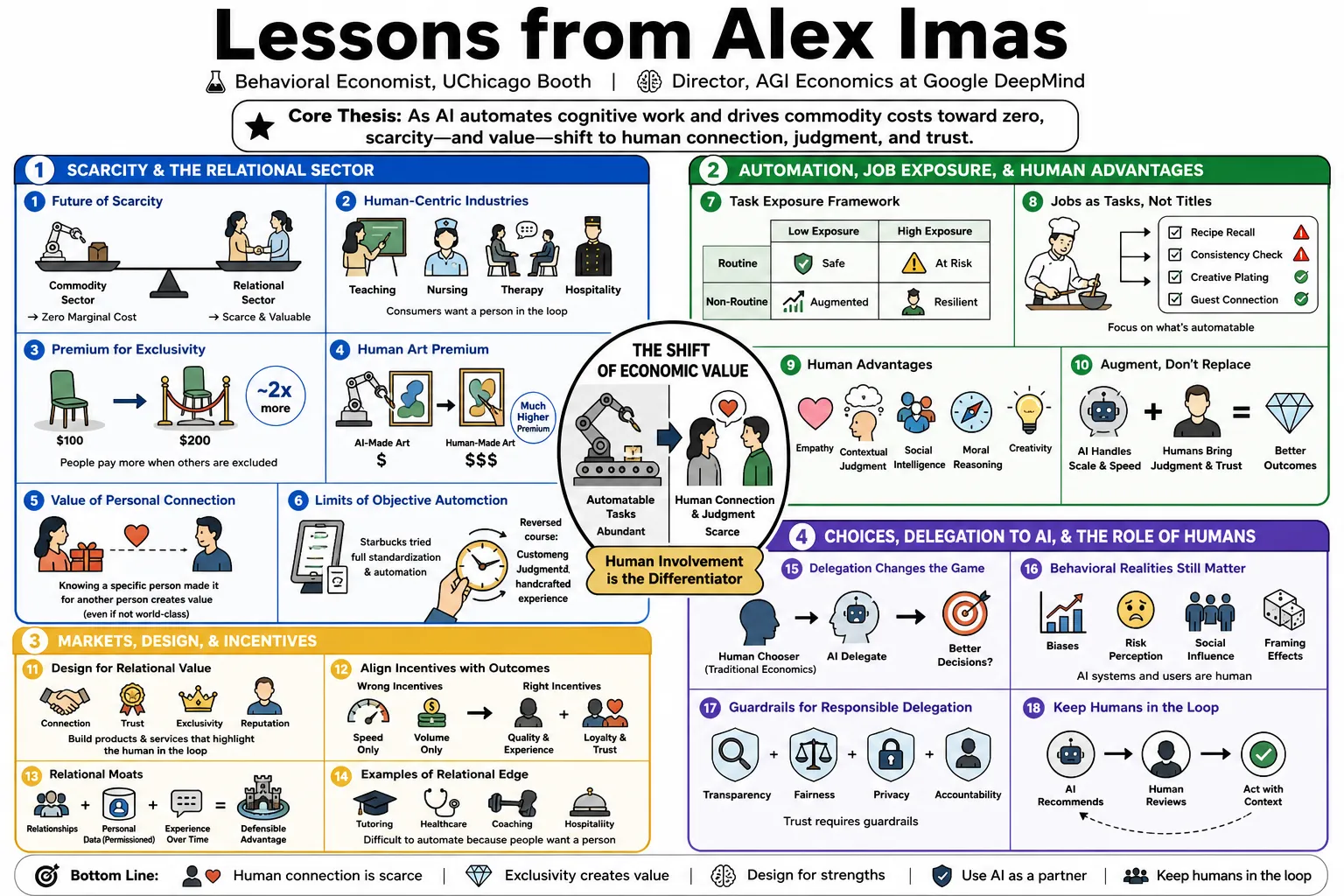
Part 1: Scarcity and the Relational Sector
- On the future of scarcity: As artificial intelligence drives the commodity sector toward zero marginal cost, economic scarcity will shift to the relational sector, where human involvement is an intrinsic part of a product's value. — Reference: dwarkesh.com
- On human-centric industries: The relational sector includes professions like teaching, nursing, therapy, and hospitality, where consumers specifically desire a person in the loop. — Reference: theneurondaily.com
- On the premium for exclusivity: In a behavioral experiment, people were willing to pay roughly twice as much for an item if they knew others would be excluded from having it. — Reference: theneurondaily.com
- On the human art premium: Human-made art commands a significantly higher exclusivity premium compared to AI-generated art. — Reference: theneurondaily.com
- On the value of personal connection: In relational markets, value can come from knowing that a specific person made something for another person, even when the creator is not a world-class artist. — Reference: theneurondaily.com
- On the limits of objective automation: Starbucks attempted to fully standardize and automate its coffee-ordering process but reversed course after realizing it undermined the personalized, handcrafted experience that customers fundamentally wanted. — Reference: theringer.com
- On AI usage beyond work: Outside of work, AI spans activities making up about 98% of Americans' non-sleep time, with disproportionately high use in high-friction tasks. — arXiv
Part 2: Automation, Job Exposure, and Labor
- On the definition of a job: A job is not a single activity but a bundle of distinct tasks, meaning automation typically affects specific components rather than entirely replacing a role. — Reference: youtube.com
- On the true meaning of AI exposure: When AI automates half of a worker's tasks, it does not inherently mean displacement. It can allow the worker to focus their effort on the remaining tasks, potentially increasing their productivity and wages. — Reference: youtube.com
- On the O-ring model of automation: To complete a job successfully, all constituent tasks must be done well. If AI automates the majority of tasks, the remaining human-operated tasks become the limiting factor that increases the value of the human worker. — Reference: youtube.com
- On the absence of an immediate jobs apocalypse: Despite widespread fears, current labor market data does not show a white-collar bloodbath or evidence that AI is broadly driving job losses, even in heavily exposed sectors like software engineering. — Reference: businessinsider.com
- On historical precedents: During the Industrial Revolution, economists predicted that machinery would permanently displace workers. They failed to account for structural economic changes where cheaper goods increased disposable income and created demand for new service jobs. — Reference: dwarkesh.com
- On consumer demand elasticity: The determining factor in whether automation leads to more or fewer jobs is consumer demand elasticity. This measures whether people buy significantly more of a product when AI-driven productivity lowers its price. — Reference: youtube.com
- On collaboration over replacement: AI in the workplace is primarily used for collaboration, with full end-to-end task automation remaining limited in scope. — arXiv
Part 3: Behavioral Anomalies in Economics
- On the realization effect: Prior outcomes drastically alter risk preferences. Individuals tend to avoid risk after experiencing a realized loss, but they take on greater risk if the loss is only on paper. — Reference: aeaweb.org
- On dynamic inconsistency: People often plan loss-exit strategies to stop taking risks after a loss and continue after a gain. In practice, they deviate from these plans by cutting their gains early and chasing their losses. — Reference: aeaweb.org
- On the value of commitment: Offering individuals a mechanism to commit to their initial strategies increases their overall willingness to accept risk. — Reference: aeaweb.org
- On the dynamics of discrimination: Discrimination can reverse based on evaluation histories. While women face significant initial bias on online platforms, they are actually favored over men after receiving a sequence of positive evaluations, suggesting the initial bias stems from incorrect beliefs rather than inherent animus. — Reference: aeaweb.org
- On the shift in behavioral economics: Early behavioral economics was dismissed as lab-based studies of confused university students, but field data eventually proved that highly incentivized experts make the same systematic psychological errors. — Reference: youtube.com
- On missing factors in mental models: Mental representation dictates how we frame choices; if a factor is missing from the mental picture, such as friction or long-term consequences, it cannot influence the decision. — Passion Struck Podcast
Part 4: AI in the Firm: Adoption and Systemic Risks
- On FOMO-driven layoffs: A narrative is emerging where companies execute layoffs simply to signal to the market that they are adopting AI, even if losing those employees makes the firm worse off. — Reference: businessinsider.com
- On the cascade effect: The social pressure to appear technologically current could trigger a cascade of job cuts driven by perception rather than true technological disruption. — Reference: businessinsider.com
- On the problem with individual economic forecasts: Individual economists have a terrible track record of forecasting labor market shifts, making their isolated predictions largely unreliable. — Reference: dwarkesh.com
- On leveraging the wisdom of the crowd: Instead of relying on individual economic forecasts, society should use prediction markets to aggregate beliefs and generate more accurate forecasts about the economic impacts of AI. — Reference: dwarkesh.com
- On missing data: We currently lack the necessary data on consumer demand elasticities and the actual rates of job creation and destruction required to accurately model AI's economic impact. — Reference: dwarkesh.com
- On shallow adoption despite broad reach: While generative AI usage is widespread across occupations representing over 88% of U.S. employment, its actual penetration into daily tasks remains shallow. — arXiv
- On recursive AI and exponential growth: The concept of exponential growth in AI challenges conventional economic models that are typically based on diminishing returns, as AI's recursive self-improvement could lead to unprecedented advancements. — FeedForward Podcast
Part 5: Rethinking Research, Policy, and Identity
- On the speed of AI deployment: The speed at which AI develops is an important factor. If full automation happens in years rather than decades, the economy will not have enough time to naturally transition workers into new sectors, necessitating rapid public policy intervention. — Reference: youtube.com
- On the universal basic ETF: Instead of relying on a universal basic income, public policy could support displaced workers by expanding capital ownership, effectively giving them a universal basic ETF to benefit from the capital replacing their labor. — Reference: youtube.com
- On academic publishing delays: The traditional academic journal process, where papers take years to publish and require authors to spend most of their time defensively anticipating referee critiques, is too slow for the rapid pace of AI development. — Reference: empiricrafting.substack.com
- On open science and Substack: Writing on platforms like Substack serves as a useful complement to academic journals, allowing researchers to share ideas, publish technical notes, and bypass the fear of being scooped in a fast-moving field. — Reference: empiricrafting.substack.com
- On unconventional career paths: Imas abandoned his plans for medical school after becoming obsessed with Bob Dylan's music, leading him to live as a painter in New York before discovering behavioral economics through an interview with Richard Thaler. — Reference: empiricrafting.substack.com
Part 6: Behavioral Economics That Survived the Lab
- On the "confused subject" hypothesis: Traditional economists initially dismissed laboratory anomalies by arguing that uninvested students making hypothetical choices did not represent real market participants. — Reference: Think Better with Alex Imas
- On transitioning to field data: The field gained mainstream economic acceptance only after researchers proved that behavioral biases persist among highly incentivized experts, such as professional golfers or institutional traders. — Reference: Think Better with Alex Imas
- On robust market anomalies: The endowment effect, originally observed with inexpensive mugs and pens, has since been shown to influence high-stakes environments such as housing and options trading. — Reference: Behavioral Scientist
- On Homo Economicus: Standard economic models depend on artificial agents rather than real people, making them incapable of accounting for predictable human errors. — Reference: The Big Picture
- On the value of predictable mistakes: Identifying the direction in which human behavior deviates from rational models can help reveal where assets or choices may be systematically mispriced. — Reference: The Big Picture
- On the availability heuristic: People judge the likelihood of events by how easily examples come to mind, leading them to overestimate vivid risks and underweight quieter ones. — Reference: The Big Picture
- On updating foundational research: Revisiting the behavioral-economics canon requires systematically replicating classic anomalies to learn which effects remain robust decades later. — Reference: Think Better with Alex Imas
Part 7: Behavioral Exploitation and Policy
- On corporate exploitation: Academic work often uses behavioral insights to improve choices through nudges, while private firms can use the same mechanisms to extract more value from consumers. — Reference: Behavioral Scientist
- On regulatory hurdles: Regulating the exploitation of behavioral biases is difficult because harm can be hard to prove when consumers may appear to prefer the manipulated outcome. — Reference: Behavioral Scientist
- On the Pareto criterion: Requiring policy interventions to leave everyone better off can inadvertently protect companies that profit from predictable weaknesses in consumer decision-making. — Reference: Behavioral Scientist
Part 8: Agentic Markets and Delegated Choice
- On agentic bargaining: Delegating market decisions to AI representatives does not homogenize results; it can produce greater outcome dispersion than standard human-to-human negotiations. — Reference: Agentic Interactions
- On the power of the principal: When AI agents interact, the characteristics of the humans who designed their instructions can matter as much as the underlying model. — Reference: Agentic Interactions
- On machine fluency: People vary in their ability to align an AI agent with their goals, creating a new source of inequality in economic outcomes. — Reference: Agentic Interactions
- On the persistence of behavioral frictions: When humans encode instructions for AI delegates, their behavioral traits and personality variables can reappear in the agents' market actions. — Reference: Agentic Interactions
- On demographic echoes: Even without direct access to a creator's personal characteristics, agent outcomes can still reflect demographic differences such as gender. — Reference: Agentic Interactions
- On auditing bias: Machine behavior may be easier to audit at scale than human behavior because models act systematically from their instructions and programming. — Reference: Justified Posteriors
- On specification hazards: An economy transacted through delegated machines introduces new information asymmetries and principal-agent risks when instructions fail to capture what users truly want. — Reference: Agentic Interactions
Part 9: Human Learning and Social Coordination
- On comparative advantage in learning: Humans remain far more sample-efficient than machines, extracting useful patterns from sparse data rather than requiring enormous training sets. — Reference: Forked Lightning
- On information compression: The human mind quickly compresses contextual nuance, while AI systems often require massive compute to learn a task for the first time. — Reference: Forked Lightning
- On context dependence: Low-context tasks are easy to verify and scale with AI, while high-context tasks remain difficult because the right approach shifts across people and situations. — Reference: Forked Lightning
- On the nature of social skills: Social skill is the ability to infer colleagues' hidden knowledge and motivations well enough to reduce friction in team production. — Reference: Forked Lightning
- On evaluating team players: Some people consistently raise group performance across randomly assigned teams, revealing a measurable contribution that standard IQ does not capture. — Reference: Forked Lightning
- On reading latent variables: Effective coordination requires inferring another person's goals, false beliefs, and preferences from observed behavior. — Reference: Forked Lightning
- On the economics of distribution: AI's advantage lies in replication: after the high fixed cost of learning a capability, that skill can be distributed at near-zero marginal cost. — Reference: Forked Lightning
Part 10: Technology Shocks and Labor Transitions
- On early automation fears: In 1820, David Ricardo recognized that industrial machinery could permanently displace labor, anticipating a concern that continues in debates about AI. — Reference: Plain English
- On the pace of structural change: Earlier technological revolutions unfolded over decades, while a compressed AI transition could outrun the economy's ability to move workers into new roles. — Reference: Odd Lots
Part 11: Growth and Welfare After AI
- On infinite variety: If advanced AI can generate endless new goods and experiences, machine-produced consumption could absorb spending even as the human share of production falls. — Reference: Plain English
- On divergent welfare: In a highly automated economy, GDP growth may diverge from human welfare, making familiar measures of progress less informative. — Reference: Justified Posteriors