Alex Karnal is a prominent healthcare investor, philanthropist, and the Co-Founder and Chief Investment Officer of Braidwell LP. Through his leadership at Braidwell, his 16-year tenure at Deerfield Management, and his work founding the Institute for Life Changing Medicines, he has fundamentally shaped how capital accelerates the development of transformational therapeutics. The following insights detail his philosophies on biotechnology, artificial intelligence, policy risk, and the personal drive required to cure the world's most complex diseases.
Part 1: The Braidwell Philosophy & Investment Strategy
- On the Firm's Mission: "We built Braidwell to be both a builder and a supporter of the health companies the world needs." — Hedgeweek: Braidwell Strategy & Platform
- On Investment Scope: "Across equity, credit, and venture, we back innovators pushing medicine and AI forward." — Hedgeweek: Braidwell Strategy & Platform
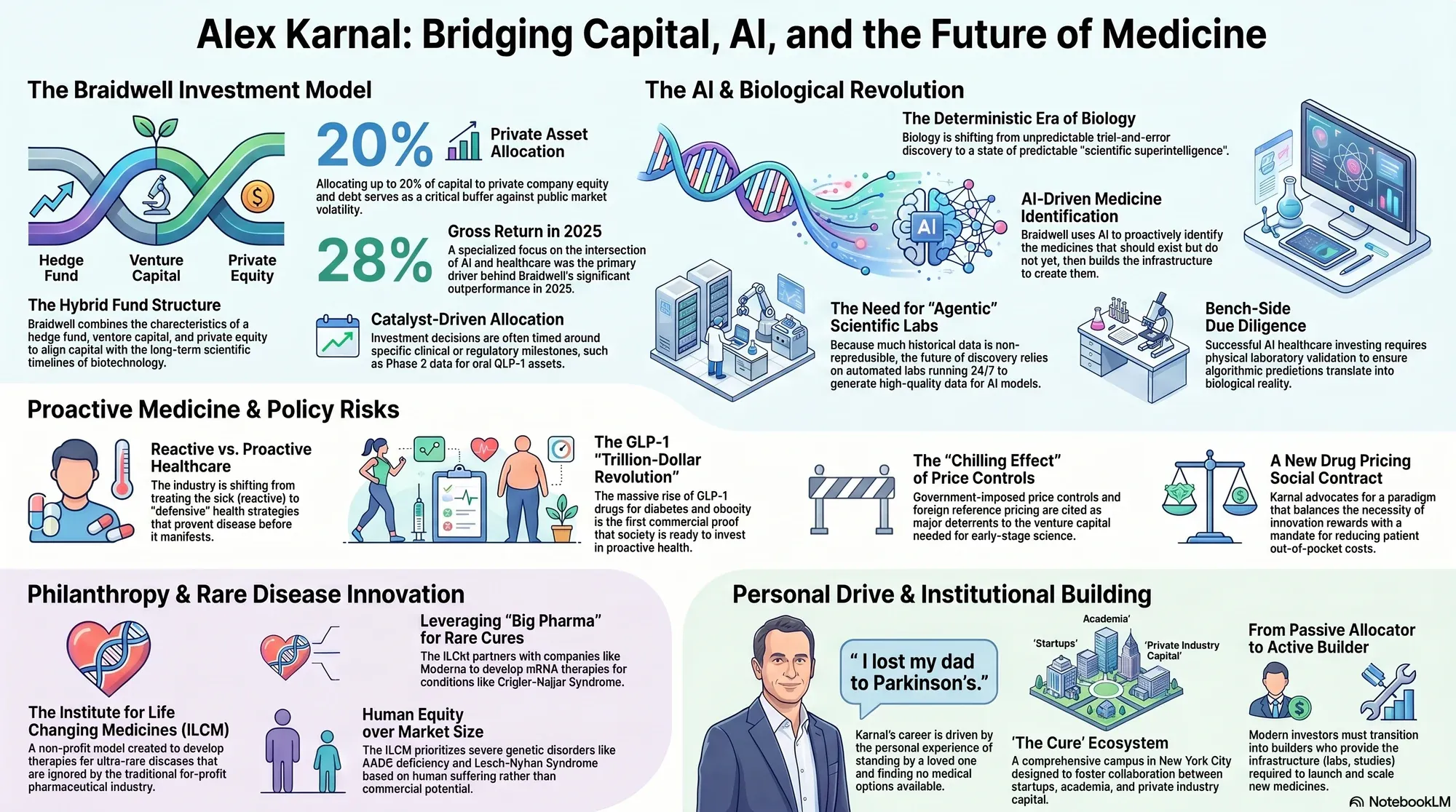
- On Hybrid Fund Structures: Braidwell's strategy blends the characteristics of a hedge fund with venture capital and private equity to support companies across their entire lifecycle. — Hedgeweek: Braidwell AI Healthcare Hedge Fund
- On Market Volatility: Allocating up to 20% of capital to private company equity and debt helps buffer the fund against the volatility of public markets. — Hedgeweek: Braidwell AI Healthcare Hedge Fund
- On the "Health Stack": Healthcare should be viewed as a layered stack, where many deadly diseases are already addressable, but the system fails at delivery and access. — Invest Like the Best: The Trillion-Dollar Health Revolution
- On Identifying Unmet Needs: The goal of modern investing is to proactively identify the medicines that should exist but do not yet, and build the infrastructure to create them. — Hedgeweek: Braidwell Strategy & Platform
- On Multi-Asset Allocation: The firm utilizes a wide range of instruments, including public and private equity, structured debt, and royalty interests, to align capital with scientific timelines. — Hedgeweek: Braidwell Capital & Asset Allocation
- On Catalyst-Driven Investing: Capital allocation should often target specific clinical or regulatory catalysts, such as impending Phase 2 data for oral GLP-1 assets. — Hedgeweek: Braidwell Catalyst-Driven Investing
- On Focused Portfolios: Concentrating investments across biotechnology, pharmaceuticals, medical devices, and diagnostics provides the necessary expertise to evaluate complex scientific risk. — Hedgeweek: Braidwell Healthcare Strategy
- On Strategic Returns: A deep focus on the intersection of artificial intelligence and healthcare was a key driver of Braidwell's reported 28% gross return in 2025. — Hedgeweek: Braidwell AI Healthcare Hedge Fund
Part 2: The Biological Revolution & Artificial Intelligence
- On the Biological Revolution: We are entering a deterministic era of biology, shifting from trial-and-error discovery to highly predictable scientific superintelligence. — Invest Like the Best: The Trillion-Dollar Health Revolution
- On Using AI in Investing: "We use AI in our own investment process to help identify the medicines that should exist but don't yet." — Hedgeweek: Braidwell Strategy & Platform
- On AI Data Quality: Much of the historically published scientific literature cannot be replicated, meaning AI models must be trained on new, high-quality data to be effective. — Invest Like the Best: The Trillion-Dollar Health Revolution
- On Agentic Scientific Labs: The future of drug discovery relies on automated laboratories running 24/7 to generate the reproducible data necessary to fuel AI models. — Invest Like the Best: The Trillion-Dollar Health Revolution
- On Braidwell Labs: "Through Braidwell Labs we go a step further, combining AI and science to discover those medicines and build the companies that bring them to life." — Hedgeweek: Braidwell Strategy & Platform
- On AI's True Value: Artificial intelligence will not simply replace doctors; rather, it will expose the massive amount of unmet medical need that has always existed but remained invisible. — Hedgeweek: Braidwell AI Healthcare Hedge Fund
- On the Convergence of AI and Biotech: AI is not just a tool for operational efficiency; it is the fundamental missing piece required to unlock the next era of precision medicine. — Hedgeweek: Braidwell AI Healthcare Hedge Fund
- On Bench-Side Due Diligence: Investing in AI healthcare requires physical laboratory validation to ensure that algorithmic predictions translate into biological realities. — Hedgeweek: Braidwell AI Healthcare Hedge Fund
- On Accelerating Discovery: Companies that build AI platforms for pharmaceutical partners are accelerating the identification of new therapeutics at an unprecedented scale. — Hedgeweek: Braidwell AI Healthcare Hedge Fund
- On AI-Enabled Diagnostics: The integration of AI into diagnostics allows for the identification of severe conditions far earlier than humanly possible, shifting the treatment paradigm. — Hedgeweek: Braidwell AI Healthcare Hedge Fund
Part 3: Proactive Medicine vs. Reactive Healthcare
- On Healthcare Paradigms: The industry is currently undergoing a massive shift from a reactive model of treating the sick to a proactive, "defensive" health strategy. — Invest Like the Best: The Trillion-Dollar Health Revolution
- On the GLP-1 Revolution: The meteoric rise of GLP-1 drugs represents the first commercial proof that society is ready to invest heavily in proactive, preventative health. — Invest Like the Best: The Trillion-Dollar Health Revolution
- On Metabolic Health: The GLP-1 class of therapeutics is a "trillion-dollar revolution" that addresses massive unmet needs in diabetes and obesity. — Invest Like the Best: The Trillion-Dollar Health Revolution
- On PCSK9 Inhibitors: Cholesterol-lowering PCSK9 inhibitors represent a fundamentally vital proactive drug class that fits the new paradigm but receives far less mainstream attention. — Invest Like the Best: The Trillion-Dollar Health Revolution
- On Execution Risk in Proactive Health: While the science behind proactive medicine is sound, the policy environment and Medicare coverage structures pose significant execution risks. — BIO Interview: Drug Pricing Social Contract & Policy
- On Disease Prevention: Utilizing existing and new medicines to prevent diseases before they manifest is the most effective way to mitigate broad public health risks. — BIO Interview: Drug Pricing Social Contract & Policy
- On Market Readiness: Successfully commercializing proactive health solutions requires that both the public and insurance providers are willing to pay for prevention. — Invest Like the Best: The Trillion-Dollar Health Revolution
- On Existing Therapeutics: The tragedy of modern healthcare is that we already possess the medicines to address many deadly diseases, but fail to deploy them proactively. — Invest Like the Best: The Trillion-Dollar Health Revolution
- On Structural Price Erosion: As proactive health becomes more common, the industry must navigate steeper price erosion while maintaining the incentives to innovate. — BIO Interview: Drug Pricing Social Contract & Policy
Part 4: Risk, Capital, and the Economics of Innovation
- On Taking Risk: "We have to take a lot of risk upfront, but there's great uncertainty in terms of what price we could realize downstream." — BIO Interview: Foreign Price Controls & Life Science Investments
- On Transformational Cures: Investors must be incentivized to fund highly risky transformational medicines rather than settling for low-risk, incremental improvements. — BIO Interview: Foreign Price Controls & Life Science Investments
- On Development Cycles: The 10- to 15-year development cycle for new drugs requires absolute economic certainty that the downstream market will reward scientific success. — Invest Like the Best: The Trillion-Dollar Health Revolution
- On Risk Misallocation: When healthcare economics become unpredictable, capital is inevitably pushed toward lower-risk sectors, starving the world of potential cures. — Invest Like the Best: The Trillion-Dollar Health Revolution
- On Protecting Inventors: A healthy ecosystem ensures that the inventors who take on the massive risk of scientific failure are adequately protected and rewarded. — Invest Like the Best: The Trillion-Dollar Health Revolution
- On the Cost of Failure: Because the vast majority of experimental drugs fail, the few that succeed must generate sufficient returns to subsidize the entire ecosystem's research. — Invest Like the Best: The Trillion-Dollar Health Revolution
- On Capital as a Catalyst: Strategic capital allocation doesn't just support science; it acts as a catalyst that actively accelerates the timeline from discovery to patient access. — BuildsBio: Life Science Real Estate Symposium
- On the Consequences of Uncertainty: "The consequence of that is that we just won't be able to take types of risk... that lead to the transformational medicines that we need for tomorrow." — BIO Interview: Foreign Price Controls & Life Science Investments
- On Alternative Asset Utilization: Leveraging unique financial instruments, such as FDA Priority Review Vouchers, helps offset risk and provide non-dilutive capital to clinical programs. — Hedgeweek: Braidwell Capital & Asset Allocation
- On the Investor's Dilemma: High-risk capital is essential to push biological boundaries, but it will only flow if regulatory and pricing environments remain stable. — BIO Interview: Foreign Price Controls & Life Science Investments
Part 5: Policy, Pricing, and the Social Contract
- On Price Controls: "This is a program that prevents investors from being able to invest and inventors from being able to invent." — BIO Interview: Foreign Price Controls & Life Science Investments
- On the "Chilling Effect": Government-imposed foreign reference pricing and broad price controls have an absolutely chilling effect on the venture capital needed for early-stage science. — BIO Interview: Foreign Price Controls & Life Science Investments
- On the Social Contract: The healthcare industry needs a "New Drug Pricing Social Contract" that effectively balances the necessity of innovation with the mandate for patient access. — BIO Interview: Drug Pricing Social Contract & Policy
- On Out-of-Pocket Costs: Rather than targeting the innovators with price controls, policymakers should focus on redesigning insurance structures to reduce patient out-of-pocket costs. — BIO Interview: Drug Pricing Social Contract & Policy
- On Intellectual Property: Strong intellectual property protections are the bedrock of biomedical innovation, allowing companies to justify decades of rigorous research and development. — Invest Like the Best: The Trillion-Dollar Health Revolution
- On Coverage Hurdles: Complex and restrictive insurance coverage structures frequently complicate the commercial path for newly approved, life-saving therapies. — BIO Interview: Drug Pricing Social Contract & Policy
- On Regulatory Predictability: Regulatory unpredictability is often a more significant barrier to life sciences investment than the underlying biological risk of the medicine itself. — BIO Interview: Foreign Price Controls & Life Science Investments
- On the Threat to GLP-1s: The greatest threat to the proliferation of the GLP-1 weight loss revolution is not scientific efficacy, but rather the restrictive policy and reimbursement environment. — BIO Interview: Drug Pricing Social Contract & Policy
- On Industry Advocacy: Serving on boards like the Biotechnology Innovation Organization (BIO) is critical to defending the industry against legislation that would stifle medical breakthroughs. — Hedgeweek: Braidwell Healthcare Strategy
Part 6: Philanthropy & Rare Diseases (The ILCM)
- On the ILCM's Mission: The Institute for Life Changing Medicines was founded to develop therapies for ultra-rare diseases that are entirely overlooked by the traditional for-profit pharmaceutical industry. — ILCM: Who We Are & Mission
- On Health as a Human Right: The foundational belief of the ILCM is that living a healthy life is a basic human right, and there should be no financial barriers to accessing life-saving science. — ILCM: Health as a Human Right
- On Non-Profit Drug Development: By operating as a self-sustaining non-profit, the ILCM can pursue cures for patient populations that are too small to justify traditional venture capital investment. — ILCM: Who We Are & Mission
- On Reinvesting Margins: The institute's model relies on reinvesting any margins from product sales or the monetization of regulatory vouchers directly back into future rare disease research. — ILCM: Who We Are & Mission
- On Crigler-Najjar Syndrome: Partnering with companies like Moderna to develop mRNA-3351 demonstrates how non-profits can leverage big pharma technology for ultra-rare conditions. — ILCM: Rare Disease Programs
- On Zero Upfront Costs: Licensing drug candidates with no upfront or downstream royalty payments is essential to making non-profit rare disease drug development financially viable. — ILCM: Rare Disease Programs
- On Gene Therapy for AADC Deficiency: The ILCM actively pursues cutting-edge cell and gene therapies to address devastating neurological conditions like AADC deficiency. — ILCM: Rare Disease Programs
- On Lesch-Nyhan Syndrome: Tackling severe, self-mutilating genetic disorders reflects a commitment to prioritizing human suffering over commercial market sizing. — ILCM: Rare Disease Programs
- On Human Equity: Philanthropic efforts in healthcare must extend beyond the laboratory to address broader issues of healthcare access and foundational human equity. — Cure: Healthcare Innovation Campus
Part 7: Institutional Building: "The Cure" and Braidwell Labs
- On "The Cure" Campus: "Deerfield is a place where all of us come together behind a belief in a world with fewer diseases and less suffering." — Cure: Healthcare Innovation Campus
- On Healthcare Ecosystems: The Cure was conceptualized not just as office space, but as a comprehensive ecosystem designed to accelerate life science innovation in New York City. — BuildsBio: Life Science Real Estate Symposium
- On Collaboration Residencies: Providing physical spaces where startups, academia, and established companies can interact is vital for fostering cross-pollination in biotech. — Cure: Innovation Residencies & Infrastructure
- On Cross-Sector Integration: Solving the most complex healthcare challenges requires the intentional integration of government resources, academic research, and private industry capital. — Cure: Innovation Residencies & Infrastructure
- On Research Infrastructure: Providing state-of-the-art wet labs, dry labs, and prototype studios removes the logistical friction that often slows down early-stage biomedical startups. — Cure: Innovation Residencies & Infrastructure
- On Discovery Engines: Co-founding Braidwell Labs created a dedicated "discovery and launch engine" that turns theoretical science into operational biotech companies. — Concordia: Annual Summit Sessions
- On Being a Builder: Modern life sciences investors must transition from being passive allocators of capital to active builders of the infrastructure required to launch new medicines. — Hedgeweek: Braidwell Strategy & Platform
- On Structural Innovation: The corporate structure of an investment firm must be purposefully designed to match the specific, long-term timelines of the science it intends to fund. — BuildsBio: Life Science Real Estate Symposium
- On Commercialization Scaling: Bridging the "valley of death" between academic discovery and commercial viability is the most critical function of specialized life science institutions. — BuildsBio: Life Science Real Estate Symposium
Part 8: Early Career, Leadership, and Personal Motivation
- On Personal Motivation: "For me this is uniquely personal because I lost my dad to Parkinson's." — BIO Interview: Foreign Price Controls & Life Science Investments
- On Hopelessness: "I stood by his side hopeless looking for options but finding none. I carry that with me every day." — BIO Interview: Foreign Price Controls & Life Science Investments
- On Daily Drive: "I come to work... trying to seek out those medicines that will change people's lives." — BIO Interview: Foreign Price Controls & Life Science Investments
- On Public Service: Advising the Reopen Connecticut Advisory Group during the COVID-19 pandemic highlighted the intersection of public health policy and economic recovery. — ILCM: Leadership & Advisory Governance
- On Academic Foundations: Degrees from the Massachusetts Institute of Technology and Johns Hopkins University established the analytical and biological frameworks for a career in biotech finance. — BuildsBio: Life Science Real Estate Symposium
- On Youth Development: Serving on the board of the Armory Foundation demonstrates a commitment to providing educational and athletic programs for underserved youth in New York. — ILCM: Alex Karnal Leadership Bio
- On Scientific Literacy: Board memberships at the Museum of Science and the New York Academy of Medicine reflect a dedication to improving broad public understanding of science. — ILCM: Leadership & Advisory Governance
- On Institutional Loyalty: A 16-year tenure rising to Partner and Co-Portfolio Manager at Deerfield Management showcased a long-term commitment to a single overarching healthcare thesis. — Hedgeweek: Braidwell Healthcare Strategy
- On Capital Markets Experience: Beginning a career in the Global Equity Linked Products Group at Merrill Lynch provided the financial structuring expertise later applied to biotech investing. — Hedgeweek: Braidwell Foundation & Background