Daniel Nadler founded Kensho Technologies and later OpenEvidence. He also earned a Harvard doctorate and published the poetry collection Lacunae. His interviews connect his financial-technology work to a later focus on helping physicians navigate medical knowledge. — Goldman Sachs 2016 Interview. — Talks at GS Interview. — Academy of American Poets Profile.
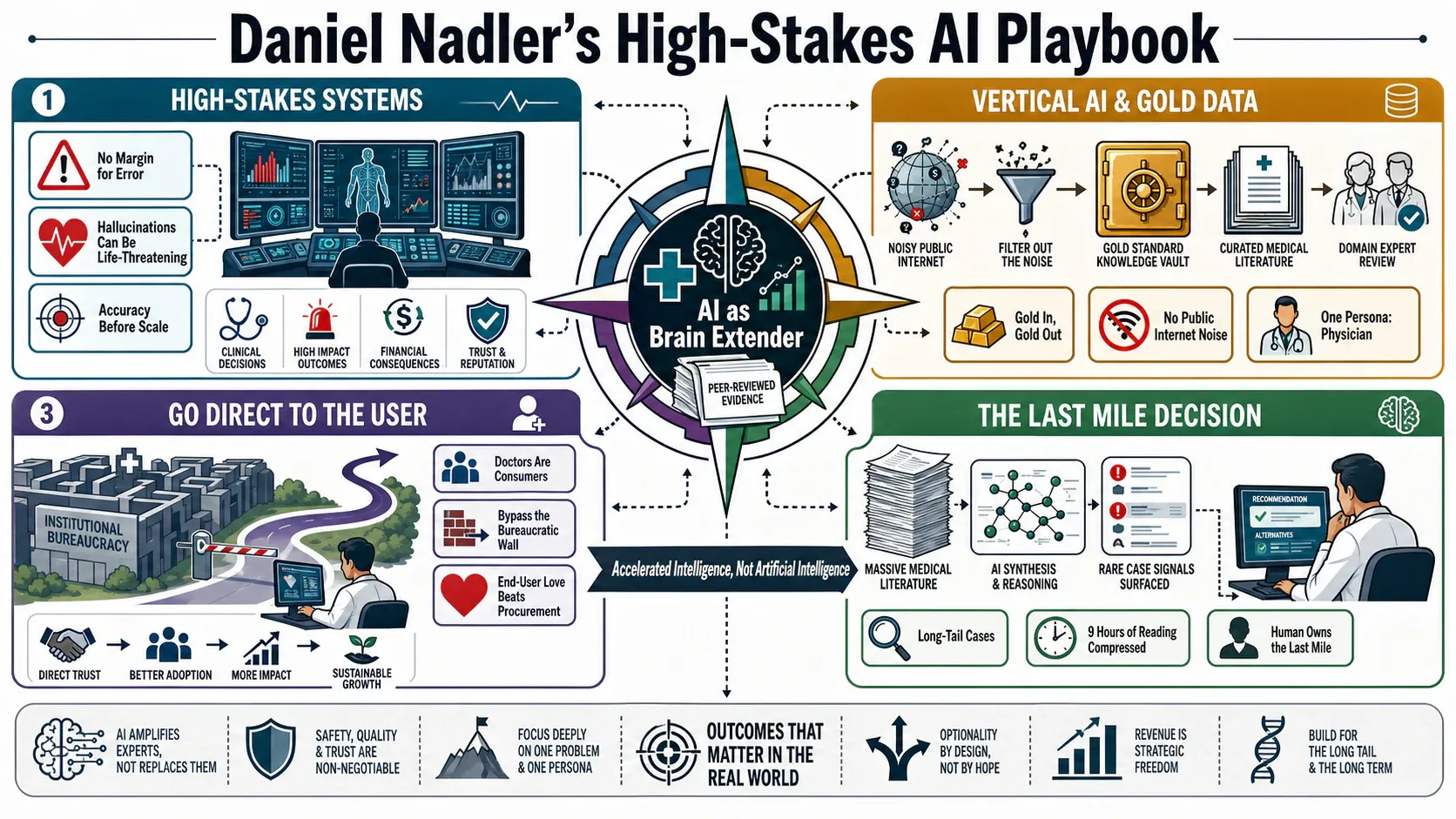
Part 1: The Transition to High-Stakes AI
- On Medical Reliability: Nadler contrasts exploratory AI uses with medical retrieval, where unsupported answers can carry serious consequences. — Sequoia Training Data Interview.
- On Accelerated Intelligence: In discussing Kensho, Nadler called AI accelerated intelligence: a way to amplify the work of financial professionals rather than simply replace their judgment. — Forbes Nadler Interview.
- On Curated Medical Data: Nadler says OpenEvidence uses licensed medical literature and does not connect its trained models to the public internet; this is a design description, not a guarantee of accuracy. — Sequoia Training Data Interview.
- On Information Overload: In a 2025 interview, Nadler estimated that keeping up with even a fraction of new literature in one medical specialty would require hours of reading each day. — No Priors Podcast.
- On a Fourth Industrial Revolution: In 2016, Nadler described Kensho as part of a broader effort to bring advanced computing to capital-markets work. This was his contemporary thesis, not a proven forecast. — Goldman Sachs 2016 Interview.
- On a Second Mission: After Kensho, Nadler chose to work on medical knowledge access through OpenEvidence, describing its potential importance to physicians. — Talks at GS Interview.
- On an AI Interregnum: In 2016, Nadler predicted a period when computers would not match human intelligence broadly but could perform many economically valuable tasks. — Goldman Sachs 2016 Interview.
- On Kensho’s Origin: Nadler says his 2013 experience at the Boston Federal Reserve exposed how much event-driven financial analysis still depended on manual news collection and spreadsheets. — Goldman Sachs 2016 Interview.
Part 2: Domain Expertise and Focusing the Product
- On Learning the Domain: Kensho’s early work grew from a concrete Federal Reserve analysis problem; Nadler later worked closely with financial institutions to refine the product. — Goldman Sachs 2016 Interview.
- On Product Focus: Nadler describes OpenEvidence as built around physicians’ specific point-of-care information needs, rather than a general-purpose consumer assistant. — Talks at GS Interview.
- On Consumer Distribution: Nadler endorses a Sequoia description of OpenEvidence as using consumer-internet distribution in healthcare: physicians can adopt it directly. The phrase originated with Sequoia. — No Priors Podcast.
- On Scaling Kensho: After S&P Global acquired Kensho, the company continued as a standalone brand while gaining a larger parent. — Forbes Nadler Interview.
- On Asking Better Financial Questions: In 2016 Nadler argued that better questions and new data could produce investment alpha, while useful signals would become common more quickly. — Goldman Sachs 2016 Interview.
Part 3: Large Organizations and "Doctors as Consumers"
- On Recognizing Institutional Friction: Drawing on finance and healthcare, Nadler says long organizational procurement cycles shaped his choice to reach physicians directly. — Sequoia Training Data Interview.
- On Doctors as Consumers: Nadler’s distribution insight was that physicians also act as individual consumers who can choose useful tools for themselves. — Sequoia Training Data Interview.
- On Direct Adoption: Nadler attributes OpenEvidence’s early reach in part to making the tool available directly to doctors instead of relying only on hospital procurement. This is his account of adoption. — Sequoia Training Data Interview.
- On Reported Physician Reach: The September 2025 No Priors episode reported that OpenEvidence had reached about 40% of U.S. doctors in 18 months. Treat this as a dated, company-reported reach figure, not a current adoption or clinical-outcome measure. — No Priors Podcast.
Part 4: AI as a Force Multiplier
- On Extending Physicians’ Knowledge: Nadler calls OpenEvidence a brain extender for doctors: a tool intended to surface relevant medical knowledge while the clinician remains responsible for care. — Talks at GS Interview.
- On the Pilot Analogy: In discussing AI in medicine, Nadler compares automation in aviation with the continuing role of pilots; it is his analogy for expert oversight, not proof of a specific clinical outcome. — No Priors Podcast.
- On Spreadsheet Work: At a 2016 Milken panel, Nadler predicted that finance roles centered on moving data between spreadsheets would be automated. The prediction should be read in its original time frame. — Los Angeles Times Milken Report.
- On Physician Burnout: In the 2025 No Priors episode, Nadler frames medical information overload and physician burnout as problems his company aims to address; whether its tool reduces burnout has not been established here. — No Priors Podcast.
- On Clinician Judgment: Nadler describes a medical-information tool that helps physicians find literature and inspect citations while leaving decisions with the clinician. — Sequoia Training Data Interview.
- On Removing Manual Research: Nadler’s 2016 account of Kensho describes replacing manual newsclip and spreadsheet searches with event-driven financial analysis; broader claims about future job quality remain predictions. — Goldman Sachs 2016 Interview.
- On the Financial Data Gap: At the Boston Federal Reserve, Nadler noticed that assessing the market effects of events still involved labor-intensive historical comparisons, a gap that inspired Kensho. — Goldman Sachs 2016 Interview.
- On Questions Versus Data Gathering: Nadler’s 2016 investment thesis placed more value on asking useful questions of data as routine collection and analysis became easier. — Goldman Sachs 2016 Interview.
Part 5: Hallucinations and the "Long Tail" of Medicine
- On Generative Imagination: Nadler distinguishes factual medical retrieval from creative or financial brainstorming, where imagined scenarios can be useful to explore. — Sequoia Training Data Interview.
- On Unusual Medical Cases: Nadler says many OpenEvidence queries involve cases a doctor might encounter only once or twice in a career; that is his description of usage, not independently verified effectiveness. — Sequoia Training Data Interview.
- On Inspectable Sources: Nadler describes linking medical answers back to underlying literature so physicians can examine the source; this design does not establish a zero-hallucination guarantee. — Sequoia Training Data Interview.
- On a Medical Search Tool: OpenEvidence is presented as a way to retrieve and examine medical research, rather than merely produce fluent conversational answers. — Talks at GS Interview.
- On Financial Risk Scenarios: Nadler gives financial risk analysis as an example where generating unusual hypothetical scenarios can help users think through possibilities; this is distinct from asserting medical facts. — Sequoia Training Data Interview.
Part 6: Building Teams and Cultivating "Neuroplasticity"
- On Learning Capacity: Nadler emphasizes candidates’ capacity to learn quickly when describing how he hires for technically demanding work. — Sequoia Training Data Interview.
- On Intelligence and Learning: In his recruiting discussion, Nadler associates intelligence with learning velocity and adaptability, rather than treating prior industry experience as the only signal. — Sequoia Training Data Interview.
- On Self-Directed Recruits: In his No Priors interview, Nadler describes seeking people who are already driven to pursue difficult work, rather than relying entirely on external motivation. — No Priors Podcast.
Part 7: On Polymathy, Poetry, and Seeing "Ahistorically"
- On Language and Perception: Nadler reflects that inherited metaphors and literary language shape how people perceive the natural world. — Boston Review Interview.
- On Cognitive Shortcuts: He uses the Homeric description of the sea as an example of how a familiar phrase can efficiently categorize a more immediate experience. — Boston Review Interview.
- On Ahistorical Poems: Nadler says he tried to write elemental poems without simply repeating inherited literary associations. — Boston Review Interview.
- On Seeing Slowly: In the interview, Nadler describes attending to visual details before naming the whole object, a way of explaining his poetic perception. — Boston Review Interview.
- On Abstract Language: Nadler reports difficulty with abstract nouns and says concrete sensory language is easier for him to grasp. This is his self-description, not a diagnosis. — Boston Review Interview.
- On Imagined Translations: Lacunae presents imagined translations of ancient love poems, using fragments and gaps to evoke an otherwise inaccessible world. — Macmillan Lacunae Catalog.
- On Moving Between Fields: Nadler’s own account places a period of study in classics and drawing between Kensho and OpenEvidence; a causal claim that poetry determined his AI architecture would go beyond that account. — Talks at GS Interview.
Part 8: Philosophy, Wealth, and Purpose
- On Retirement and Purpose: In the No Priors conversation, Nadler contrasts his impression of purposeful work in Japan with a retirement ideal centered only on leisure; it is a personal observation, not a claim about everyone in Japan. — No Priors Podcast.
- On Medical Impact: Nadler describes his move into medical knowledge tools as motivated by the possibility of helping physicians and patients; that is his stated aim, not established patient benefit. — Talks at GS Interview.
- On Film Production: Apple’s original credits list Nadler as a producer of Palmer. The credit establishes a production role, not that he personally financed the film. — Apple Palmer Credits.
- On Arts Boards: MoMA’s 2020–21 board roster lists Nadler as a director of MoMA PS1. The dated record does not establish current membership or his motivation. — MoMA 2020–21 Report.