Alex Mashrabov co-founded Higgsfield after building mobile face-animation technology at AI Factory and working on generative AI at Snap. Higgsfield now focuses on making AI video creation usable for professional social-media creators and marketing teams. — Product Market Fit Show Transcript.
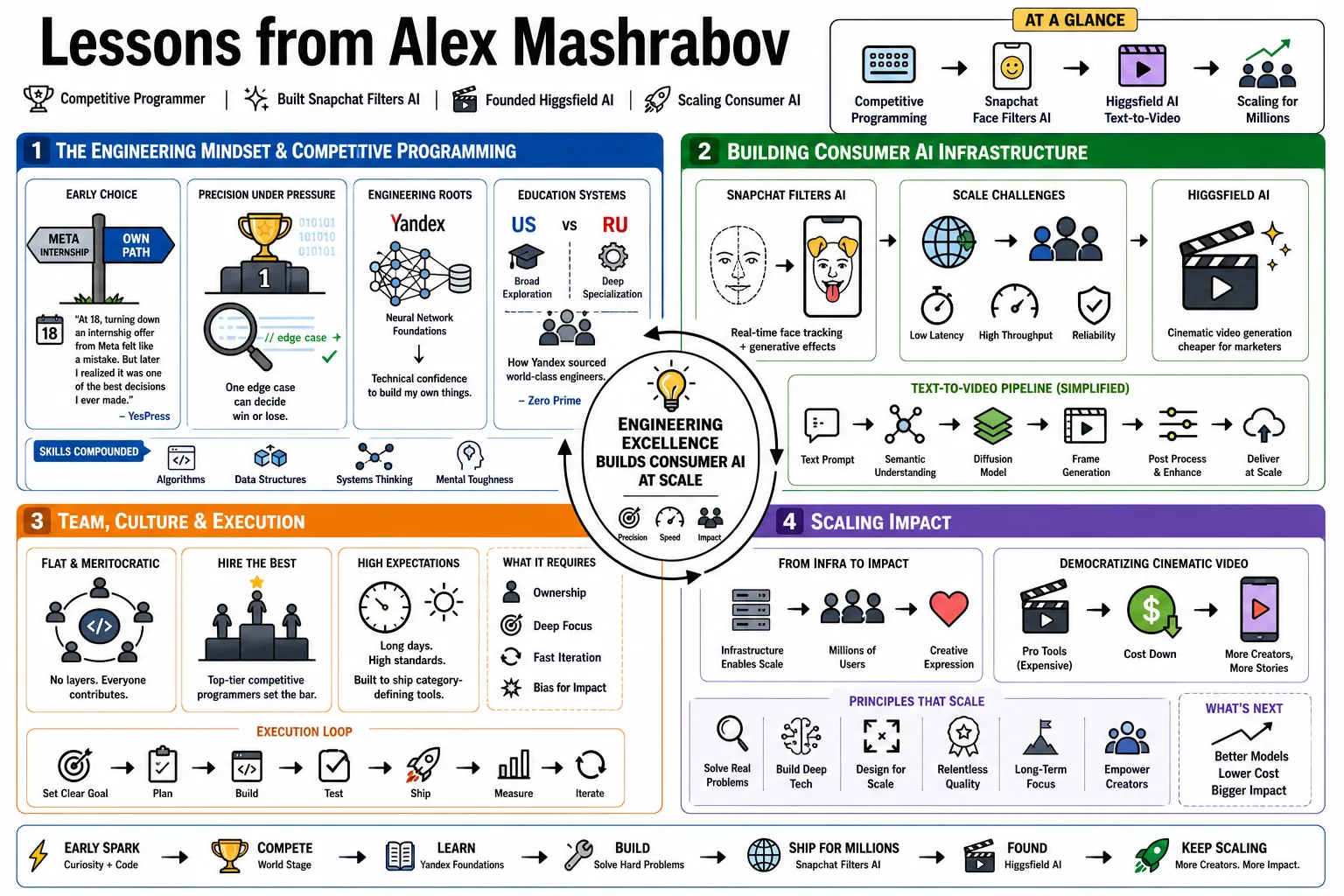
Part 1: The Engineering Mindset and Competitive Programming
- early choices: Mashrabov later viewed turning down a Meta internship at 18 as a valuable decision, though he said it initially felt like a mistake. — Pivot Interview.
- precision under pressure: He credits programming competitions as part of his technical background and says he has recruited other international competition winners into Higgsfield’s team. — Sacra Interview.
- engineering philosophy: At Yandex he worked with neural networks before spending the following decade on image and video AI, experience that informed AI Factory and Higgsfield. — Product Market Fit Show Transcript.
- flat organizational structures: Mashrabov points to Central Asian programming talent and says Higgsfield has hired multiple winners of international technical competitions. — Sacra Interview.
Part 2: Building Consumer AI at Scale
- production AI realities: His work at AI Factory and Snap showed him how mobile face-generation technology could become a widely used consumer feature. — Product Market Fit Show Transcript.
- optimizing costs: At Higgsfield’s scale, long training runs face hardware, network and data bottlenecks; Mashrabov emphasizes resilience and throughput so experiments are not lost. — Nebius Higgsfield Case Study.
- user acquisition: Higgsfield’s product choices are shaped by observing how creators use the tools and by shortening the feedback loop between release and response. — Sacra Interview.
- facial animation: AI Factory built neural face-animation capabilities for mobile use, and Mashrabov says some of that technology became Snapchat features. — Product Market Fit Show Transcript.
- pairing technical and creative expertise: Higgsfield pairs engineers with commercial creatives so the people making ads can identify failures in real production work and feed them back to the model and product teams. — SaaStr Interview.
- knowing where rapid tooling stops: Mashrabov distinguishes quick feature development from the deeper engineering required for reliable infrastructure, safety and anti-fraud as usage scales. — SaaStr Interview.
Part 3: Product Strategy and Velocity
- product iteration: Mashrabov contrasts Higgsfield’s daily product iteration with the longer development cycles of companies focused on a single frontier video model. — Sacra Interview.
- shipping speed: He says Higgsfield releases changes six days a week, using each release to learn from creator behavior. — Sacra Interview.
- learning from failure: After a consumer mobile app reached substantial usage but struggled with retention, Higgsfield shifted toward desktop workflows for professional creators and marketers. — Sacra Interview.
- overcoming adoption friction: Higgsfield’s click-to-video approach reduces the amount of detailed prompting required to create a short clip, lowering the effort needed to try the tool. — Observer Interview.
- orchestration: Mashrabov describes Higgsfield as a workflow-orchestration platform that makes different video models useful for specific commercial tasks, not merely a menu of raw model APIs. — Sacra Interview.
- rapid integration: As new models appear, he says the platform must test and integrate them into usable workflows so customers need not absorb each model’s complexity themselves. — Sacra Interview.
- treating product-market fit as continuous work: He treats product-market fit as continuing work in a fast-changing market: frequent model releases require ongoing observation, shipping and adjustment. — Sacra Interview.
- following usage rather than the roadmap: The company moved beyond its original single-model approach when new video models arrived rapidly and different models proved useful for different tasks. — SaaStr Interview.
- changing the operating cadence with scale: As the platform grew, its team added engineering effort around stability, infrastructure, safety and anti-fraud instead of treating speed of release as the only objective. — SaaStr Interview.
Part 4: The Shift to Video and Social Media Dynamics
- the demands of social platforms: Mashrabov argues that competition for attention on social platforms creates strong pressure to produce video frequently. — Observer Interview.
- the necessity of speed: He says generative video can shorten a marketing-production cycle from weeks to hours, making more frequent social posts feasible. — Observer Interview.
- democratizing creation: Mashrabov’s goal is to lower the production cost of video so that a creator’s idea and story matter more than access to an expensive shoot. — Sacra Interview.
- the future of social video: Mashrabov forecasts that AI-generated video will account for much of future social content and hopes Higgsfield will serve a large share; this is his ambition, not an established outcome. — Sacra Interview.
- scaling content creation: He describes working with AI educators and creators to teach use cases and reach audiences interested in making AI-generated video. — Product Market Fit Show Transcript.
Part 5: Technical Architecture of Video Models
- computational requirements: Mashrabov estimates video generation requires roughly a hundred times as many tokens as text generation, illustrating the greater computational burden. — Sacra Interview.
- architectural shifts: He sees progress in video models as a route toward better simulation of real-world scenes, while acknowledging that video remains a technically harder domain than text. — Sacra Interview.
- hybrid models: Observer reports Higgsfield combines diffusion-based video generation with language-based controls for camera motion and scene composition. — Observer Interview.
- training efficiency: Large video-model training requires careful memory, data and hardware choices so the team can keep experiments stable and improve iteration speed. — Nebius Higgsfield Case Study.
- rapid experimentation: Mashrabov urges AI startups to experiment continuously while using reliable infrastructure and existing tools where they do not need to invent every component themselves. — Google Cloud — Mashrabov Essay.
Part 6: World Models and the Future of Creation
- viewer expectations: Mashrabov notes that implausible object motion can break a viewer’s sense of reality in an AI-generated scene. — TechCrunch World-Models Interview.
- simulating physics: He argues that stronger world models could represent how objects are expected to move, making generated scenes more physically coherent. — TechCrunch World-Models Interview.
- eliminating manual work: If a model can infer object motion, creators may need to define fewer physical interactions by hand. — TechCrunch World-Models Interview.
- long-term vision: Mashrabov’s long-term ambition is to serve a very large base of professional video creators; it remains a forecast, not a current user count. — Sacra Interview.
- ethical considerations: As adoption grows, Mashrabov says safety, anti-fraud and infrastructure reliability require deliberate engineering beyond rapid interface development. — SaaStr Interview.
Part 7: Enterprise Adoption and Marketing Workflows
- prompt fatigue: He says detailed text prompts are a barrier for many social marketers who simply need to make a usable video quickly. — Observer Interview.
- brand safety: For brand advertisers, avoiding unwanted details makes prompts longer and more difficult; Mashrabov presents click-to-video as a way to reduce that friction. — Observer Interview.
- marketing scale: Mashrabov reports examples of large-budget customers generating a substantial share of their social-media ad creative with AI; the figure is his reported customer example, not an industry average. — Sacra Interview.
- driving down costs: He compares some AI-assisted commercial production at roughly $500 per minute with conventional work that could cost around $100,000 per minute; these are his illustrative estimates, not a universal price. — Sacra Interview.
- intuitive interfaces: Higgsfield’s interface aims to replace a long blank-prompt workflow with selected inputs and controls that are easier for a marketer to use. — Observer Interview.
- segmenting users by the job they need done: Mashrabov distinguishes creators delivering finished commercial campaigns from customers using AI mainly to brainstorm; the two groups need different workflows. — Sacra Interview.
- the new bottleneck in creative work: For AI-first commercial creators, he says the remaining bottleneck can be explaining and defending a creative vision to clients, even after production becomes cheaper. — Sacra Interview.
- using low-risk workflows to enter established organizations: He observes that established agencies often begin with lower-risk storyboarding while resisting fully AI-generated production work. — Sacra Interview.
- selling outcomes instead of model access: The higher-value workflow is not just access to a model; it helps customers move from idea to commercial asset and, increasingly, toward distribution and measurement. — SaaStr Interview.
Part 8: The Business of AI and Operational Efficiency
- durable business models: SaaStr’s firsthand interview described Higgsfield as cash-flow positive at that point; Mashrabov framed operational efficiency and paying use as important to its growth. — SaaStr Interview.
- hardware orchestration: Higgsfield uses accelerated infrastructure to train and serve its own models alongside third-party models, with reliability and throughput central to the product. — NVIDIA Higgsfield Case Study.
- defining the market: Mashrabov sees AI-generated social-media production as a potentially large new market; his market-size and company-scale projections are ambitions rather than present facts. — Sacra Interview.
- working with cloud providers: Mashrabov says trusted cloud partners, startup credits and engineering support let a small AI team focus more of its effort on the differentiated product. — Google Cloud — Mashrabov Essay.
- operational focus: He uses Canva’s paying-user scale as a comparison for how much larger video-creation adoption might become, while acknowledging that his projections are uncertain. — Sacra Interview.
- finding power buyers in disrupted industries: SaaStr’s interview reports agencies as a major share of Higgsfield’s business because the tools can offer both a new client service and more efficient production. — SaaStr Interview.
- pricing for economic value: The company’s workflow pricing is linked to the value of replacing parts of a production process, not simply to the marginal cost of one raw model generation. — SaaStr Interview.