Dr. Ali Taha Koç moved from Intel research and development into Turkish government digital-transformation leadership before becoming Turkcell’s CEO. His work has covered e-government, cybersecurity, data policy, and telecommunications. These lessons draw on his interviews, official testimony, and institutional records. — GSMA Biography.
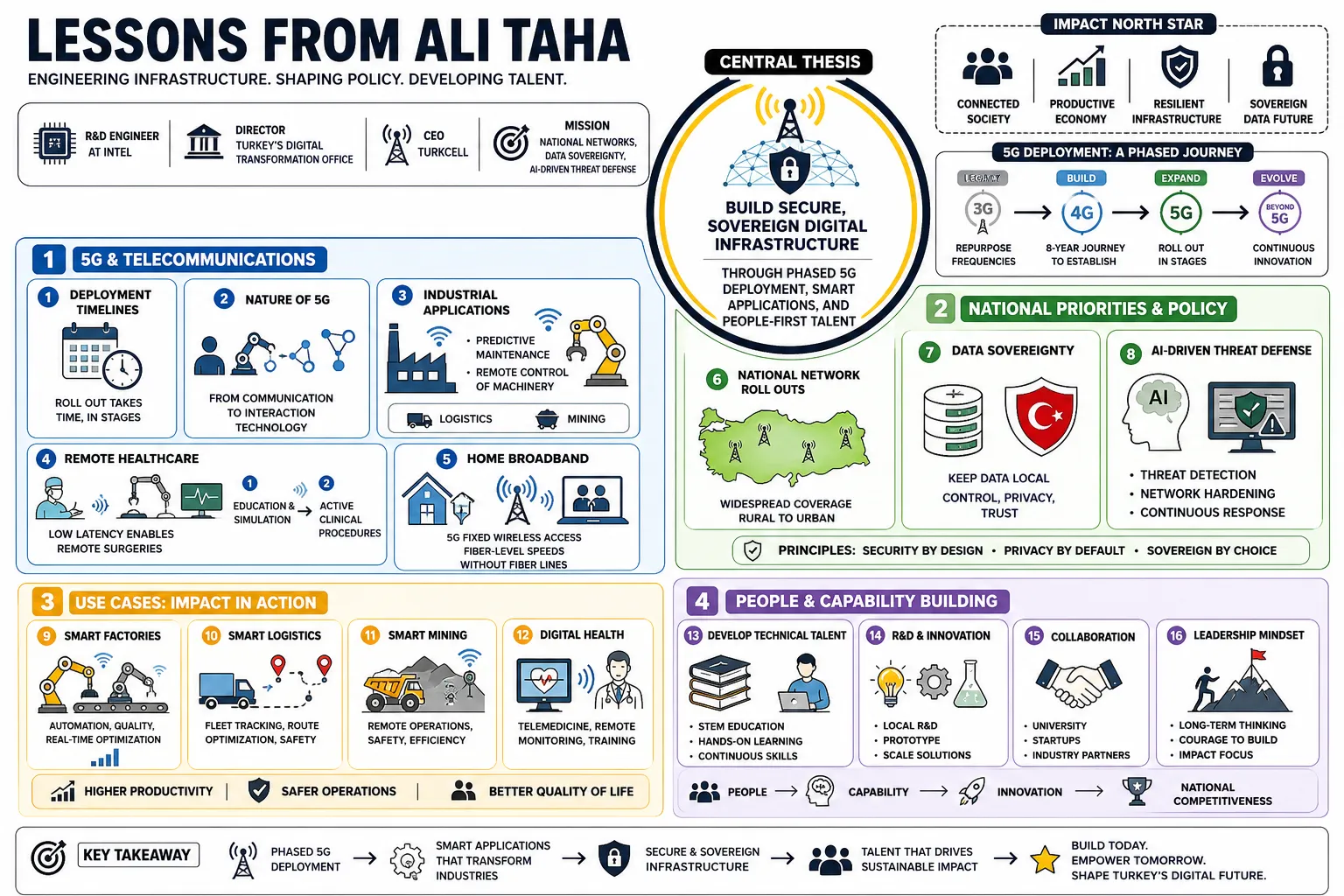
Part 1: 5G and Telecommunications
- 5G deployment timelines: Koç described 5G deployment as a staged rollout rather than an overnight switch, comparing it with the roughly eight-year 4G build-out and noting that some 3G spectrum could be repurposed. — Ekonomim Interview.
- 5G as interaction: Koç contrasted 4G as a communications network with 5G as a platform for richer interaction among people and connected machines; this is his framing, not a measured technical definition. — Ekonomim Interview.
- Industrial uses of 5G: Koç cited sensor-based predictive maintenance and remotely operated equipment in sectors such as logistics and mining as possible uses of 5G connectivity. — Ekonomim Interview.
- Remote healthcare: Koç treated remote surgery as a longer-term 5G use case and said education and simulation would come first; the interview does not establish that clinical surgery is already safe or routine. — Ekonomim Interview.
- Fixed wireless broadband: Koç said 5G fixed wireless could offer fiber-like home broadband without a new cable to every home, depending on deployment and network conditions. — Ekonomim Interview.
- Experience-based plans: Koç discussed developing 5G packages around use cases such as gaming and low-latency experiences; he did not say all data-volume tariffs had already been retired. — Ekonomim Interview.
- Connectivity and compute: Koç linked Turkcell’s 5G ambitions to planned local data-center and Google Cloud investment, arguing that faster networks need compute capacity to turn data into value. — Ekonomim Interview.
Part 2: State Digitalization and e-Government
- Digitization as a strategic necessity: Koç described digital transformation as a strategic necessity for Türkiye, tied to data-driven innovation and public services, rather than simply putting existing forms online. — Anadolu Agency Digital-Transformation Interview.
- People, process, and technology: In testimony, Koç said digital transformation depends on people, organizational processes, and technology together; a technology-only rollout is incomplete. — Turkish Parliament Testimony.
- Citizen-centered government services: Koç said government services should be organized around citizens’ needs, including integrated e-government journeys rather than forcing people to navigate each ministry separately. — Turkish Parliament Testimony.
- Domestic e-government systems: Koç oversaw work with Türksat on the e-TRNC program, an example of adapting domestically developed digital-government infrastructure for another jurisdiction; this does not prove foreign-system dependence is eliminated. — Türksat e-TRNC Program.
- Coordinating state information: Koç’s GSMA biography credits him with establishing a State Information Coordination Center to improve information flow between Turkish ministries and security units. — GSMA Biography.
Part 3: Cybersecurity and AI Threats
- Changing cyber threats: Koç argued in a 2022 interview that cyber threats had shifted from individual hackers toward automated, financially motivated and state-linked attacks; this is his assessment, not independent incident statistics. — Anadolu Agency Cybersecurity Interview.
- Potential AI-assisted attacks: Koç warned that AI could accelerate the discovery of system weaknesses and make offensive cyber operations faster; he described a risk scenario rather than a measured current attack rate. — Anadolu Agency Cybersecurity Interview.
- Unexpected attack paths: Koç used unconventional attack paths as a hypothetical illustration of how AI might probe vulnerabilities beyond familiar procedures; it should not be read as a documented incident. — Anadolu Agency Cybersecurity Interview.
- Criminal adoption risk: Koç warned that criminal groups could adopt offensive AI tools quickly. The interview frames this as a concern, not a verified ranking of who adopts technology first. — Anadolu Agency Cybersecurity Interview.
- AI-assisted defense: Koç called for defensive systems that can respond to increasingly automated cyber attacks with similarly adaptive tools. — Anadolu Agency Cybersecurity Interview.
- Security beyond code: Koç broadened his discussion of system vulnerabilities to legal, economic and social structures; this is a conceptual warning, not evidence that an AI attack has exploited those systems. — Anadolu Agency Cybersecurity Interview.
Part 4: Data Sovereignty and AI Strategy
- Protecting national data: Koç compared protecting a byte of Turkish data with protecting a handful of land, expressing a data-sovereignty priority in a 2019 summit speech. — Anadolu Agency Data-Sovereignty Report.
- Data as a security concern: Koç warned that personal and public data could be used against the country and argued for domestic cybersecurity capacity. — Anadolu Agency Data-Sovereignty Report.
- Data and AI strategy: Koç said data is essential for AI and linked Turkish data protection with the country’s ambitions for a national AI strategy; he did not demonstrate that localization alone creates an AI economy. — Anadolu Agency Data-Sovereignty Report.
- Sharing existing public records: Koç argued that government agencies should exchange information they already hold digitally so citizens do not repeatedly supply the same documents. — Anadolu Agency e-Government Interview.
- AI contribution target: In 2023 testimony, Koç described a goal of raising AI’s contribution to Türkiye’s GDP to 5% by 2025. This was a policy target, not a measured outcome. — Turkish Parliament Testimony.
Part 5: Technology Production and Human Capital
- From technology use to production: Koç said Türkiye should develop and sell its own digital products rather than only consume others’ technology. — Anadolu University Interview.
- Early cybersecurity education: Koç described cybersecurity-awareness contests for primary and secondary students and a specialist vocational high school; these were educational initiatives, not proof of workforce outcomes. — Turkish Parliament Testimony.
- Competitions as talent pipelines: Koç said the office used TEKNOFEST cybersecurity contests to identify and recruit talent, making competitions a practical route into its workforce. — Turkish Parliament Testimony.
- Patents from engineering work: Koç’s institutional biography reports 61 patents from his Intel R&D period; it supports his record but not the broader claim that patent counts determine R&D success. — GSMA Biography.
- Cross-sector career: Koç’s career spans Intel R&D, senior Turkish government digital roles, and Turkcell leadership. This documents his trajectory without asserting that such a path is necessary for others. — ITU AI for Good Biography.