Lessons from Amos Tversky
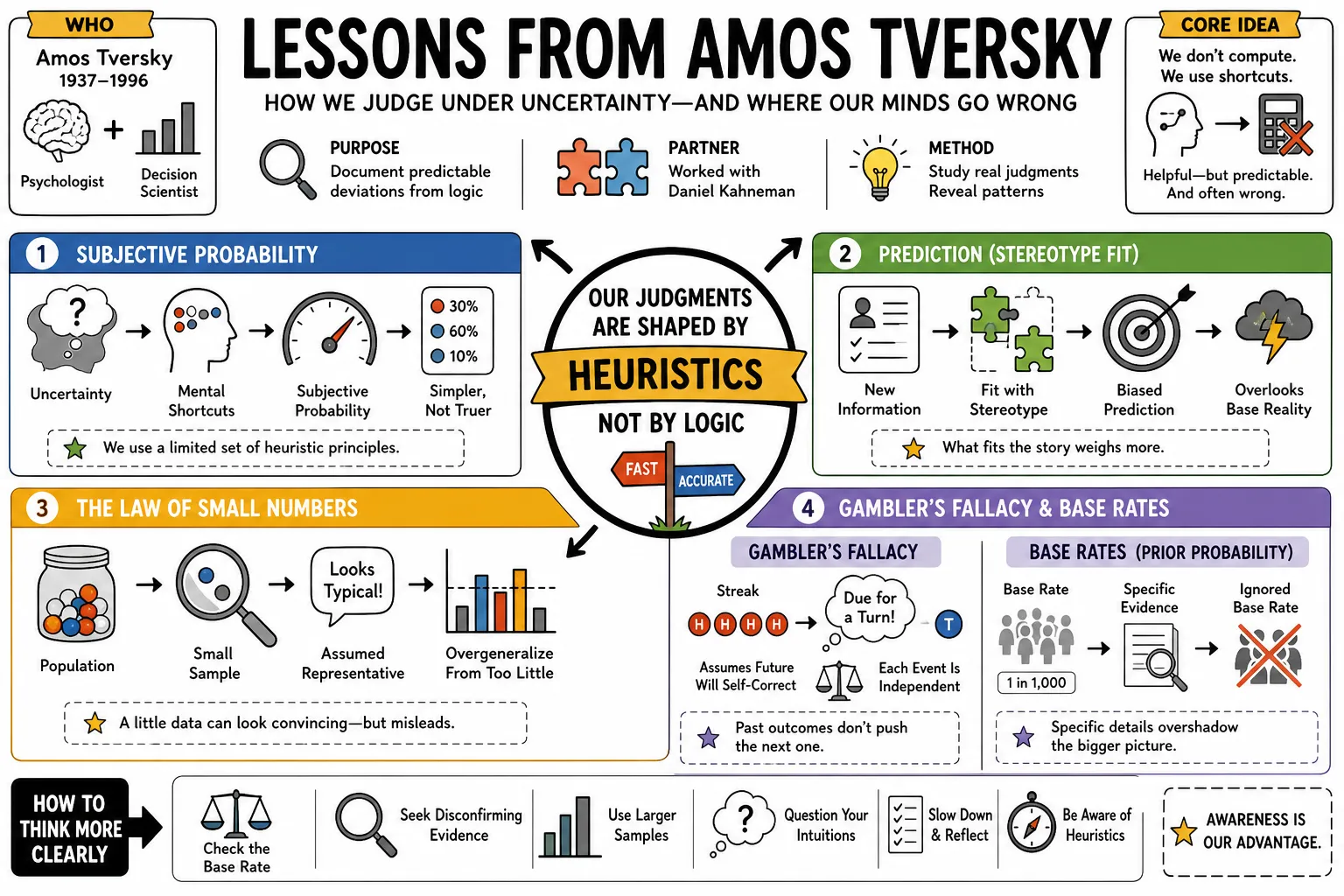
Tversky and Kahneman studied how people judge uncertain events and choose under risk. Their experiments identified heuristics that sometimes produce systematic errors. — Judgment under Uncertainty: Heuristics and Biases.
Part 1: Decision Making under Uncertainty
- On Subjective Probability: People often simplify probability judgments with a small set of heuristics; in some settings those shortcuts produce systematic errors. — Judgment under Uncertainty: Heuristics and Biases.
- On Prediction: When predicting from a description, people may rely on how representative it seems and underweight the evidence’s predictive reliability. — Judgment under Uncertainty: Heuristics and Biases.
- On the Law of Small Numbers: People can expect a small sample to resemble its parent population more closely than probability theory warrants. — Judgment under Uncertainty: Heuristics and Biases.
- On Gambler's Fallacy: People may view chance as self-correcting, expecting a run in one direction to be offset by a run in the other. — Judgment under Uncertainty: Heuristics and Biases.
- On Base Rates: In the authors’ experiments, case-specific descriptions could cause people to discount relevant prior probabilities. — Judgment under Uncertainty: Heuristics and Biases.
- On Randomness: People may regard ordinary streaks in random sequences as evidence of a nonrandom process. — Judgment under Uncertainty: Heuristics and Biases.
- On Illusion of Validity: A coherent or representative story can inspire confidence even when the evidence used to make the prediction is weak. — Judgment under Uncertainty: Heuristics and Biases.
- On Overconfidence: Confidence can remain high when predictions are based on evidence of little statistical validity. — Judgment under Uncertainty: Heuristics and Biases.
Part 2: The Architecture of Heuristics
- On Availability: Judgments of frequency or likelihood are sometimes guided by how readily examples come to mind. — Availability: A Heuristic for Judging Frequency and Probability.
- On Salience: Vivid or recent examples may be easier to retrieve, causing their frequency or probability to be overestimated. — Judgment under Uncertainty: Heuristics and Biases.
- On Anchoring: An initial value can anchor a numerical judgment; subsequent adjustments are often too small. — Judgment under Uncertainty: Heuristics and Biases.
- On Representativeness: People sometimes judge probability from how closely a case resembles a category, even when that neglects other relevant information. — Subjective Probability: A Judgment of Representativeness.
- On the Conjunction Fallacy: In their experiments, some people judged a detailed conjunction more likely than one of its constituent events, contrary to the conjunction rule. — Extensional Versus Intuitive Reasoning: The Conjunction Fallacy in Probability Judgment.
- On Imaginability: When examples are not readily retrievable, the ease of imagining possible outcomes can influence frequency estimates. — Judgment under Uncertainty: Heuristics and Biases.
- On Cognitive Effort: Heuristics make difficult probability judgments more manageable, but the simplification can produce systematic errors. — Judgment under Uncertainty: Heuristics and Biases.
- On Job Suitability: A job candidate’s resemblance to an occupational stereotype is not a substitute for base-rate and predictive evidence. — Judgment under Uncertainty: Heuristics and Biases.
Part 3: Loss Aversion and Prospect Theory
- On Asymmetric Valuation: In prospect theory, losses typically have a steeper impact on value than corresponding gains. — Prospect Theory: An Analysis of Decision under Risk.
- On Reference Points: Outcomes are evaluated as gains or losses relative to a reference point rather than by final wealth alone. — Prospect Theory: An Analysis of Decision under Risk.
- On Risk Seeking: Across the paper’s experimental choices, people often preferred a gamble to a sure loss. — Prospect Theory: An Analysis of Decision under Risk.
- On Risk Aversion: Across the paper’s experimental choices, people often preferred a sure gain to a gamble. — Prospect Theory: An Analysis of Decision under Risk.
- On the Endowment Effect: Reference-dependent loss aversion helps explain why giving up an owned good can feel more costly than acquiring it feels valuable. — Loss Aversion in Riskless Choice: A Reference-Dependent Model.
- On Status Quo Bias: A status quo can serve as a reference point, so moving away from it may be experienced as a loss. — Loss Aversion in Riskless Choice: A Reference-Dependent Model.
- On Certainty Effect: The original experiments found that certainty can receive disproportionate weight compared with a merely probable outcome. — Prospect Theory: An Analysis of Decision under Risk.
- On Probability Weighting: Their cumulative prospect theory models decision weights that differ from objective probabilities, especially around extreme probabilities. — Advances in Prospect Theory: Cumulative Representation of Uncertainty.
- On Isolation Effect: When comparing prospects, people can isolate the differing components and overlook shared features, changing the choice. — Prospect Theory: An Analysis of Decision under Risk.
Part 4: The Framing of Choices
- On Perspective: Equivalent choice problems can elicit different preferences depending on how outcomes are described. — The Framing of Decisions and the Psychology of Choice.
- On Language: In the Asian disease experiment, describing outcomes as lives saved versus deaths changed many participants’ preferred option. — The Framing of Decisions and the Psychology of Choice.
- On Rationality Requirements: Invariance requires equivalent formulations of a decision to yield the same preference; the authors’ framing experiments show violations of that requirement. — The Framing of Decisions and the Psychology of Choice.
- On Mental Accounting: A theater-ticket example shows that people may treat equivalent losses differently depending on which mental account is affected. — The Framing of Decisions and the Psychology of Choice.
- On Problem Representation: A description can establish a reference point that makes an outcome appear to be a gain or a loss. — The Framing of Decisions and the Psychology of Choice.
Part 5: Cognitive Illusions and Statistical Blindness
- On Regression to the Mean: Regression toward the mean can make outcomes following unusually good or bad performances seem caused by rewards or punishment. — Judgment under Uncertainty: Heuristics and Biases.
- On the Hot Hand Fallacy: Tversky and colleagues’ famous basketball analysis argued against a hot hand; later reanalysis challenged that inference, showing how sensitive streak tests can be to method. — Surprised by the Hot Hand Fallacy? A Truth in the Law of Small Numbers.
Part 6: Collaboration and Intellectual Friendship
- On Joint Thinking: Kahneman described the partnership as a joint mind that generated ideas neither researcher expected to produce alone. — Experiences of Collaborative Research.
- On the Creative Process: Kahneman recalls that much of their research developed through extended conversation and jointly chosen examples. — Experiences of Collaborative Research.
- On Constructive Criticism: Kahneman describes a collaboration in which they examined and criticized each other’s ideas closely, without guarding individual ownership. — Experiences of Collaborative Research.
- On Ego and Credit: They settled the first paper’s author order by a coin toss and then alternated order on later joint papers. — Experiences of Collaborative Research.
- On Laughter in Science: Kahneman recalls that their best collaborative work was accompanied by prolonged laughter. — Experiences of Collaborative Research.
- On Contrasting Styles: Kahneman says their working relationship was unusually close; later portraits that sharply opposed their personalities dramatized the contrast. — Experiences of Collaborative Research.
- On Interdisciplinary Work: Their joint work connected psychological experiments on judgment with formal theories of risky choice. — Experiences of Collaborative Research.
Part 7: The Philosophy of Research and Time
- On Waste and Productivity: Michael Lewis recounts Tversky’s view that leaving time apparently unproductive could be essential to doing worthwhile research. — Michael Lewis on The Tim Ferriss Show.
- On the Value of Error: Systematic mistakes in judgment can reveal the mental shortcuts used to assess uncertainty. — Judgment under Uncertainty: Heuristics and Biases.
- On Clarity: Kahneman recalls that the pair worked carefully on precise, readable wording for their papers. — Experiences of Collaborative Research.
- On Triage: Michael Lewis recounts that Tversky discarded much incoming mail when it did not warrant his time. — The Men Who Started a Thinking Revolution.
- On Escaping Boring Situations: Michael Lewis recounts Tversky’s habit of leaving meetings or gatherings he found unproductive. — The Men Who Started a Thinking Revolution.
Part 8: Human Nature and the Myth of Rationality
- On Rationality: The authors distinguish normative requirements of rational choice from descriptive evidence about how people actually decide. — The Framing of Decisions and the Psychology of Choice.
- On Emotion and Choice: Framing an outcome as a gain or a loss can alter the choices observed in experiments, even when the underlying outcomes are equivalent. — The Framing of Decisions and the Psychology of Choice.
- On Economic Man: The experiments challenged the descriptive adequacy of expected-utility theory for several common risky choices. — Prospect Theory: An Analysis of Decision under Risk.
- On Complexity: In his later account of work with Tversky, Kahneman describes how an accessible attribute can sometimes stand in for a harder target judgment. — A Perspective on Judgment and Choice: Mapping Bounded Rationality.