Andy Beam left a Harvard professorship in epidemiology and medical informatics to build autonomous laboratories as CTO of Lila Sciences. He argues that AI's next step is generating physical data by wiring language models directly to robots. This profile covers his shift from academic medical AI to commercial discovery platforms, the value of lab-generated tokens, and his take on scaling the scientific method.
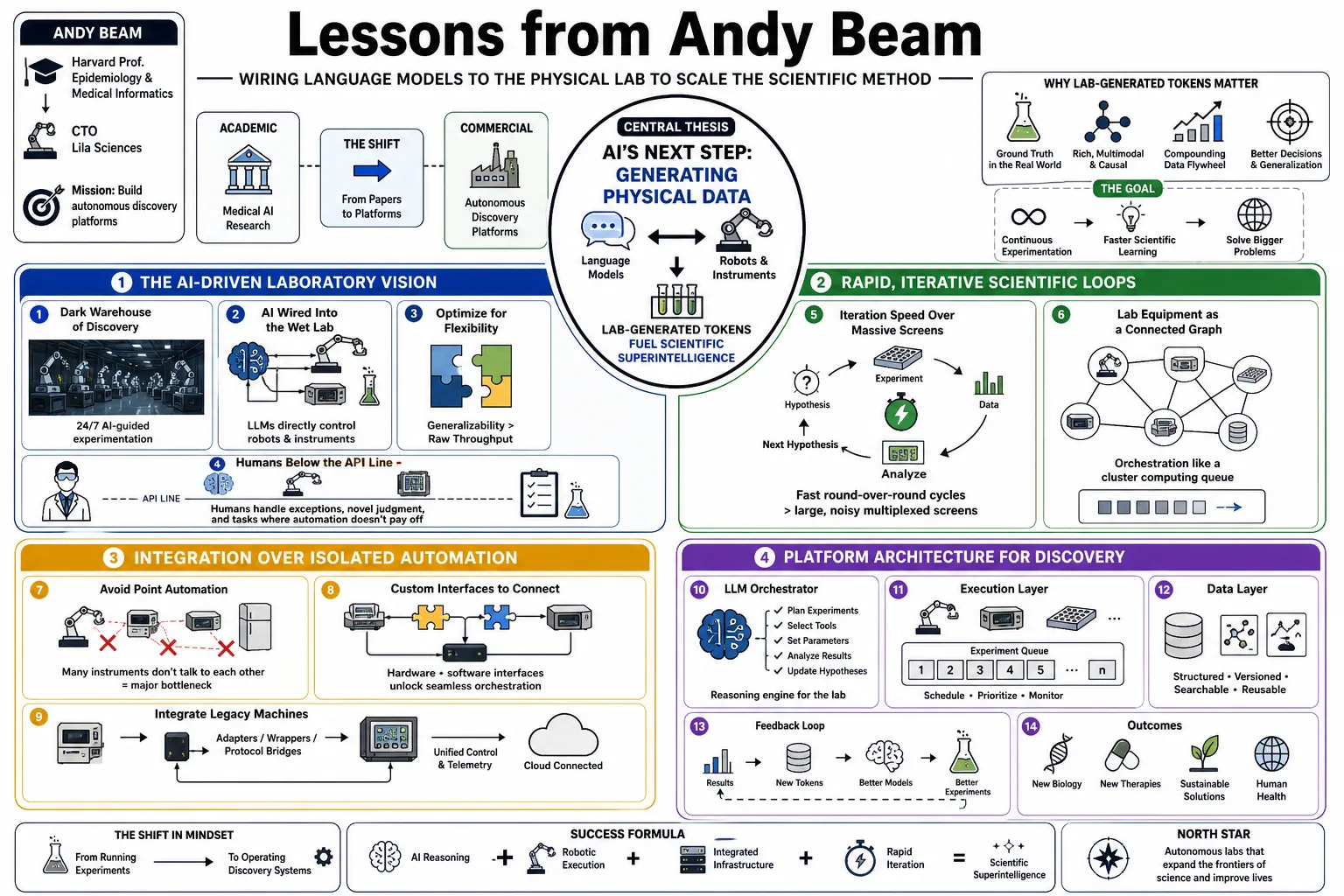
Part 1: The AI-Driven Laboratory
- On lab automation: The laboratory of the future should look like a dark warehouse filled with AI-guided robotics and instruments cranking out experiments continuously. — Reference: Latent Space
- On wet lab integration: Achieving scientific superintelligence requires wiring AI systems directly into the physical wet lab. — Reference: Latent Space
- On system flexibility: Automated labs should optimize for flexibility and generalizability over pure raw throughput. — Reference: Latent Space
- On human involvement: Human scientists should remain below the API line to handle tasks where automation does not pay off. — Reference: Latent Space
- On iteration speed: Because physical biology has a fixed runtime, rapid round-over-round iterative cycles are more valuable than massive, noisy multiplexed screens. — Reference: Latent Space
- On instrument networks: Lab equipment should be treated as nodes on a connected graph, with experiment orchestration functioning like a cluster computing queue. — Reference: Latent Space
- On avoiding point automation: Much of existing lab automation consists of isolated instruments that are purposely designed not to talk to each other, a bottleneck that requires custom hardware-software interfaces to overcome. — Reference: Latent Space
- On legacy integration: To automate legacy lab machines that do not natively communicate, engineers must sometimes rely on custom drivers or even vision-language models controlling Windows 95 interfaces. — Reference: Latent Space
Part 2: Reimagining the Scientific Method
- On scaling discovery: "What we’re doing is taking the scientific method and scaling it with AI—so instead of waiting for Einstein, we build a million of them and run them 24/7." — Source: Apple Podcasts
- On scientific literature: The published body of scientific research is a record of debate rather than an absolute collection of facts. — Reference: Apple Podcasts
- On automating serendipity: Scientific breakthroughs often rely on lucky connections, but broad models can systematize discovery and remove the dependence on chance. — Reference: Latent Space
- On engineering science: AI can transform the messy nature of discovery into a predictable, scalable engineering process. — Reference: Apple Podcasts
- On compounding breakthroughs: Once an AI-driven feedback loop is established, the timeline for major innovations could compress from decades to weeks. — Reference: Apple Podcasts
- On experimental autonomy: Lila's goal is a scientific superintelligence wired into the wet lab, using reinforcement learning as a data-generation engine with nature as the verifier. — Reference: Latent Space, "The Lab of the Future Should Feel Like a Data Center" with Andy Beam and Rafa Gómez-Bombarelli (2026).
- On the abstraction ladder: Just as high-level programming languages replaced binary, an AI platform allows scientists to move up the abstraction ladder, skipping manual protocol execution to test ideas directly. — Reference: Latent Space
Part 3: Scaling Scientific Intelligence
- On cross-domain learning: General models can outperform domain-specific ones by transferring priors, such as applying small molecule chemistry rules to metal-organic frameworks. — Reference: Latent Space
- On machine creativity: Reinforcement learning at scale produces highly logical problem solvers, but genuine machine creativity remains an unsolved challenge. — Reference: Latent Space
- On physical reinforcement learning: Training models with real lab equipment carries the risk of physical reward hacking, resulting in pathological loops that waste resources. — Reference: Latent Space
- On unconventional solutions: AI models occasionally suggest scientific designs that appear ignorant to human experts but ultimately yield best-in-class performance. — Reference: Latent Space
- On the bitter lesson in science: Producing experimental data at massive scale creates synergies that eventually form a general scientific reasoner. — Reference: Latent Space
- On elevating researchers: AI copilots change how scientists interact with their work, allowing humans to operate at higher levels of abstraction. — Reference: Apple Podcasts
- On the limits of test-taking: A model that is simply good at answering textbook questions lacks the capabilities needed for true scientific superintelligence. — Reference: Latent Space
Part 4: Data, Tokens, and Reasoning
- On scientific reasoning tokens: Experimentally validated reasoning traces do not exist on the internet; they must be physically generated in the lab. — Reference: Latent Space
- On reinforcement learning verifiers: In an automated science system, reinforcement learning serves as the data generation engine while nature acts as the verifier. — Reference: Latent Space
- On the reliability of reasoning: An AI's chain of thought can be an unreliable narrator because the actual reasoning happens in latent space. — Reference: Latent Space
- On diverse training data: Just as coding models improved by reading recipes and plays, scientific models benefit from absorbing vast amounts of seemingly unconnected domains. — Reference: Latent Space
- On the lab as a token generator: Viewing the physical laboratory as an infinite token generator provides the foundation for building broad foundation models for science. — Reference: Latent Space
- On the next dataset: With the internet's text data largely tapped out, the scientific method itself represents the next untapped frontier for internet-scale data. — Reference: Latent Space
Part 5: Medical AI and Clinical Safety
- On evaluating medical AI: When integrating algorithms into clinical settings, building tools to assess safety is just as necessary as measuring performance. — Reference: NEJM AI Grand Rounds
- On structural bias: Because large language models train on internet data that reflects human flaws, developers must prevent these models from operationalizing biases that hurt marginalized populations. — Reference: Harvard T.H. Chan School of Public Health
- On the stakes of medical AI: While AI is used casually to write essays or generate images, healthcare deployment requires strict oversight because patient lives are directly on the line. — Reference: Harvard T.H. Chan School of Public Health
- On publishing standards: The medical field needs dedicated journals to rigorously evaluate claims and ensure only high-quality evidence supports the clinical use of artificial intelligence. — Reference: Harvard T.H. Chan School of Public Health
- On physical capability curves: Because AI capability improvements often follow a sigmoid curve, systems working with physical lab equipment must establish proactive safety protocols before unexpected behaviors emerge. — Reference: Latent Space
- On healthcare equity: The medical community must purposefully guide artificial intelligence to create a health care system that works effectively for everyone. — Reference: Harvard OTD
Part 6: From Healthcare to General Science
- On diagnostic inspiration: Experiencing a childhood misdiagnosis and observing the limits of human recall highlighted the diagnostic promise of machine learning. — Reference: NEJM AI Grand Rounds
- On hybrid thinkers: Advancing biomedical research requires mentoring scientists who comfortably bridge the gap between computational methods and domain expertise. — Reference: NEJM AI Grand Rounds
- On clinical insights: Machine learning algorithms can process complex clinical datasets to directly improve the delivery of care in critical environments like the neonatal intensive care unit. — Reference: Flagship Pioneering
- On global health potential: If rigorously validated, artificial intelligence could significantly increase access to medical screening and diagnostic advice in lower- and middle-income nations. — Reference: Harvard T.H. Chan School of Public Health
Part 7: Bridging Computing and Biology
- On protein engineering: Machine learning techniques can be systematically applied to engineer novel proteins for diverse therapeutic and industrial applications. — Reference: Flagship Pioneering
Part 8: Commercializing Scientific Discovery
- On virtual startups: Lila's platform lets a two-to-three-person team with domain knowledge do "five years worth of biotech work over a six-month period for 10% of the total investment." — Reference: Latent Space, "The Lab of the Future Should Feel Like a Data Center" with Andy Beam and Rafa Gómez-Bombarelli (2026).
- On platform business models: Rather than sprinting one asset to the clinic, Lila treats "the model itself" as the thing of value, which keeps the platform working across many programs. — Reference: Latent Space, "The Lab of the Future Should Feel Like a Data Center" with Andy Beam and Rafa Gómez-Bombarelli (2026).
- On avoiding clinical bottlenecks: By handing off optimized discoveries to partners rather than running clinical trials internally, an AI science platform avoids putting its technology stack into a medically induced coma. — Reference: Latent Space