Andy Sparks is a veteran entrepreneur, co-founder of Mattermark and Holloway, and an executive coach dedicated to the development of startup CEOs. Through his "Hoo Boy" newsletter and "Management Craft" curriculum, he distills years of operational experience into actionable frameworks for leadership, sales, and self-management. This profile explores his philosophy on building companies that are both high-performing and deeply conscious of the human element. — Andy Sparks, "Executive Coaching".
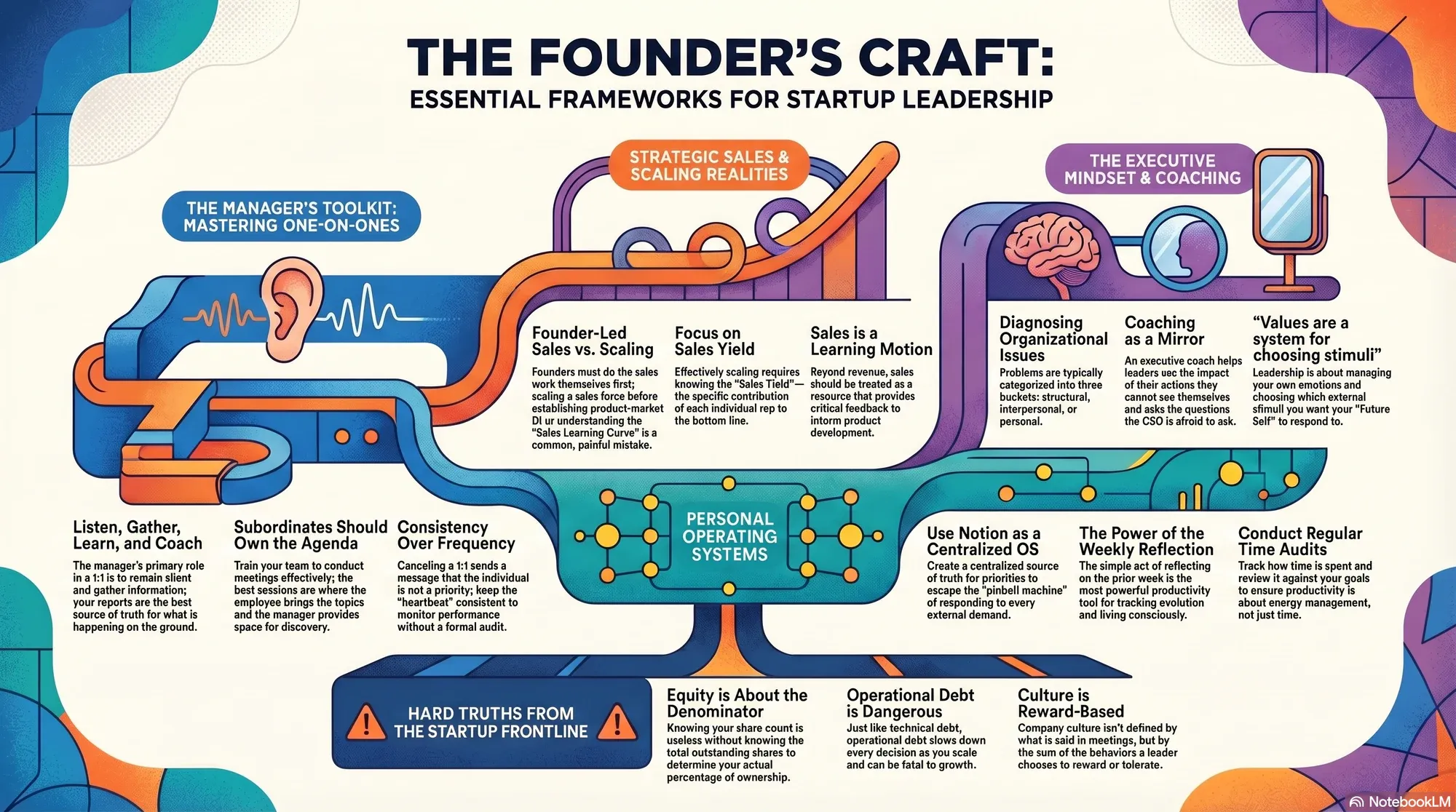
Part 1: The Manager’s Craft & The Art of One-on-Ones
- On Why One-on-Ones Matter: "1:1 meetings, when done well, are to a great working relationship as diet and exercise are to long-term health." — Reference: Andy Sparks, "Running Great One-on-Ones" (2023).
- On Preparation: Keep a shared "running agenda document" between meetings so important topics aren't forgotten and managers aren't interrupted with non-urgent matters. — Reference: Andy Sparks, "Running Great One-on-Ones" (2023).
- On Training the Team: Don't just hold one-on-ones; teach your team to run them. He built a slide deck so founders can train their teams on the practice. — Reference: Andy Sparks, "Running Great One-on-Ones" (2023).
- On Leverage: One-on-ones are high leverage: "60-90 minutes of time can enhance performance for weeks." They also reduce interruptions over Slack and other channels. — Reference: Andy Sparks, "Running Great One-on-Ones" (2023).
- On Encouraging Proactivity: "Subordinates should own the meeting agenda." A manager with eight reports spends about 12 hours a week on one-on-ones, while each report spends only 1.5, so reports are the logical agenda owners. — Reference: Andy Sparks, "Running Great One-on-Ones" (2023).
- On Frequency and Length: Start weekly, with at least 60 minutes: substantive discussion typically begins after 30 minutes, and "longer, less frequent one-on-ones beat frequent, brief ones." — Reference: Andy Sparks, "Running Great One-on-Ones" (2023).
- On defining management: His bite-sized definition: "Management is how we organize people and things to solve problems for other people." — Reference: Andy Sparks, "The False Cultural Promises of a CEO"
- On building a bench: Exceptional managers build relationships with talented people well before a job opens, so a sudden departure doesn't force hiring from scratch under pressure. — Reference: Andy Sparks, "If Someone Quits, Who Will Replace Them?"
- On complaints as gifts: Following his coach's advice, treat complaints as gifts: "when someone on the team complains, what's really happening is that they're standing up for something." — Reference: Andy Sparks, "Complaints Are Gifts"
Part 2: Sales Excellence & The Learning Curve
- On Hiring the Right Phase: Founders frequently hire execution-phase "coin-operated" reps for initiation-phase roles, often experienced sellers from large companies. That fails unless the candidate has launched new products at early-stage companies. — Reference: Andy Sparks, "Why Every Startup Hires the Wrong Sales Leader First" (2023).
- On the Sales Learning Curve: Study Mark Leslie and Charles Holloway's Sales Learning Curve before scaling sales: initiation needs a few "Renaissance" reps, transition needs "Enlightened" reps, and execution needs "Coin-Operated" reps. — Reference: Andy Sparks, "Why Every Startup Hires the Wrong Sales Leader First" (2023).
- On Sales Yield: Measure sales yield, revenue per rep divided by fully loaded cost. A yield of 1 is break-even and 2 or more signals traction. — Reference: Andy Sparks, "Why Every Startup Hires the Wrong Sales Leader First" (2023).
- On Pricing Power: He opens his startup-graveyard essay with Warren Buffett: "The single most important decision in evaluating a business is pricing power." — Reference: Andy Sparks, "Avoiding the Startup Graveyard" (2023).
- On Mattermark's Sales Trap: Mattermark sold subscriptions at $500 a month or $4,799 a year, with fully loaded sales costs of $200–300K per rep. Hired reps rarely closed more than five deals a month, so sales yield fell as deals grew more complex. — Reference: Andy Sparks, "Avoiding the Startup Graveyard" (2023).
Part 3: Executive Coaching & Leadership Psychology
- On the Coaching Transition: He does his best work at the inflection point: "Yesterday you were building the product. Today you're building the organization that builds the product." — Reference: Andy Sparks, "Executive Coaching".
- On Identifying Root Causes: After 1,400+ coaching hours, his method for getting unstuck is to separate symptoms from root causes: identify the symptoms, relieve them, diagnose the root cause, treat it, and then prevent a recurrence. — Reference: Andy Sparks, "Get Beyond Treating Symptoms: Identify Root Causes" (2024).
- On facts versus meaning: Separate observable facts from the meanings we assign them: "People are especially prone to making up stories when there are missing facts." — Reference: Andy Sparks, "The Stories in Our Heads (Fact vs. Meaning)"
- On the three tenets of trust: From his coach Khalid Halim: "Trust is made up of three things: sincerity, reliability, and competence. And trust crumbles at anything less than having all three." — Reference: Andy Sparks, "The Three Tenets of Trust"
- On what good coaches do: The best coaches—paid, a parent or a friend—show you a blind spot without making you feel ashamed of it. — Reference: Andy Sparks, "Coaches Should Accelerate Your Growth"
- On the founding COO: "The job of a founding COO is to do the most important things the company hasn't hired for yet, hire or delegate to someone in your place, and move on." — Reference: Andy Sparks, "What Does a Startup COO Actually Do?"
Part 6: Personal Productivity & Operating Systems
- On Self-Management: Drawing on Peter Drucker, "Executives who do not manage themselves for effectiveness cannot possibly expect to manage their associates and subordinates." — Reference: Andy Sparks, "Conducting a Time Audit" (2023).
- On Time Audits: Run a time audit: track your activities for 3–4 weeks, check them against your priorities, then for each ask whether to stop, delegate, reassign or modify it. — Reference: Andy Sparks, "Conducting a Time Audit" (2023).
- On Choosing Stimuli: Writing things down "is a system of choosing the stimuli you would like Future You to respond to." — Reference: Every, "Andy Sparks, CEO of Holloway, on Living a More Conscious Life" (2019).
- On Escaping the Pinball Machine: Most of the time we bounce around "like a pinball in the pinball machine of life." Note-taking systems let you design your own pinball machine to bounce around in. — Reference: Every, "Andy Sparks, CEO of Holloway, on Living a More Conscious Life" (2019).
- On Notion as an OS: Notion "is basically my operating system for work." It starts with a page defining his role and a weekly priorities note. — Reference: Every, "Andy Sparks, CEO of Holloway, on Living a More Conscious Life" (2019).
- On Managing Yourself First: Following Visa founder Dee Hock, great managers spend about half their time managing themselves and only about 5% managing subordinates. — Reference: Andy Sparks, "Great Managers Manage Themselves First" (2022).
Part 7: Lessons from the Startup Frontline (Mattermark)
- On Running Operations: He opens his sales-leader essay with William Thorndike's point that leaders must master two domains: running operations efficiently and deploying the capital those operations generate. — Reference: Andy Sparks, "Why Every Startup Hires the Wrong Sales Leader First" (2023).
- On Scaling Too Soon: Founders slide into the startup graveyard, low prices plus high-touch sales, when they "conflate discovery with sales" and scale a sales team before revenue covers its cost. — Reference: Andy Sparks, "Avoiding the Startup Graveyard" (2023).
- On Co-Founder Relationships: Many founders work hard to be better life partners but are unprepared for their business partnerships. His starting question: "What's your own responsibility for what's been happening?" — Reference: Andy Sparks, "Why We're Unprepared for Co-Founder Relationships" (2023).
Part 8: Living Consciously & Future-Self Alignment
- On Note-Taking and the Future Self: Note-taking creates a relationship between your present and future self. Even a tattoo can be a note "that Past Me had sent to Future Me." — Reference: Every, "Andy Sparks, CEO of Holloway, on Living a More Conscious Life" (2019).
- On Calendar and Priorities: He borrows Keith Rabois's rule that "your calendar should reflect your priorities." Each week he checks whether every priority has time blocked for it. — Reference: Every, "Andy Sparks, CEO of Holloway, on Living a More Conscious Life" (2019).
- On Avoiding Workplace Drama: Workplace drama follows Karpman's Drama Triangle of Victim, Rescuer and Prosecutor, and founders often play the Rescuer. The way out is coaching instead of rescuing and challenging instead of prosecuting. — Reference: Andy Sparks, "A Model for Cutting Down on Gossip and Drama at Work" (2022).