Claire Hughes Johnson is a corporate officer and advisor at Stripe, where she previously served as Chief Operating Officer from 2014 to 2021, helping scale the company from fewer than 200 to over 7,000 employees. Prior to Stripe, she spent a decade at Google leading business teams for initiatives such as AdWords and the self-driving car project. She is the author of the Wall Street Journal bestseller Scaling People: Tactics for Management and Company Building and currently serves on the boards of HubSpot, The Atlantic, Ameresco, Aurora Innovation, and Brown University.
Leadership & Management
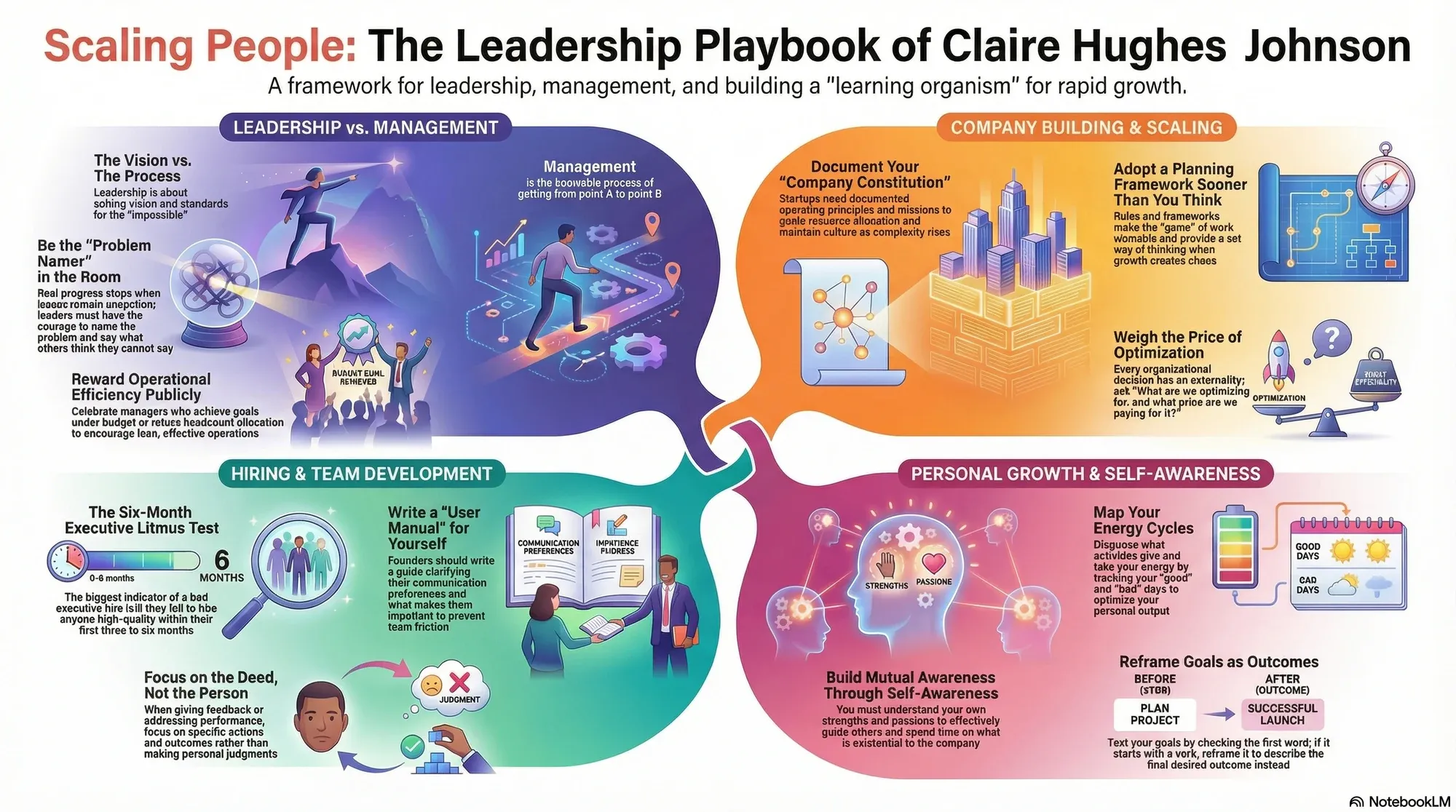
- On Leadership and Management: Distinguish between leadership and management. Leadership is about setting a vision and the standards, while management is the knowable process of getting from point A to point B. [3]
- On Standards and Devotion: Great management and leadership are about high standards and deep devotion. You are likely better at one than the other, and the goal is to balance both. [4]
- On Stretching What Seems Possible: Leaders set a vision and demand things they don't know are possible. They turn up the heat and push for more, better, and faster. [5]
- On Knowable Management: Management is knowable. It involves organizing people, processes, metrics, and goals to achieve an objective. [3]
- On Leading Beyond the Visible: Your job as a leader is to get people to go somewhere they don't see. You have to convince them that the mission is worth tackling, even if the vision is never fully achieved. [5]
- On Vulnerability and Real Power: Real power comes from vulnerability and knowing you can't do everything. [6]
- On Naming the Problem: Be the person in the room willing to name the problem. If you can't get the unspoken issue on the table, you'll get stuck. [3]
- On Saying the Unsayable: Say the thing you think you cannot say. This operating principle encourages open communication and prevents an attack-response. [7][8]
- On Outgrowing Old Methods: Don't get too comfortable. If you are succeeding in scaling, the methods you used for one phase won't work for the next. [9]
- On Existential Threats: A leader's job is to address existential threats that others are not talking about. It's like making kids eat their vegetables; you have to lead them through it. [5]
- On Modeling the Behavior: Management is not about telling people what to do. Like parenting, your team looks at what you do, not what you say. [3]
- On Contextualizing the COO Role: Define the COO role from the company's actual context—business model, trajectory, founder strengths, existing executives, and the outcome the role must produce—rather than from a generic title. — The General Podcast: Claire Hughes Johnson and Gretchen Howard on the COO job
- On Phasing COO Scope: Phase an incoming COO's scope into the organization and formalize the title after ownership has become evident, allowing trust and legitimacy to form gradually. — The General Podcast: Claire Hughes Johnson and Gretchen Howard on the COO job
Company Building & Scaling
- On Operating Principles: Create—and document—your startup's operating principles. This is a critical part of company building, which is a different skill set from finding product-market fit. [5]
- On Constitutional Documents: Your startup deserves constitutional documents to guide your actions as you grow. These documents outline what you're harnessing all your resources to accomplish. [12]
- On Early Planning: Adopt a planning framework early. You need operating processes sooner than you realize. The rules of a game are what make it fun and winnable. [9]
- On the Operating System: Come back to your operating system. As complexity rises, having a set way of thinking about how to get work done is crucial. [8]
- On Mandatory Processes: You can't make too many things at a company mandatory. Be judicious about what you require, which should likely include performance and feedback processes, a planning process, and a few tactical things like launch reviews. [9]
- On Becoming a Learning Organization: Getting your organization used to the fact that it's an iterative process and that you're a learning organism is much better than resisting change. Having to change things means you're succeeding and need something new. [9]
- On Organizational Externalities: Every organizational decision has an externality. When making changes, ask, "What are we going to optimize for and what price are we going to pay for optimizing that thing?" [6]
- On Intentional Work Models: Be intentional about what you choose for your work model (e.g., distributed, in-person). Build systems and processes around that choice because people don't organically collaborate well across time zones. [5]
- On Executive Timing: Don't assume you need to add experienced executives right away. Startups with under 150 employees can be in an "uncanny valley" where it's difficult to attract experienced operators. [5]
- On Pull Becoming Push: For a long time, your actions pull your company along. Then, your existing business starts pushing your behavior. [12]
- On Organizational Structure: There is no such thing as an optimal org structure. You have to be careful that people don't make false assumptions about who is responsible for a given decision. [9]
- On Preserving Optionality: Preserving optionality is one of the best decisions for a young company. The world five years from now is unpredictable, and products must evolve with it. [6]
- On Repeatable Excellence: Define scale by whether different people can repeatedly deliver an excellent product and customer experience, not by how many employees the company adds. — Trailblazers: Claire Hughes Johnson
- On Useful Process versus Defensive Bureaucracy: Distinguish proactive operating processes from defensive bureaucracy: make useful work patterns explicit and better, but watch controls added merely because something once went wrong. — Trailblazers: Claire Hughes Johnson
Hiring & Team Development
- On the Executive Hiring Signal: The biggest indicator of a problem with a new executive hire is if they don't hire anyone good in their first three to six months. [13]
- On Hiring Carefully and Acting Quickly: One of the most common mistakes early-stage founders make is not hiring well and then not firing fast enough when the hire isn't performing. [14]
- On Founder User Manuals: Founders should write a guide to working with them. This clarifies their involvement, communication preferences, and what makes them impatient, preventing others from learning it the hard way. [9]
- On Manager Guides: Manager guides work particularly well across regions and cultures as a way of building rapport quickly during high growth. [15]
- On Interviewing Executives: When interviewing executives, ask them about their current team and why they chose that structure. You learn a lot from how they describe the choices they made with the team they inherited. [13]
- On Hiring-Manager Ownership: You can't have people abdicating responsibility for hiring. While recruiters are critical, the hiring manager must own the process. [3]
- On Peer Feedback: Effectively giving peer feedback is essential because employees often work in teams. [6]
- On the Deed, Not the Person: When addressing someone's actions, focus on the deed, not personal judgments. It's about what they did, not who they are. [16]
- On Direct Performance Conversations: If a direct report is not working out, have a very direct conversation. Start with, "I am worried this is not working out for you," and discuss a different path. [3]
- On Team Microcultures: Leave room for teams to organically develop their micro-cultures while still linking back to company values and objectives. [16]
- On People as a Velocity Lever: Treat the people function as a strategic velocity lever: hiring, roles, compensation, and talent systems materially determine how fast a young company can build. — The General Podcast: Claire Hughes Johnson and Gretchen Howard on the COO job
- On Redirecting Management Bandwidth: Do not spend scarce management bandwidth endlessly rehabilitating problems; resolve them and redirect that attention toward challenging, developing, and retaining top talent. — Peak XV: Stripe's former COO on her biggest scaling lessons
- On Testing Ownership Through Failure: Failure stories reveal whether candidates default to blame or ownership; keep probing for self-reflection and learning rather than accepting an external explanation. — Peak XV: Stripe's former COO on her biggest scaling lessons
Personal Growth & Self-Awareness
- On Self-Awareness and Mutual Awareness: Build self-awareness to build mutual awareness. This is a foundational operating principle. [8]
- On CEO Self-Awareness: I'm a big self-awareness advocate. As a founder or CEO, you must spend time on what only you can do and what is existential to the company. [9]
- On Disagreeing with Feedback: If you get feedback you disagree with, it may be a sign you lack self-awareness. All feedback is valid, even if it's not correct. [8]
- On Auditing Your Energy: Diagnose what gives and takes your energy. Map out your good and bad days to understand what activities add to or detract from your energy. [7]
- On Strengths, Passion and Value: Do the work to understand your strengths, what you're passionate about, and where you could add value. Resist following the masses. [14]
- On Guiding People to Answers: People do not learn by being told answers. A good leader guides them to find the answer themselves and celebrates their success. [17]
- On Victimhood and Self-Awareness Gaps: There are two gaps that are really hard to overcome: people who can't stop being victims, and those with a 'self-awareness gap' who think they are the best in the world. [17]
- On Making Work Explicit: How do you get results? You make anything implicit explicit and be clear about the process and the desired outcome. [17]
- On Knowing Your Limits: I am just honest about, 'I can't do this well, and I think you want someone at their best. It's not going to be my best.' [17]
- On Building Confidence in Instinct: My job is not to tell them what to do or how to do it; it is to build their confidence in their instinct. [17]
- On Changing Paths: Don't get stuck if you realize something isn't your path. Try things out and move on. [14]
- On Seeking Expertise: The best founders are constantly calling for expertise and advice and learning themselves. [14]
- On Scaling People: We always talk about scaling companies, but companies are just collections of people. If you're not thoughtful about them and what they need to succeed, it's going to be hard to succeed as a company. [2]
- On Perspective During Hard Periods: Professional success can feel messy and uncertain while it is happening, so avoid treating a difficult present moment as proof that the work is failing. — Worklife with Molly Graham: Why success is never linear with Claire Hughes Johnson
Learn more:
- Who is the COO of Stripe? Claire Hughes Johnson's Bio - Clay
- Author Talks: Scale your people, not just your company - McKinsey
- Claire Hughes Johnson — Building Great Teams, Managers, and Self-Awareness | Prof G Conversations - YouTube
- Tactics for Management & Company Building | Claire Hughes Johnson | Talks at Google
- Scaling Startups with Stripe's Claire Hughes Johnson - Notable Capital
- Claire Hughes Johnson: How Stripe's COO Approaches Company Building | Interview
- Scaling People (with Claire Hughes Johnson) - Newcomer
- Book Review: Scaling People - Matt's Blog
- An interview with Claire Hughes Johnson - High Growth Handbook - Elad Gil
- Quotes by Claire Hughes Johnson (Author of Scaling People) - Goodreads
- Scaling People Quotes by Claire Hughes Johnson - Goodreads
- To Grow Faster, Hit Pause — and Ask These Questions from Stripe's COO
- Claire Hughes Johnson on being a “learning organism” during Stripe's growth, and more scaling advice for leaders - First Round Review
- Claire Hughes Johnson: Former COO of Stripe - Moth Fund
- How Stripe Scaled - Notes from Office Hours with Claire Hughes Johnson by @ttunguz
- Scaling People Summary of Key Ideas and Review | Claire Hughes Johnson - Blinkist
- Claire Hughes Johnson — How to Take Responsibility for Your Life, Create Rules That Work, Stop Being a Victim, Set Strong Boundaries, and More (#724) - The Blog of Author Tim Ferriss
- Quote by Claire Hughes Johnson: “Heuristics for testing your goals Assess your g...” - Goodreads
- Trailblazers: Claire Hughes Johnson
- The General Podcast: Claire Hughes Johnson and Gretchen Howard on the COO job
- Peak XV: Stripe's former COO on her biggest scaling lessons
- WorkLife: Why Success Is Never Linear with Claire Hughes Johnson