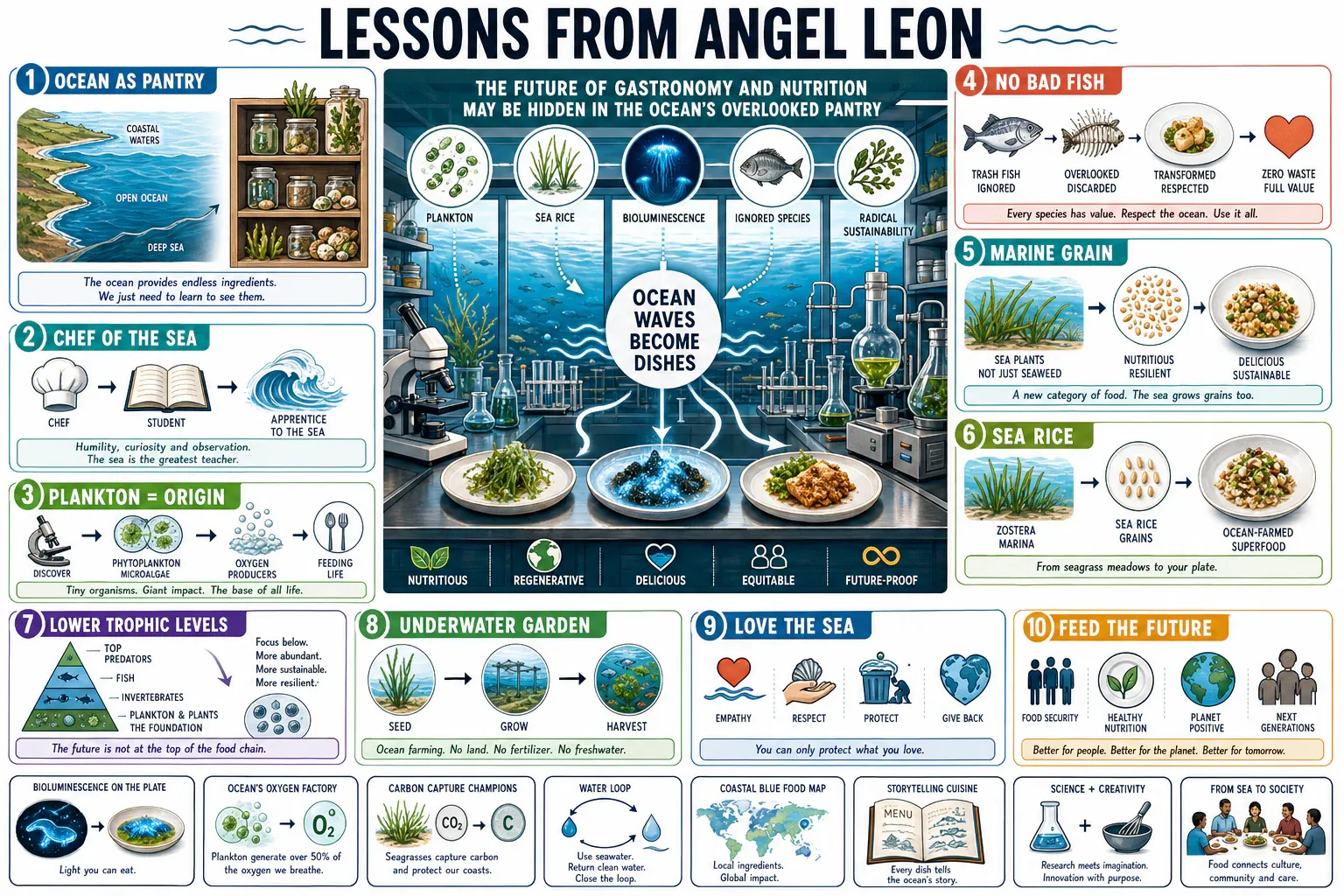
Ángel León, widely known as the "Chef of the Sea," has transformed modern gastronomy by turning his three-Michelin-starred restaurant Aponiente into an unprecedented marine laboratory. Through his pioneering work with edible bioluminescence, marine grain, and phytoplankton, he challenges the culinary world to embrace radical sustainability and look to the ocean's unexplored pantry. His visionary philosophy redefines luxury, proving that the future of human nutrition and ecological harmony lies hidden in the depths of our seas. — TIME, Matt Goulding, "Seeding the Ocean: Inside a Michelin-Starred Chef's Revolutionary Quest to Harvest Rice From the Sea" (2021).
## Part 1: The Ocean as a Pantry
- On The Sea's Magnitude: On the marine grain: "In a world that is three-quarters water, it could fundamentally transform how we see oceans." — Reference: The Guardian, Ashifa Kassam, "The rice of the sea: how a tiny grain could change the way humanity eats" (2021).
- On Hedonism: "What's more hedonistic, eating something no one on the face of the earth has ever tried, or eating another f-cking spoon of caviar?" — Reference: TIME, Matt Goulding, "Seeding the Ocean: Inside a Michelin-Starred Chef's Revolutionary Quest to Harvest Rice From the Sea" (2021).
- On Hidden Treasures: He built Aponiente's menu around discarded "trash fish," turning sea bass into mortadella and mussels into blood sausage. — Reference: TIME, Matt Goulding, "Seeding the Ocean: Inside a Michelin-Starred Chef's Revolutionary Quest to Harvest Rice From the Sea" (2021).
- On familiar shapes: To get people to eat marine proteins, give them a familiar form: "No one wanted to eat a fish sausage until we called it a sausage. We disguise it – and it works." — Reference: TOPIA Magazine, "The sustainable sea chef" (2023)
- On eating beyond habit: Aponiente uses about 5,000 kilos a week of unsold "trash" fish, because one day we will not be able to choose food as we do now: "we have to move beyond the species we have whimsically eaten out of cultural inheritance." — Reference: RTVE, "Ángel León, el chef del mar que navega a contracorriente" (2024, Spanish; translated)
- On looking locally with hunger: "We must look at our local environment with hunger and take advantage of the resources that we have closest to hand… We must be less erratic. We must be less selective." — Reference: Lux Magazine, "Chef Ángel León: Ocean Sustainability Supremo" (2022)
- On early resistance: At first, "when we started serving plankton to customers, people told us we were stealing food from the whales… People expected something else." — Reference: Foods & Wines from Spain, "Spanish Seafood Reimagined by Three-Michelin-Starred Chef Ángel León" (2024)
## Part 2: Rethinking Sustainability
- On Future Gastronomy: On marine grain: "I believe it's a new way to feed ourselves." — Reference: The Guardian, Ashifa Kassam, "The rice of the sea: how a tiny grain could change the way humanity eats" (2021).
- On Learning Ecological Balance Through Observation: Restoring Aponiente's 20 hectares of marsh taught him the limits of control: rain drops salinity and kills fish, and 5,000 gulls once ate everything. "Balance is learned by observation and through hard knocks." — Reference: Forbes España / Nautik, "Ángel León: Tendré miedo cuando el mar no me sea suficiente" (2026).
- On Letting the Environment Tell the Story: He no longer needs to tell "a chef's war story": diners sit in the middle of the restored marsh, among sailors, biologists, fishermen and cooks, and experience it directly. — Reference: Forbes España / Nautik, "Ángel León: Tendré miedo cuando el mar no me sea suficiente" (2026).
## Part 3: The Marine Grain Revolution
- On Eelgrass: As a child in Cádiz he saw what looked like vast rice fields along the bay. Years later his team realized they were Zostera marina, eelgrass with edible grains. — Reference: TIME, Matt Goulding, "Seeding the Ocean: Inside a Michelin-Starred Chef's Revolutionary Quest to Harvest Rice From the Sea" (2021).
- On Environmental Impact: According to Aponiente's research, the grain grows "without freshwater or fertiliser." — Reference: The Guardian, Ashifa Kassam, "The rice of the sea: how a tiny grain could change the way humanity eats" (2021).
- On Nutritional Value: According to Aponiente's research, the grain is gluten-free, high in omega-6 and omega-9 fatty acids, and has "50% more protein than rice per grain." — Reference: The Guardian, Ashifa Kassam, "The rice of the sea: how a tiny grain could change the way humanity eats" (2021).
- On Climate Change: Eelgrass meadows store carbon far faster than a rainforest, the Guardian reported, making cultivation both a food source and a climate tool. — Reference: The Guardian, Ashifa Kassam, "The rice of the sea: how a tiny grain could change the way humanity eats" (2021).
- On Indigenous Knowledge: He found a 1973 Science article on the Seri of Sonora, Mexico, who had eaten eelgrass for generations. The plant had been gathered before, but never cultivated. — Reference: TIME, Matt Goulding, "Seeding the Ocean: Inside a Michelin-Starred Chef's Revolutionary Quest to Harvest Rice From the Sea" (2021).
- On Culinary Versatility: He has ground the grain into flour for bread and pasta and cooked it to mimic Spain's classic rice dishes. — Reference: The Guardian, Ashifa Kassam, "The rice of the sea: how a tiny grain could change the way humanity eats" (2021).
- On Ocean Farming: "This could be the beginning of a new concept of understanding the sea as a garden." — Reference: The Guardian, Ashifa Kassam, "The rice of the sea: how a tiny grain could change the way humanity eats" (2021).
- On Piloting Marine Crops Before Scaling: Before scaling marine grain he planned to sow a single hectare "to quantify how much is harvested in a year and see whether it is a viable product" for extensive cultivation. — Reference: Forbes España / Nautik, "Ángel León: Tendré miedo cuando el mar no me sea suficiente" (2026).
- On the long-term dream: "Our dream is that one day people will be able to feed themselves exclusively with marine products that are not necessarily fish." — Reference: Foods & Wines from Spain, "Spanish Seafood Reimagined by Three-Michelin-Starred Chef Ángel León" (2024)
- On cooking life, not death: "Cooks are like forensic scientists. Everything we work with is dead. But I was always more interested in life"—which is what led him to plankton. — Reference: RTVE, "Ángel León, el chef del mar que navega a contracorriente" (2024, Spanish; translated)
- On giving nature, not describing it: Moving Aponiente into the Cádiz salt marsh: "I want to stop talking about nature and give nature"—raise, care for and cook in the place itself. — Reference: Con Mucha Gula, interview with Ángel León (2025, Spanish; translated)
- On the source of the work: "I love the sea more than I love cooking and this story begins because of the sea; it continues to inspire me today." — Reference: TOPIA Magazine, "The sustainable sea chef" (2023)
## Part 4: Edible Bioluminescence and Innovation
- On The Science of Glow: His "Luz del Mar" dish mixes two proteins to produce fluorescence at the table. — Reference: TIME, Matt Goulding, "Seeding the Ocean: Inside a Michelin-Starred Chef's Revolutionary Quest to Harvest Rice From the Sea" (2021).
## Part 5: Leadership, Struggle, and Vision
- On Early Struggles: "The first years were awful because nobody understood why I was serving customers produce that nobody wanted." For years Aponiente served only a handful of guests a day. — Reference: The Guardian, Ashifa Kassam, "The rice of the sea: how a tiny grain could change the way humanity eats" (2021).
- On Finding Peace: Hyperactive since birth and unable to read for more than a minute, he says "the sea saved me." As a boy he cut open the fish he caught with his father to see what they ate. — Reference: Forbes España / Nautik, "Ángel León: Tendré miedo cuando el mar no me sea suficiente" (2026).
- On Turning Knowledge Into Stability: At Amura in South Africa he found that where people are in need, they listen harder, because culinary knowledge can become "a profession and stability." — Reference: Forbes España / Nautik, "Ángel León: Tendré miedo cuando el mar no me sea suficiente" (2026).
- On Solitude as a Mental Reset: He sails alone at dawn in the Bay of Cádiz, with no phone signal. He calls it "the only moment of my life without adverse thoughts." — Reference: Forbes España / Nautik, "Ángel León: Tendré miedo cuando el mar no me sea suficiente" (2026).