Anthony Levandowski is an engineer and entrepreneur whose work at Google, Otto, and Uber helped shape the early autonomous-vehicle industry. In its February 2025 announcement, Pronto identified him as its chief executive and described its autonomous haulage systems for quarry operations. His career combines ambitious engineering with questions about safety, commercialization, and governance. — Pronto — Heidelberg Materials Agreement. — WIRED — Levandowski Interview.
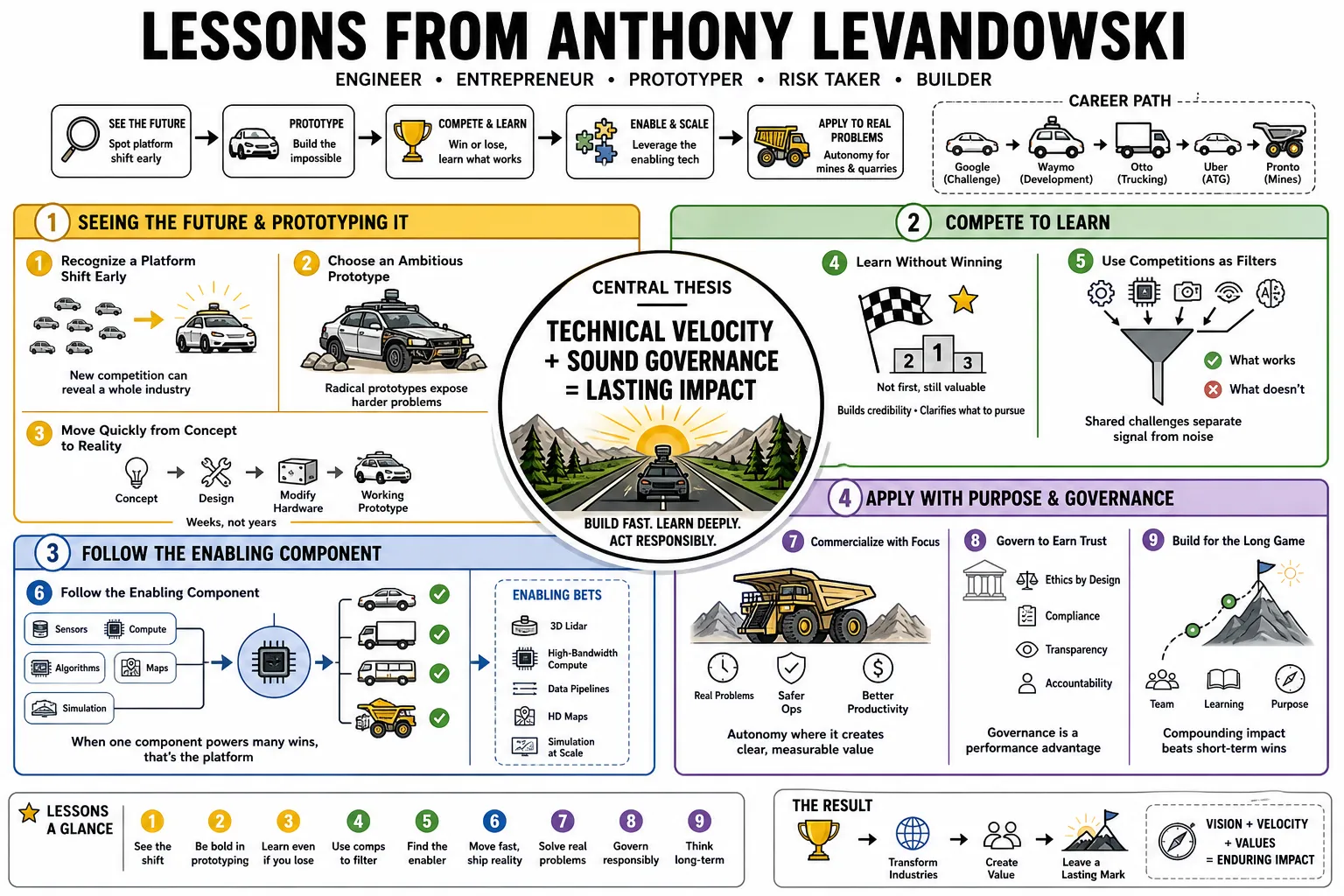
Seeing the Future and Prototyping It
- On Recognize a Platform Shift Early: Levandowski recalled recognizing the DARPA Grand Challenge as a sign of an important technological shift before he knew where autonomous vehicles would be used commercially. — WIRED — Levandowski Interview.
- On Choose an Ambitious Prototype: Levandowski chose a self-driving motorcycle for the DARPA challenge, taking on the additional problem of balancing a two-wheeled vehicle rather than starting with a conventional car. — UC Berkeley — Distinguished Innovator Lecture.
- On Learn Without Winning: Ghostrider did not win the DARPA Grand Challenge, but its design attracted Sebastian Thrun's attention and helped connect Levandowski with subsequent mapping and autonomous-vehicle work. — WIRED — Levandowski Interview.
- On Use Competitions as Filters: Levandowski described the DARPA Grand Challenge as a meeting point where researchers could discover one another's work and identify ideas that did not function. — WIRED — Levandowski Interview.
- On Follow the Enabling Component: Seeing lidar work in the DARPA competitions helped persuade Levandowski of its value. At Velodyne, he combined work on the sensor's networking with selling it to other competing teams. — WIRED — Levandowski Interview.
- On Move Quickly from Concept to Reality: For the Pribot demonstration, Levandowski's team selected a Toyota Prius with a modifiable drive-by-wire system and produced a working prototype within weeks. — WIRED — Levandowski Interview.
- On Expect Bumps During Discovery: Levandowski described repeated failures while developing Ghostrider and stressed understanding the underlying engineering problems. In the same lecture, he emphasized closed-loop oversight and trained drivers when testing vehicles in public. — UC Berkeley — Distinguished Innovator Lecture.
Execution, Teams, and Momentum
- On Replace Bespoke Cost with Commodity Hardware: The early Street View team replaced expensive custom cameras with off-the-shelf panoramic webcams. The lower-cost choice also exposed a reliability tradeoff when the cameras later failed in bad weather. — WIRED — Levandowski Interview.
- On Turn Targets into Procurement: Sebastian Thrun recalled Levandowski going to a dealership to buy a fleet of cars for Street View, turning the mapping project into a concrete vehicle-procurement effort. — WIRED — Levandowski Interview.
- On Use Deadlines to Create Momentum: The Street View team reached Larry Page's road-imagery target ahead of its deadline, but subsequent weather-related camera failures showed that meeting a production target was not the same as proving reliability. — WIRED — Levandowski Interview.
- On Build Strategic Infrastructure: Levandowski explained that Street View imagery became useful for constructing Google's own road maps, reducing its dependence on externally licensed mapping data. — UC Berkeley — Distinguished Innovator Lecture.
- On Make Technical Energy Contagious: Former colleague Ben Discoe described Levandowski's enthusiasm for engineering as contagious, particularly his excitement about how quickly a future built around robots might become practical. — WIRED — Levandowski Interview.
- On Convert Discussion into a Test: When Ben Discoe discussed using lidar to survey his family's farm, Levandowski encouraged him to take a sensor rig there and try it. Discoe reported that the experiment produced a useful three-dimensional map. — WIRED — Levandowski Interview.
- On Work Across Technical and Commercial Boundaries: At Velodyne, Levandowski worked on lidar networking while also serving as an early sales representative to teams preparing for the DARPA competition. — WIRED — Levandowski Interview.
Commercializing Autonomous Systems
- On Start Where the Environment Is Controllable: In his 2021 essay, Levandowski argued that off-road haulage offered a constrained environment in which Pronto could deploy autonomy sooner than on public roads. — Levandowski — Simplifying Autonomy with Pronto.
- On Simplify the Sensor Stack When the Use Case Allows: Pronto describes its quarry haulage system as combining artificial intelligence with hardened cameras instead of radar and lidar, with the aim of reducing deployment complexity and cost. — Pronto — Heidelberg Materials Agreement.
- On Validate Locally Before Scaling Globally: Heidelberg Materials' global agreement with Pronto followed a Texas quarry pilot and subsequent mixed-fleet deployment, illustrating a path from local testing to wider rollout. — Heidelberg Materials — Autonomous Haul Trucks.
- On Let Customer Trust Validate the Product: Levandowski described Heidelberg Materials' decision to expand globally with Pronto as validation of its product, linking customer commitment to confidence in the system. — Pronto — Heidelberg Materials Agreement.
- On Automate the Obvious Applications First: At Pronto's 2018 launch, Levandowski chose commercial trucking as the initial market for a driver-assistance product, aiming to provide useful braking, steering, and throttle support before fully driverless operation. — Levandowski — Pronto Means Ready.
- On Be Honest About Hard Safety Proof: Levandowski emphasized that autonomous-vehicle readiness requires evidence of reliability, not just successful demonstrations. In his Berkeley lecture, he described measuring interventions and failure modes, while acknowledging that the required performance threshold was still uncertain. — UC Berkeley — Distinguished Innovator Lecture.
- On Support Mixed Fleets: Pronto's deployment at Heidelberg Materials used haul trucks from different manufacturers. The customer describes the system as retrofitting an existing fleet rather than requiring complete fleet replacement. — Heidelberg Materials — Autonomous Haul Trucks.
- On Optimize for Safety, Performance, and Economics Together: Levandowski said Pronto set out to improve safety, performance, and economics together in the quarry market, treating all three as product-design goals. — Pronto — Heidelberg Materials Agreement.
Regulation, Governance, and Trust
- On Shape the Regulatory Path: Levandowski described working on Nevada's autonomous-vehicle legislation and argued that useful technical change can include changing the rules through a legal process. — UC Berkeley — Distinguished Innovator Lecture.
- On Align with Internal Stakeholders: Levandowski recalled working on Nevada's autonomous-vehicle legislation before realizing that Google had a government-relations team, and said he got into trouble for handling the effort himself. — WIRED — Levandowski Interview.
- On Distinguish Calculated Risk from Unbounded Risk: Lobbyist David Goldwater described Levandowski's work on Nevada's testing legislation as calculated risk-taking. That assessment should not be read as an endorsement of every later shortcut in Levandowski's career. — WIRED — Levandowski Interview.
- On Licensing Is Part of Deployment: The WIRED investigation reported that Otto demonstrated an autonomous truck in Nevada without first obtaining the operating licence required by the state's process, even though Levandowski had helped establish that process. — WIRED — Levandowski Interview.
- On Disclose Conflicts Clearly: Google engineers interviewed by WIRED said they initially did not know that Levandowski owned the company supplying their Topcon-branded boxes. Discovering that relationship raised questions inside the team. — WIRED — Levandowski Interview.
- On Treat Incentives as System Design: In discussing the sale of his startup to Google, Levandowski acknowledged that some employees had received the short end of the arrangement. The episode illustrates why the terms of a payout matter, not just the headline acquisition. — WIRED — Levandowski Interview.
- On Do Not Let Velocity Outrun Governance: Levandowski's case shows that technical ambition does not remove confidentiality obligations: he admitted taking a Google trade-secret document while preparing to leave, intending to use it for his own benefit and Uber's. — U.S. Department of Justice — Levandowski Case.
Reinvention and Focus
- On Narrow the Problem After Experience: Levandowski explained that Pronto adapted its earlier on-road autonomy work to off-road haulage, combining that experience with mine-site data rather than treating its original road system as a finished quarry product. — Levandowski — Simplifying Autonomy with Pronto.
- On Build a Second Act Before Conditions Are Perfect: In his 2018 launch essay, Levandowski described returning to work with Pronto after a period of professional and personal hardship, refocusing on a commercially useful driver-assistance product. — Levandowski — Pronto Means Ready.
- On Measure Progress by Deployment: In 2021, Levandowski argued that advancing autonomy meant delivering useful products to customers rather than continuing to prioritize ambitious on-road demonstrations. — Levandowski — Simplifying Autonomy with Pronto.
- On Preserve the Long View: Levandowski described the DARPA Grand Challenge as the beginning of a longer robotics journey, not its endpoint, placing early competitions in the context of continued technical development. — WIRED — Levandowski Interview.