Ben Horowitz is a cofounder and general partner of Andreessen Horowitz and the author of The Hard Thing About Hard Things and What You Do Is Who You Are. Before a16z, he was cofounder and CEO of Opsware, formerly Loudcloud. — The Hard Thing About Hard Things — Author Biography.
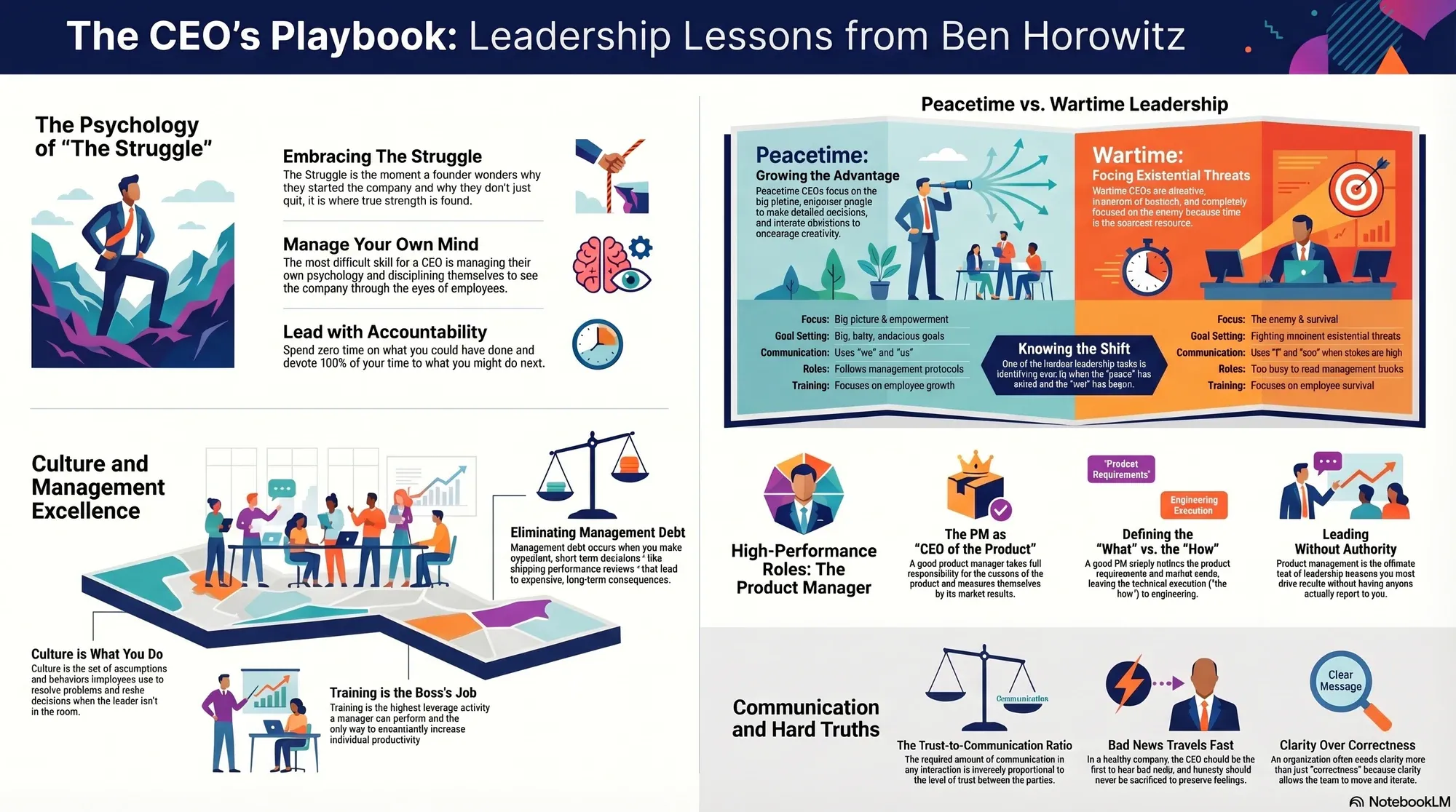
Part 1: The Struggle & Mental Resilience
- On Embracing the Struggle: Horowitz describes the struggle as a period of doubt, pressure and loneliness. Recognizing it does not make it easy, but it helps distinguish the experience from a simple personal failure. — The Struggle.
- On Perseverance: Horowitz argues that running a company teaches demands no previous management role fully prepares you for. Competence develops while doing the job. — Managing Your Own Psychology.
- On Statistical Odds: Even when the situation looks bleak, keep looking for a viable next move. Horowitz describes company-building as a changing problem involving technology, markets, competitors and people—not a reason to stop searching once the odds look poor. — The Struggle.
- On Managing Fear: Building a company can turn ambition into fear about employees, customers and survival. Horowitz describes that emotional burden as part of the struggle, not something a confident mission statement removes. — The Struggle.
- On Personal Accountability: Accept responsibility for company problems without spending all your energy blaming yourself. Horowitz recommends directing attention toward what can be fixed next. — Managing Your Own Psychology.
- On Victim Mentality: Horowitz credits his father’s advice that life is not fair. His practical response is to ask what to do next rather than wait for fairness to repair the situation. — Lenny’s Podcast — Ben Horowitz.
- On the Complexity of Hard Things: A management decision can be straightforward to understand and still painful to carry out. Horowitz uses reorganization as an example: improving communication may redistribute power and upset people, making the emotional consequences harder than the organizational diagram. — Lenny’s Podcast — Ben Horowitz.
- On Luck: Horowitz describes startup outcomes as a combination of ingenuity, hard work and luck. Effort matters, but it does not put every outcome under the founder’s control. — Andrew Chen — Ben Horowitz.
- On Self-Doubt: Mistakes are normal when learning to lead a company. Horowitz argues for maintaining enough confidence to keep making decisions, rather than interpreting every costly error as proof that you cannot do the job. — Lenny’s Podcast — Ben Horowitz.
Part 2: Peacetime vs. Wartime Leadership
- On Peacetime CEOs: In Horowitz’s peacetime framework, a company with a strong position can encourage broad creativity and delegate detailed decisions while leadership focuses on larger opportunities. — Peacetime CEO/Wartime CEO.
- On Wartime CEOs: Horowitz contrasts treating competitors as distant participants in a growing market with seeing them as an immediate threat during wartime. His framework changes the urgency of competitive attention; it does not claim that every rival is always an existential danger. — Peacetime CEO/Wartime CEO.
- On Rules and Protocols: Horowitz contrasts peacetime’s expansive goals with wartime’s urgent focus on survival. Management approaches should fit the situation rather than follow a single playbook. — Peacetime CEO/Wartime CEO.
- On Deviations: Horowitz allows room for creative deviations in peacetime but emphasizes tighter alignment to the mission when the company faces an existential threat. — Peacetime CEO/Wartime CEO.
- On Communication Styles: In his peacetime/wartime framework, Horowitz contrasts restrained peacetime communication with more forceful wartime communication. The distinction concerns situational tone, not a universal rule about which pronouns a CEO should use. — Peacetime CEO/Wartime CEO.
- On Market Dominance: Horowitz defines business peacetime as a strong competitive position in a growing core market. That gives leadership room to expand opportunities and reinforce strengths. — Peacetime CEO/Wartime CEO.
- On Survival: Horowitz defines wartime as facing an imminent threat to the company’s survival. Competition, economic shifts or changes in the market can create that situation. — Peacetime CEO/Wartime CEO.
- On Training in Wartime: Horowitz contrasts training for career development in peacetime with training for the immediate demands of survival in wartime. The purpose changes with the company’s circumstances. — Peacetime CEO/Wartime CEO.
- On Hierarchy: In an existential crisis, Horowitz describes a CEO taking more direct control and insisting on precise execution of the mission. That is a situational management mode, not a recommendation for permanent micromanagement. — Peacetime CEO / Wartime CEO.
- On Switching Modes: Peacetime and wartime call for different leadership skills. Horowitz argues that CEOs can develop both, including the judgment to recognize when ordinary management rules no longer fit the situation. — Peacetime CEO / Wartime CEO.
Part 3: Company Culture & Identity
- On Defining Culture: Culture shows up in decisions employees make without the leader present. Horowitz treats it as a practical guide to behavior, not merely a statement of company aspirations. — What You Do Is Who You Are.
- On Behavior vs. Values: Culture needs reinforcement through daily behavior. Horowitz uses Andy Grove’s management practices to show how what leaders actually require matters more than values displayed on a wall. — How the Best Leaders Build Culture.
- On Cultural Integrity: Horowitz invokes a military saying to explain that tolerating behavior below a stated standard changes the standard people experience. Cultural expectations need consistent enforcement. — What You Do Is Who You Are.
- On Virtues: Horowitz distinguishes stated beliefs from practiced behavior: culture is established by what people do. A value becomes meaningful when it changes everyday conduct. — What You Do Is Who You Are.
- On Shaping Assumptions: Employees rely on shared assumptions when resolving everyday problems. Horowitz argues that shaping those assumptions is part of building culture. — What You Do Is Who You Are.
- On Accidental Culture: Culture develops whether leaders design it or not. Horowitz argues for deliberately shaping its practices rather than leaving them to accident. — What You Do Is Who You Are.
- On Learning from Historical Leaders: Horowitz uses Toussaint Louverture as a case study of deliberately changing an organization’s culture. The lesson is to examine how practices shape behavior, rather than treating culture as fixed. — What You Do Is Who You Are.
- On Cultural Conflict: Culture should reinforce the company’s strategy. In Horowitz’s Okta example, a business built around trust needed sales and product practices that protected that trust, even when doing so made a deal harder. — How the Best Leaders Build Culture.
- On Symbols: Small, visible practices can signal what an organization considers important. Horowitz points to Andy Grove’s punctuality and attention to everyday details as ways of reinforcing precision. — How the Best Leaders Build Culture.
- On the 'Why': Explain the reason behind a management practice instead of relying only on authority. Horowitz describes why regular employee conversations help managers discover problems before they grow. — A Good Place to Work.
Part 4: Management Excellence & "Management Debt"
- On Management Debt: Horowitz calls expedient decisions with costly long-term consequences management debt. He credits Joanne Bradford with naming the concept and inspiring the essay. — Management Debt.
- On Putting Two in a Box: Putting two leaders in the same role can blur decisions and accountability. Horowitz treats that apparent short-term compromise as a form of management debt. — Management Debt.
- On Overcompensating: Matching a counteroffer outside a coherent compensation system can teach employees that threatening to leave is the route to a raise. Horowitz warns about that incentive. — Management Debt.
- On Performance Management: Without clear feedback, employees may not know expectations or weaknesses to improve. Horowitz describes the resulting execution cost as a hidden management debt. — Management Debt.
- On the Hard Answer: Horowitz says experienced CEOs often choose difficult organizational decisions now rather than pay for an easier compromise later. Past management debt informs that judgment. — Management Debt.
- On Process: Processes should solve communication problems at the company’s actual scale. Horowitz warns that introducing them too early makes the organization sluggish, while adding them too late lets complexity overwhelm it. — Taking the Mystery out of Scaling a Company.
- On Accountability: Horowitz recalls a manager’s rain-and-ark saying: predicting failure is not enough. A CEO needs to work on the response that could prevent it. — Lenny’s Podcast — Ben Horowitz.
- On Titles: Titles should communicate real responsibilities and capability. Horowitz recommends specific skill criteria and consistent promotion standards, rather than letting the title itself stand in for demonstrated competence. — Titles and Promotions.
Part 5: The Art of Hiring & Executive Quality
- On Executive Specificity: Horowitz judges executive fit against a particular company’s present needs. A strong record elsewhere does not automatically make someone right for the current role. — The Scale Anticipation Fallacy.
- On Hiring for Strength: Horowitz advises identifying the strengths a role needs, then tolerating weaknesses in less important areas. Optimizing only for a lack of faults can produce an ineffective hire. — Hiring Executives.
- On Firing with Dignity: Horowitz credits Bill Campbell with advising that ending someone’s employment need not mean taking away their respect. Prepare the conversation and protect the person’s reputation. — Preparing to Fire an Executive.
- On Mis-Hires: After an executive hire fails, Horowitz recommends examining the hiring and integration process. A poorly defined job is one possible cause, not the only explanation. — Preparing to Fire an Executive.
- On Scaling Talent: As a company grows, an executive’s job can change substantially. Horowitz recommends evaluating performance at the new scale, not assuming in advance that existing people cannot develop. — The Scale Anticipation Fallacy.
- On Hiring Big Company Execs: Running an established organization is different from building one. Horowitz recommends checking whether a large-company executive can initiate work, create processes and operate at the startup’s pace rather than assuming the résumé transfers automatically. — Big Company Execs in Little Companies.
- On Reference Checking: Horowitz recommends checking executive references against the same specific criteria used in interviews. Both candidate-provided and independently found references can help assess fit. — Hiring Executives.
- On Executive Integration: A new executive needs deliberate integration: expectations, colleagues and the role may differ from what they assumed. Horowitz treats failed integration as a system problem worth examining. — Preparing to Fire an Executive.
- On Technical vs. Cultural Fit: Brilliance does not excuse behavior that shuts down essential communication. Horowitz warns about executives whose reactions stop colleagues from raising problems; retaining an exceptional difficult employee requires containing the damage rather than pretending it does not exist. — When Smart People Are Bad Employees.
- On Promoting from Within: Internal candidates bring knowledge of the company’s technology, decisions, culture and people. Horowitz nevertheless warns that CEO succession is difficult: an internal promotion still needs someone capable of both setting direction and getting the organization to execute. — Ones and Twos.
Part 6: Good Product Manager / Bad Product Manager
- On the PM as CEO: In his older training document, Horowitz frames the PM as accountable for the product’s outcome. He cautions that the document may not fit contemporary PM roles. — Good Product Manager/Bad Product Manager.
- On Responsibility: Horowitz’s historical PM document measures responsibility by product success, not excuses about resources or other teams. Its role model is presented as an example, not current universal guidance. — Good Product Manager/Bad Product Manager.
- On Market Knowledge: In his historical PM document, Horowitz emphasizes knowing the market, product and competition well enough to devise a plan suited to the company’s actual context. — Good Product Manager/Bad Product Manager.
- On Product Definition: Horowitz’s older PM document distinguishes defining the target—the what—from solving engineering’s how. It also expects the PM to manage delivery of that target. — Good Product Manager/Bad Product Manager.
- On Competition: Horowitz’s historical PM guidance requires strong knowledge of competitors while keeping the team focused on customers and revenue, rather than simply copying a rival’s features. — Good Product Manager/Bad Product Manager.
- On Communication: Horowitz’s older PM document emphasizes clear written and verbal communication with engineering. Informal conversations gather information; direction should be communicated clearly. — Good Product Manager/Bad Product Manager.
- On Sales Alignment: In his historical PM guidance, Horowitz recommends reusable sales materials and anticipating product flaws. That avoids spending every day repeatedly answering the same sales questions. — Good Product Manager/Bad Product Manager.
- On Leading without Authority: Horowitz describes product management as leadership through influence: getting people aligned around a successful product even when they do not report to you. He separates that mindset from his old document’s company-specific tasks. — Lenny’s Podcast — Ben Horowitz.
Part 7: CEO Skills & Psychology
- On Managing Your Own Mind: Horowitz describes managing his own psychology as the hardest CEO skill he learned. He distinguishes taking problems seriously from letting them become destructive self-blame. — Managing Your Own Psychology.
- On Discipline: Horowitz credits Bill Campbell with teaching him to represent employees who are absent from the decision room. Leadership decisions should account for how those employees will experience the outcome. — How the Best Leaders Build Culture.
- On Hard Decisions: Timely decisions and clear direction are essential CEO responsibilities. Horowitz warns against avoiding a necessary executive-performance decision by trying to teach a function the CEO does not know well enough to teach. — The Sad Truth About Developing Executives.
- On Isolation: Horowitz describes difficult CEO decisions as lonely because advisers may lack context and some uncertainties are hard to share with employees. The decision’s consequences still rest with the CEO. — Managing Your Own Psychology.
- On Focus under Stress: Horowitz recommends concentrating on where the company needs to go rather than becoming consumed by possible failure. He uses a driver focusing on the road as his analogy. — Managing Your Own Psychology.
- On Self-Correction: Before reacting aloud, separate an immediate emotional response from a useful management decision. Horowitz recalls learning to discipline what he said rather than letting his feelings dictate the conversation. — The Scale Anticipation Fallacy.
- On Hesitation: When you recognize a serious company problem, investigate it rather than rationalizing it away because acting will be painful. Horowitz describes running toward the fear as a leadership discipline. — Which Way Do You Run?.
- On Vulnerability: Leave room for employees to challenge your judgment. Horowitz notes that they may have more relevant expertise or information than the CEO, so feedback should allow a real dialogue. — Making Yourself a CEO.
- On Vision: Articulate a compelling direction even when the company is struggling. Horowitz treats the ability to keep people interested in that direction as a leadership skill, alongside company-first ambition and the competence to achieve it. — Notes on Leadership.
Part 8: Communication & Hard Truths
- On Trust: Candor builds trust, which makes difficult communication more effective. Horowitz argues that concealing problems damages that trust and creates additional communication burdens. — CEOs Should Tell It Like It Is.
- On Telling the Truth: A CEO must be able to give direct, authentic feedback about work. Horowitz recommends making it useful to the employee rather than hiding the message or performing an artificial leadership persona. — Making Yourself a CEO.
- On Constructive Confrontation: Do not hide serious problems merely to maintain a positive mood. Horowitz argues that sharing the real difficulty lets more people help solve it. — CEOs Should Tell It Like It Is.
- On Clarity: Clear direction lets a team act together. Horowitz describes consolidating and prioritizing ideas, then aligning people around a high-fidelity understanding of what they are building. — Lenny’s Podcast — Ben Horowitz.
- On Bad News: Make it safe to surface bad news promptly. Horowitz recommends rewarding people for identifying problems instead of requiring them to produce a solution before they can raise the issue. — CEOs Should Tell It Like It Is.
- On Performance Feedback: Give feedback routinely rather than saving it for a rare formal review. Horowitz argues that frequent feedback makes improvement easier and difficult conversations less exceptional. — Making Yourself a CEO.
- On Hard Conversations: Be clear about a performance problem without humiliating the person. Horowitz distinguishes direct, employee-focused feedback from personal attacks or a tone driven by the manager’s mood. — Making Yourself a CEO.
- On One-on-Ones: Horowitz treats one-on-ones as employee-owned conversations that bring ideas and problems upward. They are useful communication mechanisms, but he explicitly allows effective alternatives. — One On One.
Part 9: Training & Development
- On Training Responsibility: Following Andy Grove, Horowitz sees training as a high-leverage managerial responsibility. His own training programs made job expectations concrete and helped people become effective. — Why Startups Should Train Their People.
- On High Output Management: Horowitz credits Andy Grove with measuring a manager’s output through the organization’s results and the neighboring organizations the manager influences. Personal expertise matters when it improves the team’s output, not merely when the manager possesses it. — Andy — High Output Management Foreword.
- On Productivity: Horowitz argues that training can improve productivity by teaching people how to do the work. His discussion of Grove’s framework also includes motivation, not training alone. — Why Startups Should Train Their People.
- On Standards: Before judging performance, Horowitz expects managers to establish what the job requires through training. Otherwise, evaluation can rest on expectations the employee never understood. — Why Startups Should Train Their People.
- On Onboarding: Horowitz advocates job-specific training that helps new employees become productive. His retention discussion emphasizes guidance and learning, without predicting a fixed deadline for someone quitting. — Why Startups Should Train Their People.
- On Knowledge Transfer: Horowitz recommends having experienced employees teach relevant skills and product context. Functional training can pass on knowledge that new hires would otherwise have to reconstruct. — Why Startups Should Train Their People.
- On Sales Training: Evaluate a sales leader’s ability to train the team in both sales process and the product. Horowitz recommends examining the training materials and asking how the leader builds competence, rather than judging only the leader’s own selling ability. — Hiring Executives.
- On Management Training: Horowitz recommends explicitly training managers in the practices expected of them, including feedback and one-on-ones. Naming expectations is not enough without teaching how to meet them. — Why Startups Should Train Their People.
- On Learning from Failure: Do not define a person only by their worst mistake. Horowitz argues for examining what they do well and learning from errors, while still confronting weaknesses honestly. — Lenny’s Podcast — Ben Horowitz.
Part 10: Scaling, Strategy & Market Realities
- On Lead Bullets: Horowitz credits Bill Turpin’s lead-bullets advice: when a concrete product weakness is losing business, do the sustained work to fix it rather than hoping for a clever escape. He later applied the lesson at Opsware. — Lead Bullets.
- On Market Timing: In his historical product-management training document, Horowitz emphasizes getting the right product to market at the right time. Timing is part of product execution, not just a concern after the product is built. — Good Product Manager / Bad Product Manager.
- On Competition: Competition can expose the product weakness that needs attention. In Horowitz’s Opsware example, improving performance required focused engineering work rather than trying to talk around the gap. — Lead Bullets.
- On Venture Capital: Horowitz describes venture investing as depending on a small number of exceptional companies. He credits Andy Rachleff’s concentrated-returns principle as an influence on how the firm was designed, not a guarantee that any particular investment will succeed. — Stanford eCorner — Disrupting the Venture Capital Industry.
- On Longevity: Growth changes the organizational requirements of a company. Horowitz recommends adapting specialization, structure and communication as the business grows, rather than expecting the small-team model to keep working unchanged. — Taking the Mystery out of Scaling a Company.
- On Pivoting: Changing direction can require abandoning assumptions that once defined the company. Horowitz argues that founders may find this easier because they created those assumptions in the first place; preserving the old model is not always the right response to change. — Why We Prefer Founding CEOs.
- On the Importance of Sales: A product advantage does not remove the need for effective sales execution. Horowitz describes applying the same lead-bullets discipline to channel performance instead of treating the product alone as sufficient. — Lead Bullets.
- On Scaling Culture: As the company grows, preserve employees’ sense that it is still their company. Horowitz describes that feeling of ownership as something leaders need to maintain rather than assuming culture will scale by itself. — How the Best Leaders Build Culture.
- On Long-term Thinking: Investments in innovation may incur costs well before they produce returns. Horowitz argues that commitment beyond the current quarter helps a CEO make those investments, while acknowledging that professional CEOs can also develop that commitment. — Why We Prefer Founding CEOs.
- On the Final Goal: Judge culture by the behavior it produces, not only by the identity a company claims. Horowitz’s central argument is that what people do establishes who the organization is. — What You Do Is Who You Are.