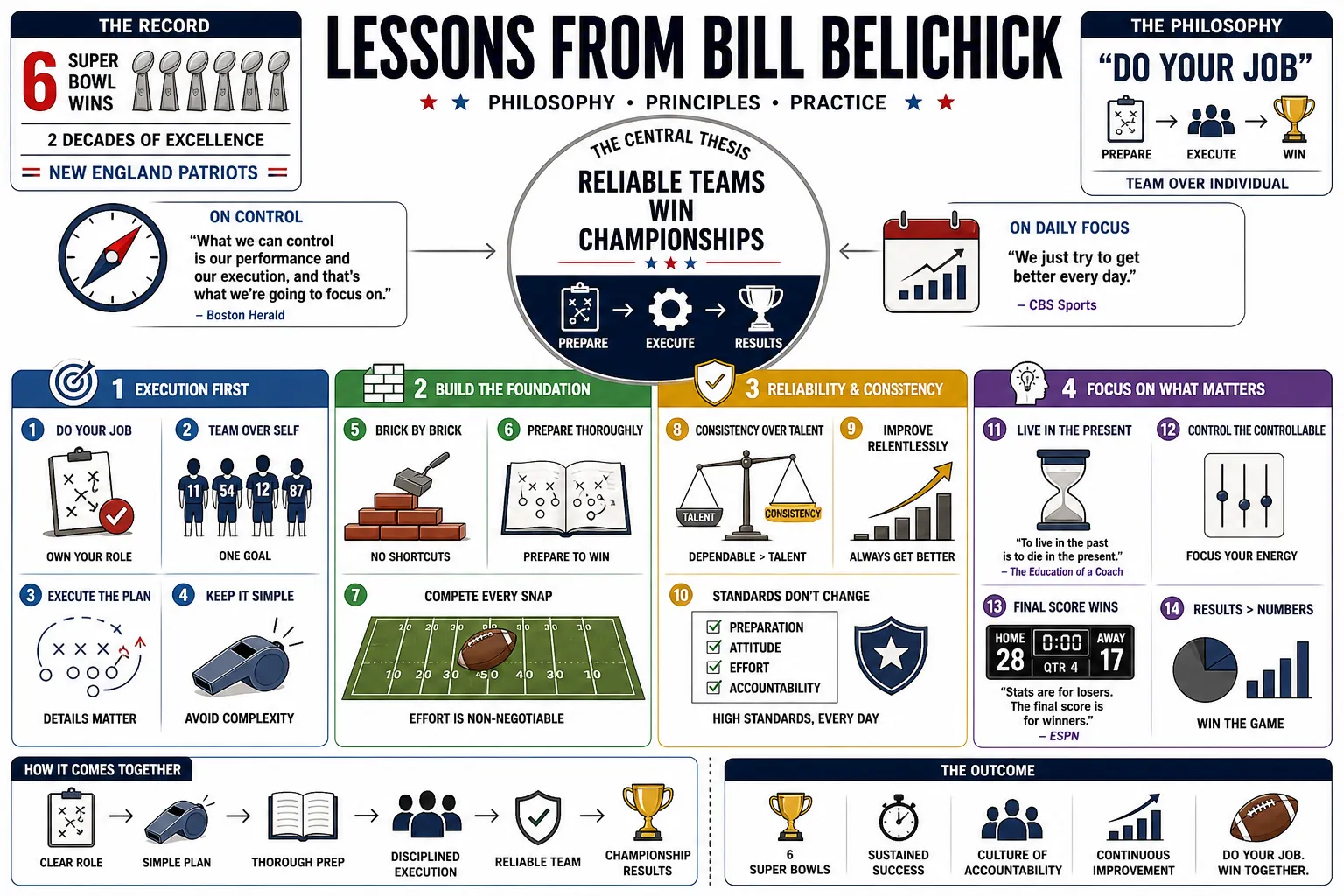
Lessons from Bill Belichick
Bill Belichick coached the New England Patriots for 24 seasons and won six Super Bowls as head coach. The lessons below examine his coaching and team-building methods through his own writing and press conferences. — Patriots — Belichick’s 24-Year Tenure.
Part 1: The Core Philosophy
- On Execution: Belichick ties leadership to individual responsibility: do your job, earn teammates’ respect, and put the team first. — Patriots — Belichick Press Conference, Oct. 30, 2002.
- On Consistency: Making an NFL roster does not secure a permanent role. Belichick expects players to stay dependable, consistent and improving as competition rises. — Patriots — Belichick Press Conference, Sept. 3.
- On Building a Foundation: Each season requires rebuilding the team’s foundation: install plays, practice them, correct mistakes and integrate new personnel. Belichick says there is no shortcut. — Patriots — Belichick Press Conference, June 10, 2004.
- On the Bottom Line: Belichick warns against judging a player or team by isolated statistics; the result of the game matters more than an individual stat line. — Patriots — Belichick Press Conference, Dec. 14, 2009.
- On What You Can Control: Belichick says teams can control how they use the preparation time available to them, even when the schedule gives one side more time than the other. — Patriots — We’re on to Cincinnati Press Conference.
- On Daily Focus: After a player makes the roster, Belichick says the job must still be earned day by day through reliable performance and improvement. — Patriots — Belichick Press Conference, Sept. 3.
- On Simplicity: Belichick seeks a workable middle ground between running the same play every time and changing on every snap. The plan must still answer the different looks an opponent presents. — Patriots — We’re on to Cincinnati Press Conference.
- On Daily Habits: Belichick says dependable professionals prepare well on each practice day and avoid letting one mistake spoil the rest of a session; consistent days can compound across a season. — Patriots — Belichick on Consistent Practice Habits.
Part 2: Preparation and Practice
- On Preparation: Belichick describes major moments as the result of many smaller, less visible preparation steps. He urges leaders to identify what matters most and do that work consistently before the moment arrives. — Belichick — The Art of Winning, Official Excerpt.
- On Practice Difficulty: Belichick says he deliberately makes practice conditions difficult, including using wet, cold or slippery footballs, so players learn to handle harder conditions than they may face in games. — Patriots — Belichick on Difficult Practice.
- On Practice Execution: Belichick says a play run poorly in practice is unlikely to work in a game; repeated good execution gives players confidence and can carry over under pressure. — Patriots — Belichick Press Conference, Aug. 11, 2004.
- On Anticipating Scenarios: Belichick makes situational football a substantial part of practice, including down and distance, personnel, time management and special-teams situations. — Patriots — Belichick on Situational Football.
- On Practice Habits: Belichick argues that a repeatable process produces good habits and dependability; teams cannot wait for a major game to begin preparing to win. — Belichick — The Art of Winning, Official Excerpt.
- On Practicing for Weather: Belichick weighs practicing in outdoor conditions against practicing indoors for better timing and execution; he does not treat the weather decision as an absolute rule. — Patriots — Belichick on Weather and Practice.
- On Off-Season Urgency: Belichick described a post-Super-Bowl preparation gap in draft and free-agency work, then said the team had caught up by late May and was on schedule for OTAs and training camp. — Patriots — Belichick on Post-Super-Bowl Preparation.
- On Details in Practice: Belichick says big moments depend on many quiet preparation tasks, including tedious details that a team must handle before it can perform well. — Belichick — The Art of Winning, Official Excerpt.
Part 3: Focus and Mental Toughness
- On Mental Toughness: Belichick describes mental toughness as overcoming injuries, road games and bad breaks while staying committed to preparation and execution with teammates. — Patriots — Belichick on Mental Toughness.
- On Managing Distractions: Belichick says a sound process prioritizes what matters and sets aside distractions surrounding a major game so players can focus on their jobs. — Belichick — The Art of Winning, Official Excerpt.
- On Resilience: Belichick describes resilience as a weekly requirement: players must remain dependable and keep improving despite the physical and mental challenges of an NFL season. — Patriots — Belichick Press Conference, Sept. 3.
- On Turning the Page: After the Kansas City loss, Belichick repeatedly redirected questions about the past and future to preparation for the next opponent, Cincinnati. — Patriots — We’re on to Cincinnati Press Conference.
- On the Immediate Task: Asked about the team’s distant record, Belichick says he focuses on the next week rather than where the team may be ten or eleven weeks later. — Patriots — Belichick on Week-to-Week Focus.
Part 4: Team-Building and Selflessness
- On Individuality: Belichick says team sports require players to give up some individual preferences and control so they can commit to a shared role and the group’s best chance of winning. — Patriots — Belichick on Individuality in a Team Sport.
- On Organizational Alignment: Belichick credits coaches, personnel, support staff and players as contributors to the organization’s operation and success, not only its star athletes. — Patriots — Belichick on Earning Respect and Support Staff.
- On Chemistry: Belichick says team chemistry and communication develop through repeated training-camp practices and consistent improvement; there is no shortcut. — Patriots — Belichick on Training-Camp Chemistry.
- On Unselfishness: Belichick says the Patriots’ team-first approach asks each person to perform their own job for the good of the group. — Patriots — Belichick on Putting the Team First.
- On Unit Function: Belichick says a football team depends less on individual talent than on how its players work together, understand one another’s help and function as a unit. — Patriots — Belichick on Team Function.
- On Trusting Teammates: Belichick links teamwork to trust, communication and concern for teammates, including a desire not to let the person beside you down. — Patriots — Belichick on Trusting Teammates.
Part 5: Leadership and Coaching
- On Coaching Impact: Belichick says players and coaches depend on one another: players need good coaching, coaches need good players, and both must do their jobs to make the group work. — Patriots — Belichick on Coaching and Players.
- On Correcting Mistakes: Belichick says coaches should identify and correct a player’s mistake while clarifying the assignment for the rest of the unit, so everyone knows what must change. — Patriots — Belichick on Correcting Mistakes.
- On Team Personality: Belichick says a team’s personality emerges from the blend of its players each season. He does not try to make all players alike; he emphasizes mutual respect, productivity and team fit. — Patriots — Belichick on Team Personality.
- On Constructive Criticism: Belichick says coaches should tell released players the truth about a roster decision, including where the player fell short, instead of hiding the reason behind a fabricated explanation. — Patriots — Belichick on Honest Roster Conversations.
- On Teaching: Belichick says coaches should adapt their teaching method when a player learns better another way; one approach will not fit every player or group size. — Patriots — Belichick on Teaching Players.
- On Adapting to Players: Belichick says a team may decide to accommodate a player’s special talents, but should make that commitment when acquiring him rather than assume it can later change a player who does not fit. — Patriots — Belichick on Evaluating Player Fit.
- On Empowerment: Belichick says coaches who gave players responsibility on the field shaped his own approach to coaching; he pairs instruction with room for players to carry out their jobs. — Belichick — The Art of Winning, Official Excerpt.
- On Evaluating Oneself: After a loss, Belichick includes his own decisions in the review and says his weekly job is to identify mistakes, correct them and avoid repeating them. — Patriots — Belichick on Evaluating a Loss.
- On Earning Respect: Belichick says leadership begins with doing one’s own job well enough to earn teammates’ respect; a title or speech cannot substitute for that performance. — Patriots — Belichick on Earning Respect and Support Staff.
Part 6: Strategy and Game Planning
- On Defensive Strategy: Belichick says a one-dimensional player lets the defense treat him accordingly; players limited to one role need to excel in that role to justify the constraint. — Patriots — Belichick on One-Dimensional Players.
- On Opponent Strengths: Belichick considers both his own team’s strengths and the opponent’s weaknesses when planning, but warns that those advantages do not always line up neatly. — Patriots — Belichick on Game-Plan Tradeoffs.
- On Versatility: Belichick says a roster needs some players who can cover multiple positions because there is not enough depth to staff every spot with a specialist. — Patriots — Belichick on Versatility and Specialization.
- On Predictability: Belichick says he prepared a fresh defensive plan for each opponent rather than merely replaying an earlier scheme that had worked; consistency meant commitment to preparation and adaptation. — Belichick — The Art of Winning, Official Excerpt.
- On Scheme Fit: Belichick cautions that a favorable scheme on paper is not worth much if the players cannot execute it on the field. — Patriots — Belichick on Game-Plan Tradeoffs.
- On In-Game Adjustments: Belichick says a game plan is tested as the opponent reveals its approach; coaches may adjust during the first few series and continue responding to counter-adjustments. — Patriots — Belichick on In-Game Adjustments.
- On Special Teams: Belichick describes special teams as roughly a third of football because kicks and exchanges can affect points, field position and possession; his staff devotes substantial preparation to those plays. — Patriots — Belichick on Special Teams.
Part 7: Player Evaluation and Roster Management
- On Character: Belichick values preparation, toughness, focus and ability to carry out the assignment in players, even when they are not the most talented by conventional measures. — Patriots — Belichick on Player Character.
- On Draft Preparation: Belichick says draft strategy follows information gathering: scouting reports, player evaluation and the combine precede a commitment to a particular selection approach. — Patriots — Belichick on Draft Preparation.
- On Specialization: Belichick also values a player who performs one position especially well; the fewer roles a player covers, the stronger he must be at his specialty. — Patriots — Belichick on Versatility and Specialization.
- On Finding Player Fit: Belichick describes his draft philosophy as selecting good players whom the Patriots believe can fit their system, while acknowledging that projecting their actual performance remains uncertain. — Patriots — Belichick Post-Draft Press Conference.
- On Dependability: Belichick praises a consistently reliable kicker as the player he would choose for a high-pressure kick, illustrating how dependable performance earns trust in decisive moments. — Patriots — Belichick on Dependable Players Under Pressure.
- On Letting Players Go: Belichick says roster cuts require projecting not just current play but future development; releasing even valued veterans can be difficult, and no fixed timing rule settles each case. — Patriots — Belichick on Difficult Roster Cuts.
- On Draft Capital: Belichick says holding multiple draft picks can provide flexibility to move within the draft and maximize opportunities; he also evaluates each potential trade on its own value. — Patriots — Belichick on Draft-Pick Flexibility.
- On Roster Construction: Belichick says draft supply can constrain a defensive system: when many teams need the same scarce position, a club may need to modify its scheme or accept less-than-ideal personnel. — Patriots — Belichick on Draft Supply and Scheme.
Part 8: Winning, Losing, and Growth
- On Avoiding Defeat: Belichick places discipline and avoiding self-inflicted mistakes at the foundation of winning; he explicitly frames not beating yourself as a prerequisite to success. — Belichick — The Art of Winning, Official Excerpt.
- On the Margin of Error: Belichick says some games can turn on one or two plays, including a turnover, penalty or special-teams decision. — Patriots — Belichick on Winning Margins.
- On Post-Game Analysis: Belichick says the team analyzes mistakes, makes corrections and moves on to the next game; the process applies whether it won or lost. — Patriots — Belichick on Evaluating a Loss.
- On Resting on Laurels: Belichick warns that a championship is not an endpoint: after a major win the team must begin preparing for the next one rather than assume past success will carry forward. — Belichick — The Art of Winning, Official Excerpt.
- On the Feeling of Losing: Belichick calls a season-ending playoff defeat deeply disappointing because the team’s work stops while surviving teams continue; he also says emotions immediately after a loss should not dictate long-term decisions. — Patriots — Belichick on the Pain of a Season-Ending Loss.
- On Continuous Improvement: Belichick says teams can improve week to week by practicing hard and correcting mistakes, though progress is not guaranteed. — Patriots — Belichick on Week-to-Week Improvement.
- On the Ultimate Objective: Belichick describes the Super Bowl as the team’s final goal and says a clear vision of that objective should guide the work, while each role contributes to the team’s success. — Belichick — The Art of Winning, Official Excerpt.